 OSHAidProductsDemosIndustriesPricingMoreClient accessCreate my accountFree🇺🇸ENCreate my accountBack to blogOSHA updateOctober 22, 2026· By the OSHAid Safety Desk
Cal/OSHA enterprise-wide violations: one policy, every site
Cal/OSHA has proposed the rules that put Senate Bill 606 into practice. Under them, a written procedure used across your locations could be cited at all of them.
A Cal/OSHA enterprise-wide violation is the kind of citation that does not stop at the site the inspector walked. California's Division of Occupational Safety and Health has posted a notice of proposed action that would write the rules for it, five years after the law that created it.
The proposal amends five sections of Title 8 — 332.4, 334, 335, 336 and 340.4 — to fit Senate Bill 606 of 2021 into the penalty framework Cal/OSHA already uses. It brings two classifications with it: enterprise-wide, which reaches every location a citation covers, and egregious, which is counted once per exposed employee.
Written comments are due by November 30, 2026, and a public hearing is set for December 3 in Oakland. Nothing is in force yet. But the proposal is worth reading now, because the thing it would make expensive is a written procedure used at more than one site — and that is a document you control.
What a Cal/OSHA enterprise-wide violation would be
The law is five years old; the rules are not. Labor Code sections 6317 and 6317.8, amended and added by Senate Bill 606 in 2021, already require the Division to issue citations for enterprise-wide and egregious violations. Cal/OSHA's notice of proposed action states that regulatory action is still necessary to incorporate those classifications into the existing framework for citation classification and penalty calculation.
Enterprise-wide, as proposed. New section 334(g) would create a rebuttable presumption that a violation is enterprise-wide when an employer has employees at multiple worksites and either of two things is true. The first: the employer has a written policy or procedure that applies to more than one worksite and that violates a standard, rule, order or regulation. The second: the Division has evidence of a pattern or practice of the same violation or violations involving more than one of the employer's worksites.
Read the first trigger twice. What is cited is the document, not only the condition on the floor.
What it would cost. Proposed section 336(k) multiplies the proposed penalty by the number of worksites the citation covers at the time of the inspection, and caps the result at $162,851. Only a classification that applies to each and every violation may be used in that computation. Enterprise-wide penalties would also lose the usual adjustments other than size, and the 50 percent abatement credit would stop being automatic: it would be granted only where the employer abated during the inspection before the citation issued, or filed a statement signed under penalty of perjury, with supporting evidence, within 10 working days after the end of the abatement period.
Egregious, as proposed. Section 334(f) would define an egregious violation as a willful violation where, within the five years before the citation, at least one condition holds: a history of one or more repeat, willful or egregious violations, five or more serious, or ten or more general or regulatory violations; intentional disregard of health and safety responsibilities, which the text illustrates with failing to maintain an operative injury and illness prevention program under Labor Code section 6401.7; conduct amounting to clear bad faith; or a violation that resulted in a fatality, a worksite catastrophe, or five or more injuries or illnesses, or an experience modifier greater than 125 percent.
Then the arithmetic. Under proposed section 336(i), the Division would issue a separate citation with a separate penalty for each instance of an employee exposed, one instance meaning one employee's exposure. The notice works the example itself: a $10,000 penalty where 10 employees were exposed would be assessed as $100,000.
One smaller change travels with the package: the history lookback in section 335(d) would move from three years to five, matching the period already used for repeat violations.
 Two workers in a storage facility go through a checklist on a clipboard beside the racking. Photo: Centre for Ageing Better, via Pexels
What to check across your sites before December
1. List the documents that travel. The written policies and procedures that are the same at every location — the injury and illness prevention program, the lockout procedure, the respirator program, the heat plan, the onboarding checklist. Under the proposal these are what carries a finding from one site to all of them. If nobody can say which version each site is running, that is the first thing to fix.
2. Read each one against the standard it implements, not against last year's version of itself. A procedure written to a standard since amended is the fact pattern proposed section 334(g) describes. If you are rebuilding one, our written safety program templates set out what it has to contain.
3. Make the injury and illness prevention program operative, not just written. The proposal names failing to maintain an operative program under Labor Code section 6401.7 as an illustration of the intentional disregard that can push a willful violation into the egregious class. A binder nobody has opened since 2023 is not an operative program.
4. Close the same finding everywhere it exists. When an audit or a near miss turns up a gap at one site, an enterprise-wide violation is built on the other sites having it too. Give the corrective action an owner and a date per location, not a single ticket.
5. Keep abatement evidence you can produce in 10 working days. That is the window in the proposed text for the signed statement and supporting evidence that would preserve the 50 percent credit on an enterprise-wide general or serious violation. Photographs, invoices, training records and dates, filed as the work is done.
6. Comment if this reaches you. Written comments go to sb606rulemakingcomments@dir.ca.gov no later than November 30, 2026, or can be made at the December 3 hearing in Oakland. The Division estimates the added penalties across the state at about $1.18 million a year, and notes that 98.6 percent of the businesses in scope are small businesses. California runs its own program under Section 18 of the OSH Act — see what OSHA compliance means for how state plans sit beside the federal rules.
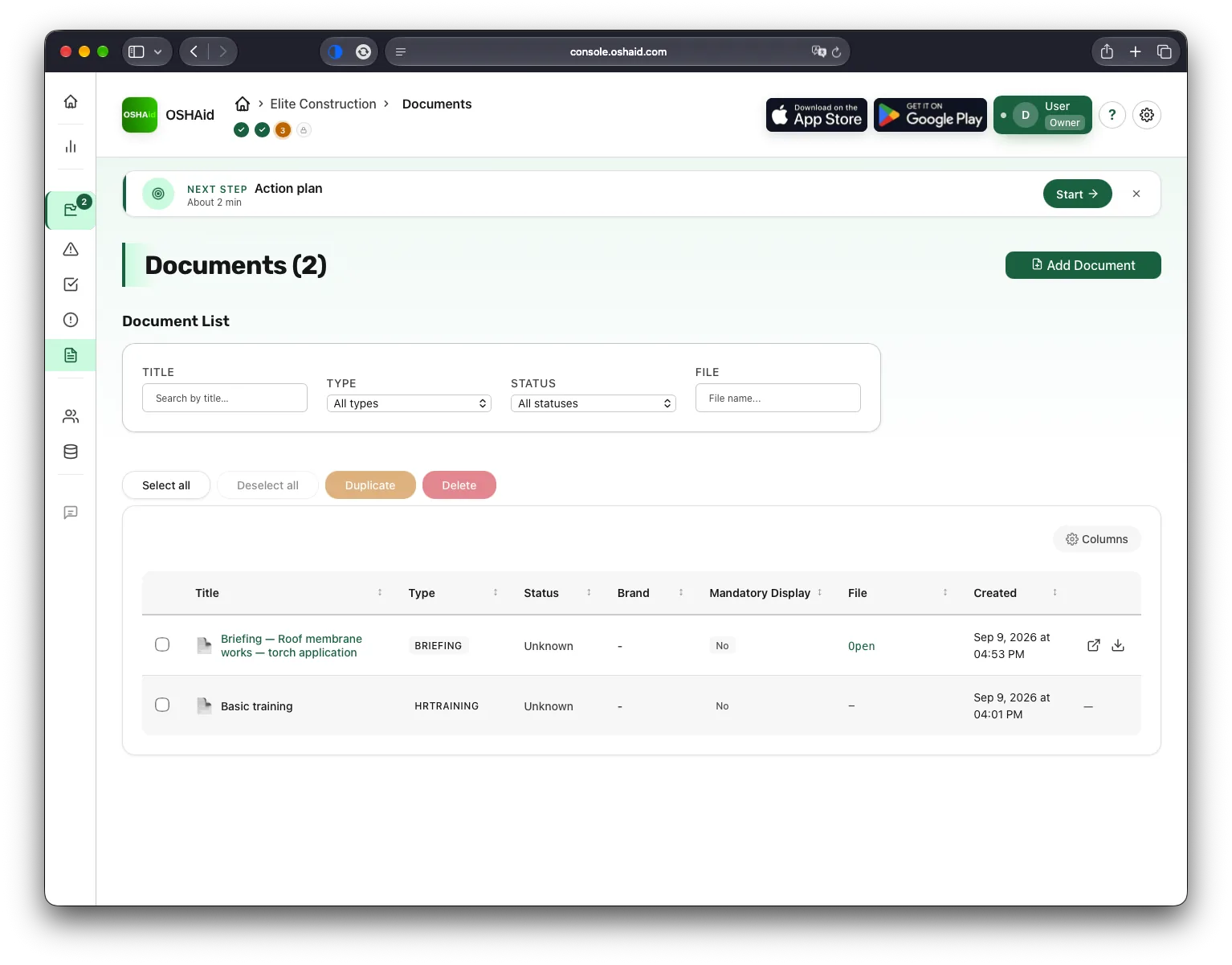 OSHAid console — document library where one written program is versioned and shared across every establishment
A program you can show, site by site
Multi-site safety drifts in a familiar way. Headquarters writes the program, each location adapts it quietly, and the gap between document and practice grows until something forces a comparison. This proposal would make that comparison a penalty calculation.
The defense it points to is unglamorous and entirely within reach: one current version of each written program, a record of which site runs what, corrective actions closed everywhere rather than where they were found, and abatement evidence filed as it happens. OSHAid keeps those in one place across establishments, so when a client, a leadership team or an inspector asks what you have in place at all your locations, the answer is something you show rather than something you reconstruct.
Questions safety officers ask
- What is an enterprise-wide violation in California?
Under Cal/OSHA's proposed section 334(g), it is a rebuttable presumption that applies when an employer has employees at multiple worksites and either a written policy or procedure used at more than one worksite violates a standard, or the Division has evidence of a pattern or practice of the same violation at more than one worksite.
- When do comments on the Cal/OSHA proposal close?
- How would an egregious violation penalty be calculated?
About this article
Written by the OSHAid Safety Desk from official sources (OSHA news releases, the text of the standards, BLS and NIOSH data), checked against those sources and reviewed before publication. It explains what a rule says; it is not legal advice for your situation. OSHAid
See your sites in one place
Create a free OSHAid account, add your establishments and keep one current version of every written program. No commitment.
Create my accountFreeDownload on theApp StoreGET IT ONGoogle PlayThe intelligent OSHA companion that automates your field compliance. Mobile app + web console + specialized safety AI agent, built for US workplaces.
🇫🇷 Hosted in EuropeGDPR CompliantProductIndustriesGuides- OSHA compliance software
- Hazard assessment guide
- Safety program templates
- JHA examples
- OSHA requirements
- OSHA recordkeeping
- OSHA standards by industry
- Workplace hazards
- Get started
- What is OSHA?
- Workplace safety glossary
- Why OSHAid?
- Enterprise solutions
- About
- Blog
- Legal notice
© 2026 OSHAid - published by DUOPP (SAS). All rights reserved.