 OSHAidProductsDemosIndustriesPricingMoreClient accessCreate my accountFree🇺🇸ENCreate my accountBack to blogState ruleOctober 31, 2026· By the OSHAid Safety Desk
Oregon workplace violence prevention rule: what to have ready by January 1
Oregon OSHA adopted Administrative Order 3-2026 on October 21. From January 1, 2027, four kinds of health care employer need a written plan, periodic assessments, a safety committee on record and training with deadlines per person.
If you run a hospital, an ambulatory surgical center, a home health agency or a home hospice program in Oregon, the Oregon workplace violence prevention rule is now a written standard with a compliance date on it.
On October 21, 2026, Oregon OSHA adopted Administrative Order 3-2026. It creates OAR 437-002-0150, Workplace Violence Prevention for Health Care Employers, and amends two existing rules. All of it takes effect January 1, 2027.
Before this order, Oregon OSHA enforced these duties straight from the statute. Moving them into a rule changes what an inspector asks to see — and it widens the list of employers who have to answer.
What Oregon OSHA adopted, and who it covers
Where it comes from. Senate Bill 537, signed in 2025, amended ORS 654.412 and 654.414. Oregon OSHA wrote the result into a rule and filed it with the Secretary of State on October 21, 2026. The adoption notice, with the full text of all three rules, is published as Oregon OSHA Administrative Order 3-2026.
Two things got bigger. SB 537 replaced the narrow idea of an *assault* with *workplace violence*: any act or threat of physical violence, harassment, intimidation, assault, homicide or any other threatening behavior that occurs in the workplace. It also extended the program requirement beyond hospitals and ambulatory surgical centers to home health agencies and home hospice programs. Oregon OSHA counts roughly 62 licensed hospitals, 91 ambulatory surgical centers, 65 licensed home health agencies and 74 licensed home hospice programs operating in the state in 2026.
The written plan. OAR 437-002-0150 requires a written workplace violence prevention and response plan based on periodic security and safety assessments. The plan addresses the physical attributes of the setting, staffing plans including security staffing, personnel policies, first aid and emergency procedures, procedures for reporting incidents, and education and training. It also sets out how internal investigations are run, how employees involved are identified, how post-incident interviews gather the facts, and what the post-incident response is — first aid or medical care for injured employees, and trauma counseling for those affected.
Everyone gets a copy. Each employee, and the employee's union representative where applicable, must receive a written copy of the plan plus a written statement that an employee who reports an incident is protected from retaliation under OAR 437-001-0295. New hires get both within 30 calendar days of hire.
The safety committee is in the loop. Employers must consult their safety committee — or employees during safety meetings where OAR 437-001-0765 allows it — on the investigation and reporting procedures, the periodic assessments, the annual program review, and the annual training.
Look back five years. Employers must assess all workplace violence incidents. That assessment measures the frequency of incidents and attempts against employees on the premises or in a patient's home over the preceding five years, or for the years of records available. It includes a root cause analysis, the plan for addressing those causes, the consequences of the incident, and a summary of how far the security considerations in the plan were implemented. Completed assessments go back to the safety committee.
Training has a deadline per person. New employees are trained within 90 days of hire, temporary employees within 14 days, and contracted security personnel working on the premises are covered too. Everyone is retrained annually, and again whenever the program changes or conditions at the workplace require it. The rule lists the topics, from escalation cycles and de-escalation techniques through restraint practices, documentation and reporting, and responding to active shooter incidents.
The log changed its name. OAR 437-001-0706 is now Recordkeeping for Health Care Workplace Violence. Employers use the Workplace Violence Incident Log, or an equivalent, alongside general injury and illness recordkeeping; Appendix A of that rule gives the instructions for filling it in.
 Two staff members in scrubs at the reception counter of a clinic, one holding a tablet — the entrance area a security and safety assessment starts with. Photo: Cedric Fauntleroy, via Pexels (Pexels License)
Oregon workplace violence prevention rule: what to do before January 1
1. Confirm you are covered. The rule names ambulatory surgical centers, hospitals, home health agencies and home hospice programs, using the definitions in ORS 442.015, 441.760, 443.014 and 654.412. It does not apply to the Oregon State Hospital. If you provide home health or hospice services, you are in scope for the first time; our page on OSHA compliance in healthcare settings covers the hazards that come with the rest of the job.
2. Run the security and safety assessment first. The plan has to be based on it. Walk the entrances, reception and triage areas and the parking lots after dark — and, for home care, the protocol for a caregiver alone in a residence.
3. Write the plan, not a policy statement. The six security considerations and the investigation and post-incident procedures are effectively a table of contents. Our written safety program templates and requirements show the structure that holds up when someone asks to see it.
4. Put the five-year incident review on the calendar now. Pulling five years of incidents is the slow part, and the rule asks for a root cause analysis, not a count.
5. Book the safety committee. Four separate items go to the committee or to a safety meeting. Minutes naming the date, the item and the recommendations are what shows it happened.
6. Schedule training by person, not by year. Track hire dates against the 90-day and the 14-day clocks, add contracted security personnel, and set the annual retraining date for each person.
7. Switch the log over. The incident log follows the new definitions, which reach threats, harassment and intimidation — not only injuries. Our guide to OSHA recordkeeping and the 300, 300A and 301 forms covers how the injury and illness side runs alongside it.
Outside Oregon, the exercise is still worth an hour. State Plans must be at least as effective as federal OSHA, and 22 of them cover private sector employers — so the rules that reach your facility may not be federal ones. OSHA's own workplace violence overview names health care professionals among the workers at higher risk.
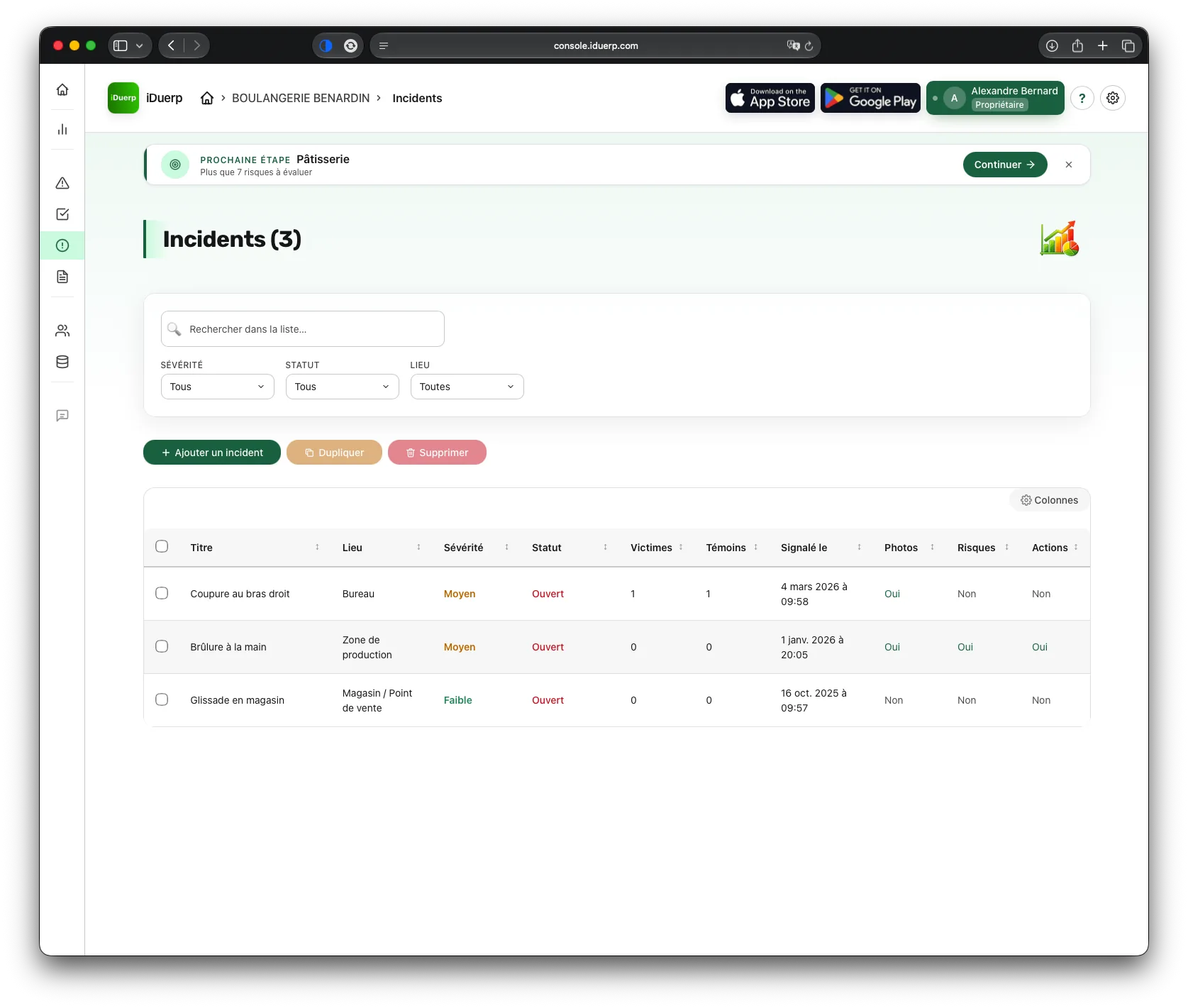 OSHAid console incident log: reported events listed with date, site, type and status, ready to export
Four things that have to exist on paper
January 1 is a date, not a project plan. Underneath it, the rule asks for four things on paper: an assessment, a plan built on that assessment, a record that the safety committee was consulted, and training delivered to named people by named dates.
Writing them is not the hard part. Producing them two years later is — when someone asks for the assessment behind the plan, the minutes behind the annual review, and the training record of the temporary employee who started on a Thursday. A safety program you can show, with the document, its date, the incident behind it and the action that closed it retrieved in a minute, is a different object from a binder you defend.
Questions safety officers ask
- When does Oregon's workplace violence prevention rule take effect?
January 1, 2027. Oregon OSHA adopted Administrative Order 3-2026 on October 21, 2026 and filed it with the Secretary of State the same day. It adopts OAR 437-002-0150 and amends OAR 437-001-0295 and OAR 437-001-0706.
- Which employers does OAR 437-002-0150 cover?
- When must new health care employees be trained on workplace violence in Oregon?
About this article
Written by the OSHAid Safety Desk from official sources (OSHA news releases, the text of the standards, BLS and NIOSH data), checked against those sources and reviewed before publication. It explains what a rule says; it is not legal advice for your situation. OSHAid
Make the plan and the log easy to produce
Create a free OSHAid account: keep your written safety programs and documents in one place, log incidents with photos and notes, and track corrective actions through to closure. No commitment.
Create my accountFreeDownload on theApp StoreGET IT ONGoogle PlayThe intelligent OSHA companion that automates your field compliance. Mobile app + web console + specialized safety AI agent, built for US workplaces.
🇫🇷 Hosted in EuropeGDPR CompliantProductIndustriesGuides- OSHA compliance software
- Hazard assessment guide
- Safety program templates
- JHA examples
- OSHA requirements
- OSHA recordkeeping
- OSHA standards by industry
- Workplace hazards
- Get started
- What is OSHA?
- Workplace safety glossary
- Why OSHAid?
- Enterprise solutions
- About
- Blog
- Legal notice
© 2026 OSHAid - published by DUOPP (SAS). All rights reserved.