 OSHAidProductsDemosIndustriesPricingMoreClient accessCreate my accountFree🇺🇸ENCreate my accountBack to blogFundamentalsOctober 21, 2026· By the OSHAid Safety Desk
OSHA cold stress requirements before the first freeze
There is no OSHA standard for working in the cold. There are still duties, and the work around the cold — roofs, docks, routes — falls under standards that apply all year.
OSHA cold stress requirements are easy to get wrong in one direction: there is no OSHA standard for working in the cold. No temperature triggers a duty, no reading on a thermometer ends a shift, and no paragraph tells you when a parka becomes mandatory.
That is not the same as having no obligations. OSHA treats cold injuries as recognized hazards, and the work your crew does in winter — clearing a roof, shoveling a dock, running a route — sits under standards that have not changed at all.
Before the first hard freeze, it is worth knowing which rule is doing the work in each case. Here is what applies, in the words OSHA uses, and the checks to run this week.
OSHA cold stress requirements: what actually applies
There is no cold stress standard. OSHA's cold stress page says so directly, and then says what fills the gap: employers must protect workers from recognized hazards under the General Duty Clause, Section 5(a)(1) of the OSH Act of 1970, which requires a place of employment free from recognized hazards that are causing or are likely to cause death or serious physical harm.
That makes recognition your job. OSHA names four cold stress conditions, and three of them do not need freezing weather.
Hypothermia occurs when body temperature drops below 95°F, and OSHA notes it can happen at cool temperatures above 40°F if a person is chilled by rain, sweat or cold water. Uncontrollable shivering is the mild sign the page tells you not to ignore.
Frostbite is the freezing of skin and tissue, which can cause permanent damage and, in severe cases, amputation.
Trench foot is a non-freezing injury from prolonged wet and cold. OSHA writes that it can occur at temperatures up to 60°F if the feet stay wet.
Chilblains come from repeated exposure to temperatures just above freezing, up to 60°F.
OSHA lists the risk factors that multiply all four: wetness or dampness, improper dress and exhaustion, along with certain health conditions and poor physical conditioning.
Around that core, ordinary standards apply with full force. OSHA's winter weather hazards page states that employers must evaluate snow removal tasks for hazards and plan how to do the work safely, and that a surface weighed down by snow must be inspected by a competent person.
On height, nothing is seasonal. In general industry, 29 CFR 1910.28(b)(1)(i) requires fall protection at an unprotected side or edge 4 feet or more above a lower level; in construction, 29 CFR 1926.501(b)(10) sets 6 feet for roofing work on low-slope roofs.
On equipment, 29 CFR 1910.132(a) requires protective clothing wherever it is necessary by reason of hazards of the environment — with a limit worth knowing. Paragraph (h)(4)(iii) says the employer is not required to pay for ordinary clothing used solely for protection from weather, naming winter coats, jackets, gloves, parkas, rubber boots and hats.
On response, 29 CFR 1910.151(b) requires a person adequately trained to render first aid, and readily available supplies, where no infirmary, clinic or hospital is in near proximity. On construction sites, 29 CFR 1926.50(d)(2) adds that the kit sits in a weatherproof container, checked before each job and at least weekly. Standard text here was read in Title 29 of the Code of Federal Regulations, issue date October 14, 2026, up to date as of October 19, 2026.
If you are mapping which hazard families already sit in your program, our workplace hazards guide connects them to the standards behind them.
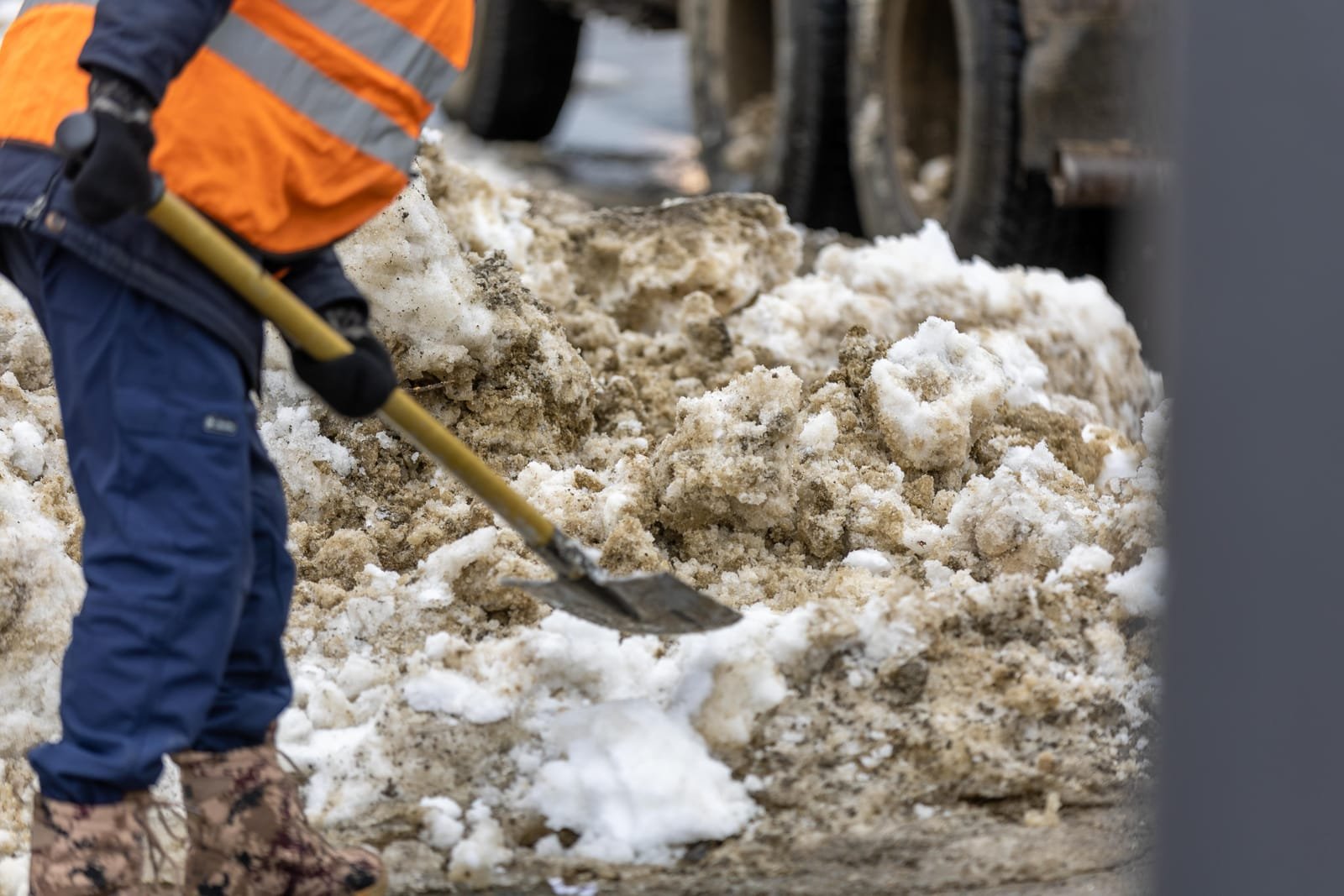 A worker in a high-visibility jacket and insulated trousers shovels packed snow and slush beside a truck. Photo: Sergei Starostin, via Pexels
Five checks before the first freeze
1. Name the jobs that get cold. Outdoor crews and drivers are obvious. Loading docks, refrigerated storage, unheated warehouses and anyone working wet are the ones that get missed. Write the list down: the duty you are working under is about recognized hazards, and a hazard nobody has named is a hazard nobody controls.
2. Decide how snow comes off the roof — before it snows. OSHA's advice is to use snow removal methods that do not involve workers going on roofs, when and where possible. If someone has to go up, the plan needs the fall protection the standard requires, a competent person's inspection of the snow-loaded surface, ladders cleared of snow and ice, and extreme caution near power lines. Fall protection in construction, 29 CFR 1926.501, sits first on OSHA's preliminary Top 10 most-cited standards for fiscal year 2026.
3. Set the work practices OSHA names. Frequent short breaks in a warm, dry area. Work scheduled for the warmest part of the day. The buddy system. Warm, sweet drinks, no alcohol. Radiant heaters where the work is fixed. Bare skin kept off cold metal and wet surfaces. Monitoring of workers' physical condition. None of that needs a purchase order; it needs a schedule.
4. Train now, not during the storm. OSHA's list is short: how to recognize the conditions that lead to cold stress, the symptoms, how to prevent it, how to help an affected coworker, and how to select proper clothing for cold, wet and windy conditions. Run it as a toolbox talk and keep the attendance list. Training with no record is a plan, not a program.
5. Walk the vehicles and the walking surfaces. For drivers, OSHA says properly trained workers should inspect the brakes, cooling system, electrical system, engine, exhaust system, tires, oil and visibility systems, and it recommends an emergency kit in the vehicle. Those checks belong with the rest of a driver's program — see our transportation safety page. On foot, clear snow and ice and spread deicer as quickly as possible after a storm; where walking on snow or ice cannot be avoided, train workers to wear footwear with good traction and insulation and to take short steps at a slower pace.
Each of those five is a task with an owner and a date, which is what a corrective action list should look like by November.
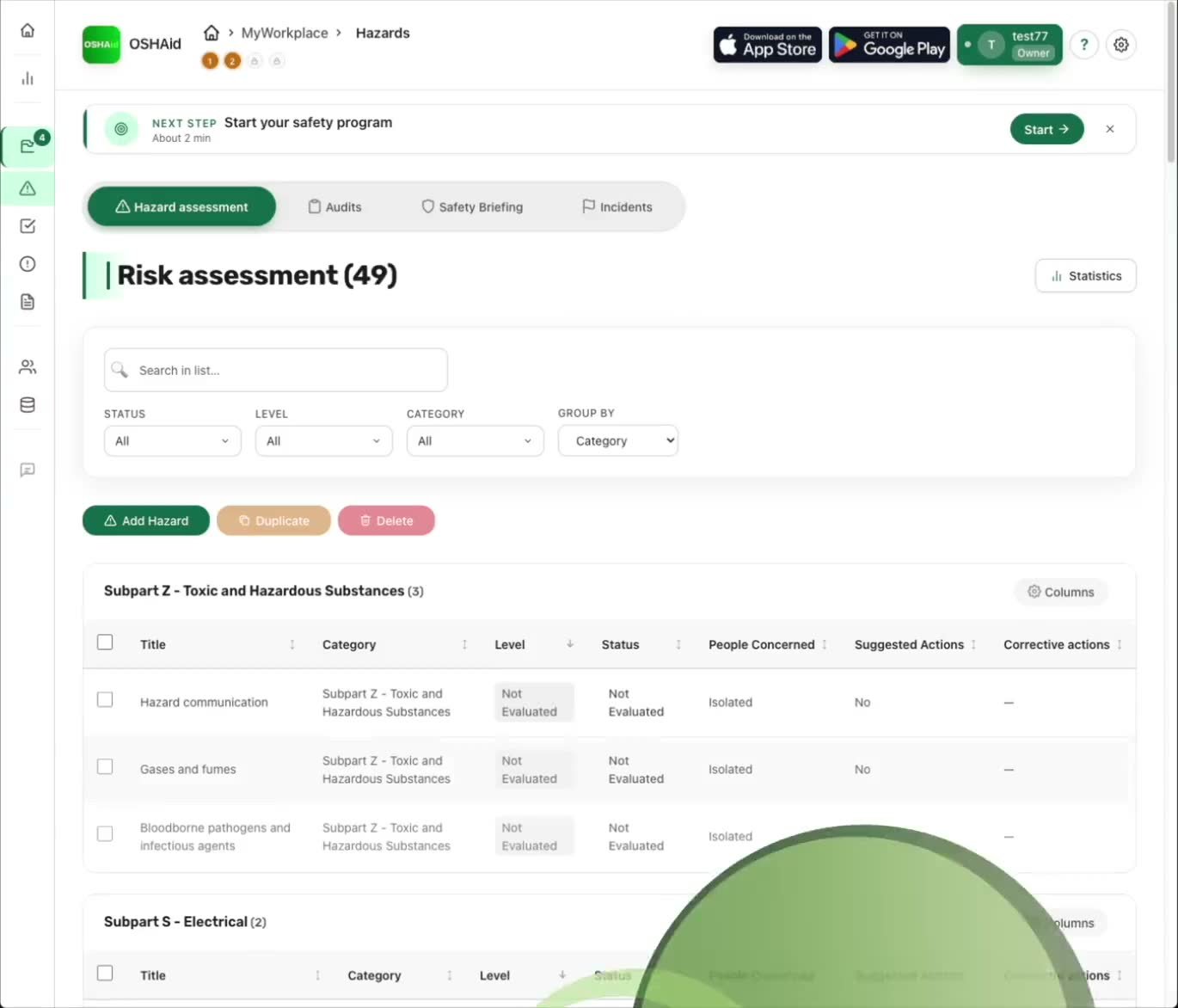 OSHAid console — risk assessment table where cold-weather hazards are scored and assigned
A winter plan you can show
Cold weather work is where safety programs quietly go informal. The crew knows to take breaks, somebody keeps a shovel in the truck, the supervisor decides on the morning. That works until the day leadership, a client or an inspector asks what the plan was, and the answer is a memory rather than a record.
The pieces that turn it into a program are small: the list of cold-exposed jobs, the snow removal method chosen before the storm, the toolbox talk with names and dates, the inspection of a snow-loaded roof, the actions with owners. OSHAid keeps them in one place, so a winter that went well is something you can show instead of something you recall.
Questions safety officers ask
- Does OSHA have a cold stress standard?
No. OSHA's cold stress page states there is no specific standard for cold stress. Employers still have to protect workers from recognized hazards under the General Duty Clause, Section 5(a)(1) of the OSH Act, and the standards covering the work itself — fall protection, PPE, first aid — apply as usual.
- Does my employer have to pay for winter coats and gloves?
- At what height is fall protection required for roof snow removal?
About this article
Written by the OSHAid Safety Desk from official sources (OSHA news releases, the text of the standards, BLS and NIOSH data), checked against those sources and reviewed before publication. It explains what a rule says; it is not legal advice for your situation. OSHAid
Get winter onto your hazard list
Create a free OSHAid account, add your cold-weather hazards and assign the actions. No commitment.
Create my accountFreeDownload on theApp StoreGET IT ONGoogle PlayThe intelligent OSHA companion that automates your field compliance. Mobile app + web console + specialized safety AI agent, built for US workplaces.
🇫🇷 Hosted in EuropeGDPR CompliantProductIndustriesGuides- OSHA compliance software
- Hazard assessment guide
- Safety program templates
- JHA examples
- OSHA requirements
- OSHA recordkeeping
- OSHA standards by industry
- Workplace hazards
- Get started
- What is OSHA?
- Workplace safety glossary
- Why OSHAid?
- Enterprise solutions
- About
- Blog
- Legal notice
© 2026 OSHAid - published by DUOPP (SAS). All rights reserved.