 OSHAidProductsDemosIndustriesPricingMoreClient accessCreate my accountFree🇺🇸ENCreate my accountBack to blogFundamentalsOctober 26, 2026· By the OSHAid Safety Desk
OSHA eyewash station requirements: when one is required
A trade piece on October 26 looked at how hard it is to keep an emergency shower tepid. The question that comes first is whether 29 CFR 1910.151(c) applies to your work area at all.
OSHA eyewash station requirements fit into a single sentence of regulation, which is exactly what makes them hard to apply.
29 CFR 1910.151(c) says that where the eyes or body of any person may be exposed to injurious corrosive materials, suitable facilities for quick drenching or flushing of the eyes and body shall be provided within the work area for immediate emergency use. That is the whole requirement. No flow rate, no distance in feet, no water temperature, no test schedule.
On October 26, 2026, Safety+Health magazine published a piece on safety shower challenges: pipework that freezes in cold climates, stored water heated by the sun in hot ones, remote sites with no reliable mains supply.
But two questions come before any of them. Does the standard reach your work area, and would an inspector call what you have there suitable? OSHA has answered both in writing, and the answers are narrower than most safety programs assume.
OSHA eyewash station requirements: what 1910.151(c) says
The trigger is corrosivity, not irritation. The standard applies where eyes or body may be exposed to injurious corrosive materials. Asked in 2009 whether a product classified as a moderate or severe eye irritant, but not corrosive, triggers the requirement, OSHA replied in one word: no. No other federal OSHA rule requires eye flushing facilities for non-corrosives.
The safety data sheet decides. In a 2004 letter OSHA wrote that if none of the materials used in a work area is an injurious corrosive, as indicated by the data sheet for each product, then an emergency eyewash or shower is not required under 1910.151(c). Under 29 CFR 1910.1200(g), Section 2 of every sheet is hazard identification and Section 4 is first-aid measures. Those two sections, product by product, are the real scoping exercise. Our workplace hazard assessment guide sets out how to run that inventory.
Exposure has to be possible. OSHA's position, quoted again in the 2009 letter, is that hazardous materials present in a way that exposure could not occur — sealed containers that will not be opened, caustics inside building piping — do not call for drench equipment. Put a sampling spigot on that same caustic line and expect employees to draw from it, and an eyewash or emergency shower is needed where that task happens.
Construction has the same sentence. 29 CFR 1926.50(g) repeats the general industry wording word for word for construction work. Both texts were read against Title 29 as it stood on October 22, 2026.
ANSI Z358.1 is guidance, not an OSHA rule. This is where most programs go wrong in the other direction. In a November 1, 2002 letter to Hawaii's OSH division, OSHA wrote that ANSI standards become mandatory OSHA standards only if and when OSHA adopts them, and that it had adopted no version of Z358.1 and therefore enforced none of them.
It still matters. The same letter says that if OSHA inspects a workplace and finds unsuitable facilities for quick drenching or flushing, a citation under 1910.151(c) would be issued, and that in judging suitability the agency may refer to the most recent consensus standard on eyewash equipment as well as other recognized medical, technical and industrial hygiene sources. A serious classification is possible, decided case by case.
Your state or city may require more. OSHA's 2004 letter notes that state laws or municipal codes can create independent requirements on top of the federal standard.
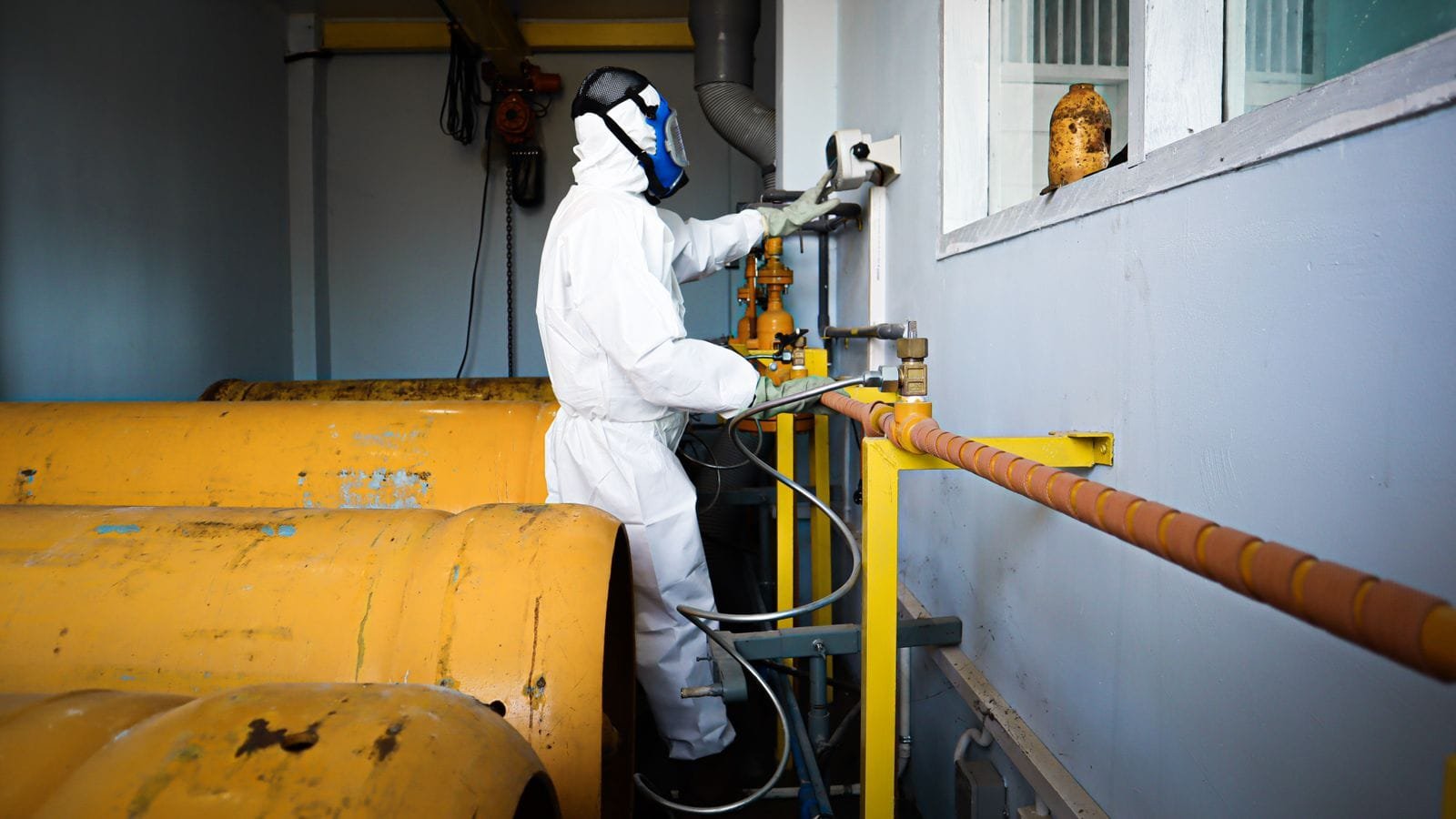 A worker in a hooded coverall, face shield and respirator opens a valve on chemical pipework beside large yellow storage tanks. Photo: Govin MU, via Pexels
What to check this week
1. Build the corrosive list before you buy anything. Walk the stockroom, the kitchen and the service van. For each product, open Section 2 of its safety data sheet and write down whether it is classified corrosive to skin or eyes. Drain cleaners, oven cleaners, battery acid and some concrete additives land there; plenty of products that smell aggressive do not.
2. Scope it by work area, not by building. The standard requires the facility within the work area, for immediate emergency use: one station at the far end of a plant does not cover a mixing bench two departments away.
3. Ask whether anyone can actually be splashed. Sealed totes that are never opened are different from a dispensing tap, a decanting bench or a line with a sampling point: the task, not the inventory, triggers the requirement.
4. Measure what you have against the current consensus standard. OSHA does not enforce ANSI/ISEA Z358.1, but it may refer to it when deciding whether your facility is suitable. Safety+Health reports that the standard defines tepid flushing fluid as 60 to 100 degrees Fahrenheit and calls for equipment that can deliver flushing fluid for at least 15 minutes. Those two numbers are the ones an inspector is most likely to arrive knowing.
5. Look at temperature and freezing the way the article does. Exposed pipework can freeze and block a shower outright. Water that has sat in a sun-heated line can come out hot enough to add a second injury. Insulation, freeze protection, heated or tempered supply and limiting solar gain are design answers, not paperwork answers.
6. Test it and keep the record. OSHA sets no test frequency for drench equipment. A citation turns on whether the facility was suitable when it was needed, so a dated activation check — valve opens, flow holds, water runs clear and tepid — is the cheapest evidence you can keep.
7. Close the loop with first aid and training. 29 CFR 1910.151(b) requires adequate first aid supplies to be readily available, and a trained person where no infirmary, clinic or hospital is in near proximity. Section 4 of each data sheet gives the flushing instruction for that product; workers who may be splashed should know it beforehand.
8. Put the station on the hazard map. Drench equipment is a control for a chemical exposure, so it belongs in the same record as the hazard it answers — see our guide to workplace hazards and their controls.
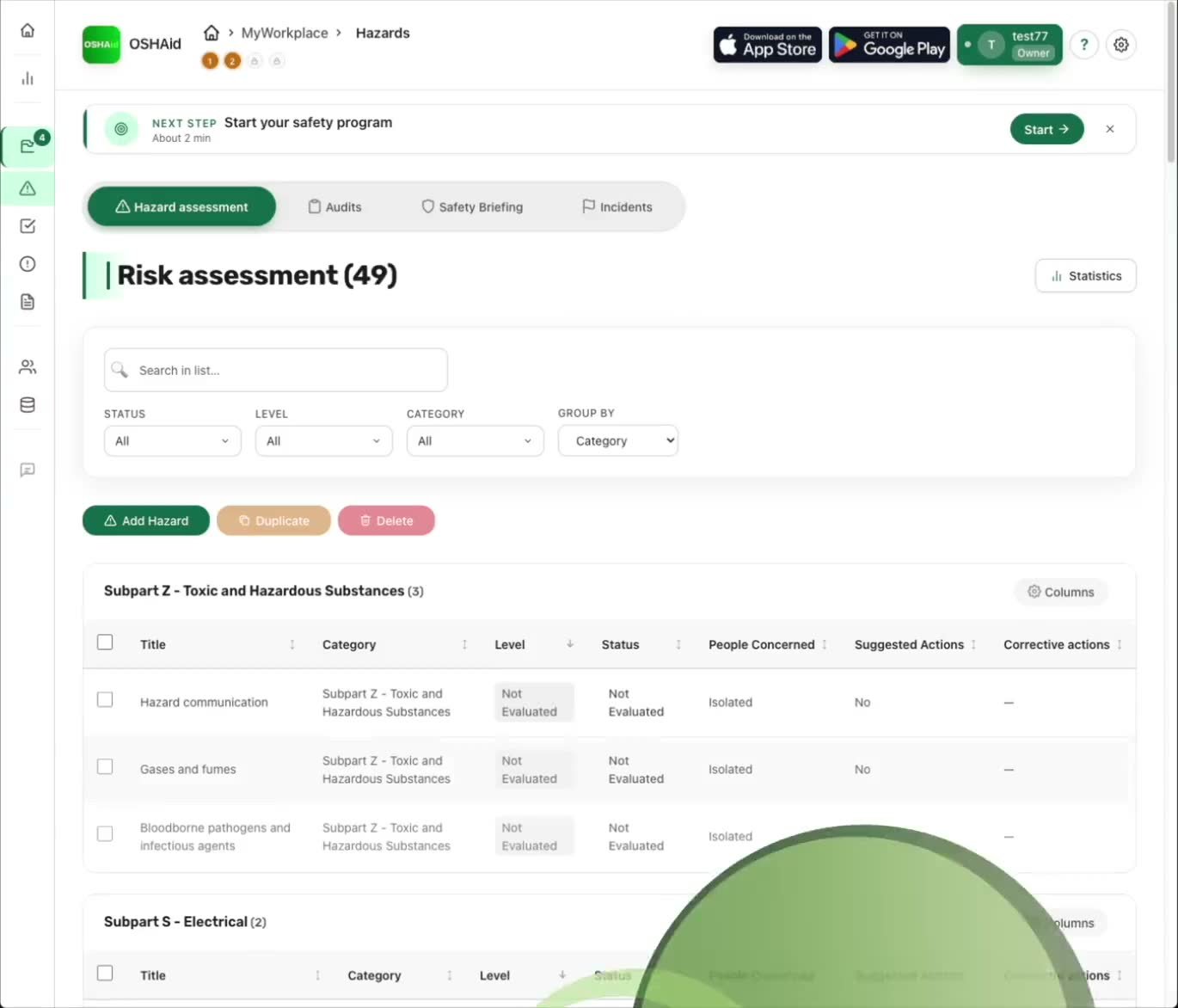 OSHAid console — the risk assessment table, where a corrosive chemical exposure sits beside the control that answers it and the evidence behind it
One sentence of rule, a file of evidence
A standard this short shifts the work onto the employer. There is no checklist to satisfy, so what remains is a judgment you have to be able to explain: these are the corrosives we handle, this is where someone could be splashed, this is the equipment we put there, and this is the record that it works.
That is a file, not an opinion, and a safety officer should be able to put it on a screen in an afternoon — for an inspector, for a client asking for proof, or for a leadership team asking what the safety program bought. OSHAid keeps hazards, assessments, corrective actions and documents in one place so that the answer to "show me" is a screen instead of a search.
Questions safety officers ask
- Does OSHA require an eyewash station in every workplace?
No. 29 CFR 1910.151(c) applies where the eyes or body may be exposed to injurious corrosive materials. OSHA has written that if no material used in a work area is an injurious corrosive, as indicated by its safety data sheet, an emergency eyewash or shower is not required under that standard.
- Does OSHA enforce ANSI Z358.1 for eyewash stations?
- How close must an eyewash station be to the hazard?
About this article
Written by the OSHAid Safety Desk from official sources (OSHA news releases, the text of the standards, BLS and NIOSH data), checked against those sources and reviewed before publication. It explains what a rule says; it is not legal advice for your situation. OSHAid
Map the chemicals before anyone asks
Create a free OSHAid account, list the corrosives in each work area, record the controls that answer them, and keep the evidence in one place. No commitment.
Create my accountFreeDownload on theApp StoreGET IT ONGoogle PlayThe intelligent OSHA companion that automates your field compliance. Mobile app + web console + specialized safety AI agent, built for US workplaces.
🇫🇷 Hosted in EuropeGDPR CompliantProductIndustriesGuides- OSHA compliance software
- Hazard assessment guide
- Safety program templates
- JHA examples
- OSHA requirements
- OSHA recordkeeping
- OSHA standards by industry
- Workplace hazards
- Get started
- What is OSHA?
- Workplace safety glossary
- Why OSHAid?
- Enterprise solutions
- About
- Blog
- Legal notice
© 2026 OSHAid - published by DUOPP (SAS). All rights reserved.