 OSHAidProductsDemosIndustriesPricingMoreClient accessCreate my accountFree🇺🇸ENCreate my accountBack to blogCase lawOctober 30, 2026· By the OSHAid Safety Desk
OSHA general duty clause: a rule you do not enforce is not a defense
On October 28, 2026, the Eighth Circuit denied review of a general duty clause citation. The reasoning reads like a checklist for any employer whose worst hazard has no standard of its own.
The OSHA general duty clause is the obligation that applies when no specific standard reaches the hazard in front of you. It is one sentence long, and most safety officers meet it for the first time on a citation.
On October 28, 2026, the US Court of Appeals for the Eighth Circuit denied a trucking company's petition for review of a general duty clause citation issued after a worker on foot was fatally struck by a truck during an oil rig move. The court's published opinion in Hall Trucking Inc. v. Secretary of Labor runs eight pages, and most of it turns on something narrower than the incident: whether the employer's own safety measures were adequate.
That question is the one a compliance officer asks on site, long before anyone goes to court.
What OSHA has to prove, and where this case turned
The clause itself. Section 5(a)(1) of the OSH Act requires each employer to furnish "employment and a place of employment which are free from recognized hazards that are causing or are likely to cause death or serious physical harm." The text is on OSHA's page for employer and employee duties, codified at 29 U.S.C. 654(a)(1).
Four elements. For a general duty clause violation, the Secretary of Labor must prove that a condition or activity in the workplace presented a hazard, that the employer or its industry recognized it as a hazard, that the hazard was likely to cause or did cause death or serious physical harm, and that a feasible means to eliminate or materially reduce it existed. In this case, only the fourth element was contested.
Feasible means has two halves. OSHA has to specify the particular steps the employer should have taken to avoid citation, and demonstrate the feasibility and likely utility of those measures. Where the employer already has safety procedures, the burden is on OSHA to show those procedures were inadequate.
How a procedure is shown to be inadequate. Adequacy is measured against the precautions a reasonably prudent employer familiar with the circumstances of the industry would take. The court repeated the rule that an employer does not satisfy its obligation by putting safety measures in a manual "unless those measures are actually followed and enforced," and that OSHA may prove inadequacy by showing the employer did not follow its procedures or did not properly communicate them to employees.
What the record showed. The company's procedures did list back-up alarms, back-up cameras, employee training, high-visibility gear and discipline for employees who ignored safety rules. During the incident, the back-up camera had glare, the spotter had his back turned, and employees were not wearing high-visibility gear. Employees generally ignored back-up alarms. There were no written policies for struck-by hazards. On that record, the court held that substantial evidence supported the finding that the measures were inadequate.
A menu of options can be a specific step. The abatement OSHA named was an internal traffic control plan: a process in which the employer picks among alternatives such as plans to minimize interactions between employees and trucks, required high-visibility gear and training. The employer answered that a plan is not a specific step, and that such plans are not an industry standard. The court held that a process approach can supply the steps, and that feasibility turns on whether safety experts recognize a precaution as feasible, "not whether the precaution's use has become customary."
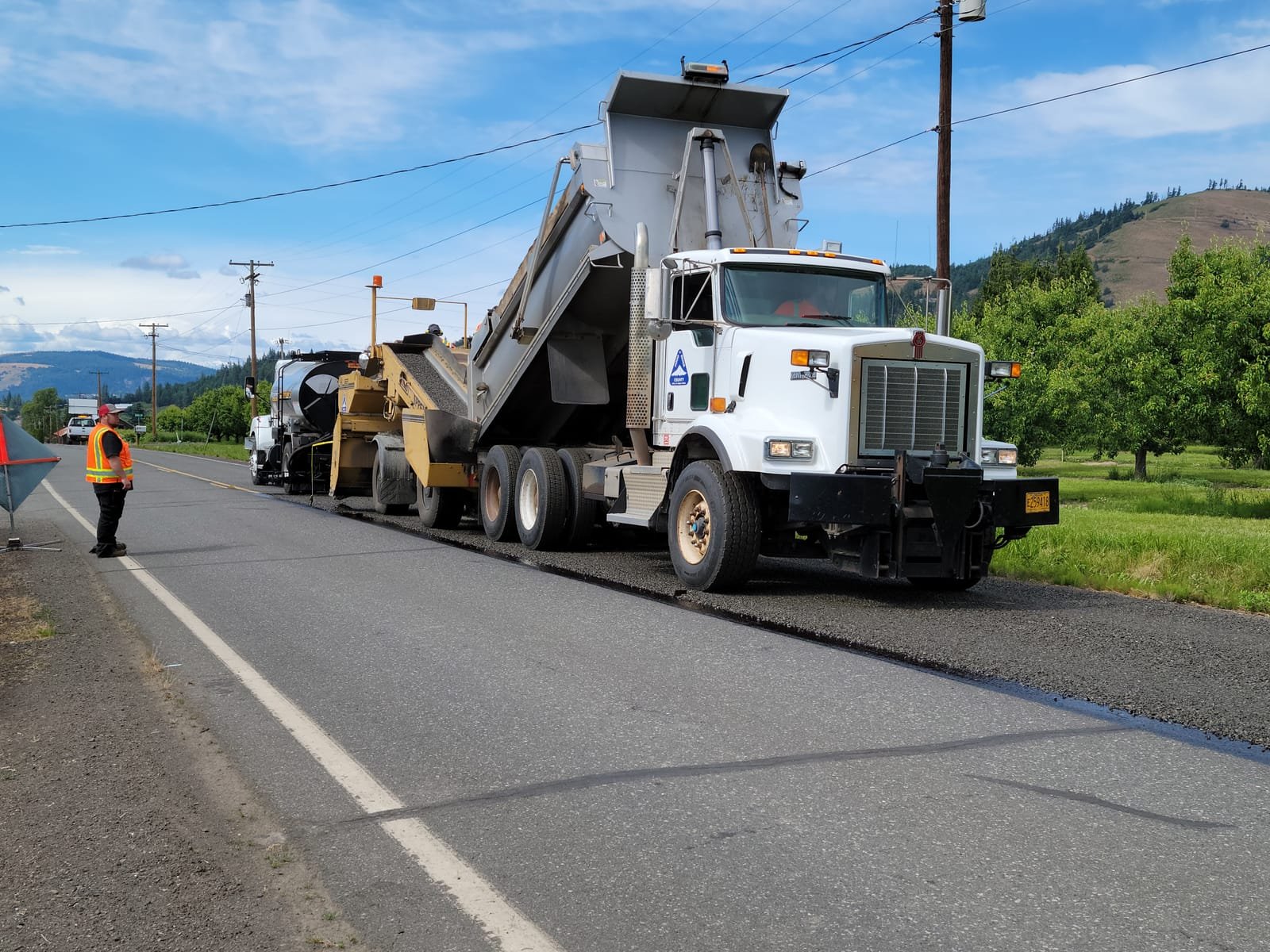 A highway paving crew at work: a dump truck backing to a paver while a worker in a high-visibility vest stands on the shoulder a few feet from the moving equipment. Photo: Tom Shamberger, via Pexels (Pexels Licence)
OSHA general duty clause: what to check this week
1. Separate what a standard covers from what it does not. Under 29 CFR 1910.5(f), an employer in compliance with a standard is deemed in compliance with section 5(a)(1) — but only to the extent of the condition, practice, means, method, operation or process that standard covers. Everything outside that line is general duty territory. Our guide to the obligations every US employer carries is the place to start the inventory.
2. Put the unwritten rules in writing. The hazard in this case was workers on foot around moving trucks, and the company had no written struck-by policy. If a hazard is obvious enough that your crew has informal habits around it, those habits belong in a document.
3. Keep proof that you communicated them. Dated training records with names and subjects are what answers the "properly communicate" half of the test. An unsigned handbook is not.
4. Keep proof that you enforce them. "Actually followed and enforced" is the phrase that decided this case. A rule everyone ignores — a back-up alarm nobody reacts to — is evidence against you, not for you.
5. Go and watch the work at the hour it happens. Camera glare, a spotter facing the wrong way and vests left in the cab are the sort of facts that end up in an ALJ's findings. They are also the sort of facts a supervisor can fix the same morning.
6. Write a traffic plan wherever people and vehicles share ground. Yards, docks, lay-down areas and rig moves all qualify. Name the exclusion zones, the signals, the vest rule and the training; a plan that lets the site choose among workable options is still a plan. If you run trucks, our page on safety requirements in transportation operations covers the hazards that recur there.
7. If you are cited, raise every argument early. Under 29 U.S.C. 660(a), no objection that has not been urged before the Commission will be considered by a court, absent extraordinary circumstances. Here the employer argued on appeal that a specific construction standard displaced the general duty clause. The court never reached the question: the argument had not been raised in the petition for discretionary review, so it was waived.
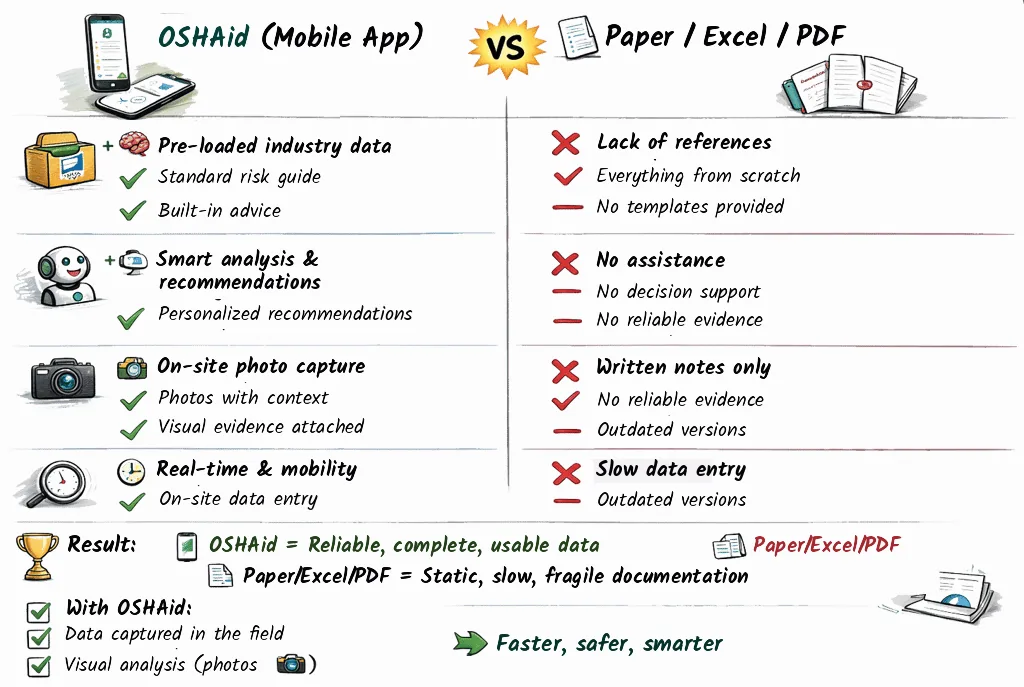 Whiteboard sketch contrasting a paper safety binder with the same program kept in an app: written programs and records retrievable on request instead of filed away
The binder is not the program
Every general duty clause case comes down to the same gap: the distance between what the manual says and what happens in the yard. OSHA does not have to prove you had no procedures. It can prove the ones you had were not followed, or were never really passed on.
That is why the useful question is not "do we have a policy for this?" but "what could I show?" A dated policy, the training records that go with it, the inspection that found the gap and the corrective action that closed it — retrieved in a minute, in front of whoever is asking. That is a program you can show, instead of a binder you defend.
Questions safety officers ask
- What is the OSHA general duty clause?
It is section 5(a)(1) of the OSH Act, 29 U.S.C. 654(a)(1). It requires each employer to furnish employment and a place of employment free from recognized hazards that are causing or are likely to cause death or serious physical harm. OSHA uses it where no specific standard covers the hazard.
- What must OSHA prove for a general duty clause citation?
- Does a written safety program prevent a general duty clause citation?
About this article
Written by the OSHAid Safety Desk from official sources (OSHA news releases, the text of the standards, BLS and NIOSH data), checked against those sources and reviewed before publication. It explains what a rule says; it is not legal advice for your situation. OSHAid
Make your safety rules provable
Create a free OSHAid account, keep your written safety programs and documents in one place, and track corrective actions through to closure. No commitment.
Create my accountFreeDownload on theApp StoreGET IT ONGoogle PlayThe intelligent OSHA companion that automates your field compliance. Mobile app + web console + specialized safety AI agent, built for US workplaces.
🇫🇷 Hosted in EuropeGDPR CompliantProductIndustriesGuides- OSHA compliance software
- Hazard assessment guide
- Safety program templates
- JHA examples
- OSHA requirements
- OSHA recordkeeping
- OSHA standards by industry
- Workplace hazards
- Get started
- What is OSHA?
- Workplace safety glossary
- Why OSHAid?
- Enterprise solutions
- About
- Blog
- Legal notice
© 2026 OSHAid - published by DUOPP (SAS). All rights reserved.