 OSHAidProductsDemosIndustriesPricingMoreClient accessCreate my accountFree🇺🇸ENCreate my accountBack to blogOSHA updateOctober 27, 2026· By the OSHAid Safety Desk
OSHA hard hat requirements: when Type I is not enough
In a letter of interpretation dated August 17, 2026, OSHA says no ANSI helmet type is mandatory, then explains the point at which top-only protection stops being adequate.
OSHA hard hat requirements have not changed, but the question safety officers keep asking has: do we have to replace hard hats with safety helmets, and does OSHA now expect Type II?
OSHA answered both in a letter of interpretation dated August 17, 2026. The short version: 29 CFR 1910.135(b) does not require employers to use a particular ANSI helmet type, such as Type II. The longer version is the one that matters on your site — where a hazard assessment identifies blows to the side of the head, head protection that covers only the top may not be adequate, and the citation then lands on the assessment rather than on the helmet.
What you own matters less than what your assessment says you need.
OSHA hard hat requirements: what the August 17 letter says
The standard sets a floor, not a model. 29 CFR 1910.135(a) requires you to ensure that each affected employee wears a protective helmet where there is a potential for head injury from falling objects, and a helmet designed to reduce electrical shock hazard near exposed conductors that could contact the head. Paragraph (b)(1) requires that head protection comply with ANSI Z89.1-2009, Z89.1-2003 or Z89.1-1997, or that it be at least as effective as a device built to one of them.
No ANSI type is mandated. The letter states that 1910.135(b) does not require employers to use a particular ANSI helmet type. It then sets out the difference the types describe: Type I helmets are designed to reduce the force of impact from a blow to the top of the head, Type II helmets from a blow to the top or the side of the head.
The hazard assessment decides. Under 29 CFR 1910.132(d)(1) you must assess the workplace for hazards that are present or likely to be present, then select and have each affected employee use PPE that protects against the hazards identified. OSHA's conclusion follows from that sentence: where the assessment finds top-or-side impact hazards, top-only protection may not be adequate, and OSHA will require PPE — Type II, for example — matched to the hazard found.
The citation lands on the selection. Asked what it would cite if side-impact hazards were present and only Type I helmets had been issued, OSHA answered that it may cite 1910.132(d)(1)(i) for failure to provide PPE appropriate to the hazards. The failure is in the choice, not in the catalogue.
The 2024 bulletin is advisory. OSHA's Safety and Health Information Bulletin SHIB 3-6-2024, *Head Protection: Safety Helmets in the Workplace*, is advisory and creates no new legal requirement; enforcement turns on the facts of the workplace and the applicable standards. The bulletin says OSHA chose Type II, Class G helmets for its own staff after a job hazard analysis, and that employers may reach a different conclusion from their own.
There is no General Duty Clause shortcut. Asked whether section 5(a)(1) could be used where Type I helmets meet lateral hazards, OSHA said no: under 1910.5(f), where a condition is addressed by the PPE and head protection standards, OSHA cites those standards instead.
Construction reads the same. 29 CFR 1926.100(b) lists the same three ANSI Z89.1 editions and adds Section 9.7, electrical insulation, for employees exposed to high-voltage shock and burns. Both texts were read against Title 29 as it stood on October 23, 2026.
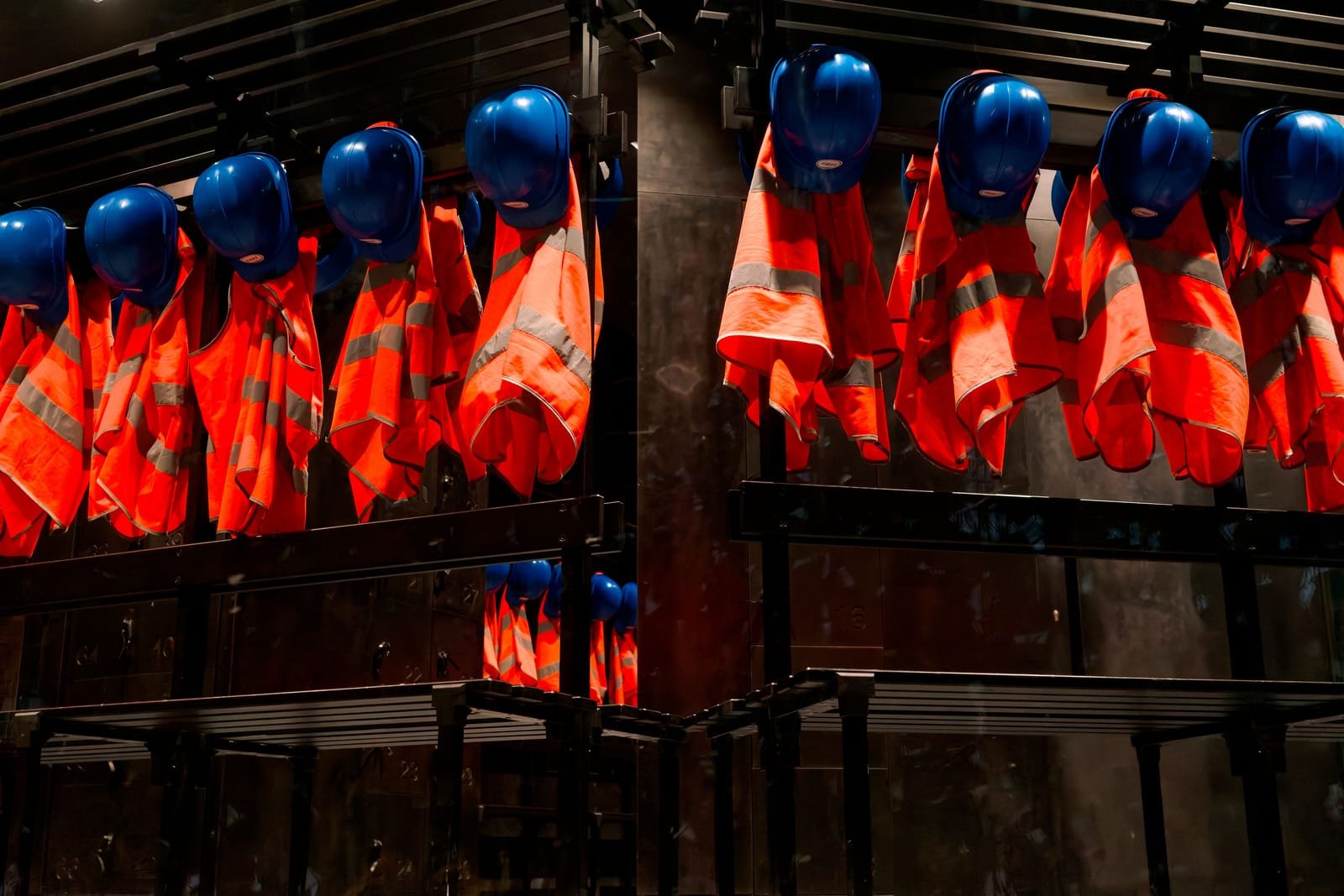 Rows of blue hard hats hanging above orange high-visibility vests on changing-room racks. Photo: Carsten Ruthemann, via Pexels (Pexels Licence)
What to check this week
1. List the tasks where a blow could arrive from the side. The letter names the scenarios it was asked about: equipment swing, vehicle traffic, slips, trips and falls that lead to side impacts, and work around crane operations, rigging, signal work, industrial fabrication and welding. None makes Type II automatic, but each is a reason to write the question down. Our Job Hazard Analysis examples show the task-by-task format that makes that visible.
2. Re-certify the assessment, not just the PPE order. 1910.132(d)(2) requires a written certification identifying the workplace evaluated, the person certifying, the date or dates of the assessment, and the document itself as a certification of hazard assessment. Four elements, and they are the first thing an inspector asks for.
3. Write down why you chose what you chose. OSHA's letter says 1910.132(d) is performance based and sets no format, then lists what documentation should show: the areas, tasks or operations evaluated; the hazards considered, including foreseeable lateral or off-center impact; the basis for the protection selected; and any product performance information, manufacturer instructions or equipment limitations you weighed. Non-mandatory Appendix B to Subpart I is the model OSHA points to.
4. Do not over-correct. OSHA is explicit that Type II helmets may often be appropriate but are not the only acceptable option, and that any head protection providing equal or greater protection can be used. A blanket Type II purchase order is not compliance either.
5. Check the class as well as the type. The type covers impact; the class covers electricity. The 2024 bulletin describes Class G proof-tested at 2,200 volts, Class E at 20,000 volts, and Class C as not intended to protect against electrical contact. Where your crews work decides which applies — see how obligations differ by sector in our guide to OSHA standards by industry.
6. Train before the new helmet goes on a head. 1910.132(f) requires training on when and what PPE is necessary, how to don, doff, adjust and wear it, its limitations, and its care, maintenance, useful life and disposal. Employees must demonstrate they understand before doing the work, and a change of PPE is listed as a trigger for retraining. Changing helmet models without that step creates the gap.
7. Remember who pays. Under 1910.132(h)(1) the employer provides PPE at no cost to employees. Head protection is not among the exceptions, which cover items such as non-specialty safety-toe footwear and ordinary weather clothing.
8. Check fit, for every head. 1910.132(d)(1)(iii) requires PPE selected to properly fit each affected employee. A helmet that will not sit level on a worker is not the right selection, whatever the type on the label.
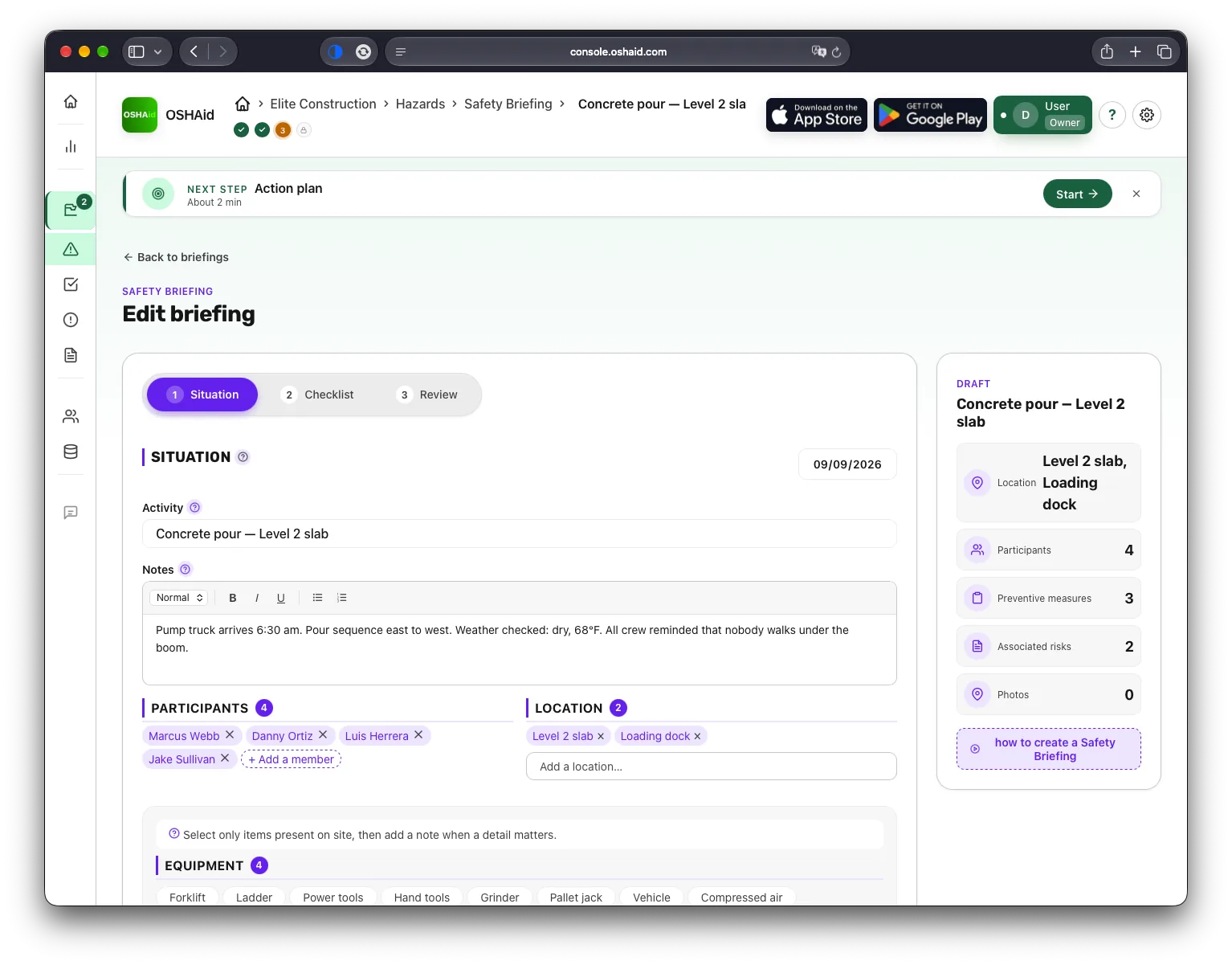 OSHAid console — the safety briefing editor, where the training on a new helmet model is written, delivered and signed
The helmet is the answer; the assessment is the proof
OSHA's letter puts the question back where it belongs. Nobody is cited for owning Type I helmets. They are cited for not showing that someone looked at the work, saw where an impact could come from, and chose accordingly.
That is a record, not an opinion: the tasks evaluated, the hazards considered, the protection selected and why, the training that followed, the date on all of it. One file answers an inspector, a client audit and a leadership question. OSHAid keeps hazard assessments, PPE decisions, briefings and their evidence in one place, so "show me" is a screen rather than a search.
Questions safety officers ask
- Does OSHA require Type II safety helmets?
No. In a letter dated August 17, 2026, OSHA wrote that 29 CFR 1910.135(b) does not require employers to use a particular ANSI helmet type. But where a hazard assessment identifies blows to the top or side of the head, OSHA will require head protection that protects against that hazard, and Type II is one example.
- Are hard hats still allowed, or must we switch to safety helmets?
- What does OSHA expect in a head protection hazard assessment?
About this article
Written by the OSHAid Safety Desk from official sources (OSHA news releases, the text of the standards, BLS and NIOSH data), checked against those sources and reviewed before publication. It explains what a rule says; it is not legal advice for your situation. OSHAid
Put the head protection decision on the record
Create a free OSHAid account, run the hazard assessment task by task, record the head protection you selected and why, and keep the training with it. No commitment.
Create my accountFreeDownload on theApp StoreGET IT ONGoogle PlayThe intelligent OSHA companion that automates your field compliance. Mobile app + web console + specialized safety AI agent, built for US workplaces.
🇫🇷 Hosted in EuropeGDPR CompliantProductIndustriesGuides- OSHA compliance software
- Hazard assessment guide
- Safety program templates
- JHA examples
- OSHA requirements
- OSHA recordkeeping
- OSHA standards by industry
- Workplace hazards
- Get started
- What is OSHA?
- Workplace safety glossary
- Why OSHAid?
- Enterprise solutions
- About
- Blog
- Legal notice
© 2026 OSHAid - published by DUOPP (SAS). All rights reserved.