 OSHAidProductsDemosIndustriesPricingMoreClient accessCreate my accountFree🇺🇸ENCreate my accountBack to blogOSHA updateNovember 3, 2026· By the OSHAid Safety Desk
OSHA lithium-ion battery requirements: no single standard, fourteen that apply
OSHA announced a new Lithium-ion Battery Safety page in its November 2 QuickTakes. The page confirms there is no lithium-specific standard, then lists the general industry and construction rules that already cover charging, storage, training and thermal runaway.
Ask most safety officers what the OSHA lithium-ion battery requirements are and the honest answer is a shrug. No 29 CFR section has "lithium" in its title, so the batteries in your power tools, scooters, forklifts and energy storage cabinets feel like a hazard nobody wrote a rule for.
On November 2, 2026, OSHA's QuickTakes newsletter announced a new Lithium-ion Battery Safety topic page covering how to manufacture, use, store, recycle and ship these batteries. Its first line is the one worth reading twice: there is no specific standard, but many standards may apply.
That changes the question. Not "does a rule exist?" but "which of the rules I already live under reach the battery charging bench in the corner?"
What the OSHA lithium-ion battery requirements rest on
No lithium standard, and OSHA says so plainly. OSHA's standards list for lithium-ion batteries opens by stating that while there is not a specific OSHA standard for lithium-ion batteries, many OSHA standards may apply, as well as the General Duty Clause, section 5(a)(1) of the OSH Act.
The page names the standards instead. For general industry it points to 1910.38 emergency action plans and 1910.39 fire prevention plans; 1910.119 process safety management and 1910.120 HAZWOPER; 1910.132 personal protective equipment and 1910.134 respiratory protection; 1910.147 lockout/tagout; 1910.151 medical services and first aid; 1910.160 fixed extinguishing systems; 1910.178 powered industrial trucks; 1910.303 electrical general requirements; and, in Subpart Z, 1910.1000 air contaminants, 1910.1020 access to employee exposure and medical records, and 1910.1200 hazard communication.
Construction gets its own list. It runs 1926.35 employee emergency action plans, 1926.59 hazard communication, 1926.65 HAZWOPER, 1926.150 and 1926.151 fire protection and prevention, 1926.403 electrical general requirements, 1926.417 lockout and tagging of circuits, and 1926.441, Batteries and battery charging — which puts charging installations in designated areas, protects charging apparatus from damage by trucks, and requires facilities for quick drenching of the eyes and body within 25 feet of battery handling areas.
Thermal runaway is the hazard the list is built around. OSHA describes it as a chain reaction in which the heat released by one failing cell damages nearby cells, set off by a manufacturing defect, mechanical damage, excessive heat or cold, or improper charging. The warning signs it names are a rise in battery temperature, fire, or venting of gas, vapor or smoke, and the fires can release hydrogen fluoride, hydrogen cyanide and carbon monoxide.
The hazard communication question has a precise answer. 1910.1200 exempts an "article": a manufactured item, other than a fluid or particle, whose end use depends on the shape it was given in manufacture and which under normal use releases no more than very small quantities of a hazardous chemical and poses no physical hazard or health risk. OSHA states that when a cell or battery does not meet that exemption, the manufacturer or importer must classify the chemical hazards and pass the hazard information to downstream users.
And a January letter settles a recordkeeping argument. An employer asked OSHA whether a burn was work-related when an employee carried personal rechargeable lithium-ion batteries for an e-cigarette in a pocket and they ignited at work. OSHA's January 20, 2026 letter of interpretation answers yes: the precipitating event is the fire in the work environment, and none of the eight exceptions in 1904.5(b)(2) covers a personal item brought on site during assigned working hours.
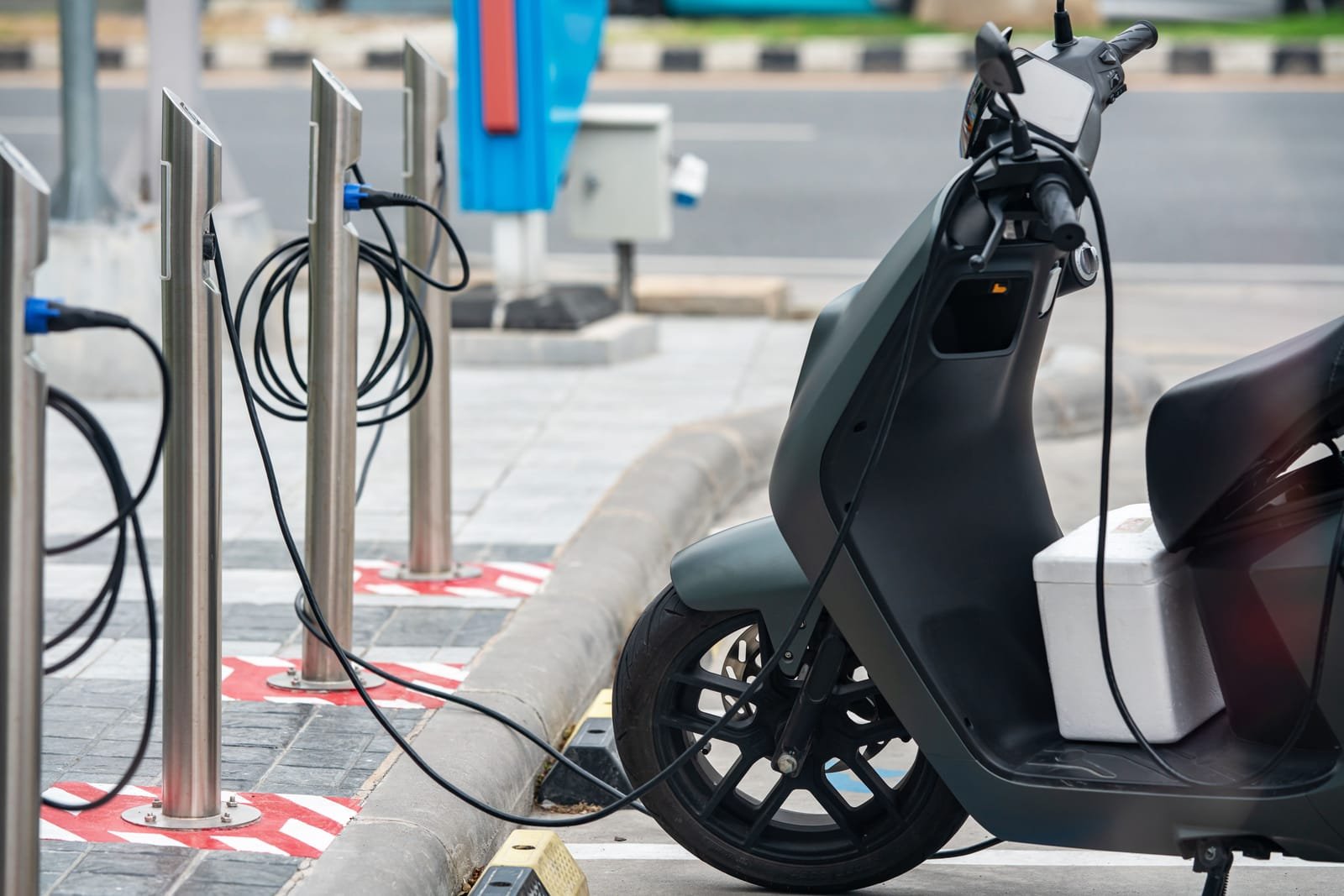 An electric scooter plugged into a row of stainless charging posts at a street charging station, cables coiled on the stands. Photo: panumas nikhomkhai, via Pexels (Pexels License)
Meeting the OSHA lithium-ion battery requirements this week
1. List where the cells actually are. Cordless tools and their chargers, e-bikes and scooters, pallet jacks and powered industrial trucks, laptops and radios, any stationary energy storage system — and the personal devices employees charge at their desks. Our guide to workplace hazard categories and controls is the place to file what you find.
2. Give charging a designated place and a written rule. OSHA's control guidance asks for storage in dry, cool locations, charging and maintenance per the manufacturer's instructions, and limiting the quantity stored, pointing to NFPA 800 and NFPA 855. Those are consensus standards OSHA has not adopted: a benchmark for your practice, not a basis for a citation. The same list asks for safety showers and eyewash stations wherever exposure to electrolytes may occur.
3. Write the battery into the emergency action plan. OSHA asks employers to make sure the plan includes lithium-related incident response procedures based on the manufacturer's instructions and NFPA guidance, and that workers are trained on them. Where a fire prevention plan is required, 29 CFR 1910.39 wants it in writing, listing major fire hazards with their handling and storage procedures and their ignition sources — an employer with 10 or fewer employees may communicate it orally. Our written safety program templates and requirements show the structure.
4. Train people to spot a failing battery. OSHA names it as a control in its own right: train workers to identify defective, damaged or failing lithium-powered devices and batteries. Add the venting, swelling and heat signs, and run the training in a language and literacy level workers understand.
5. Decide the disposal route today. Batteries go to designated recycling facilities, never into municipal trash or recycling bins, and battery types are not mixed in recycling.
6. Fix the recordkeeping position before the case appears. A burn from a personal battery that ignites on your premises during assigned hours is recordable. Our guide to OSHA recordkeeping and the 300, 300A and 301 forms covers the entry and the seven-day clock that runs from the moment you hear about it.
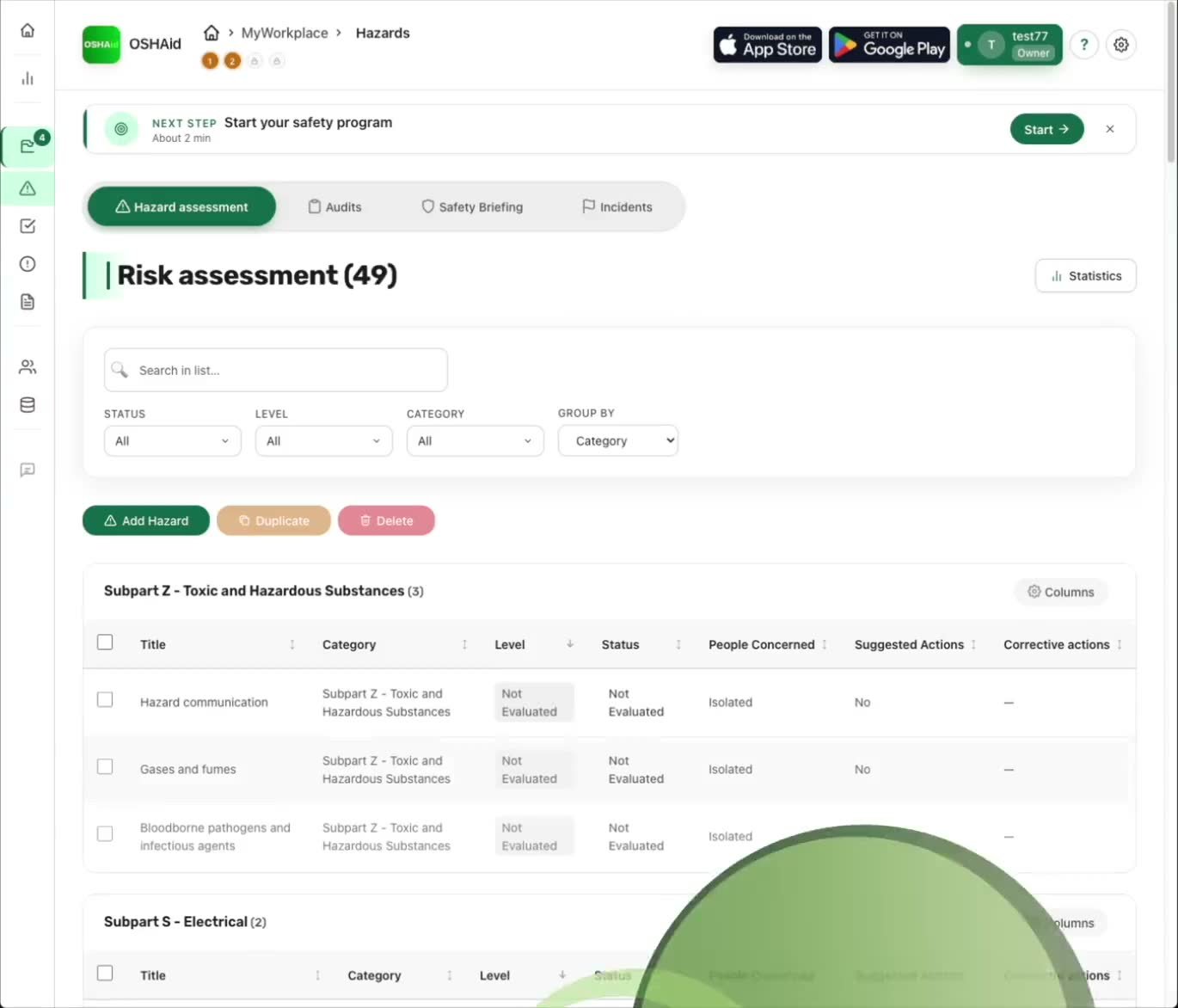 OSHAid console — the risk assessment table, where a battery charging hazard sits beside its score and the control answering it
Scattered rules, one answer you can show
The awkward thing about a hazard governed by fourteen general industry standards and no standard of its own is that compliance never looks like a single document: no lithium permit to produce, no annual lithium inspection to date.
What you can produce is the chain: the inventory that found the charging bench, the assessment that scored it, the charging rule it produced, the training record behind that rule, and the emergency procedure for a venting cell. Assembled after an incident, that is a defense. Assembled now, each piece carrying its own date, it is simply what your safety program looks like.
Questions safety officers ask
- Is there an OSHA standard for lithium-ion batteries?
No. OSHA's Lithium-ion Battery Safety page states that while there is not a specific OSHA standard for lithium-ion batteries, many OSHA standards may apply, as well as the General Duty Clause, section 5(a)(1) of the OSH Act. The page lists the general industry, shipyard, marine terminal and construction standards involved.
- Do lithium-ion batteries need a safety data sheet?
- Is a burn from an employee's personal battery recordable?
Related reading
All posts- Nov 8, 2026Bloodborne pathogens PPE requirements: what a wiped gown no longer doesResearch
- Nov 4, 2026OSHA eye protection requirements: when safety glasses are not enoughOSHA update
- Nov 1, 2026OSHA 300 log requirements: who keeps one, and what goes on itFundamentals
- Sep 25, 2026Lockout tagout requirements: the gaps OSHA keeps citingCase study
About this article
Written by the OSHAid Safety Desk from official sources (OSHA news releases, the text of the standards, BLS and NIOSH data), checked against those sources and reviewed before publication. It explains what a rule says; it is not legal advice for your situation. OSHAid
Put the battery hazard where you can find it again
Create a free OSHAid account: log the hazard with a photo, score it, attach the control and the training, and keep the whole chain in one place. No commitment.
Create my accountFreeDownload on theApp StoreGET IT ONGoogle PlayThe intelligent OSHA companion that automates your field compliance. Mobile app + web console + specialized safety AI agent, built for US workplaces.
🇫🇷 Hosted in EuropeGDPR CompliantProductIndustriesGuides- OSHA compliance software
- Hazard assessment guide
- Safety program templates
- JHA examples
- OSHA requirements
- OSHA recordkeeping
- OSHA standards by industry
- Workplace hazards
- Get started
- What is OSHA?
- Workplace safety glossary
- Why OSHAid?
- Enterprise solutions
- About
- Blog
- Legal notice
© 2026 OSHAid - published by DUOPP (SAS). All rights reserved.