 OSHAidProductsDemosIndustriesPricingMoreClient accessCreate my accountFree🇺🇸ENCreate my accountBack to blogOSHA updateOctober 20, 2026· By the OSHAid Safety Desk
NRTL approved equipment: what OSHA means by "approved"
OSHA expanded a testing laboratory's scope of recognition on October 16, 2026. The notice is routine. The rule behind it decides whether the equipment you just bought is acceptable.
NRTL approved equipment is a phrase that travels on purchase orders and spec sheets without anyone stopping to check what it obliges you to do. On October 16, 2026, OSHA published its final decision to expand the scope of recognition of Nemko North America, Inc. as a Nationally Recognized Testing Laboratory, adding one recognized test site in Lysaker, Norway.
The notice itself is administrative. One sentence in it is not. Recognition, OSHA writes, "enables employers to use products approved by the NRTL to meet OSHA standards that require product testing and certification."
That is the whole mechanism. OSHA does not test your machines. It recognizes the laboratories that do, and the mark those laboratories leave on a product is what lets you show that the equipment on your floor is acceptable.
What OSHA means by "approved"
Start with the electrical standard, because that is where most employers meet the rule. 29 CFR 1910.303(a) is one sentence long: the conductors and equipment required or permitted by Subpart S "shall be acceptable only if approved, as defined in § 1910.399."
29 CFR 1910.399 then defines approved as acceptable to the authority enforcing the subpart — the Assistant Secretary of Labor for Occupational Safety and Health — and defines acceptable three ways.
First, it is accepted, certified, listed, labeled or otherwise determined to be safe by a nationally recognized testing laboratory recognized under 29 CFR 1910.7. Second, for a kind of equipment that no such laboratory accepts, certifies, lists, labels or determines to be safe, it is inspected or tested by another Federal agency, or by a State, municipal or other local authority responsible for enforcing the occupational safety provisions of the National Electrical Code, and found in compliance. Third, for custom-made equipment or related installations designed and fabricated for one particular customer, the manufacturer determines it safe for its intended use on the basis of test data which the employer keeps and makes available for inspection.
Read that third route twice. It is the only one that puts a document in your own files instead of a label on a machine.
The definitions are equally specific about what a label has to be worth. Equipment is listed when it appears in a list published by a nationally recognized laboratory that makes periodic inspections of production and states that the equipment meets nationally recognized standards. It is labeled when that laboratory's mark is attached to it and the labeling indicates compliance with those standards. OSHA's NRTL program page describes the same chain from the other end: each laboratory is recognized for a defined scope of test standards, and then authorizes manufacturers to apply its registered certification mark.
29 CFR 1910.7 sets out what a laboratory must prove before OSHA recognizes it: the capability to test equipment against appropriate test standards, inspection of the run of production at the factory, field inspections to check that its mark is being used properly, and complete independence from the employers, manufacturers and vendors whose equipment it tests.
None of this is confined to Subpart S. In construction, 29 CFR 1926.403(a) says it in eight words: all electrical conductors and equipment shall be approved. For fire protection equipment, 29 CFR 1910.155(c)(3) builds the same definition on the same laboratories, with the National Fire Protection Association fire code in place of the NEC on its second route.
And the label does not travel alone. 29 CFR 1910.303(b)(2) requires that listed or labeled equipment be installed and used in accordance with any instructions included in the listing or labeling. A certified machine used outside its listing stops being the answer to an inspector's question. If you are not sure which hazard families on your site have standards like these behind them, our workplace hazards guide maps them.
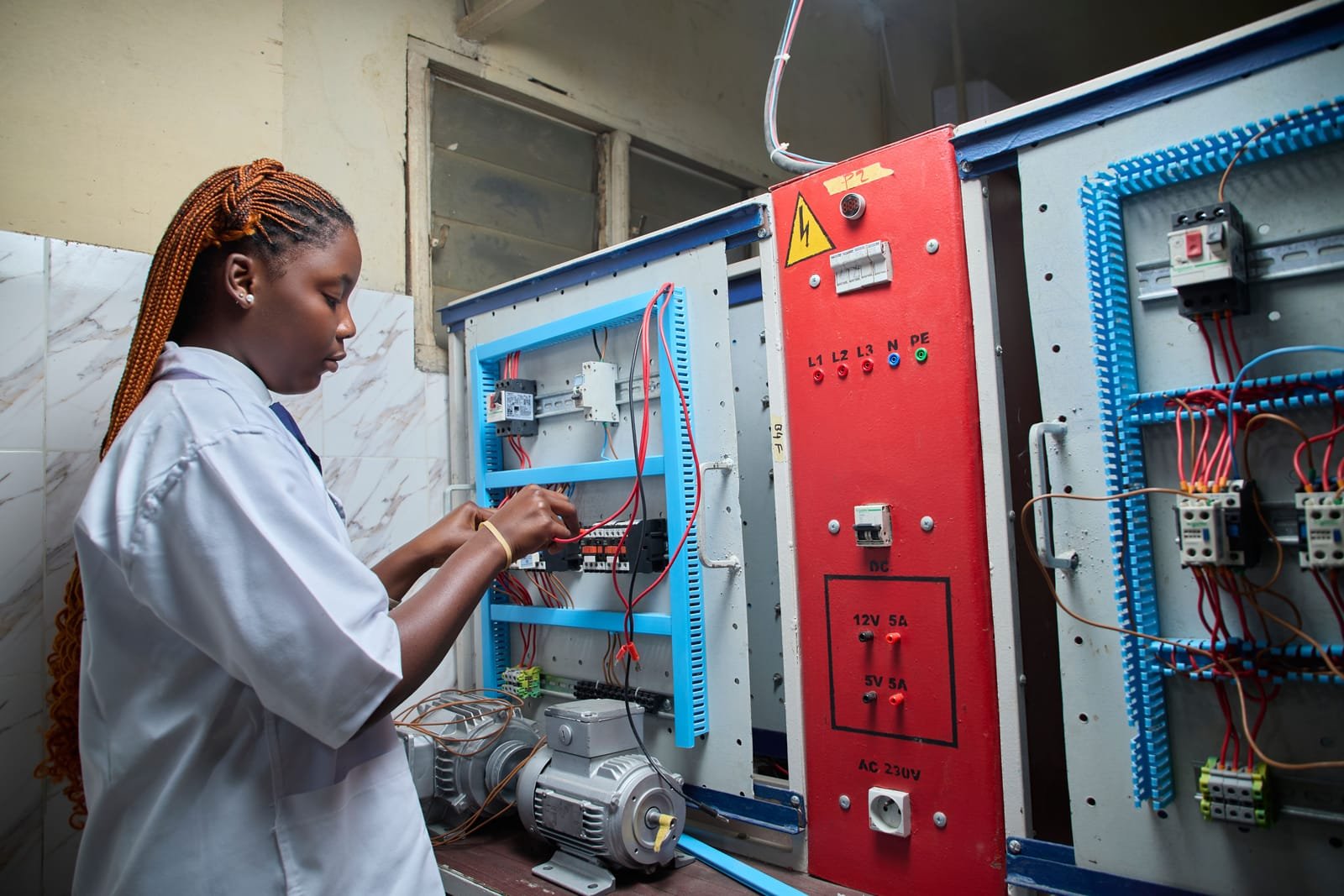 A technician works inside an open electrical control cabinet, wiring breakers and contactors mounted on rails. Photo: mickael ange konan, via Pexels
NRTL approved equipment: five checks for this week
1. Walk one area and look at what is actually attached. Pick the room with the most plugged-in equipment — a kitchen, a workshop, a maintenance bay — and look for a certification mark on each item. A mark, or nothing. The nothings are your scope.
2. Match the mark to a scope, not just to a logo. A laboratory is recognized for specific product types, each one specified by the applicable test standard, and for specific test sites. A mark on a product category the laboratory was never recognized for is not the approval the standard asks for.
3. Read the listing instructions for your three worst cases. Paragraph (b)(2) ties the label to the instructions that come with it. Equipment rated for dry indoor use standing in a wash-down area is the familiar example, and 1910.303(b)(6) is explicit: unless identified for use in that operating environment, conductors and equipment are not to be located in damp or wet locations.
4. Pull the file for anything custom or shop-built. A fabricated guard, a purpose-built conveyor, a one-off test bench: if no laboratory lists that kind of equipment, the third route in 1910.399 is what you are relying on, and it works only if you hold the manufacturer's test data and can produce it on request. No file, no route.
5. Give every gap an owner and a date. Re-certify, replace, take out of service, or document: those are the four endings. Write down which one, who owns it, and by when — the same way you would handle any other corrective action.
The service trades live inside this rule all day: panels, switchboards, site distribution boards, insulated tools and power tools. Our guide to OSHA compliance for service businesses lists the hazards and the equipment that belong in that assessment.
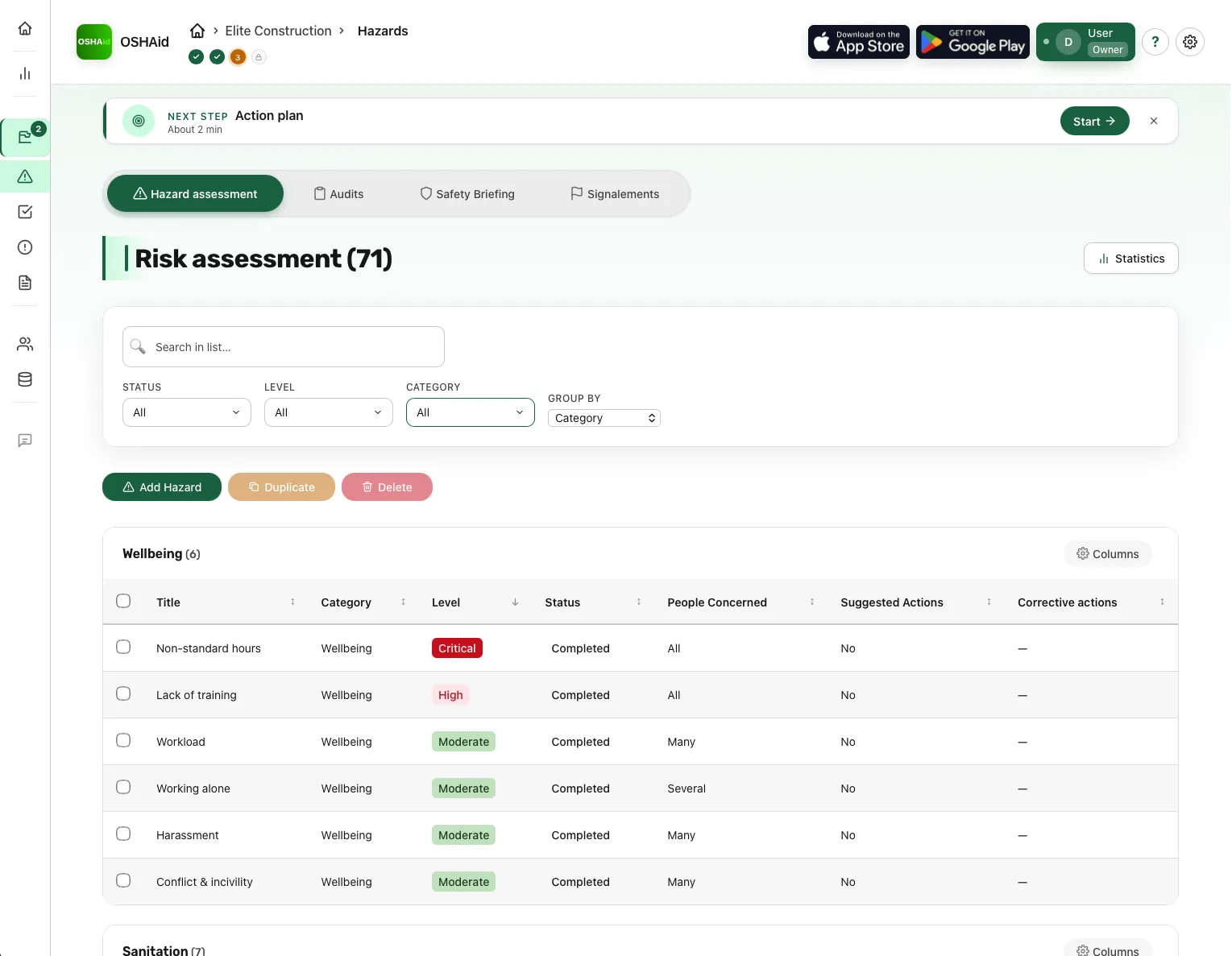 OSHAid console, the hazard list: equipment and hazards recorded per workplace with the standard behind each one
A mark you can show, not hunt for
The distance between a compliant floor and a cited one is rarely a missing machine. It is whether, on the day someone asks, you can point to a mark, say which laboratory and which scope stands behind it, and open the test data for the one machine nobody else ever built. That is an evidence problem before it is an engineering problem.
OSHAid keeps those pieces together: equipment and hazards listed per workplace with risk scores, manufacturer documents and test data in a document library, audits that record what you checked and when, and corrective actions with an owner and a deadline. When leadership, a client or a compliance officer asks whether your equipment is approved, you open the record instead of rebuilding it.
Questions safety officers ask
- What does NRTL approved equipment mean?
It means a Nationally Recognized Testing Laboratory — one OSHA has recognized under 29 CFR 1910.7 — has accepted, certified, listed or labeled the product. Under 29 CFR 1910.303(a) and the definitions in 1910.399, that is the main way electrical equipment counts as approved for OSHA purposes.
- What if no testing laboratory covers my equipment?
- Does the approval rule apply outside electrical equipment?
About this article
Written by the OSHAid Safety Desk from official sources (OSHA news releases, the text of the standards, BLS and NIOSH data), checked against those sources and reviewed before publication. It explains what a rule says; it is not legal advice for your situation. OSHAid
Know what is on your floor
Create a free OSHAid account, list your equipment and assign the gaps. No commitment.
Create my accountFreeDownload on theApp StoreGET IT ONGoogle PlayThe intelligent OSHA companion that automates your field compliance. Mobile app + web console + specialized safety AI agent, built for US workplaces.
🇫🇷 Hosted in EuropeGDPR CompliantProductIndustriesGuides- OSHA compliance software
- Hazard assessment guide
- Safety program templates
- JHA examples
- OSHA requirements
- OSHA recordkeeping
- OSHA standards by industry
- Workplace hazards
- Get started
- What is OSHA?
- Workplace safety glossary
- Why OSHAid?
- Enterprise solutions
- About
- Blog
- Legal notice
© 2026 OSHAid - published by DUOPP (SAS). All rights reserved.