 OSHAidProductsDemosIndustriesPricingMoreClient accessCreate my accountFree🇺🇸ENCreate my accountBack to blogCase studyOctober 8, 2026· By the OSHAid Safety Desk
OSHA trenching requirements: the rule that decides who may enter a trench
On October 7, OSHA proposed $254,884 in penalties against a Pennsylvania excavation contractor after a trench wall failed on a storm sewer job. Every requirement behind those citations is decades old.
OSHA trenching requirements come down to one question your crew answers every morning: is this trench protected before anyone steps into it?
On October 7, 2026, the Department of Labor cited a Chambersburg, Pennsylvania excavation contractor $254,884 in proposed penalties. OSHA opened the investigation on April 2, 2026, after a trench wall failed where workers were installing a storm sewer system 12 feet below ground, in a trench not adequately protected from soil collapse. One worker was fatally injured.
Nothing in the case turns on a new rule. The requirements behind it sit in 29 CFR 1926 Subpart P, and OSHA has run a National Emphasis Program on trenching, Directive CPL 02-00-161, since 2018.
OSHA's trenching and excavation page puts the stakes plainly: cave-ins pose the greatest risk to workers' lives. The standard is therefore written as a decision you make before entry, not a hazard you manage once people are down there.
What the OSHA trenching requirements say
Five feet is the default trigger. Under 29 CFR 1926.652(a)(1), each employee in an excavation must be protected from cave-ins by an adequate protective system. Two exceptions, and only two: excavations made entirely in stable rock, and excavations less than 5 feet deep where examination of the ground by a competent person gives no indication of a potential cave-in. Title 29 is current as of October 6, 2026.
Three ways to protect a trench. OSHA names sloping or benching the walls, shoring them with supports, and shielding with a trench box. Under the standard's simplest sloping option, walls are cut at an angle no steeper than one and one-half horizontal to one vertical, which is 34 degrees measured from the horizontal. Above 20 feet of depth, the protective system must be designed by a registered professional engineer.
A trench is narrower than most people assume. Subpart P defines one as a narrow excavation whose width, measured at the bottom, is not greater than 15 feet. A footing cut, a utility run and a sewer line all qualify. The dimensions trigger the rule, not the word on the job ticket.
The competent person is a role with teeth. Subpart P defines a competent person as one capable of identifying existing and predictable hazards in the surroundings, or working conditions which are unsanitary, hazardous or dangerous to employees, and who has authorization to take prompt corrective measures to eliminate them. Someone who can spot the problem but cannot stop the work does not meet the definition.
Inspections are daily, and then some. 29 CFR 1926.651(k)(1) requires daily inspections of the excavation, the adjacent areas and the protective systems by that competent person: before work starts, as needed through the shift, and after every rainstorm or other hazard-increasing occurrence. Where they find evidence of a possible cave-in or a failing protective system, paragraph (k)(2) requires exposed employees to be removed until the necessary precautions have been taken.
What OSHA cited in Pennsylvania. The release describes a willful violation for failing to protect workers from cave-ins, two repeat violations for failing to assign a competent person to daily trench inspections and for failing to remove employees from hazardous conditions, and serious violations covering hazard prevention training, a safe means of exit, materials kept two feet from the edge, and roll-in hazards. The employer has 15 business days to request an informal conference or contest the findings.
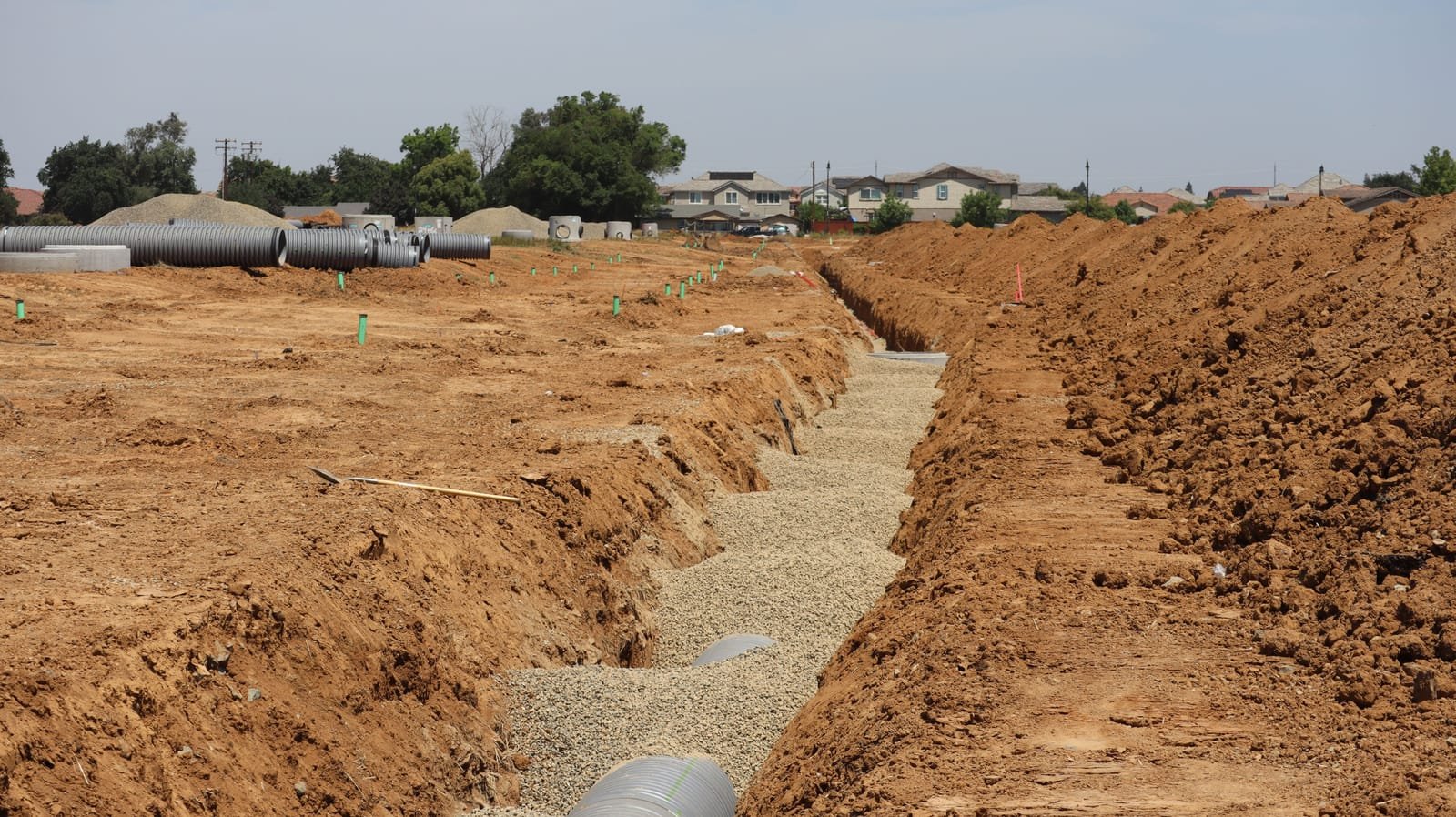 An open storm-drain trench cut through a suburban housing development, bedding gravel in the bottom, pipe sections stacked on one side and spoil piled along the edge. Photo: D Goug, via Pexels
Six checks before anyone enters a trench this week
1. Make the protection call at the tailgate. Decide the method, slope or shore or shield, before the machine starts, and write it down with the depth and the soil type you assumed. A call made at the edge, with the crew waiting, is the one that gets skipped.
2. Name the competent person, and give them the authority. Put the name on the job paperwork, and make sure the crew knows that person can stop the work. Subpart P requires both halves: a title without the authority is not a competent person.
3. Inspect before the shift, and after the rain. The daily inspection is not a form filed at the end of the week. Record the time, the depth, the soil, the protective system in place and what you found, every day and every time conditions change.
4. Put the ladder in before the people. A trench 4 feet or more deep needs a stairway, ladder, ramp or other safe means of egress, positioned so no worker has more than 25 feet of lateral travel to reach it. One ladder at one end of a long run does not meet that.
5. Move the spoil back two feet. Excavated material and equipment must be kept at least 2 feet from the edge, or held by retaining devices sufficient to stop them falling or rolling in. Loose rock or soil on the face has to be scaled off or stopped by barricades.
6. Train for recognition, and keep the proof. 29 CFR 1926.21(b)(2) requires the employer to instruct each employee in the recognition and avoidance of unsafe conditions and the regulations applicable to their work. For trench work that means soil types, access and egress, the spoil-pile rule, and who to tell when something looks wrong. Write it as a task-level analysis, in the format our job hazard analysis examples use, and keep the signed record beside the inspection log.
If excavation is regular work for you, the OSHA standards that apply to construction reach well past Subpart P, into fall protection and struck-by hazards.
 OSHAid console, the audits list: each daily trench inspection logged with its date, its site and what the competent person found
Protection is the floor; proof is what you show
Subpart P is short and old, and crews still die in trenches, because the duty it creates is continuous: the trench changes after every rain and every pass of the machine. The employers who stay out of trouble are rarely the ones who memorized the standard, but the ones who can produce, on the spot, the day's inspection with the depth, the soil, the system in place and the name of the person who signed it. Compliance is the floor. Above it, the trench program becomes something you can show on a screen rather than a binder you have to defend.
Questions safety officers ask
- At what depth does OSHA require trench protection?
At 5 feet. 29 CFR 1926.652(a)(1) requires an adequate protective system for each employee in an excavation, except where it is made entirely in stable rock, or is less than 5 feet deep and a competent person's examination of the ground gives no indication of a potential cave-in. Above 20 feet, a registered professional engineer must design the system.
- Who can be the competent person on a trench?
- How far from a trench must the spoil pile be?
About this article
Written by the OSHAid Safety Desk from official sources (OSHA news releases, the text of the standards, BLS and NIOSH data), checked against those sources and reviewed before publication. It explains what a rule says; it is not legal advice for your situation. OSHAid
Show your trench program instead of defending it
Create a free OSHAid account and keep your hazards, audits, corrective actions and compliance documents in one place. No commitment.
Create my accountFreeDownload on theApp StoreGET IT ONGoogle PlayThe intelligent OSHA companion that automates your field compliance. Mobile app + web console + specialized safety AI agent, built for US workplaces.
🇫🇷 Hosted in EuropeGDPR CompliantProductIndustriesGuides- OSHA compliance software
- Hazard assessment guide
- Safety program templates
- JHA examples
- OSHA requirements
- OSHA recordkeeping
- OSHA standards by industry
- Workplace hazards
- Get started
- What is OSHA?
- Workplace safety glossary
- Why OSHAid?
- Enterprise solutions
- About
- Blog
- Legal notice
© 2026 OSHAid - published by DUOPP (SAS). All rights reserved.