 OSHAidProductsDemosIndustriesPricingMoreClient accessCreate my accountFree🇺🇸ENCreate my accountBack to blogFundamentalsOctober 28, 2026· By the OSHAid Safety Desk
OSHA variance: the route when you cannot comply
On October 15, 2026, Oregon OSHA gave notice that it intends to revoke a variance it granted in 2021. A variance is real relief, and it lives and dies with the rule it bends.
An OSHA variance is what an employer applies for when a standard plainly applies and compliance as written is not possible — not by the effective date, or not by that method.
Most safety officers never file one. The employers who need one often assume there are only two outcomes, comply or be cited. There is a third, written into the OSH Act itself.
A live example landed this month. On October 15, 2026, Oregon OSHA gave notice that it proposes to revoke variance V-003-21, issued to Bear Creek Orchards, Inc. in August 2021. It had allowed labor housing in which unrelated cohorts slept in one room behind physical barriers, in place of OAR 437-004-1115(6). The reason given is plain: the COVID-19 housing requirements it varied from have been repealed. The revocation is proposed for November 4, 2026.
That is the part employers miss. A variance is not an exemption. It is an order with conditions attached, tied to a standard, and it can be revoked.
OSHA variance: the two kinds and what each must prove
A temporary variance buys time. Section 6(b)(6)(A) of the OSH Act, 29 U.S.C. 655(b)(6)(A), lets an employer apply for a temporary order where three things are established: that you are unable to comply by the standard's effective date because professional or technical personnel, or materials and equipment, are unavailable, or because necessary construction or alteration of facilities cannot be completed by that date; that you are taking all available steps to safeguard employees against the hazards the standard covers; and that you have an effective program for coming into compliance as quickly as practicable.
It runs on a clock. No temporary order may be in effect longer than the period you need to achieve compliance or one year, whichever is shorter. It may be renewed not more than twice, and a renewal application has to be filed at least 90 days before the order expires. No interim renewal may remain in effect longer than 180 days.
It is not a pause. The order prescribes the practices, means, methods, operations and processes you must adopt while it is in effect, and states your compliance program in detail. You trade one set of obligations for another written one.
A permanent variance changes the method. Section 6(d) is a different test. You have to demonstrate, by a preponderance of the evidence and on the record, that the methods you use or propose to use will provide employment and places of employment as safe and healthful as those that would prevail if you complied with the standard. The order then prescribes the conditions you must maintain and the methods you must use, to the extent they differ from the standard.
"Permanent" is a label, not a promise. Section 6(d) says such a rule or order may be modified or revoked on application by an employer or employees, or by the Secretary on their own motion, at any time after six months from its issuance. 29 CFR 1905.13 adds the federal mechanics: OSHA publishes notice of its intention in the Federal Register, invites written data, views or arguments, and informs the affected employer and employees of their right to request a hearing.
The paperwork is listed, not guessed at. 1905.10(b) sets out eleven items a temporary-variance application must contain and 1905.11(b) eight for a permanent one, both filed in writing with the Assistant Secretary for Occupational Safety and Health. Under 1905.10(c) you may also apply for an interim order, effective until the variance is decided. Part 1905 was read against Title 29 as it stood on October 26, 2026.
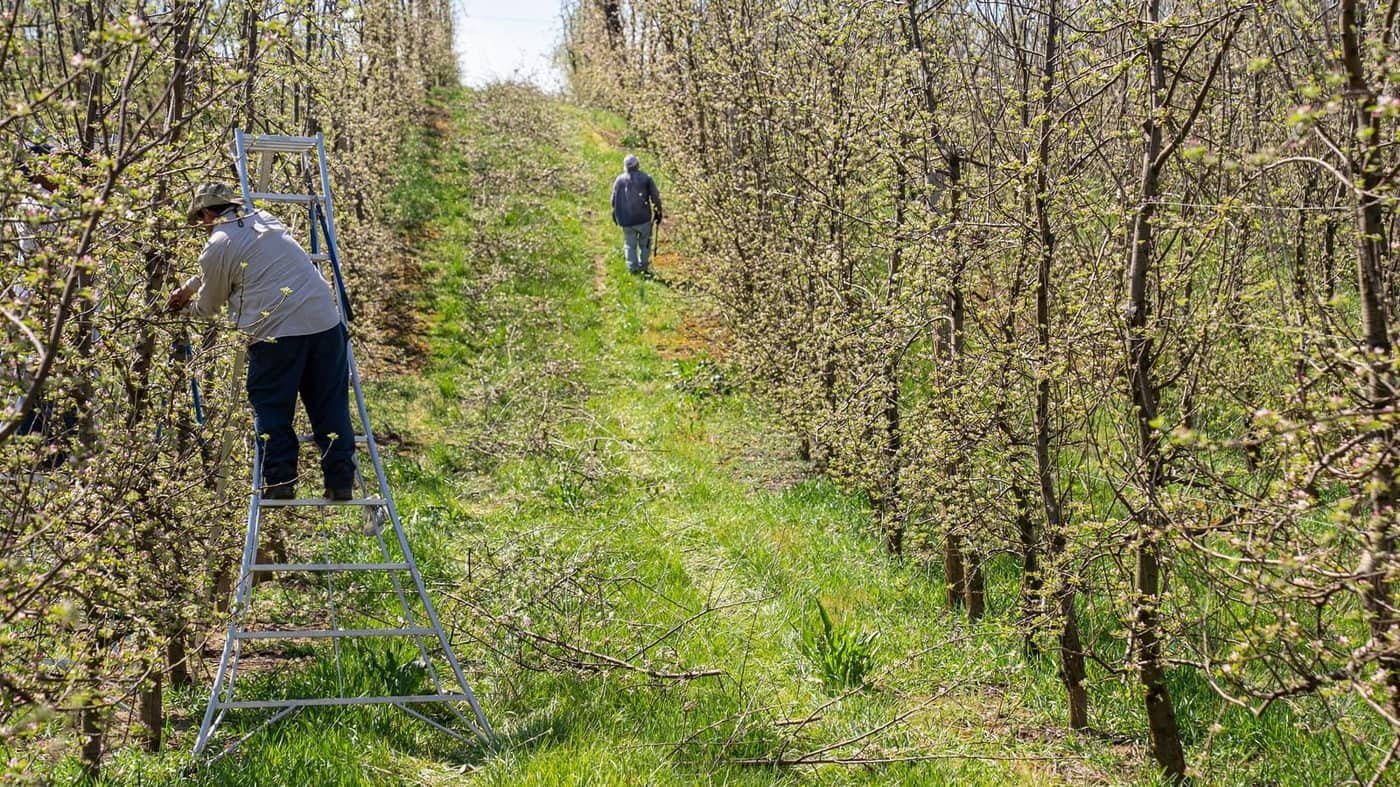 Two orchard workers thinning fruit trees in spring, one working from an orchard tripod ladder in the grass row between the rows of trees. Photo: Mark Stebnicki, via Pexels (Pexels Licence)
What to check before you file
1. Confirm the duty before you ask for relief from it. A variance is relief from a named standard or portion of one, and 1905.10(b)(3) makes you specify which. Our guide to mandatory OSHA obligations sets out what applies to most employers whatever the sector.
2. Pick the right test. Cannot comply yet, for want of people, materials, equipment or construction time? Temporary. Have a different method you believe is as safe and healthful? Permanent. 1905.14(a) lets OSHA deny an application that does not conform to the section it was filed under.
3. Get first-hand representations. 1905.10(b)(4) does not run on your own say-so: the representation that you cannot comply must be supported by representations from qualified persons having first-hand knowledge of the facts represented.
4. Put dates on the protection, not just the problem. 1905.10(b)(5) asks for the steps you have taken and will take, with specific dates where appropriate, to protect employees against the hazard. Paragraph (b)(6) asks when you expect to comply, again with dates.
5. Tell your employees, three ways, and certify it. Under 1905.10(b)(9) and 1905.11(b)(5) the application must state that affected employees were informed: a copy given to their authorized representative, a summary posted where notices to employees are normally posted — 1905.11(b)(5) accepts the application itself in place of the summary — and other appropriate means. Paragraph (b)(10) asks you to describe how they were told of their right to petition for a hearing.
6. Expect it to be public, and open to challenge. Unless it is denied as defective, 1905.14(b) has OSHA publish notice of the filing in the Federal Register, inviting written data, views or arguments. Under 1905.15, an affected employer, an affected employee or the state agency with jurisdiction may request a hearing.
7. Handle the State Plan question up front. Where the variance would cover more than one state, including a State Plan state, and the federal standard is identical in substance to the state's, 1905.10(b)(11) requires a side-by-side comparison, a certification that you have not filed on the same facts there, and a statement of any pending state citations.
8. Watch the rule your variance hangs on. Oregon's October 15 notice is the lesson in a line: the housing rule was repealed, so the variance from it had nothing left to do. Relief tracks the standard it came from — one more reason the paper trail matters, as OSHA compliance does day to day.
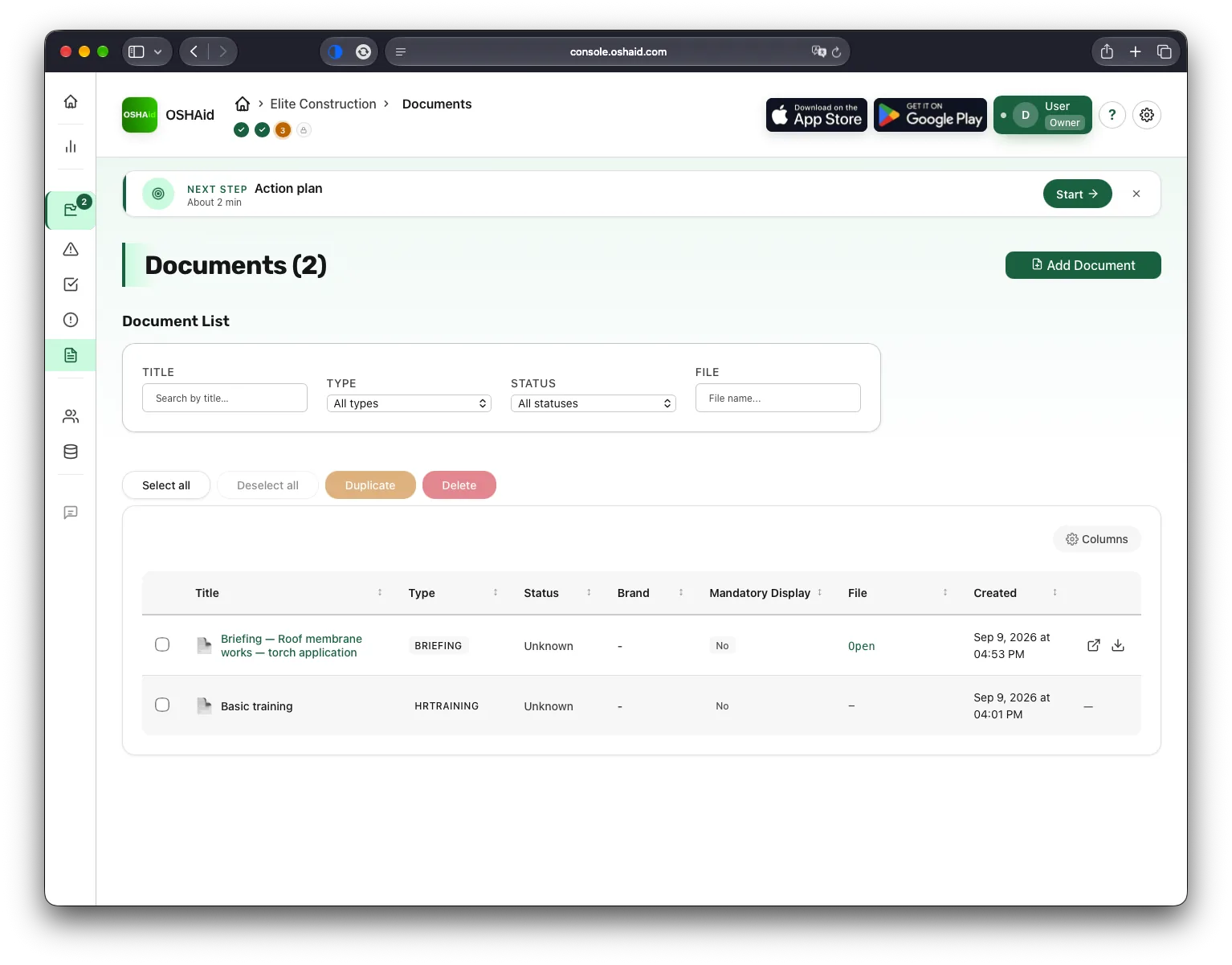 OSHAid console — the document library, where a variance application, the interim measures behind it and the employee notice are filed together
A variance is a file, not a favor
Every route in Part 1905 ends in the same place: a written record showing that someone read the standard, judged what it asked of this workplace, and set out what would be done instead and by when. The application is evidence; the order that follows is a condition you have to keep.
That is the discipline a good safety program already runs on, minus the Federal Register notice. Where a standard is hard to meet, the employers who come out well are the ones who can produce the assessment, the interim measures and the dates on request, rather than reconstruct them afterwards.
Questions safety officers ask
- How long does a temporary OSHA variance last?
No longer than the period you need to achieve compliance, or one year, whichever is shorter. Section 6(b)(6)(A) of the OSH Act allows renewal not more than twice, and the renewal application must be filed at least 90 days before the order expires. No interim renewal may remain in effect longer than 180 days.
- Can OSHA revoke a variance it has already granted?
- Do employees have to be told about a variance application?
About this article
Written by the OSHAid Safety Desk from official sources (OSHA news releases, the text of the standards, BLS and NIOSH data), checked against those sources and reviewed before publication. It explains what a rule says; it is not legal advice for your situation. OSHAid
Keep the record a variance would need
Create a free OSHAid account, record the standards that apply to your sites, the interim measures you have put in place and the dates behind them. No commitment.
Create my accountFreeDownload on theApp StoreGET IT ONGoogle PlayThe intelligent OSHA companion that automates your field compliance. Mobile app + web console + specialized safety AI agent, built for US workplaces.
🇫🇷 Hosted in EuropeGDPR CompliantProductIndustriesGuides- OSHA compliance software
- Hazard assessment guide
- Safety program templates
- JHA examples
- OSHA requirements
- OSHA recordkeeping
- OSHA standards by industry
- Workplace hazards
- Get started
- What is OSHA?
- Workplace safety glossary
- Why OSHAid?
- Enterprise solutions
- About
- Blog
- Legal notice
© 2026 OSHAid - published by DUOPP (SAS). All rights reserved.