 OSHAidProductsDemosIndustriesPricingMoreClient accessCreate my accountFree🇺🇸ENCreate my accountBack to blogCase studyOctober 24, 2026· By the OSHAid Safety Desk
Permit-required confined space: what has to happen before entry
OSHA repeated the sequence in October after a fatal entry: identify the space, test it, control the hazards, train the crew, plan the rescue.
A permit-required confined space is not simply a tight room. It is a space a worker can climb into, never designed for anyone to stay in, that can hurt them through its atmosphere, its contents or its shape.
OSHA set the sequence out again in its October 14 QuickTakes newsletter: before anyone enters, identify and test the space, control the hazards, train workers to recognize and respond to the risks, and have an effective rescue plan ready.
The reminder followed an entry that went wrong. On March 15, 2026, two workers were fatally injured after entering a confined space on a barge in Alaska. OSHA's inspection found that Hamilton Construction LLC had failed to properly inspect and test confined spaces before letting workers enter, had not provided required training, and had not arranged for prompt rescue services. In September the company agreed to correct the hazards and provide additional confined space training.
Nobody labels these spaces for you. Deciding which ones you have is the first thing the standard asks.
What makes a space a permit-required confined space
Two definitions, in that order. Under 29 CFR 1910.146, a confined space is one large enough for an employee to enter bodily and perform assigned work, with limited or restricted means of entry or exit, and not designed for continuous employee occupancy. The standard's own examples are ordinary: tanks, vessels, silos, storage bins, hoppers, vaults and pits.
It becomes a permit-required confined space when it also has at least one of four characteristics: it contains or could contain a hazardous atmosphere; it holds material that could engulf an entrant; its shape could trap or asphyxiate someone through inwardly converging walls or a floor sloping to a smaller cross-section; or it contains any other recognized serious safety or health hazard. The text was read against Title 29 as it stood on October 22, 2026.
Which rulebook applies depends on the work. 1910.146 is a general industry standard, and its scope excludes agriculture, construction and shipyard employment. Construction has its own Subpart AA, where 29 CFR 1926.1203 requires a competent person, before work begins, to identify all confined spaces in which employees may work and each one that is a permit space. Shipyards run on 29 CFR part 1915 — which is why the Alaska case turned on a shipyard competent person. Same hazard, three sets of rules: our guide to OSHA standards by industry explains the split.
The evaluation is required; the entry is not. The employer must evaluate the workplace for permit spaces and inform exposed employees by danger signs or an equally effective means. Decide that nobody enters, and you must take effective measures to keep them out. Decide that they do, and you must implement a written permit space program, available to employees and their representatives.
Two narrower routes exist, both documented. Where the only hazard is atmospheric and continuous forced air ventilation alone keeps the space safe, paragraph (c)(5) allows alternate procedures, with monitoring data and a certification signed and dated before entry. Where every hazard has been eliminated without entering, paragraph (c)(7) allows reclassification for as long as that holds. OSHA notes the limit: ventilating an atmosphere is not eliminating the hazard.
 An open hatch cover on a steel deck, looking down a fixed ladder into an orange-lit compartment of pipework below. Photo: Nata Romualdo, via Pexels
What to put in place before the next entry
1. Walk the site and list the spaces. Tanks, pits, vaults, hoppers, ductwork, manholes, sumps, tank trailers. Record why each is or is not a permit space. On construction work that identification is a competent person's job, done before work starts.
2. Post the signs. A sign reading "DANGER — PERMIT-REQUIRED CONFINED SPACE, DO NOT ENTER" satisfies the requirement, and is the cheapest control you will buy.
3. Write the program if anyone enters. It must cover preventing unauthorized entry, identifying and evaluating hazards before entry, isolating the space, purging or ventilating it, specifying acceptable entry conditions and verifying them throughout. Our written safety program templates show the structure.
4. Test the air from outside, in the right order. Oxygen first, then combustible gases and vapors, then toxic gases and vapors — then monitor as necessary during the work. Any authorized entrant, or their representative, may watch the testing and must get the results.
5. Issue a permit that answers the obvious questions. Which space, what for, how long, the entrants, the attendant, the entry supervisor, the hazards, the isolation measures, the acceptable entry conditions, the test results with the tester's name and time, and how rescue is summoned. The supervisor signs it before entry begins, and it is posted at the portal so entrants see the preparations were done.
6. Keep the attendant outside. The attendant keeps an accurate count of who is inside, stays out until relieved, and orders evacuation when conditions change. An attendant may enter to attempt a rescue only if trained and equipped for it, and only once relieved.
7. Arrange rescue before the entry, not during it. The employer must evaluate whether a rescue service can reach entrants in time for the hazards involved and is equipped and proficient, and give it access to the spaces to plan and practice. An in-house team needs PPE, rescue training, entrant-level proficiency, first aid and CPR, with one member currently certified.
8. Train, then certify the training. Training comes before an employee is first assigned duties, on a change of duties, when a new hazard appears, and whenever entry procedures are not being followed. The certification carries each employee's name, the trainer's initials and the dates.
9. Settle the contractor questions in advance. A host employer tells the contractor the site has permit spaces, what makes them so and what precautions are in place, coordinates entry and debriefs afterward. The contractor owes the host its own program and any hazards it met or created.
10. Review it once a year. Canceled permits are kept at least a year, and the program reviewed within a year of each entry using them.
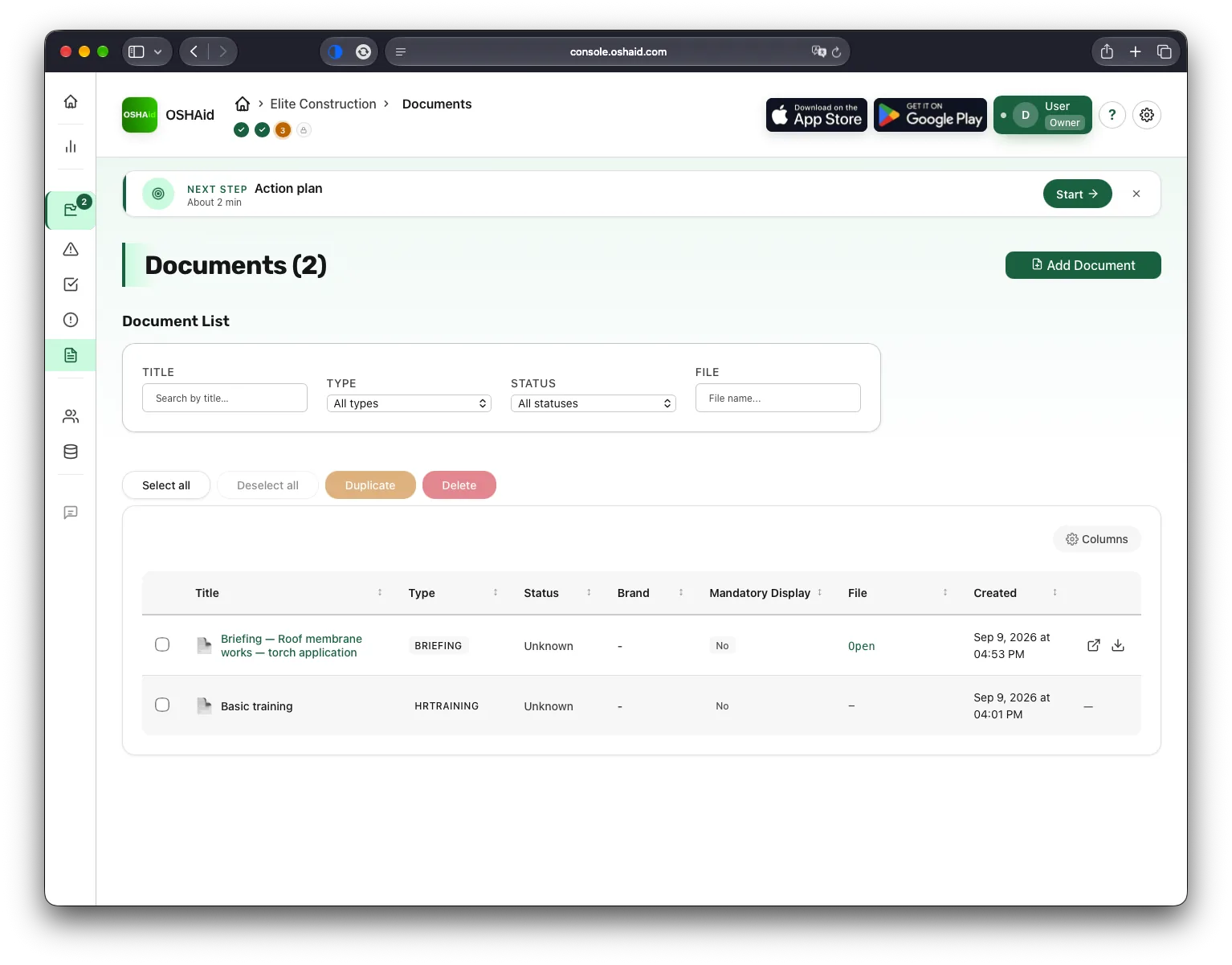 OSHAid console — document library, where the written permit space program, the permits and the training records live in one place
A space you can point to, not one you remember
Most confined space programs fail quietly. The list of spaces lives in one person's head, the meter's calibration record is in a drawer, the permits sit in a folder nobody reopens, the rescue plan is a phone number. Each piece exists; none of it can be produced in an afternoon.
The fix is not more paperwork, it is one place for the same paperwork. A safety officer who can show the list of permit spaces, the hazard analysis behind each, the training dates and the last permit has something that holds up to a client audit, a leadership question or an inspection. OSHAid keeps hazards, job hazard analyses, corrective actions and documents together, so what your crew already does becomes something you can show.
Questions safety officers ask
- What is a permit-required confined space?
It is a confined space — enterable, with limited entry or exit, not designed for continuous occupancy — that also contains or could contain a hazardous atmosphere, holds material that could engulf an entrant, has a shape that could trap or asphyxiate someone, or contains any other recognized serious safety or health hazard.
- Does every confined space entry need a permit?
- How long must confined space entry permits be kept?
About this article
Written by the OSHAid Safety Desk from official sources (OSHA news releases, the text of the standards, BLS and NIOSH data), checked against those sources and reviewed before publication. It explains what a rule says; it is not legal advice for your situation. OSHAid
Put every confined space on one list
Create a free OSHAid account, add the spaces your crew can enter, and keep the hazard analysis, the controls and the records in one place. No commitment.
Create my accountFreeDownload on theApp StoreGET IT ONGoogle PlayThe intelligent OSHA companion that automates your field compliance. Mobile app + web console + specialized safety AI agent, built for US workplaces.
🇫🇷 Hosted in EuropeGDPR CompliantProductIndustriesGuides- OSHA compliance software
- Hazard assessment guide
- Safety program templates
- JHA examples
- OSHA requirements
- OSHA recordkeeping
- OSHA standards by industry
- Workplace hazards
- Get started
- What is OSHA?
- Workplace safety glossary
- Why OSHAid?
- Enterprise solutions
- About
- Blog
- Legal notice
© 2026 OSHAid - published by DUOPP (SAS). All rights reserved.