 OSHAidProductsDemosIndustriesPricingMoreClient accessTry OSHAidFree🇺🇸ENTry OSHAidBack to blogFundamentalsNovember 11, 2026· By the OSHAid Safety Desk
Respirator fit test requirements: the annual clock in 1910.134
A tight-fitting respirator has to be fit tested before an employee first wears it, again whenever the facepiece changes, and at least once a year after that. Respiratory protection is sixth on OSHA's preliminary Top 10 most-cited list for fiscal year 2026.
Respirator fit test requirements are easy to meet once and easy to lose track of afterwards. The standard asks for a test before an employee first uses a tight-fitting respirator, another whenever the facepiece changes, and one at least every year after that. Nothing announces the annual one.
29 CFR 1910.134 applies to general industry, shipyards, marine terminals, longshoring and construction, and it is among the standards OSHA cites most: respiratory protection is sixth on the preliminary Top 10 most frequently cited standards for fiscal year 2026, the list OSHA last updated on October 5, 2026.
This is what paragraph (f) requires, what the test is allowed to look like, and what it has to leave behind on paper. The text below was read on eCFR, title 29 current as of November 9, 2026.
What the respirator fit test requirements say
The trigger list is three lines long. 29 CFR 1910.134(f)(2) requires the employer to ensure that an employee using a tight-fitting facepiece respirator is fit tested prior to initial use of the respirator, whenever a different respirator facepiece (size, style, model or make) is used, and at least annually thereafter.
A fourth trigger comes from the employee. Paragraph (f)(3) requires an additional fit test whenever the employee reports — or the employer, the licensed health care professional, a supervisor or the program administrator observes — changes in the employee's physical condition that could affect respirator fit: facial scarring, dental changes, cosmetic surgery, or an obvious change in body weight. Under (f)(4), an employee who passed a test and then reports that the fit is unacceptable must be given a reasonable opportunity to select a different facepiece and to be retested.
The medical evaluation comes before the fit test, not after. Paragraph (e)(1) requires the employer to provide a medical evaluation to determine the employee's ability to use a respirator before the employee is fit tested or required to use the respirator in the workplace.
The test has to follow an OSHA-accepted protocol. Paragraph (f)(5) sends you to appendix A, and paragraph (o) makes compliance with that appendix mandatory. Appendix A holds four qualitative protocols — isoamyl acetate, saccharin solution aerosol, Bitrex and irritant smoke (stannic chloride) — and the quantitative ones: generated aerosol, the ambient aerosol condensation nuclei counter protocol, two modified ambient aerosol CNC protocols added by the final rule of September 26, 2019 (84 FR 50739), and two controlled negative pressure protocols.
Qualitative testing has a ceiling. Under (f)(6), a qualitative fit test may only be used on negative pressure air-purifying respirators that must achieve a fit factor of 100 or less. Above that the test has to be quantitative, and (f)(7) treats a quantitative test as passed at a fit factor of 100 or more for a tight-fitting half facepiece, 500 or more for a tight-fitting full facepiece. Tight-fitting powered air-purifying and atmosphere-supplying respirators are fit tested in the negative pressure mode whatever mode they are worn in, under (f)(8).
The seal is tested on the face that will wear it. Appendix A rules out a test where there is any hair growth between the skin and the facepiece sealing surface, and paragraph (g)(1)(i) goes further: the employer must not permit a tight-fitting facepiece to be worn by an employee with facial hair that comes between the sealing surface and the face, or that interferes with valve function. Glasses and goggles have to be worn so they do not interfere with the seal, and the appendix requires the fit test to be performed while the employee wears any safety equipment worn in the job that could affect fit.
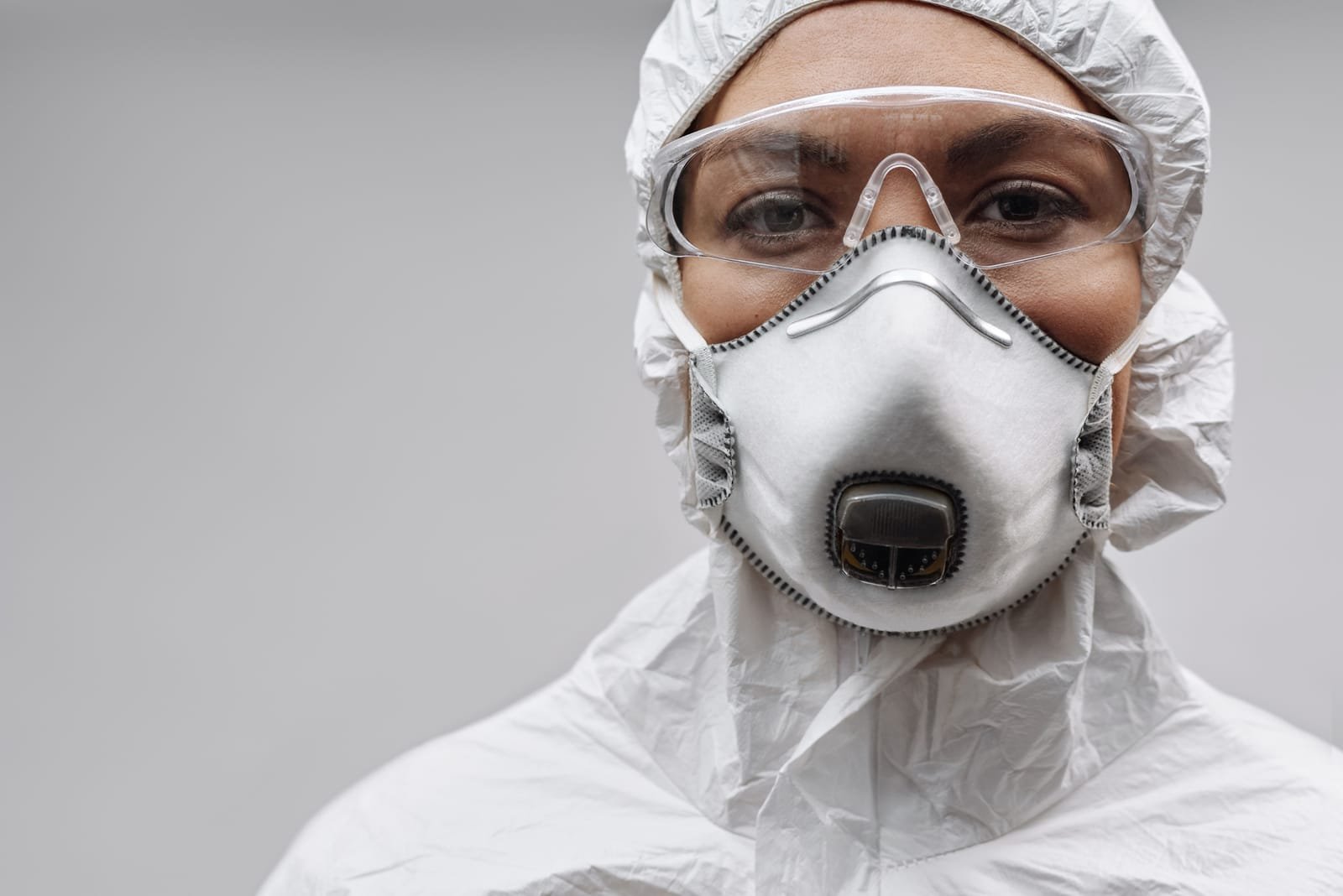 A worker in a white coverall and safety goggles wearing a tight-fitting filtering facepiece respirator, the seal a fit test is meant to check. Photo: Michelangelo Buonarroti, via Pexels (Pexels License)
Six checks before the next fit test
1. Build the list of who is due. Paragraph (m)(2)(i) requires a record of every fit test carrying the employee's name or identification, the type of test performed, the specific make, model, style and size of respirator tested, the date of the test, and the result — pass or fail for a qualitative test, the fit factor and strip chart or other recording for a quantitative one. Under (m)(2)(ii) that record is kept until the next fit test replaces it, which makes the file itself the schedule.
2. Clear the medical evaluation first. A fit test run on an employee who has not been medically evaluated is work you may have to do twice, and it puts (e)(1) the wrong way round.
3. Test the respirator the employee will actually wear. Paragraph (f) requires the employee to be fit tested with the same make, model, style and size of respirator that will be used. A substitution in the stockroom — another size, another model of the same brand — is a new fit test under (f)(2), not a detail.
4. Settle facial hair before test day, not at the appointment. A worker turned away at the provider is a lost slot and a lost hour. The rule also applies on an ordinary Tuesday: (g)(1)(i) prohibits the wearing, not only the testing.
5. Match the protocol to the respirator. If a half mask has to reach a fit factor above 100, a qualitative test cannot establish it. Decide that before booking a provider, and ask which appendix A protocol they run.
6. Write the procedure down and keep the records where people can find them. Paragraph (c)(1)(iii) requires the written respiratory protection program to contain fit testing procedures for tight-fitting respirators, and (k) requires training that recurs annually. A respirator is also the last line of 1910.134(a)(1), which puts engineering controls first as far as feasible — read it next to the hazard categories and the controls that come before PPE and the rest of the OSHA obligations that apply to every covered employer.
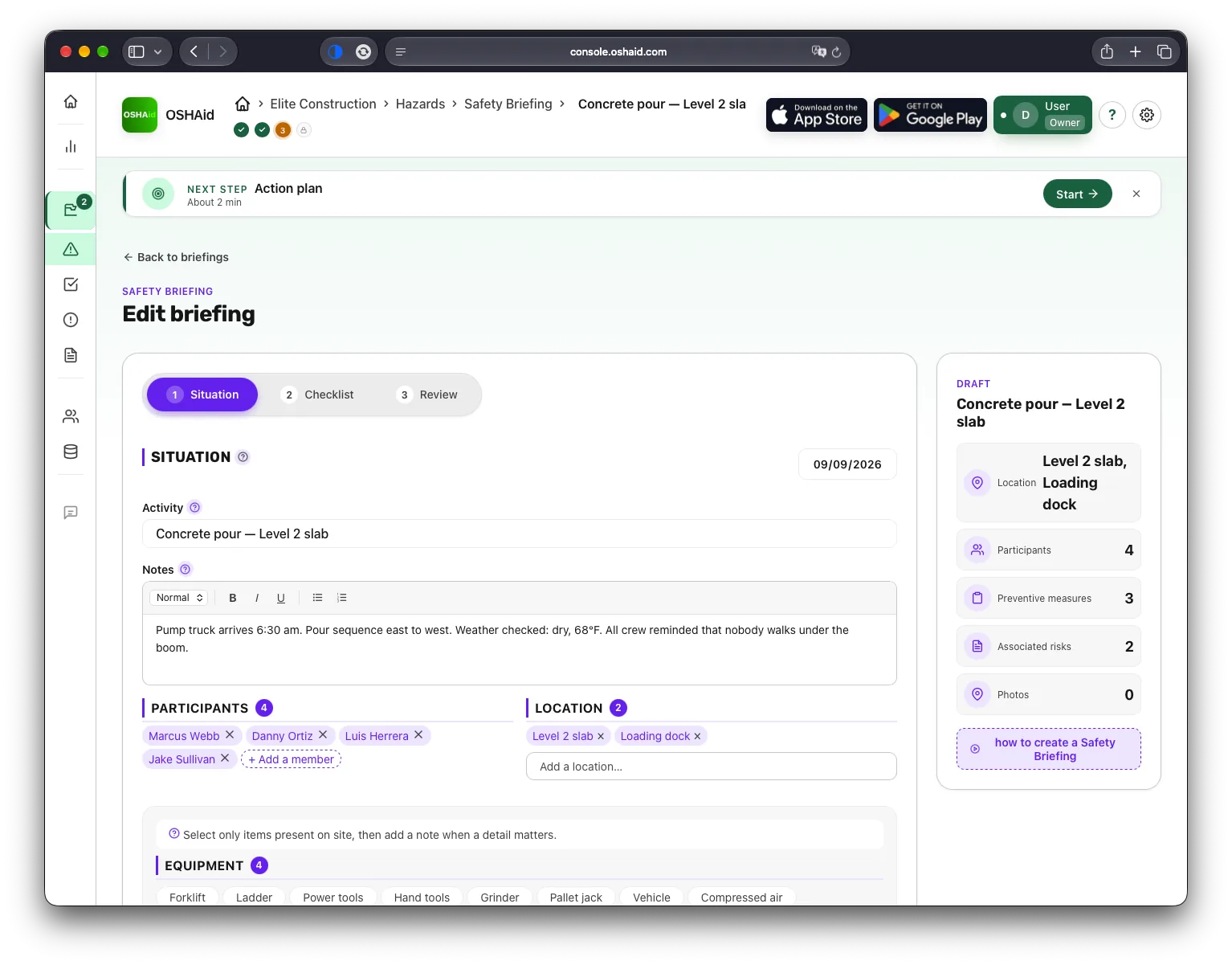 OSHAid console: the safety briefing editor, where the annual respirator training that goes with a fit test is prepared, delivered and signed
A fit test is a date, a face and a mask
Fit testing is one of the few duties in a safety program where the proof is naturally small: a name, a type of test, a make and model, a date, a result. Five fields, kept until the next test.
The difficulty is never the test itself. It is knowing, in November, which people are due in January, which of them changed respirator in June, and where the record went when the provider emailed it. That is a list problem, not a respiratory one.
A program that can show the list — who wears what, tested when, due when — answers the question a client, an inspector or your own leadership asks, in one screen. One that cannot has to call the provider back every time the subject comes up.
Questions safety officers ask
- How often is a respirator fit test required?
29 CFR 1910.134(f)(2) requires a fit test before initial use of the respirator, whenever a different facepiece — size, style, model or make — is used, and at least annually after that. Paragraph (f)(3) adds a test whenever a change in the employee's physical condition that could affect fit is reported or observed.
- Does an N95 need a fit test?
- Can an employee with a beard be fit tested?
Related reading
All posts- Nov 18, 2026OSHA abatement certification: the step that closes a citationCitations
- Nov 12, 2026OSHA warehouse inspection: what the emphasis program targetsInspections
- Nov 10, 2026Respirator storage requirements: what a stockpile still has to proveGuidance
- Oct 10, 2026Respirator medical evaluation requirements: what has to happen before the fit testOSHA update
About this article
Written by the OSHAid Safety Desk from official sources (OSHA news releases, the text of the standards, BLS and NIOSH data), checked against those sources and reviewed before publication. It explains what a rule says; it is not legal advice for your situation. OSHAid
Keep every fit test beside the person who passed it
Create a free OSHAid account: your written respiratory protection program, the people it covers, their training and the records that prove it — in one place your team can open. No commitment.
Try OSHAidFreeDownload on theApp StoreGET IT ONGoogle PlayThe intelligent OSHA companion that automates your field compliance. Mobile app + web console + specialized safety AI agent, built for US workplaces.
ProductIndustriesGuides- OSHA compliance software
- Hazard assessment guide
- Safety program templates
- JHA examples
- OSHA requirements
- OSHA recordkeeping
- OSHA standards by industry
- Workplace hazards
- Get started
- What is OSHA?
- Workplace safety glossary
- Why OSHAid?
- Enterprise solutions
- About
- Blog
- Legal notice
© 2026 OSHAid - published by DUOPP (SAS). All rights reserved.
Help us improve OSHAid
We only measure site traffic. No advertising, no resale of data.
OKDeclineLearn more