 OSHAidProductsDemosIndustriesPricingMoreClient accessTry OSHAidFree🇺🇸ENTry OSHAidBack to blogDeadlineSeptember 28, 2026· By the OSHAid Safety Desk
HazCom deadline: what you must update by November 20
OSHA moved the date back four months. For substances, employers have until November 20, 2026 to update workplace labels, the written program and training.
The HazCom deadline that matters to most employers is November 20, 2026. By that date, for substances, your workplace labels, your written hazard communication program and your training have to line up with OSHA's revised Hazard Communication Standard.
If you have July 20, 2026 noted somewhere, cross it out. OSHA moved all four compliance dates back by four months in a final rule published January 15, 2026. The work did not change. The calendar did.
This one is easy to miss, because the heavy lifting falls on chemical manufacturers and importers, whose own date passed in May. Your share is smaller and more specific. It is also worth getting right: Hazard Communication was the second most frequently cited standard in OSHA's fiscal year 2025 Top 10.
What the HazCom deadline actually requires
The revised Hazard Communication Standard, 29 CFR 1910.1200, took effect on July 19, 2024. It did not switch on all at once. Paragraph (j) sets staggered compliance dates running into 2028, and they split the work between the people who classify chemicals and the people who use them.
Chemical manufacturers, importers and distributors evaluating substances had to comply with all modified provisions by May 19, 2026. That is where updated safety data sheets and updated shipped-container labels come from.
Employers come next. For substances, the standard says all employers shall, *as necessary*, update any alternative workplace labeling used under paragraph (f)(6), update the hazard communication program, and provide any additional employee training under paragraph (h)(3) for newly identified physical hazards, health hazards or other hazards — no later than November 20, 2026.
Mixtures follow the same pattern later: manufacturers and importers by November 19, 2027, employers by May 19, 2028.
Each of those four dates moved. OSHA's final rule of January 15, 2026 extended them all by four months, pushing the employer date for substances from July 20, 2026 to November 20, 2026.
The reason any of this exists is the final rule of May 20, 2024, which amended the standard to conform to Revision 7 of the Globally Harmonized System. Among other changes it revised the criteria for classifying certain health and physical hazards, revised the provisions for updating labels, and added labeling provisions for small containers. When classification criteria change, a chemical you have bought for years can arrive carrying a different hazard statement.
Two words in the standard do a lot of work: as necessary. If your suppliers' updated sheets and labels carry no new hazards for the chemicals you actually hold, there may be very little to change. You still have to look in order to know that, and paragraph (e)(1) requires a written hazard communication program at each workplace to record how you meet the labeling, safety data sheet and training requirements. If yours has not been opened since the last update, our written safety program templates set out what it has to contain.
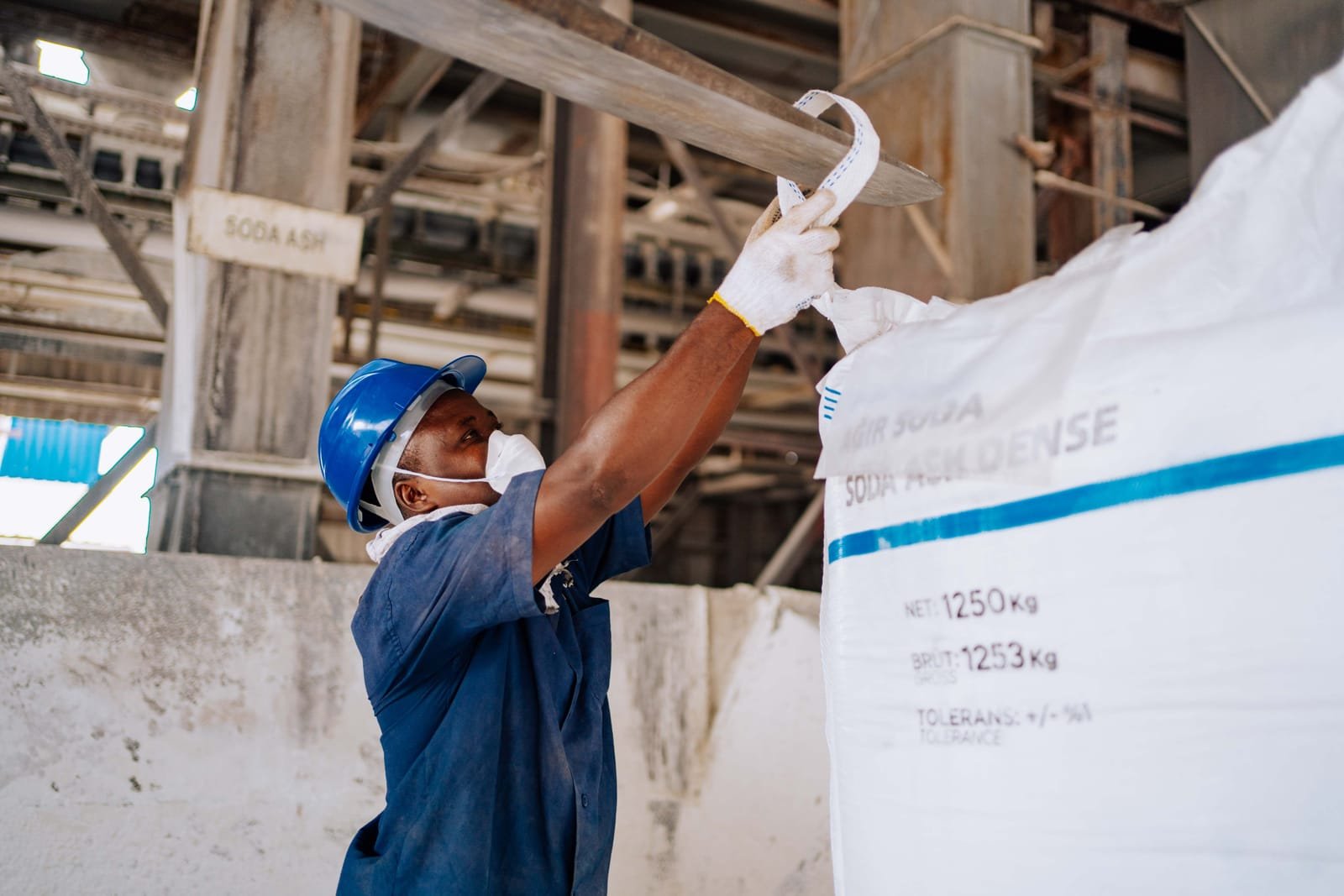 A worker in a hard hat and dust mask checks the printed identifier on a bulk bag of soda ash in a processing plant. Photo: Keegan Checks, via Pexels
Five checks to run before November 20
1. Rebuild the chemical list. Paragraph (e)(1)(i) requires a list of the hazardous chemicals known to be present, using the product identifier referenced on the safety data sheet. Walk the site, not the spreadsheet: the drum at the back of the shop and the aerosol can in the maintenance cart both count. If you are starting from a blank page, our workplace hazard assessment guide covers how to work through an area systematically.
2. Compare what your suppliers have sent. For each chemical on the list, put the newest safety data sheet next to the one in your file and look at the hazard classification and the label elements. Paragraph (g)(8) requires you to keep the sheets in the workplace and to make sure they are readily accessible to employees during each work shift in their work areas; electronic access is allowed as long as it creates no barrier to immediate access.
3. Fix your own labels. Paragraph (f)(6) covers the containers you label in-house — the transfer bottle, the decanted solvent, the spray bottle under the sink. Where a supplier's classification has changed, the in-house label has to follow. This is the step that fails quietly, because no shipment arrives to force the question.
4. Update the written program. Add the chemicals that are new, drop the ones you stopped buying, and check that the program still describes how you meet the labeling, safety data sheet and training requirements. Date the revision.
5. Train on what is genuinely new. The duty is tied to newly identified hazards, so this is not a full re-run of HazCom for everyone. Cover the hazards that changed, where the sheets live and how to read the label. Paragraph (h)(1) requires training at initial assignment and whenever a new chemical hazard employees have not previously been trained about is introduced into their work area. Record who attended and when — a session with no attendance list is hard to show later.
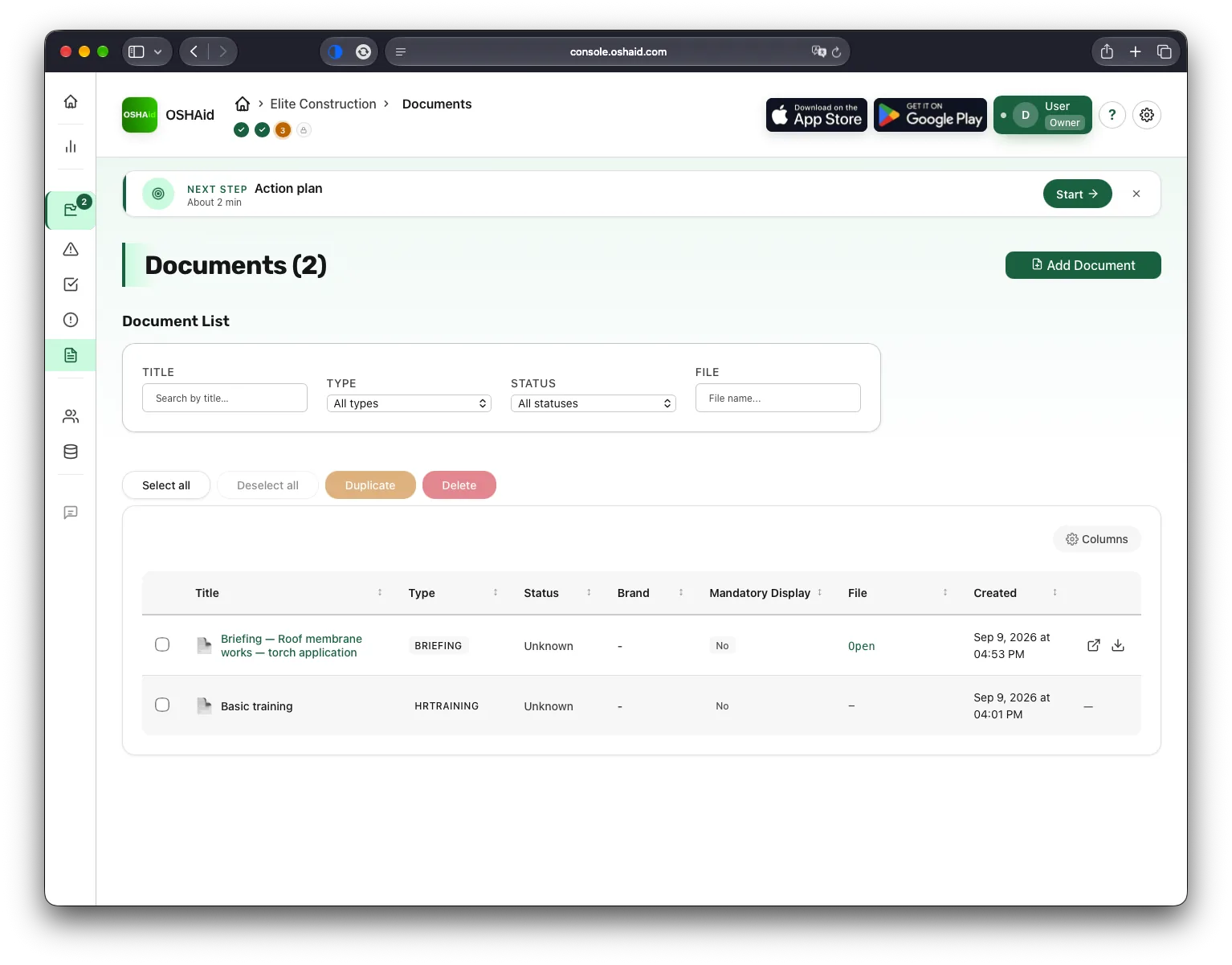 OSHAid console — document library holding the written hazard communication program and the current safety data sheets
A program you can show
November 20 is not a filing date. Nothing gets submitted and nobody sends you a receipt, which is exactly why it slips. What it really asks is whether you can answer a plain question: for every hazardous chemical on your site, do you hold the current safety data sheet, does the container in the workroom carry a label that matches it, and can you name the people you trained on what changed? Answer that with a dated program, a current chemical list and an attendance record, and the deadline takes care of itself. OSHAid keeps those three things in one place, so the next time leadership, a client or a compliance officer asks, you open the record instead of rebuilding it.
Questions safety officers ask
- When is the HazCom deadline for employers?
For substances, November 20, 2026. By that date employers must, as necessary, update alternative workplace labeling, the hazard communication program and employee training for newly identified hazards. For mixtures, the employer date is May 19, 2028. Chemical manufacturers and importers had earlier dates: May 19, 2026 for substances and November 19, 2027 for mixtures.
- Did OSHA extend the HazCom compliance dates?
- What do employers have to update by November 20, 2026?
Related reading
All posts- Nov 20, 2026Rubber insulating glove testing requirements: the six-month clockOSHA update
- Nov 5, 2026OSHA asbestos awareness training: the duty that follows the buildingCase law
- Sep 29, 2026Engineered stone silica ban: what Cal/OSHA has put in writingRulemaking
- Sep 26, 2026Naloxone in the workplace: what OSHA's new fact sheet saysOSHA update
About this article
Written by the OSHAid Safety Desk from official sources (OSHA news releases, the text of the standards, BLS and NIOSH data), checked against those sources and reviewed before publication. It explains what a rule says; it is not legal advice for your situation. OSHAid
Get your HazCom program in order
Create a free OSHAid account and keep your chemical list, safety data sheets and training records together. No commitment.
Try OSHAidFreeDownload on theApp StoreGET IT ONGoogle PlayThe intelligent OSHA companion that automates your field compliance. Mobile app + web console + specialized safety AI agent, built for US workplaces.
ProductIndustriesGuides- OSHA compliance software
- Hazard assessment guide
- Safety program templates
- JHA examples
- OSHA requirements
- OSHA recordkeeping
- OSHA standards by industry
- Workplace hazards
- Get started
- What is OSHA?
- Workplace safety glossary
- Why OSHAid?
- Enterprise solutions
- About
- Blog
- Legal notice
© 2026 OSHAid - published by DUOPP (SAS). All rights reserved.
Help us improve OSHAid
We only measure site traffic. No advertising, no resale of data.
OKDeclineLearn more