 OSHAidProductsDemosIndustriesPricingMoreClient accessTry OSHAidFree🇺🇸ENTry OSHAidBack to blogRulemakingSeptember 29, 2026· By the OSHAid Safety Desk
Engineered stone silica ban: what Cal/OSHA has put in writing
A discussion draft would prohibit fabricating artificial stone above 1.0% crystalline silica in California. The federal silica standards already cover the same tasks everywhere else.
An engineered stone silica ban is now on paper in California. On September 16, 2026, Cal/OSHA posted a discussion draft that would make the manufacture or fabrication of artificial stone containing more than 1.0% crystalline silica by weight a prohibited activity in any California workplace.
Read the caveat before the headline: this is a discussion draft, not an adopted rule, and Cal/OSHA has not announced an effective date. The agency asked for comments by September 30, 2026.
If you cut countertops outside California, nothing here binds you. It is still worth ten minutes. The draft is the clearest description yet of which tasks regulators now treat as the dangerous ones, and federal OSHA has been running a focused inspection initiative aimed at this same industry since September 2023.
What the engineered stone silica ban would prohibit
Cal/OSHA's emergency rulemaking page carries the draft under a plain heading: emergency rulemaking to prohibit the fabrication of engineered stone countertops containing more than one percent crystalline silica. It would add a new section 5204.1 to California's General Industry Safety Orders and amend the two existing silica sections, 5204 and 1532.3.
The new section's scope is the manufacture or fabrication of countertops, backsplashes, walls, flooring, waterfall countertop edges and similar products made from slabs or panels containing crystalline silica. Sixty days after the emergency regulation's effective date, making or fabricating artificial stone with more than 1.0% crystalline silica by weight would be strictly prohibited.
The draft defines artificial stone broadly: reconstituted, synthetic, composite, engineered or manufactured stone, made by binding silica-bearing material with resins, epoxies or polymers into a slab. Fired ceramic and porcelain tiles and panels are excluded. Fabrication means cutting, grinding, drilling, routing, polishing, finishing or joining a slab into a final or near-final product.
Three duties travel with the prohibition. You would have to tell every employee, verbally and in writing in a language they understand, that fabricating artificial stone containing crystalline silica is dangerous to life and health and is prohibited. Highly visible signs, in English and Spanish, would go at every entrance. And you would have to hold documentation showing a material contains 1.0% or less crystalline silica by weight — absent that documentation, the draft treats the material as if it exceeds the limit.
Fabricating above the limit would count as an imminent hazard subject to an Order Prohibiting Use. A limited exception lets an employer work through material it already held before the effective date, but only if it complies fully with section 5204, and all fabrication of that material must stop 180 days after the effective date.
The draft also tightens section 5204 itself. It creates an artificial stone action level of 3.0 micrograms per cubic meter as an 8-hour time-weighted average for high-exposure trigger tasks. It requires wet methods that hold exposures below the applicable action level, and says what that means: water covering the entire surface where the tool meets the work, not an intermittent squirt bottle. For high-exposure trigger tasks it calls for a full-face tight-fitting powered air-purifying respirator, or another respirator with an assigned protection factor of at least 1,000, with less protective options only where air sampling every six months shows exposures stay below the action level. In construction, section 5204.1 would reach onsite fabrication, with a stated exception for onsite installation, maintenance or repair.
None of this arrived without warning. On May 22, 2026, the Standards Board announced a unanimous vote to grant a petition filed on behalf of the Western Occupational and Environmental Medicine Association, and asked Cal/OSHA to prepare the finding of emergency. The same release records that California adopted a permanent silica standard in February 2025, and that CDPH found the average age of workers who died of the disease was under 50.
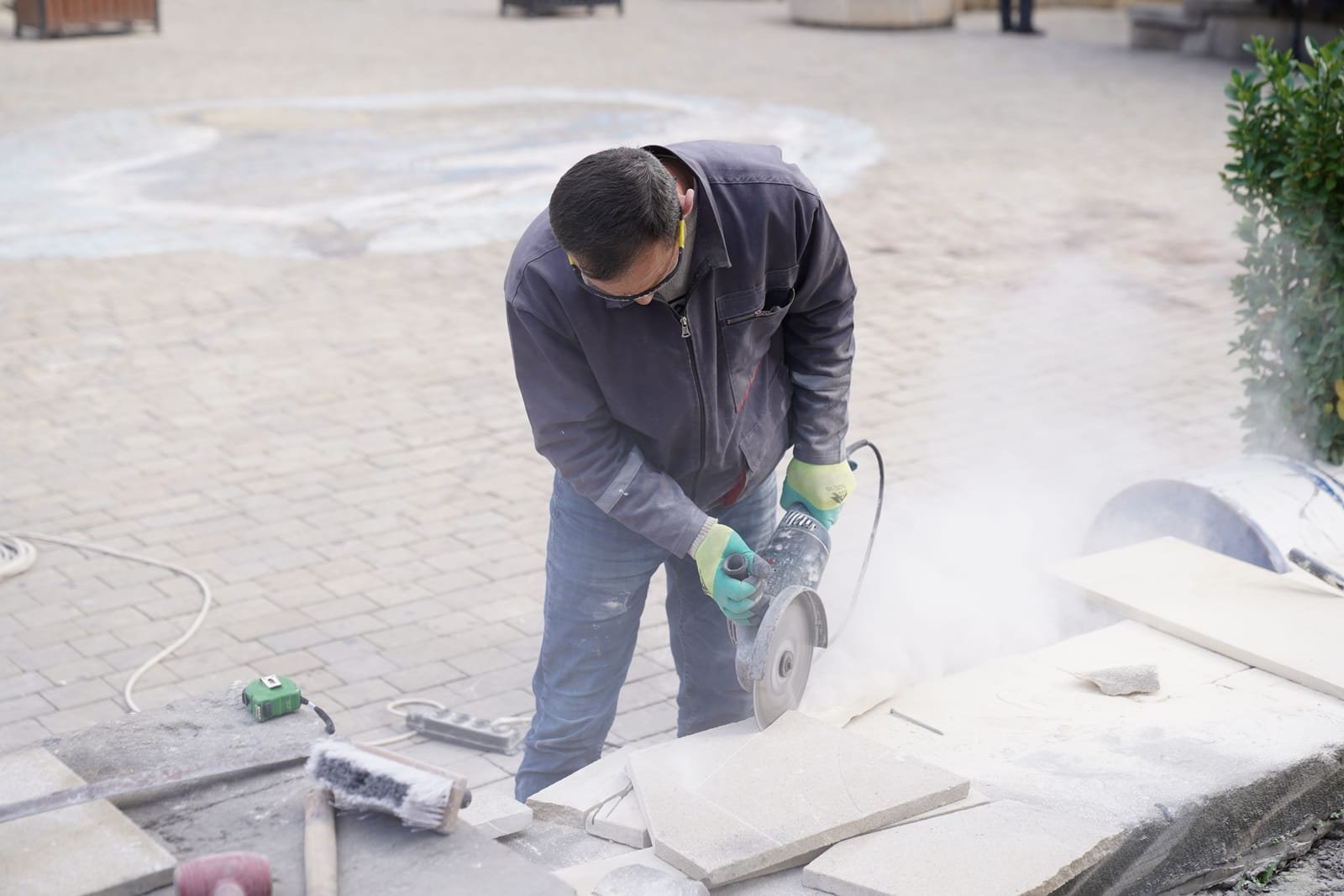 A worker dry-cuts a stone slab with a hand-held angle grinder outdoors, raising a cloud of dust. Photo: Tahir Xəlfəquliyev, via Pexels
Five checks to run this week, wherever you fabricate
1. Find out what your slabs are made of. Ask each supplier for documentation of the crystalline silica content by weight of every slab product you hold. California's draft would make the absence of that paperwork decisive, but the document is useful anywhere: it tells you which materials sit at the top of your risk list.
2. Look hard at how you cut. Dry cutting, grinding and polishing is what puts respirable silica in the air. Under 29 CFR 1910.1053 for general industry and 29 CFR 1926.1153 for construction, no employee may be exposed above 50 micrograms per cubic meter of air as an 8-hour time-weighted average. Continuous water at the blade, not a bottle on the bench, is the control that does the work.
3. Check whether you owe an exposure assessment. Both standards set an action level of 25 micrograms per cubic meter as an 8-hour TWA. At or above it, you have to assess the exposure of each affected employee, by air monitoring or objective data, and repeat that monitoring on the schedule the standard sets. If you cut stone and have never sampled, you do not know which side of the line you are on.
4. Match the respirator to the task, not to the drawer. A dust mask is not a substitute for an exposure control. Where respirators are required, they come with a written respiratory protection program, fit testing and medical evaluation attached. Our workplace hazards guide sets out how to work from a hazard to the controls and the standard behind it.
5. Know whether you are on an inspection list. In a news release dated September 25, 2023, the Department of Labor announced an enforcement and compliance initiative for the engineered stone fabrication and installation industries, supplementing OSHA's National Emphasis Program for respirable crystalline silica. It prioritizes programmed inspections in Cut Stone and Stone Product Manufacturing and in Brick, Stone and Related Construction Material Merchant Wholesalers. If one describes you, treat the checks above as overdue. Our guide to OSHA standards by industry maps the rest of what applies to your sector.
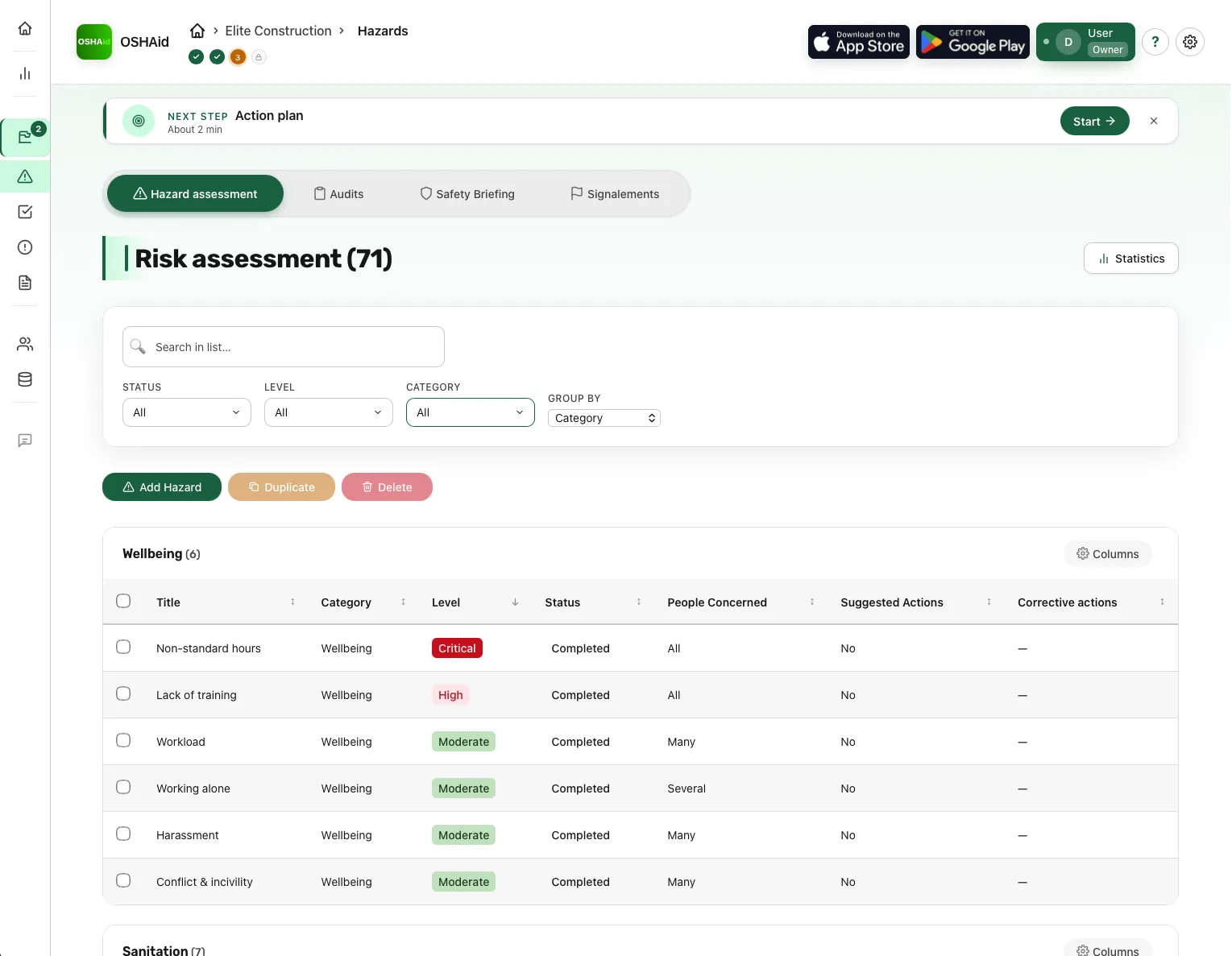 OSHAid console — hazard list showing respirable crystalline silica alongside the standard that governs it
A program you can show
Silica is the rare hazard where the paperwork and the protection point the same way. The supplier document that proves what a slab contains, the sampling result that shows where your exposures sit, the fit test on file for the person running the saw — each one is both a control and the evidence that the control exists. Shops that keep those three things current read a rule like California's as a schedule change. Shops that do not spend the first week of it reconstructing records instead of fixing the dust. OSHAid keeps the hazard, the corrective action and the proof in one place, so when leadership, a client or a compliance officer asks what you are doing about silica, you open the file instead of rebuilding it.
Questions safety officers ask
- Is engineered stone banned in California?
Not yet. On September 16, 2026, Cal/OSHA posted a discussion draft that would prohibit manufacturing or fabricating artificial stone containing more than 1.0% crystalline silica by weight, taking effect 60 days after the emergency regulation's effective date. It is a draft, and Cal/OSHA has not announced an effective date. Comments were due September 30, 2026.
- What is the OSHA exposure limit for respirable crystalline silica?
- Would the California draft cover countertop installation?
Related reading
All posts- Nov 14, 2026Storm cleanup safety requirements before your crew goes outStorm season
- Oct 9, 2026OSHA fixed ladder requirements: the 2036 deadline is still in the ruleOSHA update
- Sep 30, 2026Responding to an OSHA complaint: the five working days that followInspections
- Sep 28, 2026HazCom deadline: what you must update by November 20Deadline
About this article
Written by the OSHAid Safety Desk from official sources (OSHA news releases, the text of the standards, BLS and NIOSH data), checked against those sources and reviewed before publication. It explains what a rule says; it is not legal advice for your situation. OSHAid
Put your silica controls on the record
Create a free OSHAid account and keep your hazard list, corrective actions and training records in one place. No commitment.
Try OSHAidFreeDownload on theApp StoreGET IT ONGoogle PlayThe intelligent OSHA companion that automates your field compliance. Mobile app + web console + specialized safety AI agent, built for US workplaces.
ProductIndustriesGuides- OSHA compliance software
- Hazard assessment guide
- Safety program templates
- JHA examples
- OSHA requirements
- OSHA recordkeeping
- OSHA standards by industry
- Workplace hazards
- Get started
- What is OSHA?
- Workplace safety glossary
- Why OSHAid?
- Enterprise solutions
- About
- Blog
- Legal notice
© 2026 OSHAid - published by DUOPP (SAS). All rights reserved.
Help us improve OSHAid
We only measure site traffic. No advertising, no resale of data.
OKDeclineLearn more