 OSHAidProductsDemosIndustriesPricingMoreClient accessCreate my accountFree🇺🇸ENCreate my accountBack to blogOSHA updateOctober 9, 2026· By the OSHAid Safety Desk
OSHA fixed ladder requirements: the 2036 deadline is still in the rule
OSHA has proposed deleting the deadline by which every fixed ladder over 24 feet must have a fall arrest or ladder safety system. The rulemaking record closed on October 8. The text of the standard has not changed.
OSHA fixed ladder requirements turn on one measurement: does the ladder extend more than 24 feet above the level below it? Above that height, 29 CFR 1910.28(b)(9) decides what has to be on the ladder, and the answer depends on when the ladder was installed.
That paragraph is under review. On April 6, 2026, OSHA published a proposed rule, Walking-Working Surfaces, 91 FR 17165, that would remove the November 18, 2036 deadline by which every fixed ladder over 24 feet must be equipped with a personal fall arrest system or a ladder safety system. The record closed this week: OSHA's deregulatory rulemaking page set October 8, 2026 as the deadline for final written briefs, after the informal hearing held on August 24, 2026.
A closed record is not a final rule. Read in the eCFR on October 9, 2026, with Title 29 current as of October 7, 2026, paragraph (b)(9) still says what it has said since 2016, 2036 deadline included.
So this is a good week to know what your ladders need today, and what a final rule would change.
What the OSHA fixed ladder requirements say today
The trigger is 24 feet, measured to the lower level. 29 CFR 1910.28(b)(9) applies to fixed ladders that extend more than 24 feet (7.3 m) above a lower level. Below that height, the standard sets no fall protection system requirement for the ladder itself, though the ladder still has to meet the design and use rules of 29 CFR 1910.23.
What is required depends on the installation date. A fixed ladder installed before November 19, 2018 must be equipped with a personal fall arrest system, a ladder safety system, a cage or a well. A fixed ladder installed on or after that date must be equipped with a personal fall arrest system or a ladder safety system. On a new ladder, in other words, a cage is no longer enough on its own.
Replacement moves a ladder forward. When a fixed ladder, cage or well, or any portion of a section of one, is replaced, paragraph (b)(9)(i)(C) requires a personal fall arrest system or a ladder safety system in at least the section where the replacement sits. Repairing an old installation piece by piece brings the current requirement in one section at a time.
The 2036 date is the sentence under review. Paragraph (b)(9)(i)(D) states that on and after November 18, 2036, all fixed ladders are equipped with a personal fall arrest system or a ladder safety system. That is the provision OSHA proposes to remove.
What the proposal would, and would not, do. OSHA's notice says removing the deadline would let fixed ladders with cages or wells stay in service until the end of their service lives, and that the new-ladder rule in (b)(9)(i)(B) and the replacement rule in (b)(9)(i)(C) would be unchanged. The rulemaking follows a petition filed on July 28, 2025 by member companies of three industry associations, and OSHA also asked for comment on the broader request behind it: repealing the personal fall arrest requirement for ladders over 24 feet. The agency expects the change to reach a narrow set of ladders, those between 24 and 30 feet with no system installed that would not have been replaced by November 2036.
Nothing else in the subpart moves. OSHA's notice is explicit that employers must continue to meet the ladder requirements of 1910.23 and the general requirements of 1910.22, which cover safe loads, safe access and egress, inspection, general maintenance and good repair. Under 1910.23(b)(9), ladders are inspected before initial use in each work shift and more frequently as necessary. Under 1910.30(a), each employee who uses a personal fall protection system is trained by a qualified person before being exposed to a fall hazard.
 Looking straight up a yellow fixed ladder enclosed in a hooped cage, bolted to a steel structure against a clear sky. Photo: - Manouar, via Pexels
Five checks for your fixed ladders this week
1. Measure the climb, do not estimate it. The rule turns on more than 24 feet above a lower level, not on how tall the building looks. Walk the site and record the climb height of every fixed ladder: roof access, tank and silo ladders, pit and vault ladders, the one bolted to the back of the loading dock.
2. Write the installation date beside each ladder. November 19, 2018 is the line that decides whether a cage alone is still acceptable on that ladder. Where nobody knows the date, record that instead of guessing, and treat that ladder as the first one to document rather than the one to skip.
3. Flag every ladder you expect to repair. A replaced section, a new cage, a swapped rail: each one brings paragraph (b)(9)(i)(C) into play for that part of the ladder. Price the fall protection into the repair decision before the work order goes out, not after the welder has left.
4. Inspect the systems you already have. 1910.29(i) sets the criteria for ladder safety systems, among them that the system lets the employee climb using both hands, and that the connection between the carrier or lifeline and the attachment point on the body harness does not exceed 9 inches. A carrier installed in 2019 and never looked at since is not protection.
5. Keep the ladders in your hazard register, not in a private spreadsheet. Five fields are enough per ladder: height, installation date, system in place, last inspection, planned replacement. Kept that way, the inventory answers a compliance officer and justifies a capital request with the same record. Our guide to workplace fall hazards and their controls sets out the categories to file them under, and OSHA standards by industry is where to start if your sites span several trades: ladders on a construction site fall under 29 CFR 1926 Subpart X, not the general industry subpart discussed here.
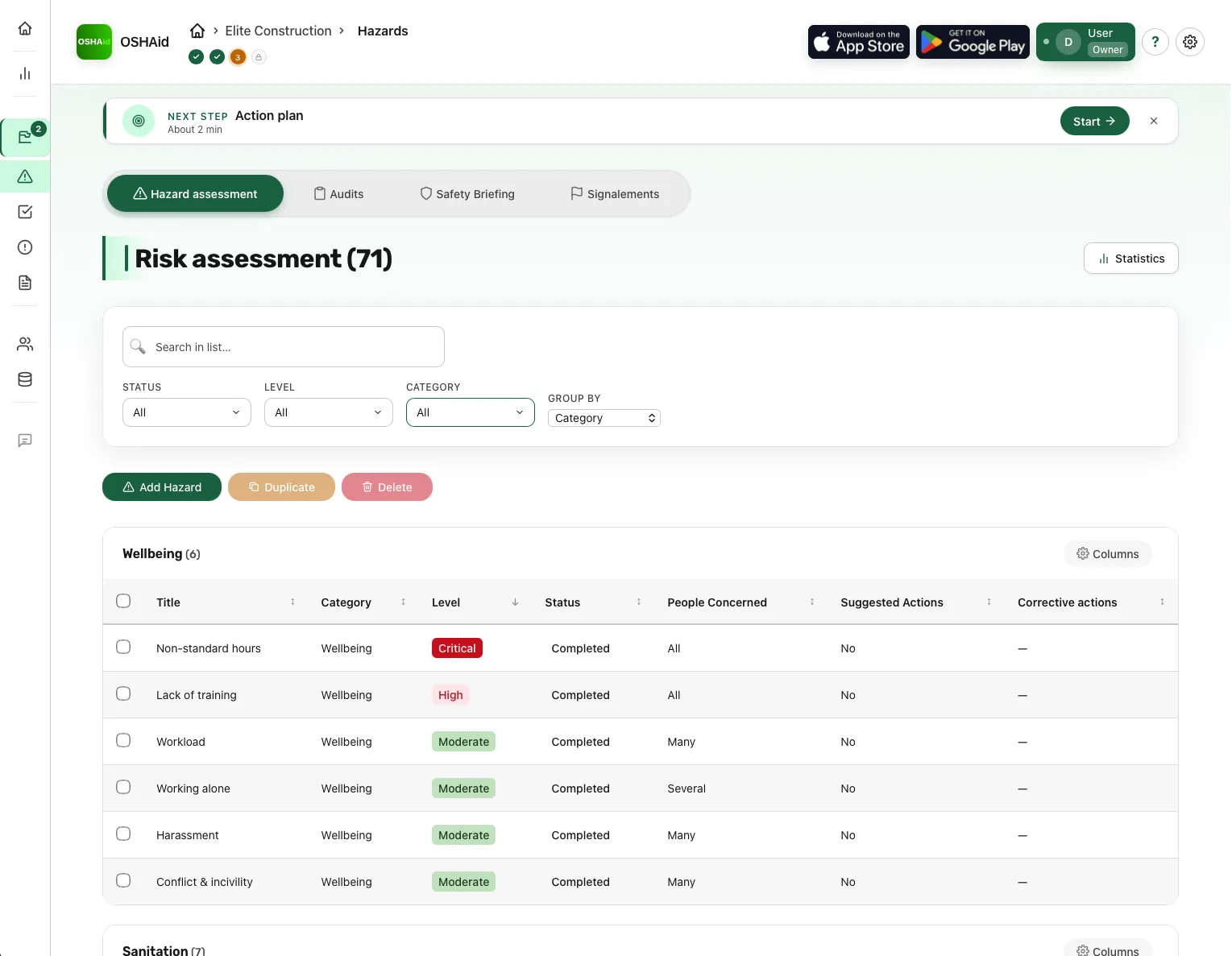 OSHAid console, the hazard assessment table: every hazard listed with its category, its risk level and the corrective action attached — where a fixed ladder inventory belongs
A deadline you can show, not one you hope moves
A proposal creates a particular risk for the person who owns safety: the temptation to stop planning because a requirement might go away. It might. It also might not, and the only text that binds you is the one in the eCFR on the day an inspector asks. The employers who come out of this well already know how many fixed ladders they have, how tall each one is, what is installed on it and when it was last inspected. That inventory costs a morning, it survives any outcome of the rulemaking, and it turns a compliance question into something you can show on a screen rather than a binder you have to defend.
Questions safety officers ask
- At what height does OSHA require fall protection on a fixed ladder?
More than 24 feet above a lower level. 29 CFR 1910.28(b)(9) applies to fixed ladders that extend more than 24 feet (7.3 m) above the level below them. Shorter fixed ladders must still meet the ladder design and use requirements of 29 CFR 1910.23.
- Are ladder cages still allowed on fixed ladders?
- Does OSHA's proposal remove the November 18, 2036 fixed ladder deadline?
About this article
Written by the OSHAid Safety Desk from official sources (OSHA news releases, the text of the standards, BLS and NIOSH data), checked against those sources and reviewed before publication. It explains what a rule says; it is not legal advice for your situation. OSHAid
Show your fall protection program instead of defending it
Create a free OSHAid account and keep your hazards, audits, corrective actions and compliance documents in one place. No commitment.
Create my accountFreeDownload on theApp StoreGET IT ONGoogle PlayThe intelligent OSHA companion that automates your field compliance. Mobile app + web console + specialized safety AI agent, built for US workplaces.
🇫🇷 Hosted in EuropeGDPR CompliantProductIndustriesGuides- OSHA compliance software
- Hazard assessment guide
- Safety program templates
- JHA examples
- OSHA requirements
- OSHA recordkeeping
- OSHA standards by industry
- Workplace hazards
- Get started
- What is OSHA?
- Workplace safety glossary
- Why OSHAid?
- Enterprise solutions
- About
- Blog
- Legal notice
© 2026 OSHAid - published by DUOPP (SAS). All rights reserved.