 OSHAidProductsDemosIndustriesPricingMoreClient accessTry OSHAidFree🇺🇸ENTry OSHAidBack to blogStorm seasonNovember 14, 2026· By the OSHAid Safety Desk
Storm cleanup safety requirements before your crew goes out
California's Department of Industrial Relations told employers on November 13 to prepare worksites for winter storms. What it asks for - a hazard review, training and protective equipment for cleanup and recovery work - is written into OSHA's own standards for every employer whose crew goes out after the weather.
Storm cleanup safety requirements are the ones nobody reads in advance. A tree is across the access road, the yard is under four inches of water, the power is out, and somebody is already driving out there.
On November 13, 2026 California's Department of Industrial Relations reminded employers and workers to prepare for winter storm season. Its list of what severe weather brings is familiar: heavy rain, flooding, strong winds, landslides, debris flows and power outages.
The reminder is Californian; the duties behind it are not. OSHA puts the hazards of flood response and recovery work on the employer, and the standards that carry that duty - hazard assessment, protective equipment, training, distance from a live line - apply wherever the storm lands.
What storm cleanup safety requirements cover
The reminder names five things to do before the storm. DIR asks employers to review and update Injury and Illness Prevention Programs and Emergency Action Plans; monitor weather, road and emergency conditions; identify hazards associated with flooding, high winds, downed power lines, unstable structures, landslides and debris flows; make sure workers understand emergency procedures and how to report unsafe conditions; and provide training and protective equipment for employees involved in emergency response, cleanup or recovery work.
A storm is, in regulatory terms, a new hazard. California's Injury and Illness Prevention Program standard, 8 CCR 3203, requires inspections to identify and evaluate hazards whenever the employer is made aware of a new or previously unrecognized hazard, at subsection (a)(4)(C), and training whenever that happens, at (a)(7)(E). A flooded yard and a leaning tree qualify.
Federally, the duty runs through the PPE standard. 29 CFR 1910.132(d)(1) requires the employer to assess the workplace to determine if hazards are present, or are likely to be present, which necessitate personal protective equipment, then select it, communicate the selection decisions to each affected employee, and select PPE that properly fits. Subsection (d)(2) requires a written certification naming the workplace evaluated, the person certifying, the dates, and the document itself as a certification of hazard assessment. The text is current as of November 12, 2026.
Training has its own trigger. 1910.132(f)(1) covers when PPE is necessary, what is necessary, how to don, doff, adjust and wear it, its limitations and its care. Paragraph (f)(2) requires each employee to demonstrate understanding before performing work that requires PPE, and (f)(3)(i) requires retraining when changes in the workplace render previous training obsolete. A storm changes the workplace.
OSHA's cleanup alert is four lines long. Keeping Workers Safe during Flood Cleanup (OSHA 3972-06, 2019) names generators - use gas and diesel-powered generators outdoors to prevent exposure to carbon monoxide; electrical - keep a safe distance from downed or damaged power lines, with repairs performed by trained electrical utility workers; downed trees - gloves and foot, eye, hearing, head and fall protection when using chainsaws and chippers; and chemical and biological hazards - wash hands with soap and clean water, and wear protective clothing, goggles, gloves and boots.
A safe distance has a number. 29 CFR 1910.333(c)(3)(i)(A) provides that an unqualified person working in an elevated position near overhead lines must be positioned so that the person, and the longest conductive object they may contact, cannot come closer than 10 feet to an unguarded, energized line at 50 kV or below, plus 4 inches for every 10 kV above that; (c)(3)(i)(B) applies the same distances to a conductive object carried on the ground.
The rest of the list sits on one OSHA page. OSHA's flood response and recovery guidance covers driving, where six inches of standing water is enough to stall some cars; and mold, where the advice is to correct moisture problems, ventilate and use hand, eye and respiratory protection, with an N-95 respirator recommended. The same page says utility restoration, hazardous spill cleanup and search and rescue should only be conducted by workers who have the proper training, equipment and experience.
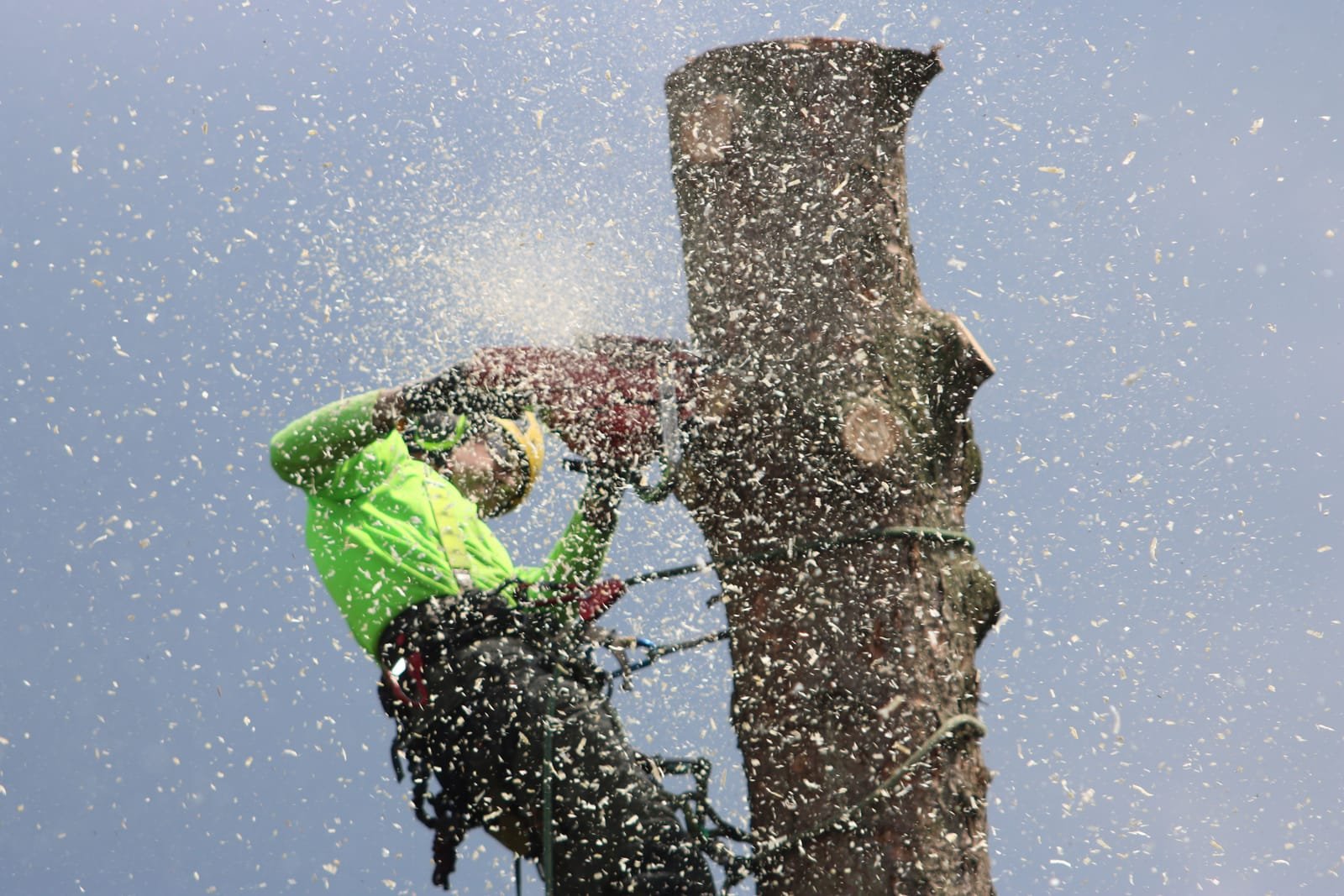 An arborist high on a bare tree trunk cutting into it with a chainsaw, wearing a helmet with face and hearing protection and a climbing harness, sawdust filling the air around him. Photo: Henk Schuurmans, via Pexels (Pexels License)
Six checks before the next storm
1. Walk the site and write down what water and wind will change. The access road that floods, the roof somebody will be asked to clear, the tree leaning over the yard, the panel in the basement. Our guide to workplace hazard categories and their controls works as a checklist for that walk.
2. Certify the PPE assessment in writing. 1910.132(d)(2) asks for one document: the workplace evaluated, who certified it, the dates, and a line identifying it as a certification of hazard assessment. Storm work is where that document earns its keep: the equipment it names is the kit that leaves with the truck.
3. Decide who may approach a downed line, and give everyone else the number. Ten feet, and the repair belongs to the utility. Write the reporting step next to it: who gets called, and who keeps people back while the call is made.
4. Put the generators outdoors in the procedure, not in the briefing. Carbon monoxide is colorless and odorless, so the rule has to hold every time - for the pump and the pressure washer as much as the generator.
5. Issue the chainsaw kit as a kit. Gloves, chaps, foot protection, eye protection, hearing protection, head protection and fall protection: OSHA lists them together because a saw at height uses all of them. Only power equipment built to be used outdoors and in wet conditions goes out. Crews who do this daily know the kit, and our page on the OSHA standards that apply on construction sites covers it. The maintenance crew borrowed for the week may not.
6. Say in advance who can stop the work. DIR's reminder states that employers cannot require workers to report to, or prevent them from leaving, an affected work area they reasonably believe is unsafe, and cannot prevent them from using their phones to seek emergency assistance or check whether conditions are safe. Certain workers, including first responders and disaster service workers, may be exempt. A crew told this before the storm does not have to settle it standing in the water.
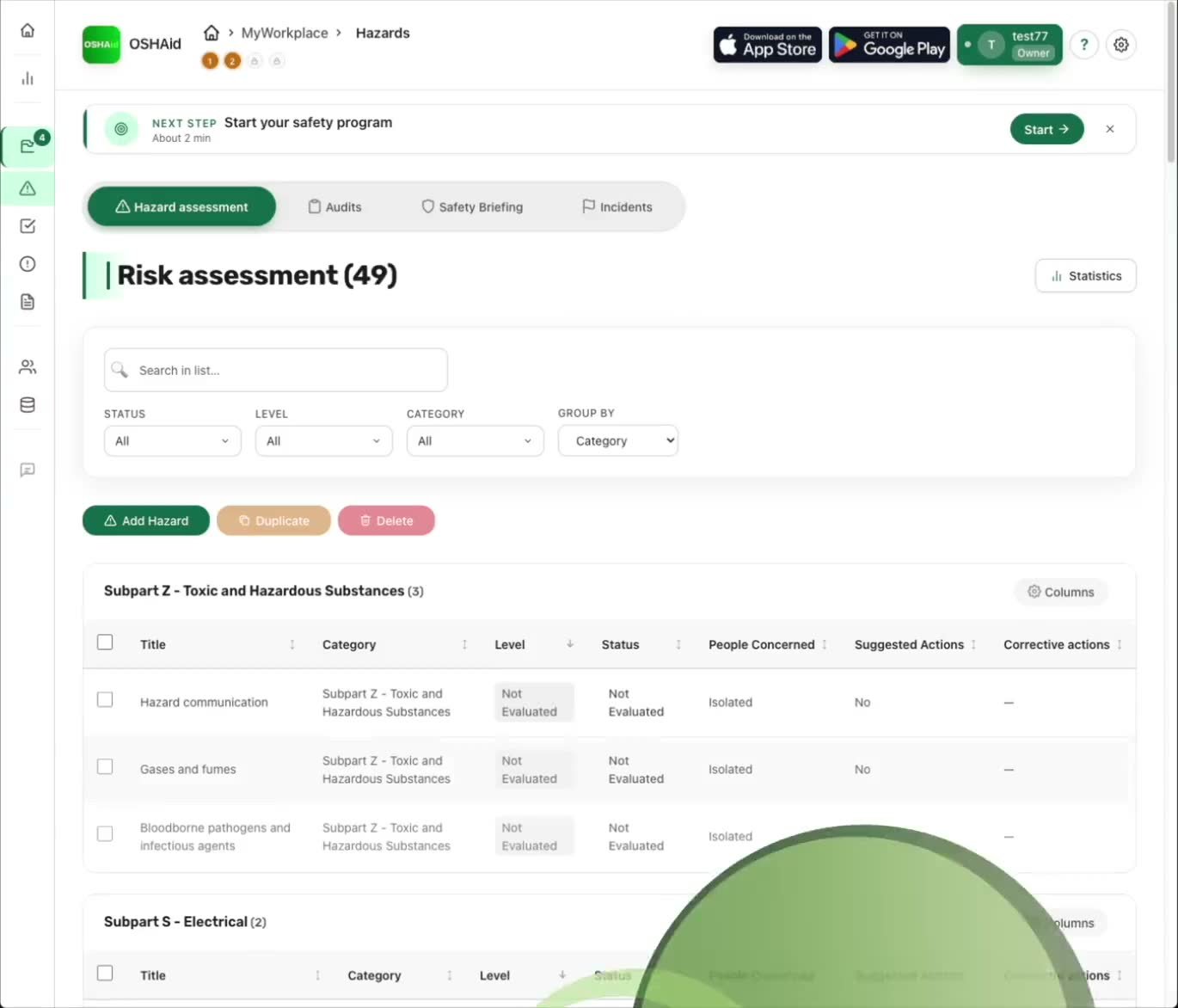 OSHAid console: the hazard assessment table, where each hazard identified on a site is scored and carries the protective equipment and the action decided for it
What the storm leaves in the file
Storm work is improvised by definition: the weather decides where the job is, and the crew settles the rest standing in it.
What does not have to be improvised is the part written down first: the hazard assessment with a date on it, the equipment list that matches it, the record showing who was briefed on the saw and the live line, and the name of the person who can call it off.
That is also the file a client, an insurer or a compliance officer asks for once the water is gone: the one that shows a safety program working, instead of a binder being defended.
Questions safety officers ask
- What PPE does OSHA require for storm and flood cleanup?
OSHA's flood cleanup alert lists gloves and foot, eye, hearing, head and fall protection for chainsaw and chipper work, and protective clothing, goggles, gloves and boots against chemical and biological contamination. Under 29 CFR 1910.132(d), you assess the workplace and select the PPE the hazards found there require.
- How far must workers stay from a downed power line?
- Does a storm require new safety training?
Related reading
All posts- Nov 18, 2026OSHA abatement certification: the step that closes a citationCitations
- Nov 13, 2026OSHA whistleblower complaint: the hearing rules change on December 9Rule change
- Nov 6, 2026OSHA ladder inspection requirements: what a 3.66 million-unit recall asks of youRecall
- Oct 14, 2026Construction PPE fit requirements: what the rule asksOSHA update
About this article
Written by the OSHAid Safety Desk from official sources (OSHA news releases, the text of the standards, BLS and NIOSH data), checked against those sources and reviewed before publication. It explains what a rule says; it is not legal advice for your situation. OSHAid
Have the storm file ready before the storm
Create a free OSHAid account: record the hazard assessment with its date, assign the corrective actions it produces, and keep the training records and written programs beside them, in one place your crew can open from the yard. No commitment.
Try OSHAidFreeDownload on theApp StoreGET IT ONGoogle PlayThe intelligent OSHA companion that automates your field compliance. Mobile app + web console + specialized safety AI agent, built for US workplaces.
ProductIndustriesGuides- OSHA compliance software
- Hazard assessment guide
- Safety program templates
- JHA examples
- OSHA requirements
- OSHA recordkeeping
- OSHA standards by industry
- Workplace hazards
- Get started
- What is OSHA?
- Workplace safety glossary
- Why OSHAid?
- Enterprise solutions
- About
- Blog
- Legal notice
© 2026 OSHAid - published by DUOPP (SAS). All rights reserved.
Help us improve OSHAid
We only measure site traffic. No advertising, no resale of data.
OKDeclineLearn more