 OSHAidProductsDemosIndustriesPricingMoreClient accessTry OSHAidFree🇺🇸ENTry OSHAidBack to blogRule changeNovember 13, 2026· By the OSHAid Safety Desk
OSHA whistleblower complaint: the hearing rules change on December 9
The Department of Labor published a final rule on November 9 making electronic filing mandatory for represented parties in hearings before its administrative law judges — the forum that handles the retaliation cases OSHA investigates under most of the statutes it enforces.
An OSHA whistleblower complaint rarely arrives as a lawsuit. It arrives as a letter from an area office saying a current or former employee believes they were punished for raising a safety concern, and that the agency has opened an investigation.
On November 9, 2026 the Department of Labor published a final rule amending 29 CFR part 18, the rules of practice for hearings before its Office of Administrative Law Judges. It takes effect on December 9, 2026.
The rule changes nothing about what counts as retaliation. It changes how a file moves once a complaint reaches a hearing, and that is worth reading before one does.
Where an OSHA whistleblower complaint goes
Two routes, and they do not end in the same room. Section 11(c) of the OSH Act, 29 U.S.C. 660(c), protects a worker who reports a hazard or asks for an inspection. OSHA's page on that provision sets out the route: the employee files with the Secretary within 30 days of the alleged violation, the Secretary investigates and notifies the complainant within 90 days of receiving the complaint, and where a violation is found the Secretary brings an action in a United States district court. 29 CFR 1977.15(d)(1) repeats the 30-day limit and treats later complaints as presumptively untimely.
The other statutes run through an administrative hearing instead. OSHA enforces the retaliation provisions of more than 20 federal statutes, listed on its whistleblower program site — among them the Surface Transportation Assistance Act, the Federal Railroad Safety Act, the Clean Air Act and the Asbestos Hazard Emergency Response Act. Each sets its own deadline: 29 CFR 1978.103(d) gives an employee 180 days to file a STAA complaint, and 1978.103(e) provides that a STAA complaint alleging facts that would also violate section 11(c) is deemed filed under both.
After OSHA issues findings, the clock is 30 days. 29 CFR 1978.106(a) requires any party who wants review to file objections and a request for a hearing within 30 days of receiving the findings and preliminary order, with the Chief Administrative Law Judge and in accordance with 29 CFR part 18, serving copies on the other parties and on the OSHA official who issued the findings. If no timely objection is filed, the findings and the preliminary order become the final decision of the Secretary, not subject to judicial review.
Objecting does not suspend a reinstatement order. The same section stays the preliminary order on a timely objection except the portion requiring preliminary reinstatement, which is effective immediately on the respondent's receipt of the findings; a stay of that portion is granted only on exceptional circumstances.
The hearing itself is run under part 18. 29 CFR 1978.107(a) and, for the environmental statutes, 29 CFR 24.107(a) both send the proceeding to the rules of practice before the Office of Administrative Law Judges. Under 29 CFR 18.10(a), where a specific Department of Labor regulation governs a proceeding that regulation applies, and part 18 covers what it does not address.
What changes on December 9. The final rule, published at 91 FR 70790, rewrites section 18.30: a person represented by an attorney or a non-attorney representative must file through the Department's eFile/eServe system unless another form of filing is allowed by the judge for good cause or allowed or required by standing order. A self-represented person may use the system but is not required to. Anyone who files electronically is deemed to consent to electronic service of the judge's documents and of papers filed by registered users. A paper is filed when the system receives it, and under the revised section 18.32 the last day for an electronic filing ends at 11:59:59 p.m. in the time zone of the presiding judge's office. Exhibits to be offered in evidence must be filed electronically too, unless an exhibit cannot be. The revised section 18.40 requires the judge to give the parties at least 14 days' notice of the date, time and place of a hearing and of its manner — in person, by telephone, by videoconference or by other means.
 Two workers in hard hats talking face to face at a construction site, one in a high-visibility vest holding a clipboard, the moment a safety concern is raised and written down. Photo: Mikael Blomkvist, via Pexels (Pexels License)
Six checks before December 9
1. Know which route a complaint against you would take. A hazard reported internally or to OSHA is section 11(c), and that path ends in district court. A commercial-vehicle safety complaint, a railroad complaint or an environmental one is investigated by OSHA and then, on objection, heard by an administrative law judge.
2. Put the 30-day objection clock in the calendar now. It runs from receipt of OSHA's findings. Let it pass and the findings and the preliminary order become the Secretary's final decision, with no judicial review.
3. Ask whoever would represent you whether they are registered. From December 9 a represented party files through eFile/eServe. An exemption for good cause exists, but it is something the judge allows, not something a party elects.
4. Check the reporting procedure your employees actually use. 29 CFR 1904.35(b)(1) requires a reasonable procedure for reporting work-related injuries and illnesses, one that would not deter or discourage a reasonable employee from reporting accurately; that each employee is told how to report; that each employee is told they have the right to report and that discharging or discriminating against someone for reporting is prohibited; and that you do not discriminate against an employee who reports. Our guide to OSHA injury and illness recordkeeping covers the forms that procedure feeds.
5. Date what gets raised, and date what you did about it. The question in a retaliation case is why an adverse action was taken. A concern logged on a date, assigned to someone and closed out with a note is a record; a remembered conversation is not.
6. Brief the supervisors, not only the managers. The duty not to discriminate against an employee for reporting sits in the standard itself, and the person who acts on a report first is usually a foreman or a shift lead. What OSHA compliance covers is a short read to hand them.
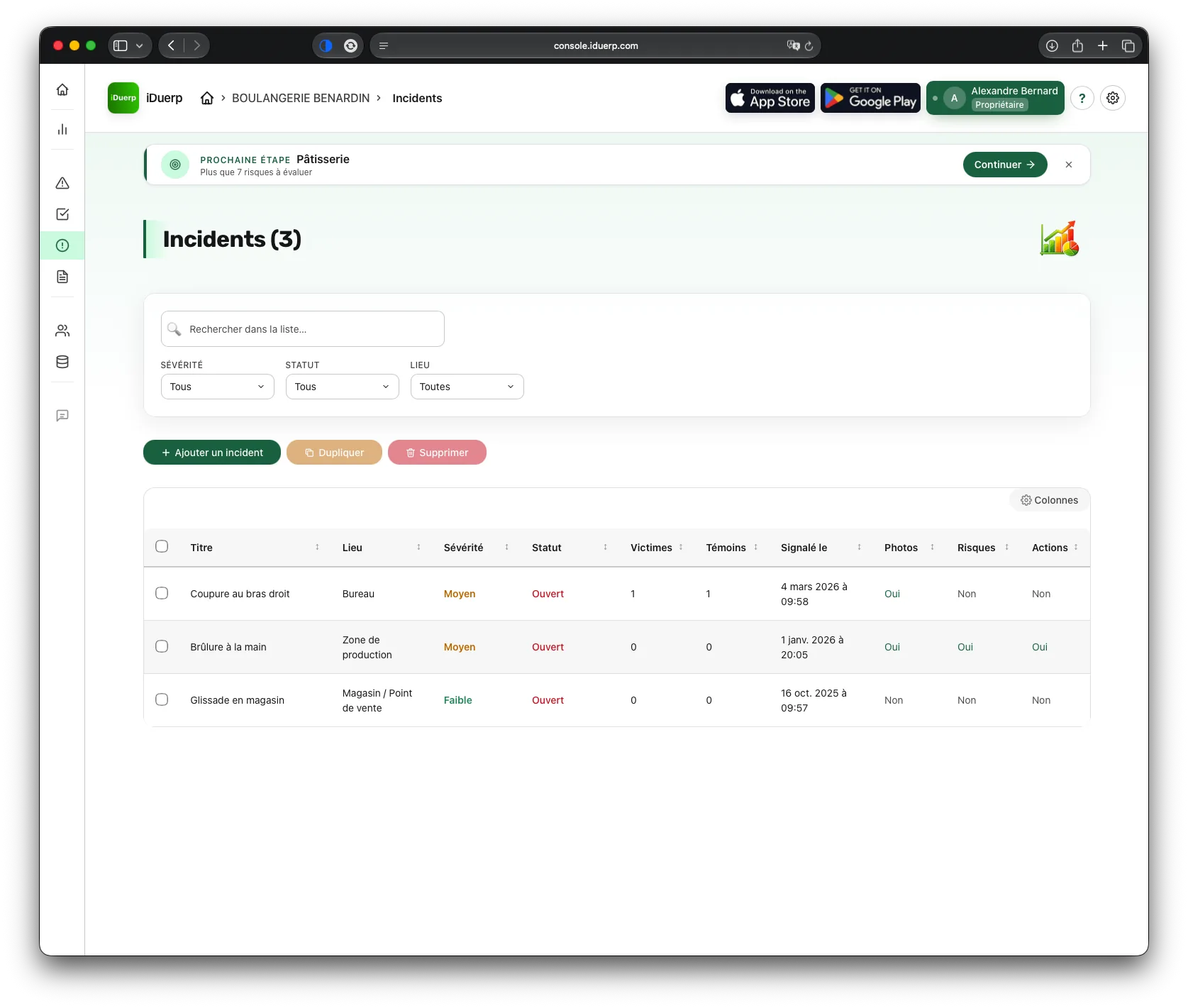 OSHAid console: the incident log, where a reported hazard or injury is recorded with its date and its author, next to the action that followed
Show the record, not the recollection
Almost none of this rule is about safety. It is about filing, systems and service — the machinery that starts once a complaint has already been made.
What keeps a complaint from reaching that machinery is older than any of it: an employee who can report a hazard without weighing the cost, a supervisor who treats the report as information, and a file that shows with dates what was raised and what was done about it.
That file is also the one a leadership team, a client or a compliance officer asks to see. Built once, it answers all three.
Questions safety officers ask
- How long does an employee have to file an OSHA whistleblower complaint?
It depends on the statute. Under section 11(c) of the OSH Act, 29 CFR 1977.15(d)(1) gives 30 days from the alleged violation. Under the Surface Transportation Assistance Act, 29 CFR 1978.103(d) gives 180 days. Each statute OSHA enforces sets its own filing deadline.
- Does an OSHA whistleblower complaint go before a judge?
- What changes in Department of Labor hearings on December 9, 2026?
Related reading
All posts- Nov 21, 2026Temporary worker safety training: who gives it, who proves itCase study
- Nov 19, 2026OSHA incident rate by industry: what the 2025 data showsData
- Nov 14, 2026Storm cleanup safety requirements before your crew goes outStorm season
- Nov 12, 2026OSHA warehouse inspection: what the emphasis program targetsInspections
About this article
Written by the OSHAid Safety Desk from official sources (OSHA news releases, the text of the standards, BLS and NIOSH data), checked against those sources and reviewed before publication. It explains what a rule says; it is not legal advice for your situation. OSHAid
Keep the record that answers the question
Create a free OSHAid account: log a reported hazard or incident with its date and its author, assign the corrective action, and keep the written procedure beside it, in one place your team can open. No commitment.
Try OSHAidFreeDownload on theApp StoreGET IT ONGoogle PlayThe intelligent OSHA companion that automates your field compliance. Mobile app + web console + specialized safety AI agent, built for US workplaces.
ProductIndustriesGuides- OSHA compliance software
- Hazard assessment guide
- Safety program templates
- JHA examples
- OSHA requirements
- OSHA recordkeeping
- OSHA standards by industry
- Workplace hazards
- Get started
- What is OSHA?
- Workplace safety glossary
- Why OSHAid?
- Enterprise solutions
- About
- Blog
- Legal notice
© 2026 OSHAid - published by DUOPP (SAS). All rights reserved.
Help us improve OSHAid
We only measure site traffic. No advertising, no resale of data.
OKDeclineLearn more