 OSHAidProductsDemosIndustriesPricingMoreClient accessCreate my accountFree🇺🇸ENCreate my accountBack to blogOSHA updateOctober 14, 2026· By the OSHAid Safety Desk
Construction PPE fit requirements: what the rule asks
Washington filed a proposal on October 6, 2026 to copy OSHA's fit language into its construction PPE rule. The federal sentence it copies has applied on every site under federal OSHA jurisdiction since January 13, 2025.
On October 6, 2026, Washington's Department of Labor & Industries filed a proposed rule that adds one line to its construction PPE standard: the employer must ensure that protective equipment "is selected to ensure that it properly fits each affected employee".
That line is not new. It is copied, word for word, from 29 CFR 1926.95(c)(2), and the federal construction PPE fit requirements have applied on every site under federal OSHA jurisdiction since January 13, 2025.
A state filing is a useful reminder, because this rule landed quietly. It added no new equipment, no new paperwork and no new deadline, which is exactly why it is easy to miss — and why an inspector can raise it on a site where nothing else looks wrong.
Here is what the requirement says, what OSHA means by "properly fits", and what to check on your crew this week.
What the construction PPE fit requirements say
The text is three lines long. Paragraph (c) of 29 CFR 1926.95, headed "Design and selection", requires employers to ensure that all personal protective equipment (1) is of safe design and construction for the work to be performed, and (2) is selected to ensure that it properly fits each affected employee. Read in the eCFR on October 14, 2026, with Title 29 current as of October 9, 2026, that is the whole of it.
Paragraph (c)(2) arrived with the final rule Personal Protective Equipment in Construction, published at 89 FR 100321 on December 12, 2024 and effective January 13, 2025.
What "properly fits" means. OSHA did not define the phrase in the regulation. In the proposal it explained that properly fits means the PPE "is the appropriate size to provide an employee with the necessary protection from hazards and does not create additional safety and health hazards arising from being either too small or too large". Asked to put more detail into the rule text, OSHA answered that it was "not convinced that further details within the regulatory text are necessary for the construction industry" and that it can issue guidance later.
The failure modes are ordinary. NIOSH told the docket that "safety glasses slipping off, loose gloves getting caught on machines or exposing skin, or blisters forming from ill-fitting safety boots make working more difficult and can adversely affect worker safety and job satisfaction". None of that looks like a violation until someone is hurt.
This is an old duty made explicit. General industry has required employers to "select PPE that properly fits each affected employee" since 1994, at 29 CFR 1910.132(d)(1)(iii). OSHA described the construction change as making an existing obligation explicit, and sized it accordingly: it estimated that 184,935 construction employees might need non-standard sizes of PPE, and assumed up to 10 percent of them — 18,494 workers — were being given incorrectly fitting equipment before the rule.
Comfort is not the test. OSHA wrote that it "cannot issue a citation simply because PPE that properly fits is uncomfortable", while cautioning that uncomfortable PPE is more likely to go unused. Separately, 29 CFR 1926.28(a) still makes you responsible for requiring the wearing of appropriate PPE wherever employees are exposed to hazardous conditions.
If you work in a state-plan state, watch the state text too. OSHA lists 22 State Plans covering private sector and state and local government workers, and they must be at least as effective as federal OSHA. Under 29 CFR 1953.5(a)(1), a state adopts a new federal standard, or an at-least-as-effective equivalent, within six months of promulgation, or shows its own standard already matches. Washington's filing, CR-102 AO 26-08, proposes the change to WAC 296-155-200, with virtual hearings on November 10 and 16, 2026, written comments open until November 23, 2026 at 5 p.m., and adoption intended for March 2, 2027.
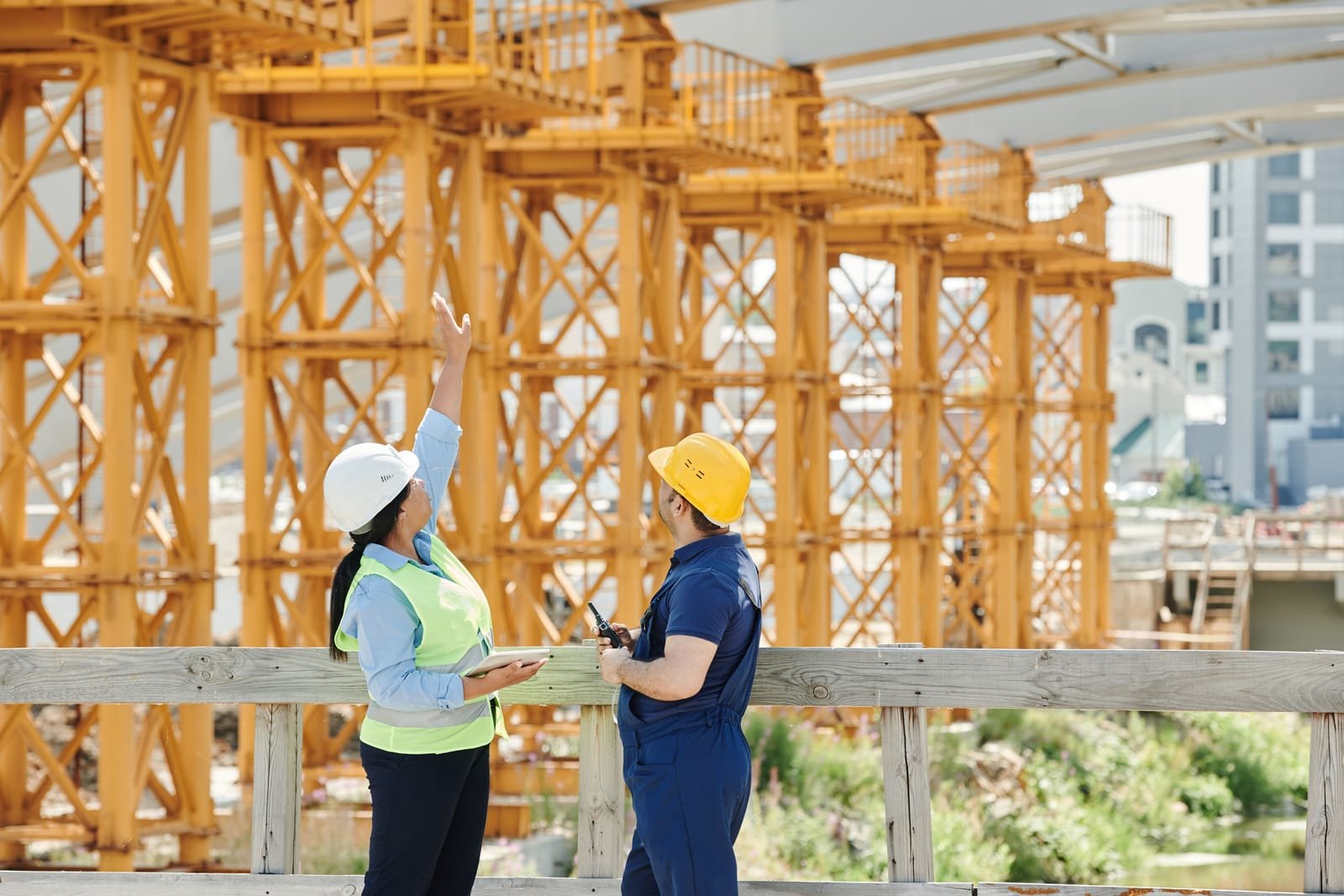 Two construction workers in hard hats and a high-visibility vest standing at a railing in front of a steel-framed building under construction. Photo: Mikael Blomkvist, via Pexels
Five checks on your crew this week
1. Start with the equipment that fails when it is loose. Fall-protection harnesses, gloves near rotating tools, high-visibility garments worn as an outer layer, and eye protection that slides down a nose bridge. Walk the crew, item by item, and write down each person the standard sizes do not fit. Everything else that applies to a construction site assumes the PPE on the worker is doing its job.
2. Ask the people who stop wearing it. A worker who pushes safety glasses onto a hard hat brim twenty times a shift is telling you about fit, not attitude. The sizing problem is usually named before it is measured, and the answer rarely sits in a toolbox talk about compliance.
3. Fix it in purchasing, not on the jobsite. OSHA's own cost estimate budgeted 10 minutes to assess an employee's PPE needs and another 10 minutes to find replacement equipment in the right size. That is the size of the task: a purchasing decision, not a jobsite improvisation. Cutting, taping or re-knotting equipment to make it fit is how you create the second hazard the rule is about.
4. Respirators have a harder test than fit. 29 CFR 1926.103 makes the requirements of 1910.134 apply identically in construction, and 1910.134(f)(2) requires an employee using a tight-fitting facepiece respirator to be fit tested before initial use, whenever a different facepiece is used, and at least annually. A visual size judgement never satisfies that paragraph.
5. Keep the record yourself. Construction's 1926.95 carries no written-certification paragraph the way general industry's hazard assessment does at 1910.132(d)(2), so nothing forces a file into existence. Note the date you reviewed fit, the names you could not size, what you ordered and when it arrived, next to the hazards those controls answer to. An inspector reading that file sees a program; an inspector reading nothing sees a crew in borrowed gear.
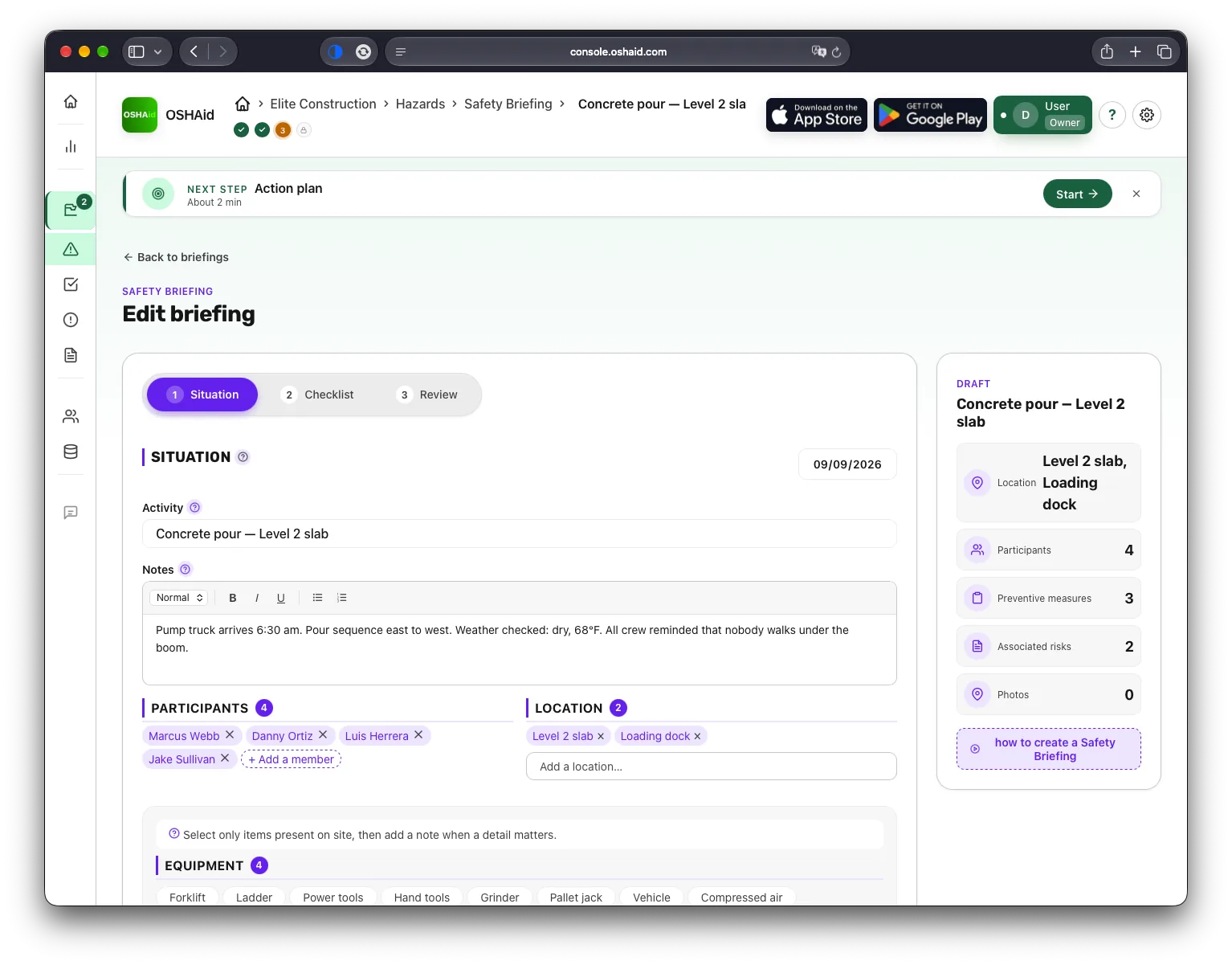 OSHAid console, the safety briefing editor: a toolbox talk prepared for a crew, with the topics covered and the attendance list
Fit is the part you can show
Nothing about this requirement is hard. It asks for equipment that is the right size for the person wearing it, and the evidence that you looked. What makes it worth an hour this week is that it is one of the few duties an inspector can assess by standing still and watching a crew work — no sampling, no records request, no calculation. The same is true of the people you want to impress: a client walking the site, an insurer, a new operations director. A safety program that can produce the fit review, the sizes ordered and the dates they reached the crew is a program you can show, not a binder you defend.
Questions safety officers ask
- Does OSHA require PPE to fit each construction worker?
Yes. 29 CFR 1926.95(c)(2) requires employers to ensure all personal protective equipment is selected to ensure that it properly fits each affected employee. The paragraph took effect on January 13, 2025. General industry has carried the same duty since 1994 at 29 CFR 1910.132(d)(1)(iii).
- What does "properly fits" mean in OSHA's construction PPE standard?
- Can OSHA cite us because PPE is uncomfortable?
About this article
Written by the OSHAid Safety Desk from official sources (OSHA news releases, the text of the standards, BLS and NIOSH data), checked against those sources and reviewed before publication. It explains what a rule says; it is not legal advice for your situation. OSHAid
Keep your PPE program in one place
Create a free OSHAid account and keep your hazards, audits, corrective actions and compliance documents in one place. No commitment.
Create my accountFreeDownload on theApp StoreGET IT ONGoogle PlayThe intelligent OSHA companion that automates your field compliance. Mobile app + web console + specialized safety AI agent, built for US workplaces.
🇫🇷 Hosted in EuropeGDPR CompliantProductIndustriesGuides- OSHA compliance software
- Hazard assessment guide
- Safety program templates
- JHA examples
- OSHA requirements
- OSHA recordkeeping
- OSHA standards by industry
- Workplace hazards
- Get started
- What is OSHA?
- Workplace safety glossary
- Why OSHAid?
- Enterprise solutions
- About
- Blog
- Legal notice
© 2026 OSHAid - published by DUOPP (SAS). All rights reserved.