 OSHAidProductsDemosIndustriesPricingMoreClient accessCreate my accountFree🇺🇸ENCreate my accountBack to blogTrainingOctober 15, 2026· By the OSHAid Safety Desk
Forklift certification requirements: what OSHA asks
OSHA answered the question in its October 14, 2026 QuickTakes. The standard behind the answer, 29 CFR 1910.178, is seventh on the agency's preliminary list of most-cited standards for fiscal 2026.
OSHA's QuickTakes newsletter of October 14, 2026 took a reader question that a lot of employers answer wrong: "Do I need to be certified to operate a forklift at work?" The agency's answer, in the October 14 issue, was yes — training, an evaluation of your performance in your workplace, and then a certification issued by your employer.
The forklift certification requirements behind that answer sit in one paragraph, 29 CFR 1910.178(l), and they are shorter than most safety managers expect. What catches employers out is rarely the training itself. It is the record, the evaluation that falls due every three years, and the assumption that a card from an outside trainer finishes the job.
This is not an obscure corner of the rulebook: 1910.178 sits seventh on OSHA's preliminary Top 10 most-cited standards for fiscal 2026, covering October 1, 2025 through August 31, 2026.
Everything below is read from the eCFR, with Title 29 current as of October 13, 2026.
What the forklift certification requirements say
Training comes before the truck. Paragraph (l)(1) of 29 CFR 1910.178 requires the employer to ensure that each powered industrial truck operator is competent to operate safely, "as demonstrated by the successful completion of the training and evaluation specified in this paragraph (l)". Until that training is finished, the employee may only drive for training purposes.
It has three parts, not one. Under (l)(2)(ii), training "shall consist of a combination of formal instruction", "practical training" and "evaluation of the operator's performance in the workplace". Classroom time alone does not satisfy the paragraph, and neither does a video. Trainees may drive only under the direct supervision of someone qualified to train and evaluate, and only where that operation endangers nobody.
The syllabus is written for you. Paragraph (l)(3) lists the initial topics in two groups. Truck-related: controls and instrumentation, steering, visibility, vehicle capacity, vehicle stability, operating limitations, the inspections the operator performs, refueling or battery charging. Workplace-related: surface conditions, load stability, pedestrian traffic, narrow aisles, ramps, hazardous (classified) locations, and closed environments where carbon monoxide or diesel exhaust can build up. The standard itself is the last topic. You may drop one only where you can demonstrate it does not apply to safe operation in your workplace.
The employer certifies — not the trainer. Paragraph (l)(6) says "The employer shall certify that each operator has been trained and evaluated as required by this paragraph (l)", and that the certification "shall include the name of the operator, the date of the training, the date of the evaluation, and the identity of the person(s) performing the training or evaluation". An outside trainer can deliver the instruction and can run the evaluation. The certification is still yours to make and keep, and the evaluation has to happen in your workplace, with your traffic.
Prior training can count. Paragraph (l)(5) says you need not repeat a topic an operator was already trained in, where that training suits the truck and the working conditions, provided the operator "has been evaluated and found competent to operate the truck safely".
Nobody under 18 drives. QuickTakes states that workers under age 18 cannot legally operate a forklift, even once trained. The rule behind it is a child labor rule rather than an OSHA standard: 29 CFR 570.58, Hazardous Occupations Order No. 7, lists operating a high-lift truck among the occupations declared particularly hazardous for minors between 16 and 18 years of age in non-agricultural employment.
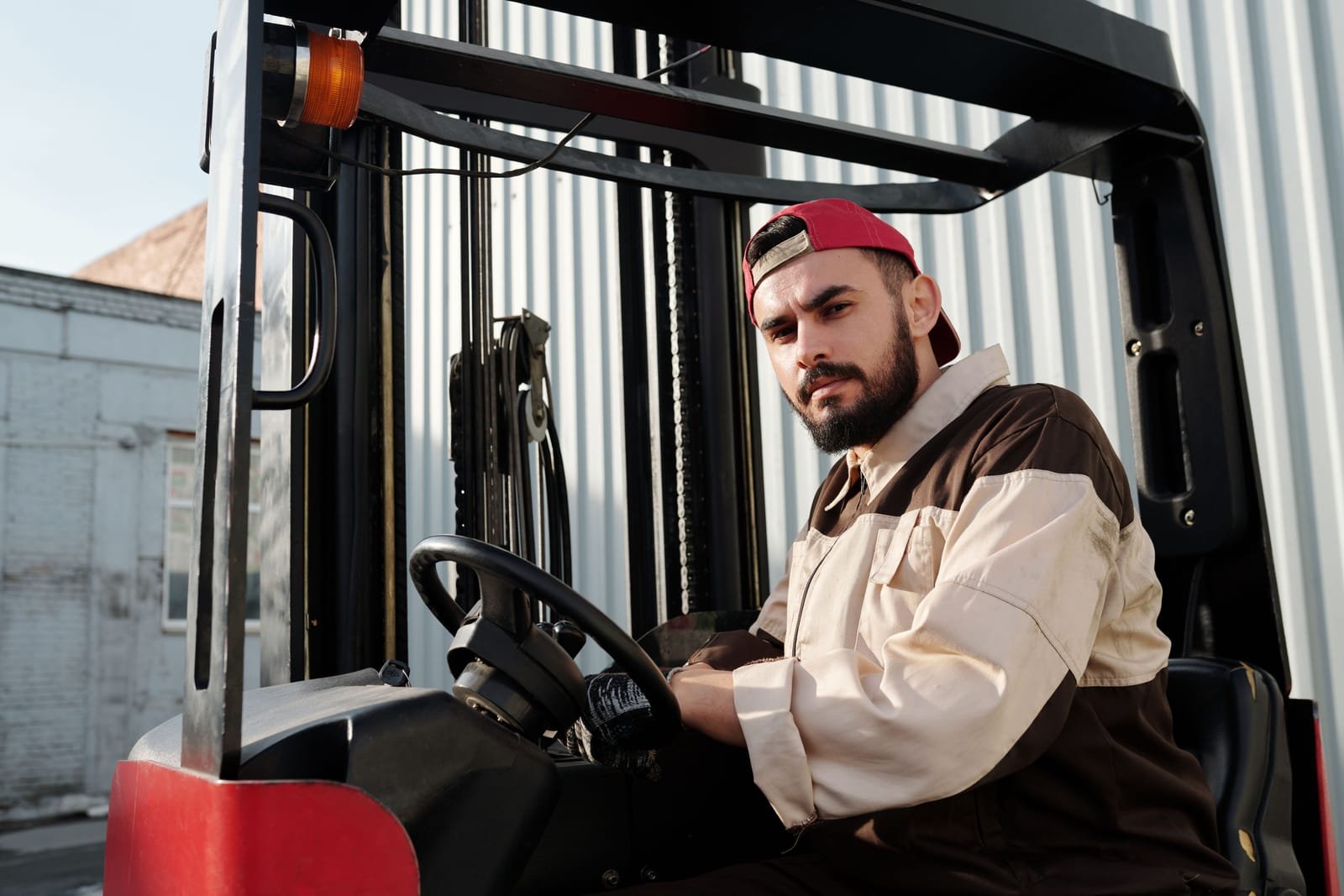 A forklift operator seated at the controls of a lift truck outside an industrial building, one hand on the steering wheel. Photo: Tiger Lily, via Pexels
Six checks on your operators this week
1. List the operators against the trucks they drive. Paragraph (l)(4)(ii)(D) requires refresher training when an operator "is assigned to drive a different type of truck". A sit-down counterbalanced rider and a stand-up reach truck are different types, and that gap stays invisible until you write the list.
2. Open the certification records and look for four things. Name of the operator, date of the training, date of the evaluation, and who performed the training or the evaluation. A vendor card with a photo and an expiry date is not that record. If one of the four is missing, the certification does not say what (l)(6) requires it to say.
3. Find the oldest evaluation date. Paragraph (l)(4)(iii) requires an evaluation of each operator's performance "at least once every three years". It is the clock most employers lose, because nothing prompts it. Put those dates where you track the rest of your workplace hazards and controls.
4. Know the four triggers that come sooner. Refresher training is also required when the operator has been observed operating unsafely, has been involved in an accident or a near-miss, has received an evaluation showing unsafe operation, or when a workplace condition changes in a way that could affect safe operation. A near-miss is on that list; treat it as the trigger it is.
5. Check that the daily examination happens. Paragraph (q)(7) requires trucks to "be examined before being placed in service", at least daily, and after each shift where they run around the clock. Defects "shall be immediately reported and corrected", and under (q)(1) any truck not in safe operating condition has to be removed from service.
6. Walk the pedestrian routes. OSHA notes that "retail establishments often face greater challenges than other worksites in maintaining pedestrian safety", and its powered industrial trucks page lists how people get hurt: lift trucks driven off loading docks, lifts falling between a dock and an unsecured trailer, workers struck by a truck, and falls from elevated pallets and tines. If forklifts and people share aisles in your stores or stockrooms, that traffic belongs in the hazard assessment behind your retail safety program.
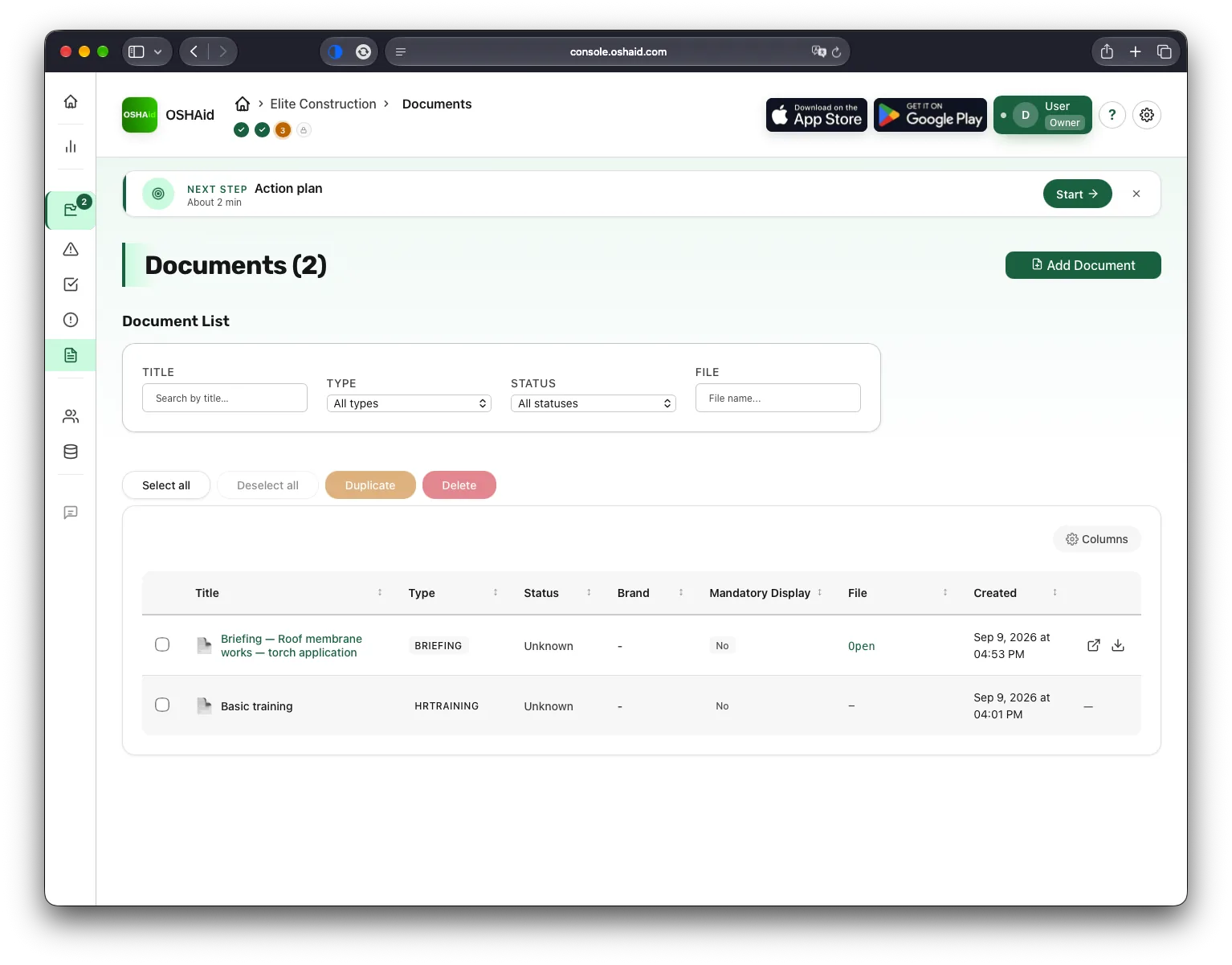 OSHAid console, the document library: compliance documents filed by category, with their dates and owners
The record is the part you can show
Forklift training is the rare OSHA duty most employers already do. They train, they watch the new operator drive, they decide the person is safe. What goes missing is the trace: the dated certification with its four named elements, the three-year evaluation, the refresher after the near-miss nobody wrote down. That trace is also the only part an inspector, a client auditing your site or an insurer can look at. A program that can produce the operator list, the certifications and the evaluation dates in a minute is a program you can show — not a binder you defend after something goes wrong.
Questions safety officers ask
- Do you need a license to operate a forklift?
OSHA does not issue forklift licenses. 29 CFR 1910.178(l) requires the employer to train the operator, evaluate that operator's performance in the workplace, and then certify that both happened. The certification has to name the operator, the training date, the evaluation date and the person who did the training or the evaluation.
- How often does forklift certification have to be renewed?
- Can a 17-year-old operate a forklift at work?
About this article
Written by the OSHAid Safety Desk from official sources (OSHA news releases, the text of the standards, BLS and NIOSH data), checked against those sources and reviewed before publication. It explains what a rule says; it is not legal advice for your situation. OSHAid
Keep your operator records in one place
Create a free OSHAid account and keep your hazards, audits, corrective actions and compliance documents in one place. No commitment.
Create my accountFreeDownload on theApp StoreGET IT ONGoogle PlayThe intelligent OSHA companion that automates your field compliance. Mobile app + web console + specialized safety AI agent, built for US workplaces.
🇫🇷 Hosted in EuropeGDPR CompliantProductIndustriesGuides- OSHA compliance software
- Hazard assessment guide
- Safety program templates
- JHA examples
- OSHA requirements
- OSHA recordkeeping
- OSHA standards by industry
- Workplace hazards
- Get started
- What is OSHA?
- Workplace safety glossary
- Why OSHAid?
- Enterprise solutions
- About
- Blog
- Legal notice
© 2026 OSHAid - published by DUOPP (SAS). All rights reserved.