 OSHAidProductsDemosIndustriesPricingMoreClient accessCreate my accountFree🇺🇸ENCreate my accountBack to blogOSHA updateOctober 16, 2026· By the OSHAid Safety Desk
OSHA sling inspection requirements and records
On October 16, 2026 the Labor Department sent OSHA's rigging paperwork package to OMB for review, with comments open until November 16. The notice is a plain list of the rigging records OSHA expects 115,829 employers to hold.
The Labor Department published a notice in the Federal Register on October 16, 2026 that changes no line of any safety standard. It asks the Office of Management and Budget to renew the paperwork approval behind 29 CFR 1926.251, Rigging equipment for material handling. Comments are due November 16, 2026.
Read as an employer rather than as a regulator, it is still useful. A paperwork package is OSHA setting out, in one place, the records it believes a standard already requires you to hold — and the OSHA sling inspection requirements in 1926.251 produce three kinds: markings, inspection records, and proof-test certificates.
The scale says how ordinary this is: OSHA estimates 115,829 covered employers, 263,953 responses a year and 49,160 hours of annual burden, under OMB control number 1218-0233.
Here is what the standard asks before the next lift, and afterwards.
What the OSHA sling inspection requirements say
Two inspections, on two clocks. Paragraph (a)(1) of 29 CFR 1926.251 requires rigging equipment for material handling to be inspected prior to use on each shift and as necessary during its use, and defective equipment to be removed from service. Paragraph (a)(6) is narrower and stricter: each day before being used, the sling and all fastenings and attachments are inspected for damage or defects by a competent person designated by the employer, with additional inspections where service conditions warrant. Damaged or defective slings come out of service immediately.
Alloy steel chain slings carry a second clock. Under (b)(6)(i), a thorough periodic inspection is made on a regular basis set by the frequency of use, the severity of service, the nature of the lifts and experience with similar slings — in no event at intervals greater than once every 12 months. Paragraph (b)(6)(ii) turns that into the one record the standard names: the employer makes and maintains a record of the most recent month in which each alloy steel chain sling was thoroughly inspected, and makes it available for examination.
A sling with no legible tag is out of service. Paragraph (a)(2) requires rigging equipment to carry permanently affixed, legible identification markings prescribed by the manufacturer indicating the recommended safe working load, forbids loading beyond it, and forbids using the equipment at all without those markings. Welded alloy steel chain slings state size, grade, rated capacity and sling manufacturer, under (b)(1). Synthetic web slings carry the manufacturer's name or trademark, the rated capacities for the type of hitch and the type of material, under (e)(1).
Three tests leave paper behind. Special custom design grabs, hooks, clamps and other lifting accessories are marked with their safe working loads and proof-tested to 125 percent of their rated load before use, under (a)(4). Welded end attachments on wire rope slings are proof tested at twice their rated capacity before initial use, and (c)(15)(ii) has the employer retain the certificate and make it available for examination. Hooks for which no manufacturer's recommendation is available are tested to twice the intended safe working load before first use, and (f)(2) requires the employer to maintain a record of the dates and results of those tests.
Outside construction, the same duties sit in a different part. General industry reads 29 CFR 1910.184, Slings: the daily competent-person inspection at (d), the 12-month ceiling and the month record at (e)(3), the retained proof-test certificate at (e)(4). A shop and a jobsite can run the same slings under two different standards, which is the ordinary problem the standards that apply to your industry create. Every paragraph above was read in the eCFR with Title 29 current as of October 14, 2026.
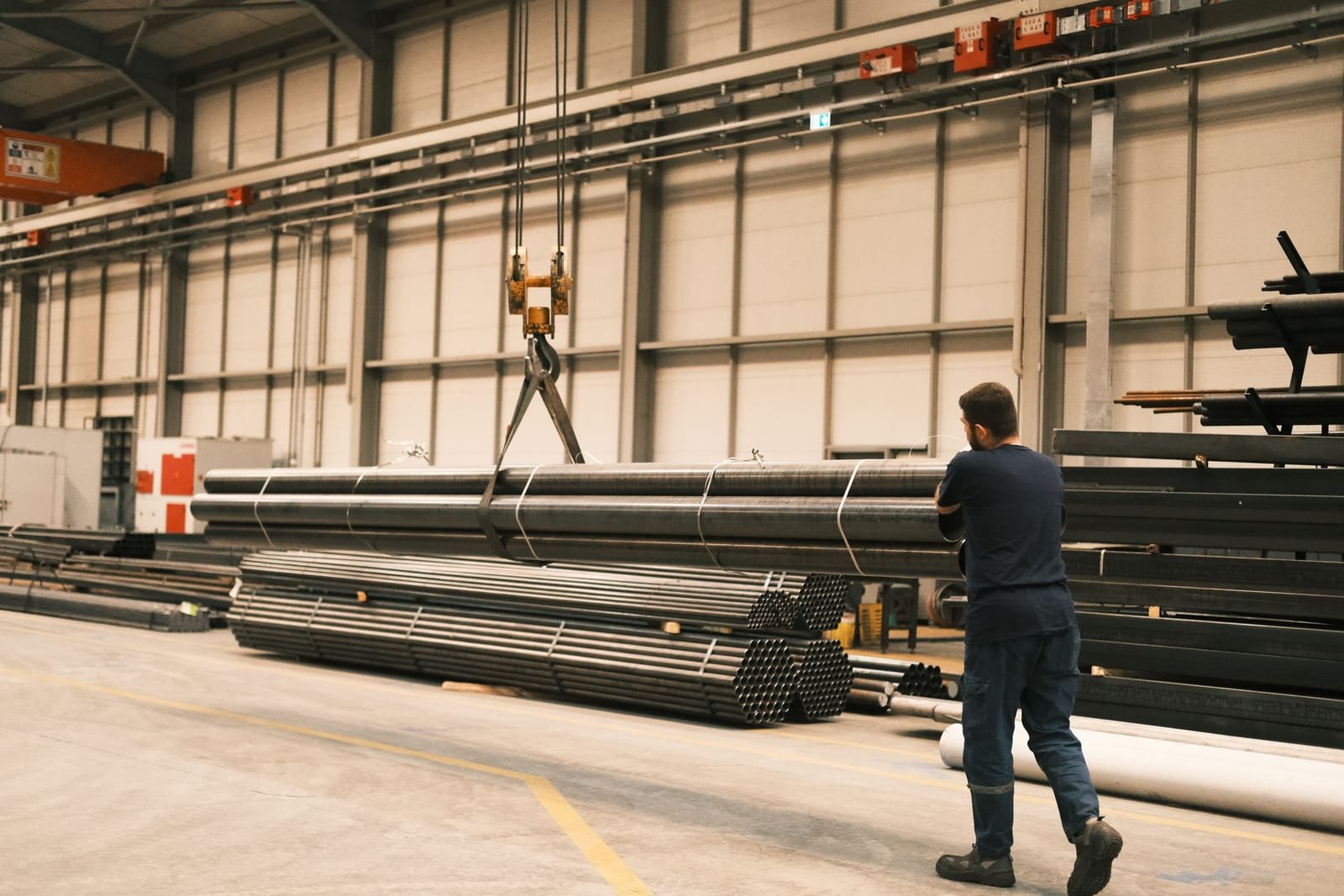 A worker guides a bundle of steel pipes slung beneath an overhead crane hook inside a metal fabrication shop. Photo: Cemrecan Yurtman, via Pexels
Five checks before the next lift
1. Put a name on the competent person. Both standards hand the daily inspection to a competent person designated by the employer. 29 CFR 1926.32(f) defines that person as one capable of identifying existing and predictable hazards in the surroundings or working conditions which are unsanitary, hazardous or dangerous to employees, and who has authorization to take prompt corrective measures to eliminate them. The authorization half is the part usually missing: if the person inspecting cannot pull a sling out of service without asking a supervisor first, you have not designated anyone.
2. Read every tag in the rigging locker. Markings are the fastest audit you will run, and they are pass or fail: a sling whose identification markings are missing or illegible cannot be used at all, under (a)(2)(iii). Remove it, and order the replacement the same day.
3. Find the oldest month in your chain sling records. The record required by (b)(6)(ii) is the most recent month of thorough inspection for each alloy steel chain sling. Find the oldest and count forward 12 months. That date is a deadline, and nothing on the floor will remind you of it.
4. Pull the three certificates into one folder. The 125 percent proof test for custom lifting accessories, the proof-test certificate for welded end attachments, and the dates and results of hook tests. Two of the three must be made available for examination, which means available on the day someone asks.
5. Write the removal criteria onto the inspection form. The standard lists them, so your form can too. A synthetic web sling comes out of service for acid or caustic burns, melting or charring of any part of the sling surface, snags, punctures, tears or cuts, broken or worn stitches, or distortion of fittings. Wire rope goes when visible broken wires exceed 10 percent of the total in any length of eight diameters, or it shows other signs of excessive wear, corrosion or defect. Alloy steel chain goes when wear at any point of a link exceeds OSHA's Table H-1. A list on the form turns a glance into an inspection, the same way a job hazard analysis written down turns a lifting plan into one.
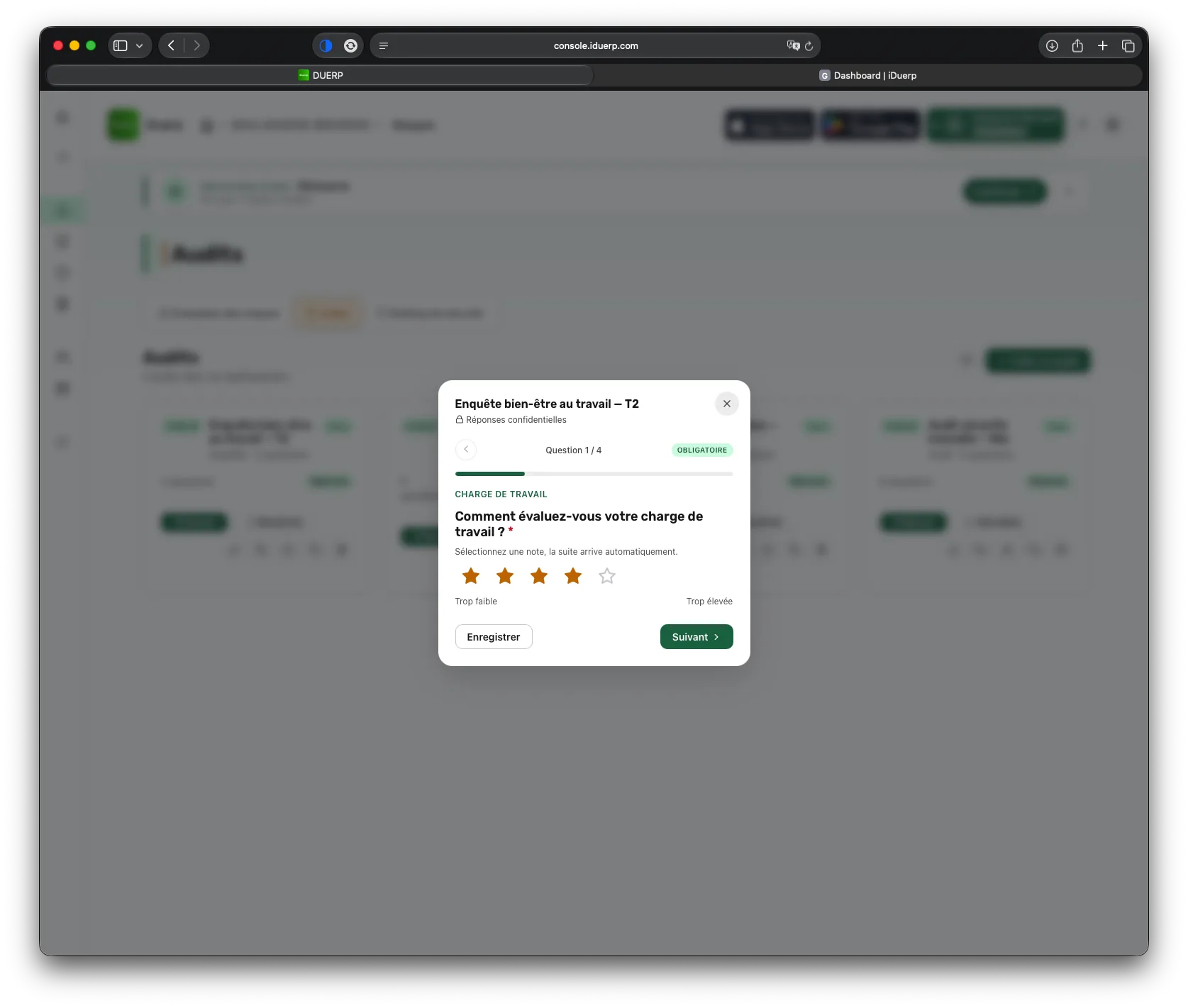 OSHAid console, the audits list: inspections planned and completed, each with its scope, date and status
Rigging is a program you can show
Nothing in the October 16 Federal Register notice adds a duty. It restates, in OSHA's own words, which parts of a rigging program are expected to exist on paper: the markings, the month each chain sling was last inspected, the certificates behind the tests. That is a short list, and it is what a client walking your shop, an insurer or a compliance officer asks for — not your safety philosophy, but three records and the name of the person who signs them. If the paperwork burden itself concerns you, the comment window runs to November 16, 2026. If it does not, the useful half-hour this week is spent in the rigging locker, reading tags.
Questions safety officers ask
- How often does OSHA require slings to be inspected?
Each day before being used, by a competent person designated by the employer, under 29 CFR 1926.251(a)(6) and 1910.184(d), plus additional inspections during use where service conditions warrant. Rigging equipment is also inspected prior to use on each shift under 1926.251(a)(1).
- Does OSHA require written sling inspection records?
- Who can inspect slings under OSHA rules?
About this article
Written by the OSHAid Safety Desk from official sources (OSHA news releases, the text of the standards, BLS and NIOSH data), checked against those sources and reviewed before publication. It explains what a rule says; it is not legal advice for your situation. OSHAid
Keep your rigging records in one place
Create a free OSHAid account and keep your hazards, audits, corrective actions and compliance documents in one place. No commitment.
Create my accountFreeDownload on theApp StoreGET IT ONGoogle PlayThe intelligent OSHA companion that automates your field compliance. Mobile app + web console + specialized safety AI agent, built for US workplaces.
🇫🇷 Hosted in EuropeGDPR CompliantProductIndustriesGuides- OSHA compliance software
- Hazard assessment guide
- Safety program templates
- JHA examples
- OSHA requirements
- OSHA recordkeeping
- OSHA standards by industry
- Workplace hazards
- Get started
- What is OSHA?
- Workplace safety glossary
- Why OSHAid?
- Enterprise solutions
- About
- Blog
- Legal notice
© 2026 OSHAid - published by DUOPP (SAS). All rights reserved.