 OSHAidProductsDemosIndustriesPricingMoreClient accessCreate my accountFree🇺🇸ENCreate my accountBack to blogCase studyOctober 17, 2026· By the OSHAid Safety Desk
OSHA repeat violation: what triggers one and what it costs
On October 15, 2026 Oregon OSHA announced $317,587 in penalties against a roofing contractor, two of the three violations classified fifth-repeat. Under federal rules a repeated violation carries a maximum of $165,514, ten times the serious maximum.
On October 15, 2026, Oregon OSHA announced $317,587 in penalties against a Beaverton construction company after inspecting a roofing job in Molalla. Crews were working on the roof of a two-story house wearing full-body harnesses that were not attached to any anchor, at fall heights of up to 19 feet.
Two of the three violations were classified fifth-repeat, meaning the sixth citation for each of those requirements in less than two years. An OSHA repeat violation is not a new rule. It is the same rule you were cited for before, priced differently.
Under federal rules that difference is about tenfold: a serious violation tops out at $16,550, a repeated one at $165,514. The company has appealed, so nothing in that case is final. The arithmetic behind a repeat classification is still worth understanding before it reaches your company.
Here is what federal OSHA counts as a repeat, how far back it looks, and what to check this week.
What counts as an OSHA repeat violation
What Oregon OSHA cited. The October 15 announcement lists three violations against Luka's General Construction LLC of Beaverton: no fall protection system where workers faced falls of 6 feet or more, $167,294, fifth-repeat; a ladder that did not extend at least 3 feet above the roof surface, $138,146, fifth-repeat; and no certification records showing employees had been trained to recognize fall hazards, $12,147, first-repeat. Oregon OSHA says the company corrected the first two and is under an order to correct the third. It has filed an appeal, which employers there may do within 30 calendar days of a citation.
The same three requirements are federal. 29 CFR 1926.501(b)(13) requires each employee engaged in residential construction activities 6 feet or more above lower levels to be protected by a guardrail system, safety net system or personal fall arrest system, unless the employer demonstrates that is infeasible or creates a greater hazard and implements a fall protection plan. Under 1926.1053(b)(1), a portable ladder used for access to an upper landing surface must have side rails extending at least 3 feet above it, or be secured at the top with a grasping device. Under 1926.503(b)(1), the employer verifies fall-hazard training by preparing a written certification record carrying the employee's identity, the dates of the training and the signature of the trainer or the employer.
Those are the standards OSHA cites most. On OSHA's preliminary FY2026 list of most frequently cited standards, covering October 1, 2025 through August 31, 2026, fall protection (1926.501) ranks first, construction ladders (1926.1053) fifth and fall protection training (1926.503) eighth.
How federal OSHA decides a violation is repeated. Chapter 4 of OSHA's Field Operations Manual sets two conditions: the employer has been cited previously for the same or a substantially similar condition or hazard, and that citation has become a final order of the Occupational Safety and Health Review Commission. The earlier citation must have become final before the second violation occurs or is observed, and a citation nobody contests becomes final by operation of law. The usual test of substantially similar is that the identical standard was violated both times, though the manual allows for similar hazards cited under different standards. OSHA then applies a five-year window: the citation issues within five years of the previous citation's final order date or final abatement date, whichever is later.
One line multi-state employers miss. The same chapter states that prior citations by State Plan states cannot be used as a basis for federal OSHA repeated violations. A state plan also runs its own classifications, and Oregon's fifth-repeat has no federal equivalent, so a contractor crossing state lines can carry two separate histories. What does not change is the price: 29 CFR 1903.15(d) caps a repeated violation at $165,514 and a serious violation at $16,550, as Title 29 reads in the eCFR current to October 15, 2026. For the duties behind those numbers, see what OSHA requires of every employer.
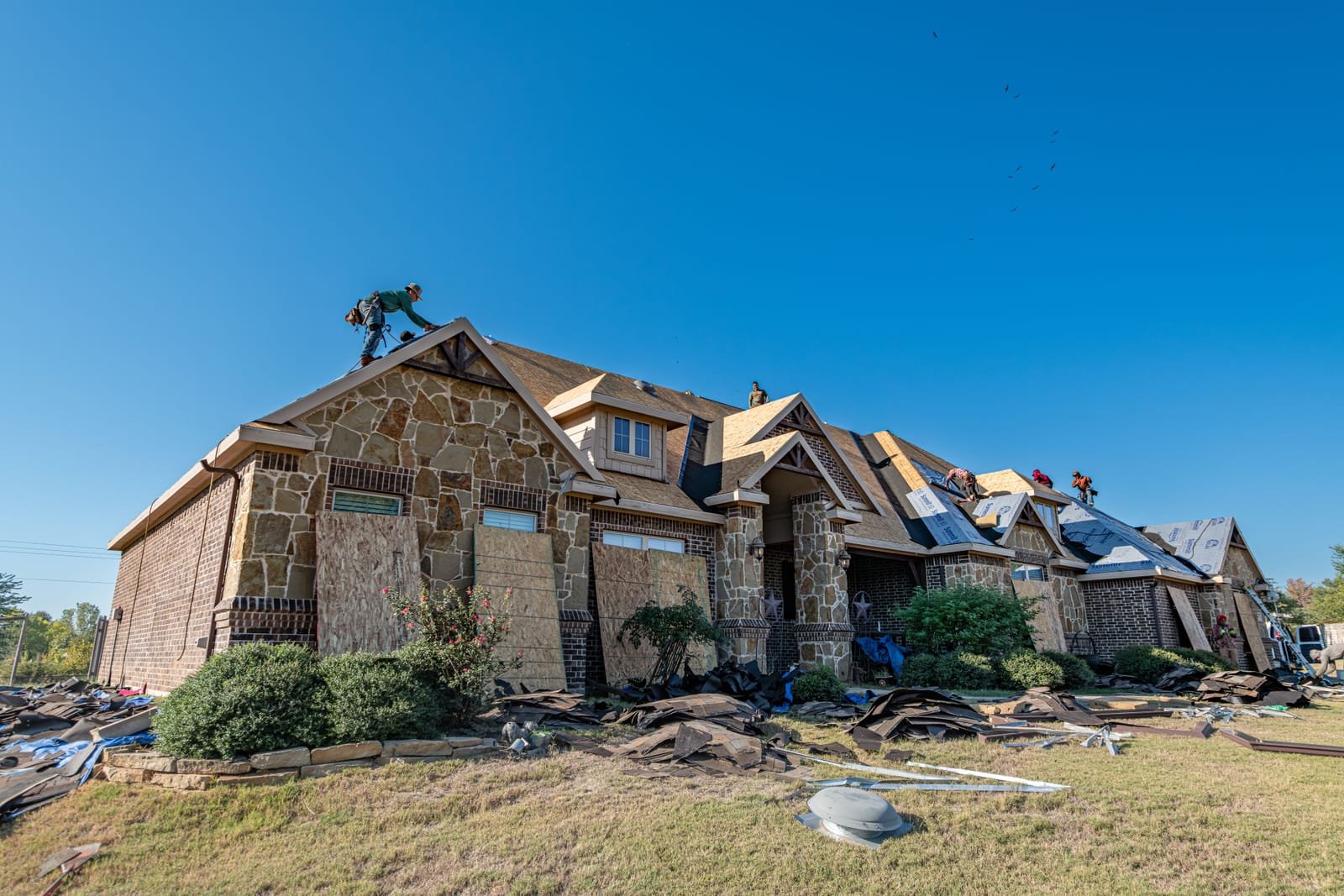 Roofers working along the ridge and slope of a brick house during a residential roof replacement under a clear sky. Photo: Ryan Stephens, via Pexels
Five checks before your next inspection
1. Pull your own citation history first. List every citation your company received in the last five years: the standard, the date the citation became a final order, and the abatement date. That list is what converts a serious violation into a repeated one, and the area office already keeps its own copy.
2. Turn each past citation into a physical control. A repeat is rarely a new hazard. It is a control that never got installed. For each entry on the list, name the thing that prevents it — the anchor point on the roof, the ladder extending three feet above the eave, the guardrail at the leading edge — then confirm it exists on site today, not only in the written program.
3. Check that harnesses are connected to something. Harnesses worn but not tied off is the fact pattern in the Oregon case, and it is a common one. A personal fall arrest system is a system: anchorage, connectors and body harness. With any one of the three missing, there is no system, and the finding is the same as if nobody wore anything.
4. Print one training certification record at random. Pick an employee and produce the record required by 1926.503(b)(1): identity, dates of training, signature. If it takes more than a minute, the record does not work. Under the standard that certification is not merely evidence that training happened, it is how the employer verifies compliance, and paragraph (b)(2) requires the latest one to be maintained.
5. Book the free consultation instead of waiting for the inspection. OSHA's On-Site Consultation Program is delivered by state agencies and universities, is free, is aimed primarily at smaller businesses, and is separate from OSHA enforcement. For the hazards most likely to appear on a jobsite list, start with the safety standards that apply in construction.
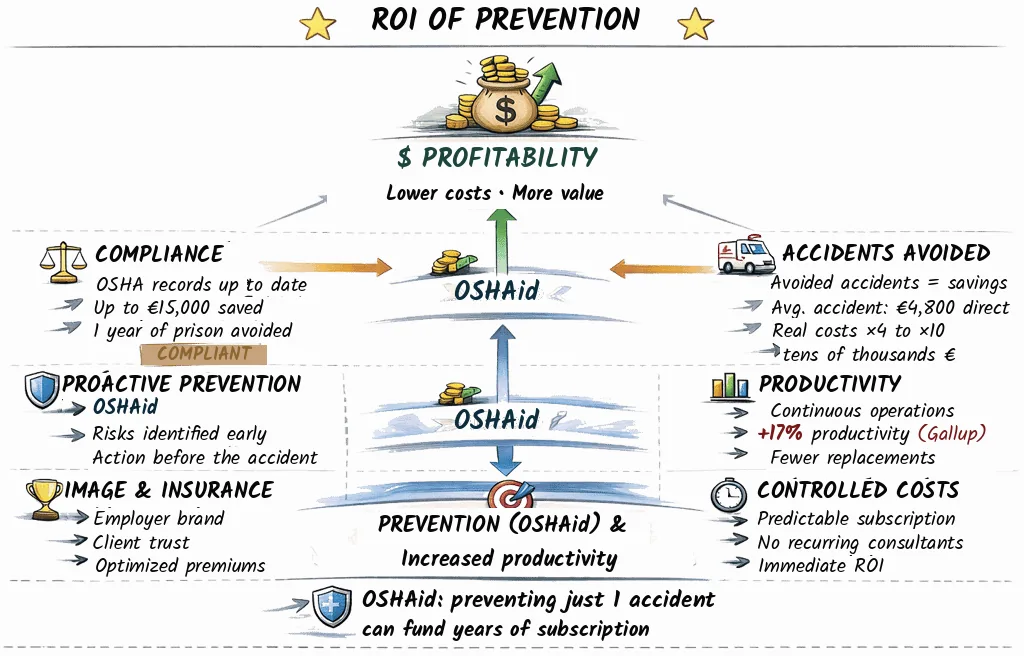 OSHAid whiteboard: what prevention costs against what an accident costs, sketched side by side
A record you can show beats a history you explain
A repeat classification is a statement about your records as much as your jobsite: OSHA is saying it has seen this condition at your company before. The way out is not a thicker binder. It is being able to show, on the day someone asks, that every past citation has a named control, a date on which that control was verified, and a training record behind the people doing the work. That is the difference between a safety program you defend and one you can put in front of a client, an insurer or a compliance officer. The Oregon contractor corrected two of the three violations before the announcement went out. The harder question, and the one a repeat classification asks, is what keeps them corrected after the inspector leaves.
Questions safety officers ask
- What is an OSHA repeat violation?
OSHA cites a repeated violation when the employer was previously cited for the same or a substantially similar condition or hazard and that citation became a final order of the Review Commission before the new violation. OSHA policy applies a five-year window, running from the final order or final abatement date.
- How much is the penalty for an OSHA repeat violation?
- Do state OSHA citations count toward a federal repeat violation?
About this article
Written by the OSHAid Safety Desk from official sources (OSHA news releases, the text of the standards, BLS and NIOSH data), checked against those sources and reviewed before publication. It explains what a rule says; it is not legal advice for your situation. OSHAid
Keep your fall protection records in one place
Create a free OSHAid account and keep your hazards, audits, corrective actions and compliance documents in one place. No commitment.
Create my accountFreeDownload on theApp StoreGET IT ONGoogle PlayThe intelligent OSHA companion that automates your field compliance. Mobile app + web console + specialized safety AI agent, built for US workplaces.
🇫🇷 Hosted in EuropeGDPR CompliantProductIndustriesGuides- OSHA compliance software
- Hazard assessment guide
- Safety program templates
- JHA examples
- OSHA requirements
- OSHA recordkeeping
- OSHA standards by industry
- Workplace hazards
- Get started
- What is OSHA?
- Workplace safety glossary
- Why OSHAid?
- Enterprise solutions
- About
- Blog
- Legal notice
© 2026 OSHAid - published by DUOPP (SAS). All rights reserved.