 OSHAidProductsDemosIndustriesPricingMoreClient accessCreate my accountFree🇺🇸ENCreate my accountBack to blogEnforcementOctober 18, 2026· By the OSHAid Safety Desk
OSHA multi-employer citation policy: who gets cited on a shared site
OSHA cited six construction employers after inspecting one excavation in Monroe, New York, with $648,094 in proposed penalties. The general contractor's share was not the largest.
In a news release dated October 13, 2026, OSHA announced citations against six construction employers after inspecting a single excavation at a mixed-use project in Monroe, New York. The proposed penalties total $648,094, spread across a general contractor and five subcontractors.
Six companies, one hole in the ground. That arithmetic comes from the OSHA multi-employer citation policy, a directive in force since 1999 under which more than one employer can be cited for the same hazardous condition.
If you bring subcontractors onto your site, or you are the subcontractor, this is the policy that decides whose name goes on the citation — not simply whoever owns the project, and not only whoever created the hazard.
Here is what the directive says, what the Monroe citations show, and what to check before your next shared jobsite.
What the OSHA multi-employer citation policy says
Two steps, four roles. OSHA's Multi-Employer Citation Policy, CPL 02-00-124, effective December 10, 1999, states that on multi-employer worksites, in all industry sectors, more than one employer may be citable for a hazardous condition that violates an OSHA standard. A compliance officer works through it in two steps: first decide which role the employer holds, then decide whether what it did met the obligations of that role. One company can hold more than one role at once.
Creating employer: the employer that caused a hazardous condition that violates an OSHA standard. It can be cited even when the only workers exposed belong to another company.
Exposing employer: an employer whose own employees are exposed to the hazard. If it created the condition, it is cited as a creating employer. If someone else created it, the exposing employer is expected to use whatever authority it has to protect its people, and where it has none, to ask the creating or controlling employer to fix the hazard, warn its own crew, and take reasonable alternative protective measures.
Correcting employer: an employer on the same site, in a common undertaking with the exposing employer, responsible for correcting a hazard — usually the one installing or maintaining safety equipment.
Controlling employer: the employer with general supervisory authority over the worksite, including the power to correct safety and health violations itself or require others to correct them. That authority can come from the contract or from the way the company actually runs the site. Its duty is reasonable care to prevent and detect violations, which the directive says plainly is a lesser duty than the one an employer owes its own employees. How closely it must look depends on the scale of the project, how quickly the work and its hazards change, and what it already knows about the other employer's safety performance.
What the Monroe citations show. OSHA's news release, numbered 26-1530-NEW and listed in the newsroom under October 16, 2026, says inspectors responded to an allegation of struck-by and collapse hazards at an 18-acre mixed-use project and found an embankment close to 75 feet high, not adequately sloped or shored. OSHA issued 23 serious and 5 willful citations across the six employers. The spread matters: the general contractor, Advanced Plan and Build LLC, was proposed $175,444, while two subcontractors were proposed $198,615 and $188,684. Holding the contract did not make the general contractor the only employer cited, and subcontracting did not make anyone's exposure cheaper. The citations are proposed, not final: each employer has 15 business days from receipt to comply, request an informal conference with OSHA's area director, or contest them before the independent Occupational Safety and Health Review Commission.
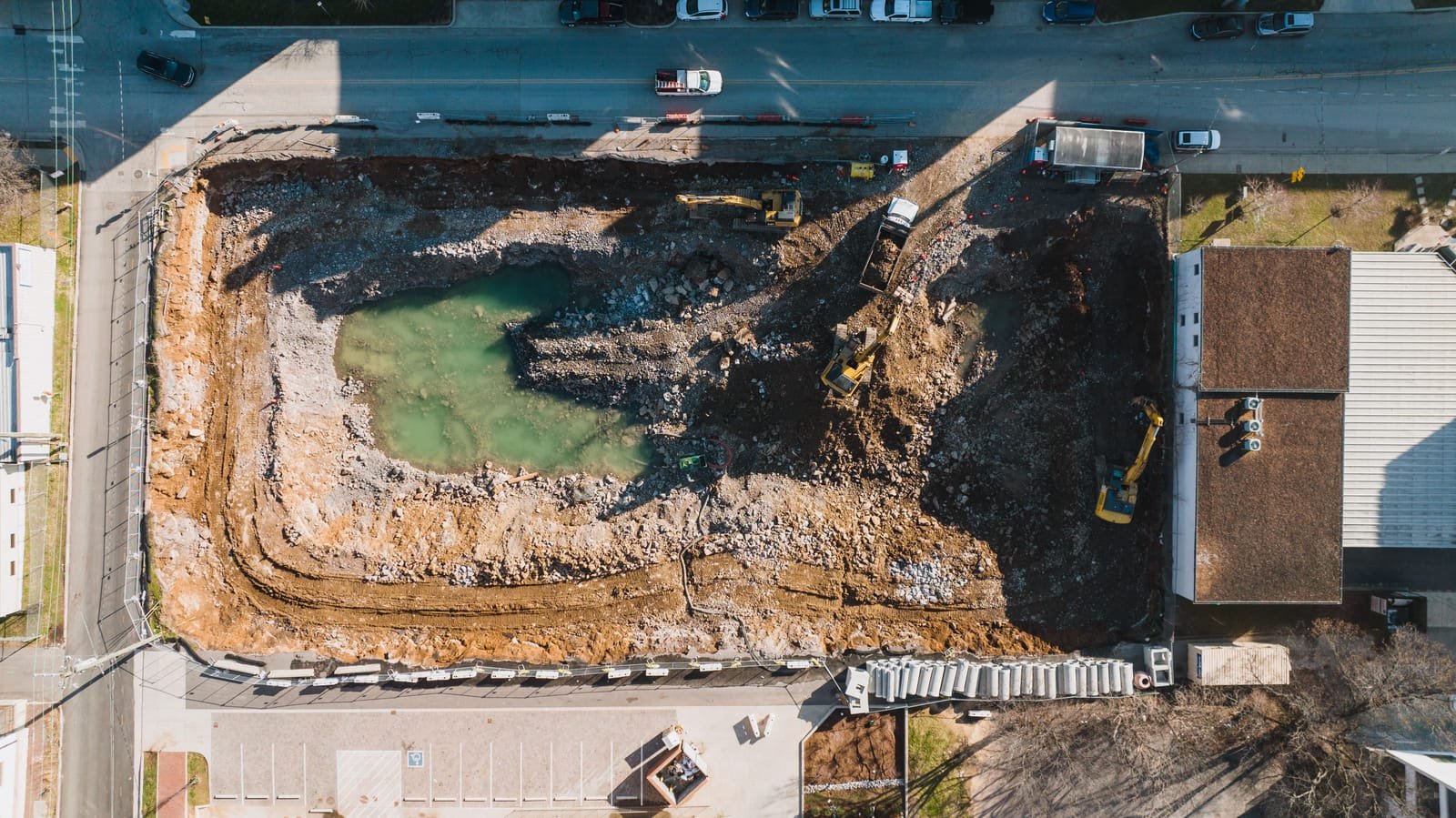 Top-down drone view of an urban excavation site in Nashville, Tennessee, where several excavators and trucks work the same open pit beside a city street. Photo: K, via Pexels
Five checks before your next shared jobsite
1. Decide, in writing, who the controlling employer is. The directive takes that authority from the contract or from practice, so leaving it unwritten does not avoid the role; it only means OSHA reads your site to decide who held it. Name the company, the person on site, and what they can stop.
2. Give the daily excavation inspection to someone who can halt work. Under 29 CFR 1926.651(k)(1), a competent person inspects the excavation, the adjacent areas and the protective systems daily for evidence of possible cave-ins, failing protective systems, hazardous atmospheres or other hazardous conditions, before the start of work and as needed through the shift, and again after every rainstorm or other hazard-increasing occurrence. 29 CFR 1926.32(f) defines that competent person as one capable of identifying those hazards and authorized to take prompt corrective measures to eliminate them. If your inspector must phone the office before clearing the trench, you have not designated one.
3. Know the depth at which an engineer stops being optional. Appendix F to Subpart P of Part 1926 states that protective systems for excavations more than 20 feet deep must be designed by a registered professional engineer. The design is written, names the engineer who approved it, and one copy stays at the jobsite while the system is in place, under 1926.652(b)(4) and (c)(4). Below that depth there are cheaper routes — allowable slopes, the appendix tables, tabulated data — but each is still a choice you must be able to show. Every paragraph here was read in the eCFR with Title 29 current as of October 15, 2026.
4. Protect against what falls as well as what collapses. 29 CFR 1926.651(j)(1) requires protection from loose rock or soil that could fall or roll from an excavation face: scaling, barricades on the face, or equivalent means. Paragraph (j)(2) keeps spoil and equipment at least 2 feet back from the edge, or behind retaining devices. Those are the struck-by hazards sitting beside the cave-in hazard in the same hole — the hazards a construction site produces, written as a standard.
5. When you cannot fix a hazard yourself, record that you asked. That is the exposing employer's path out, and it exists only as a record: the request to the controlling or creating employer, the date, what you told your crew, and the alternative protection you used meanwhile. A written hazard assessment is where it belongs, because it already names the hazard you are asking someone else to correct.
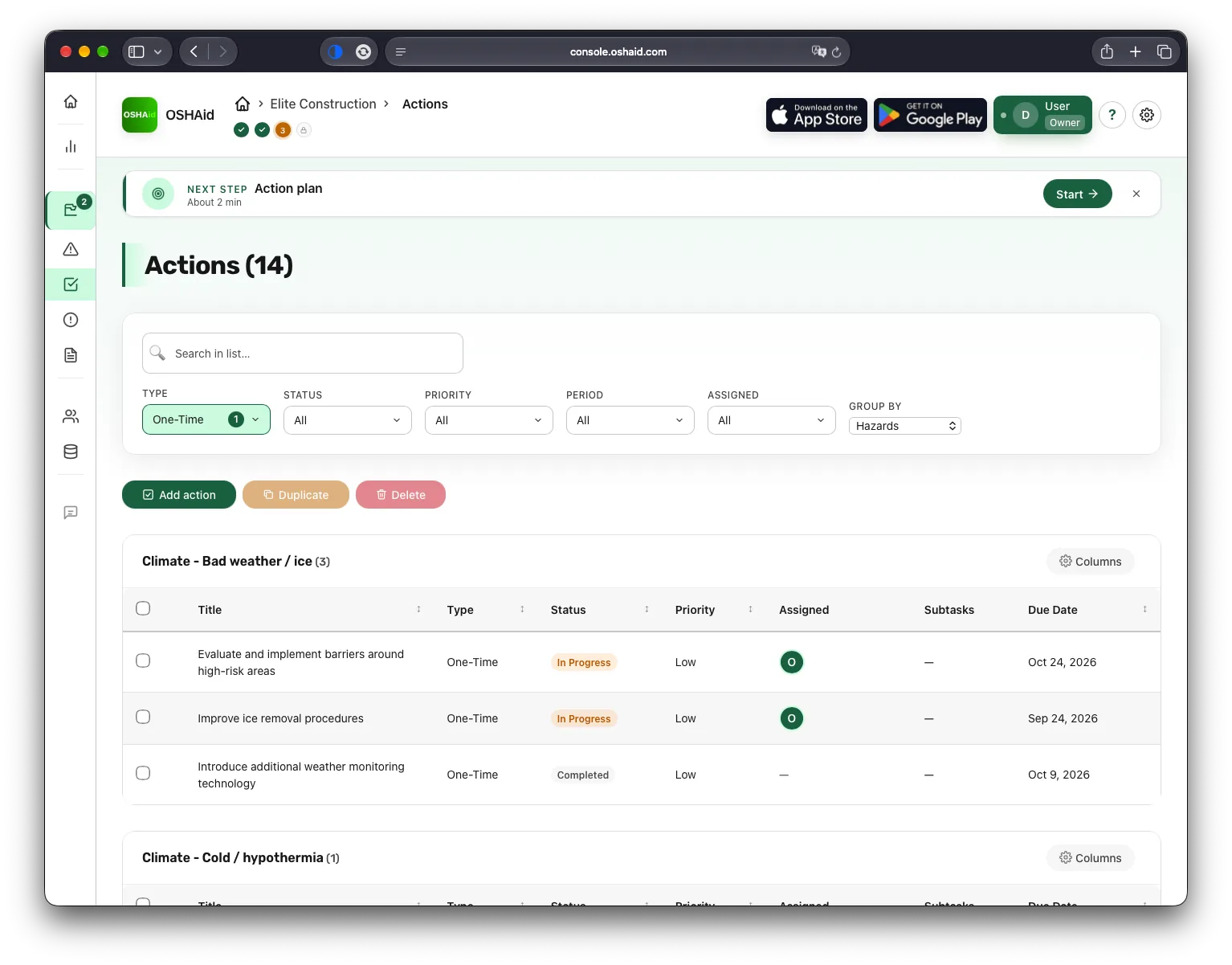 OSHAid console, the corrective actions table: each action with its owner, due date and status
On a shared site, the record is the defense
Multi-employer citations turn on what each company knew and did, and a year later nobody remembers either without a record. The general contractor who can produce the dates of its site walks, the subcontractor who can produce the email asking for the trench to be sloped, the correcting employer who can produce the install sheet for the shoring — each answers the second step of the directive before it is asked. That is a different position from arguing about the contract after the citation arrives, and it is the version a client, an insurer or a leadership team can be shown.
Questions safety officers ask
- Can a general contractor be cited for a subcontractor's OSHA violation?
Yes. Under OSHA's enforcement directive CPL 02-00-124, more than one employer may be citable for the same hazardous condition. A controlling employer with general supervisory authority over the site must exercise reasonable care to prevent and detect violations, even where only another employer's workers are exposed.
- What is a controlling employer under OSHA?
- How deep can an excavation be before OSHA requires an engineer?
About this article
Written by the OSHAid Safety Desk from official sources (OSHA news releases, the text of the standards, BLS and NIOSH data), checked against those sources and reviewed before publication. It explains what a rule says; it is not legal advice for your situation. OSHAid
Keep your jobsite records in one place
Create a free OSHAid account and keep your hazards, audits, corrective actions and compliance documents in one place. No commitment.
Create my accountFreeDownload on theApp StoreGET IT ONGoogle PlayThe intelligent OSHA companion that automates your field compliance. Mobile app + web console + specialized safety AI agent, built for US workplaces.
🇫🇷 Hosted in EuropeGDPR CompliantProductIndustriesGuides- OSHA compliance software
- Hazard assessment guide
- Safety program templates
- JHA examples
- OSHA requirements
- OSHA recordkeeping
- OSHA standards by industry
- Workplace hazards
- Get started
- What is OSHA?
- Workplace safety glossary
- Why OSHAid?
- Enterprise solutions
- About
- Blog
- Legal notice
© 2026 OSHAid - published by DUOPP (SAS). All rights reserved.