 OSHAidProductsDemosIndustriesPricingMoreClient accessCreate my accountFree🇺🇸ENCreate my accountBack to blogFundamentalsOctober 19, 2026· By the OSHAid Safety Desk
OSHA fire extinguisher requirements: placement, checks and annual training
OSHA's October 14 QuickTakes names October Fire Prevention Month and opens its fire safety list with four words: have a fire extinguisher. The standard behind them asks for more.
OSHA's QuickTakes newsletter of October 14, 2026 names October Fire Prevention Month and lists an October 20 Passport to Safety and Health webinar, Fire Safety in the Workplace. Its Six Keys to Fire Safety item starts the list with the simplest line on it: have a fire extinguisher.
The OSHA fire extinguisher requirements behind that line sit in 29 CFR 1910.157, and they ask for more than a red cylinder on a bracket. The standard sets where extinguishers go, how far an employee may have to walk to reach one, who inspects them and how often, and what you have to teach people every year.
It also holds the paragraph most employers never read: the one that releases you from nearly all of it, if you make a different decision and put it in writing.
Here is what the standard says, read in the eCFR with Title 29 current as of October 15, 2026, and what to check this week.
What the OSHA fire extinguisher requirements actually say
Provide, mount, identify. 29 CFR 1910.157(c)(1) states that the employer shall provide portable fire extinguishers and shall mount, locate and identify them so that they are readily accessible to employees without subjecting the employees to possible injury. Paragraph (c)(4) keeps them fully charged, operable and in their designated places at all times except during use. Only approved extinguishers count, and extinguishers using carbon tetrachloride or chlorobromomethane may not be provided at all.
Travel distance is a rule, not a preference. Paragraph (d) fixes how far an employee may travel to reach an extinguisher: 75 feet or less for Class A fires, 50 feet or less from a Class B hazard area, and 75 feet or less from a combustible metal working area to a Class D extinguishing agent. Class C extinguishers follow the pattern of the Class A or Class B hazards already in the area.
Monthly eyes, annual hands. Under paragraph (e), the employer is responsible for the inspection, maintenance and testing of every portable extinguisher in the workplace. Each one is visually inspected monthly. Each one also gets an annual maintenance check, and the employer records the annual maintenance date and retains that record for one year after the last entry or the life of the shell, whichever is less, available to the Assistant Secretary on request. Stored pressure dry chemical extinguishers that need a 12-year hydrostatic test are emptied and maintained every 6 years. When an extinguisher goes out for service, equivalent protection takes its place.
Training is annual, and it covers two groups. Paragraph (g) requires an educational program on the general principles of extinguisher use and the hazards of incipient stage fire fighting wherever extinguishers are provided for employee use, given on initial employment and at least annually after that. Employees designated under an emergency action plan to use firefighting equipment get training in that equipment, on initial assignment and at least annually.
The exemption nobody reads. Paragraph (b)(1) exempts an employer from the whole section when it has established and implemented a written fire safety policy requiring the immediate and total evacuation of employees on the fire alarm, with an emergency action plan meeting 29 CFR 1910.38 and a fire prevention plan meeting 29 CFR 1910.39, and extinguishers are not available in the workplace, unless a specific standard in part 1910 requires one. A narrower version, paragraph (b)(2), drops only the distribution rules where the plan names certain employees as the only ones authorized to use the extinguishers. Evacuate-only is a legitimate choice. It is only legitimate in writing.
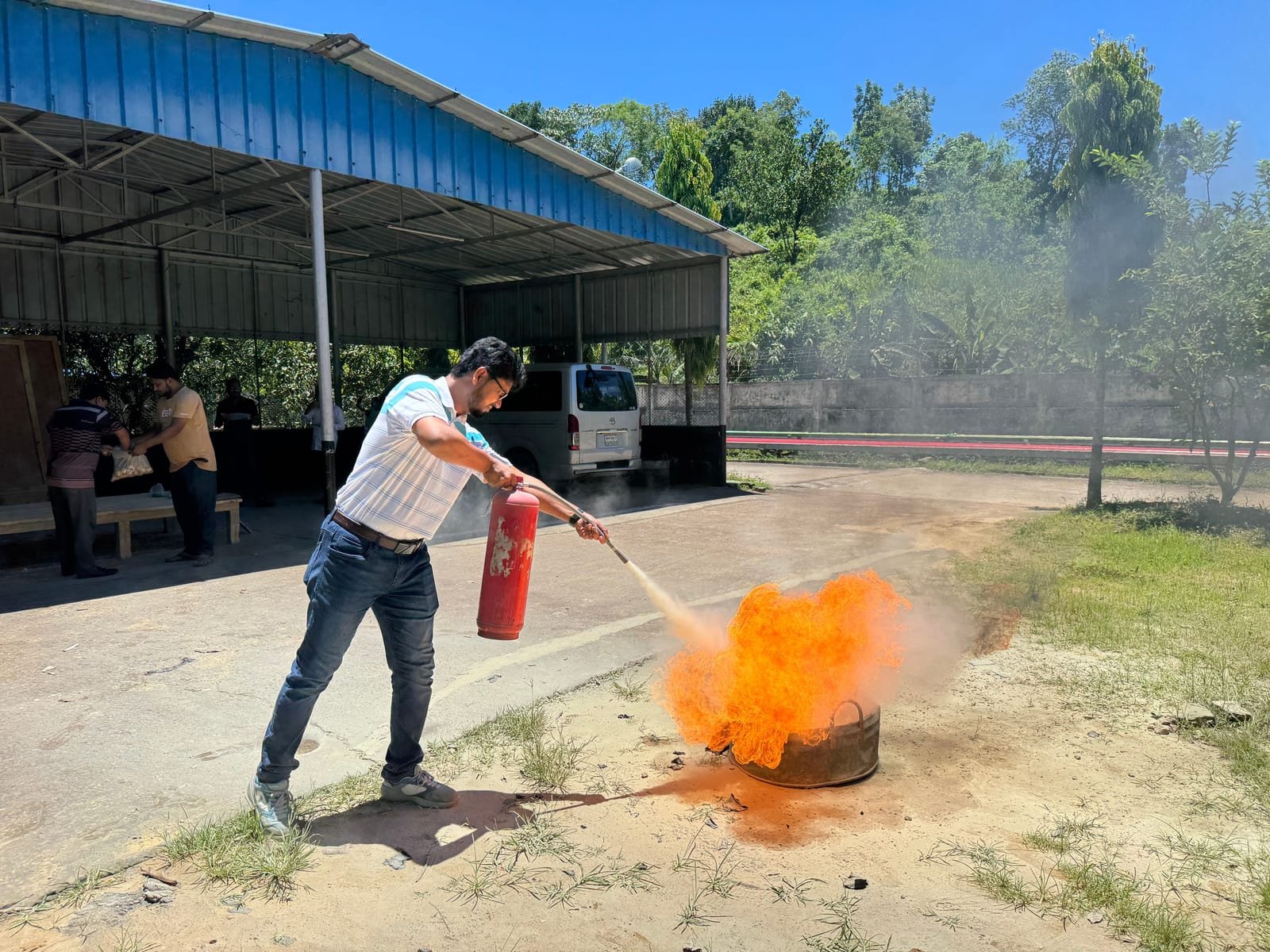 A worker discharges a portable fire extinguisher onto a small controlled training fire in an open yard. Photo: Shutterbug Aminul, via Pexels
Five checks to run this week
1. Walk the distance instead of estimating it. Pace the longest path a worker would really take from a Class A hazard to the nearest extinguisher, through the doorways and around the racking that path actually has. Then do it at 50 feet for your Class B areas: flammable liquids, solvents, grease.
2. Read the tag, then find the record. The monthly visual inspection and the annual maintenance check are two different obligations, and only the annual one leaves a record you must keep for a year. If your service vendor holds the only copy, you cannot produce it when an inspector asks.
3. Decide fight or evacuate, on paper. If the answer is evacuate, paragraph (b)(1) expects the written policy, the emergency action plan, the fire prevention plan, and no extinguishers available for employee use. Most workplaces keep extinguishers, so the annual education in paragraph (g) applies to them. Choose deliberately and build the written safety program that matches the choice you made.
4. Put the annual education on a date. At least annually is a date, not an intention. The same session is where you tell people which fires not to fight, which is the other half of what paragraph (g) asks you to cover.
5. Clear the exit route while you are standing there. 29 CFR 1910.37(a)(3) states that no materials or equipment may be placed, either permanently or temporarily, within the exit route, and that exit routes may not pass through rooms that can be locked or lead into dead-end corridors. Each exit must be marked by a sign reading Exit, in letters at least 6 inches high with principal strokes at least three-quarters of an inch wide, under paragraphs (b)(2) and (b)(7). Where hot surfaces and grease are part of the daily job, that walk is worth the ten minutes it takes before service starts.
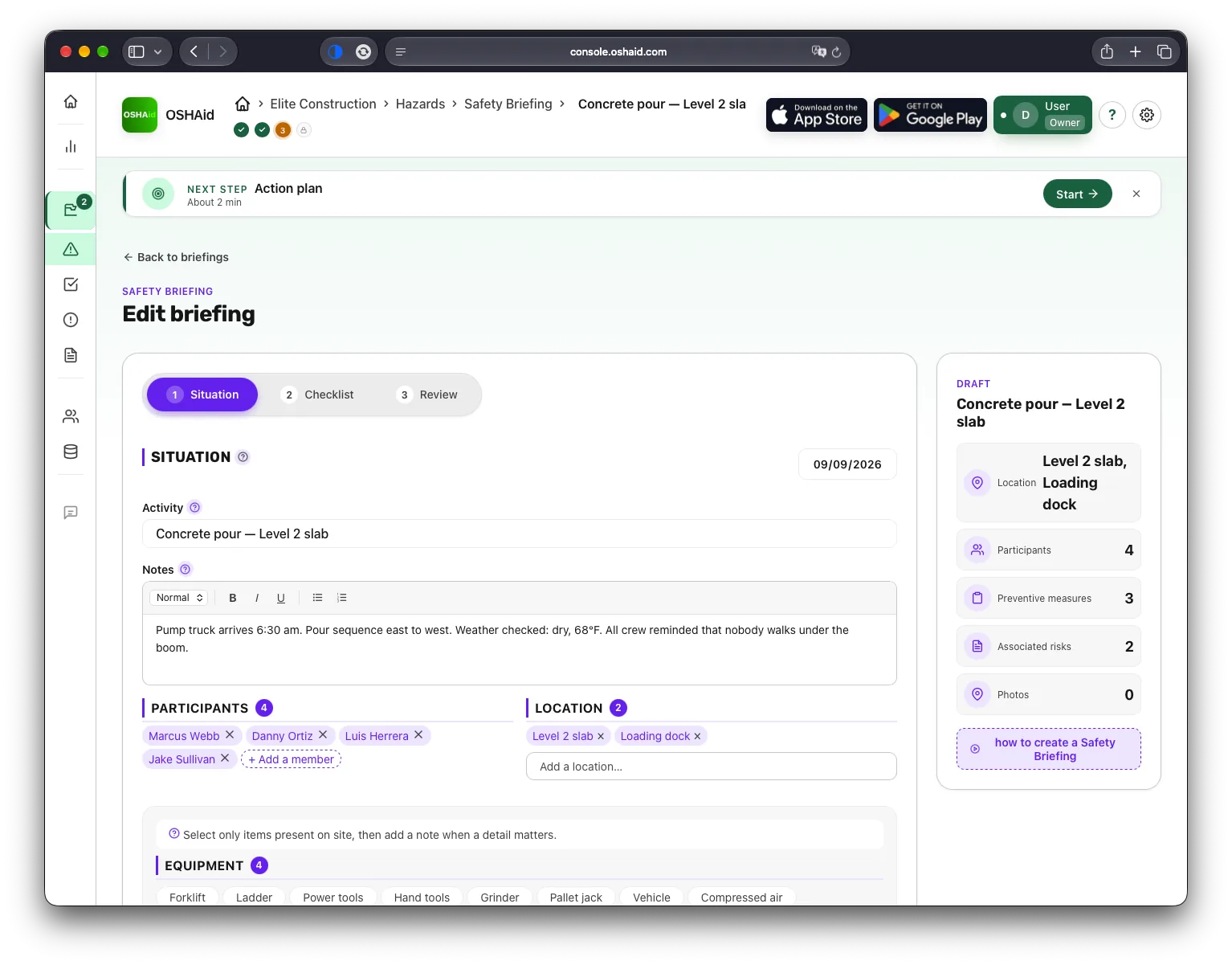 OSHAid console, the safety briefing editor: a training session prepared, assigned and dated for the crew
Fire readiness is a record, not a red cylinder
Every requirement in 1910.157 leaves a trace, and that is the point. The monthly inspection, the annual maintenance date, the training session with names against it, the written policy that says whether your crew fights a fire or leaves the building: each one is a document you can hand to a client, an insurer or your leadership team without preparing an explanation first. Fire Prevention Month is a reasonable deadline to make them exist, because the month a fire starts is not the month to start looking for them.
Questions safety officers ask
- Does OSHA require fire extinguishers in the workplace?
Where extinguishers are provided for employee use, 29 CFR 1910.157(c)(1) requires the employer to mount, locate and identify them so they are readily accessible. An employer is exempt from the section when a written policy requires immediate total evacuation, an emergency action plan and fire prevention plan exist, and no extinguishers are available.
- How often does OSHA require fire extinguisher inspections?
- Is fire extinguisher training required every year?
About this article
Written by the OSHAid Safety Desk from official sources (OSHA news releases, the text of the standards, BLS and NIOSH data), checked against those sources and reviewed before publication. It explains what a rule says; it is not legal advice for your situation. OSHAid
Keep your fire safety records where you can find them
Create a free OSHAid account and keep your hazards, audits, training sessions and compliance documents in one place. No commitment.
Create my accountFreeDownload on theApp StoreGET IT ONGoogle PlayThe intelligent OSHA companion that automates your field compliance. Mobile app + web console + specialized safety AI agent, built for US workplaces.
🇫🇷 Hosted in EuropeGDPR CompliantProductIndustriesGuides- OSHA compliance software
- Hazard assessment guide
- Safety program templates
- JHA examples
- OSHA requirements
- OSHA recordkeeping
- OSHA standards by industry
- Workplace hazards
- Get started
- What is OSHA?
- Workplace safety glossary
- Why OSHAid?
- Enterprise solutions
- About
- Blog
- Legal notice
© 2026 OSHAid - published by DUOPP (SAS). All rights reserved.