 OSHAidProductsDemosIndustriesPricingMoreClient accessCreate my accountFree🇺🇸ENCreate my accountBack to blogState ruleOctober 4, 2026· By the OSHAid Safety Desk
Indoor heat illness prevention: everything starts at 82 degrees
Cal/OSHA issued another high-heat advisory on October 2. The indoor standard behind it has applied since July 2024 to restaurants, warehouses and manufacturing plants, on any day the thermometer reaches 82.
Indoor heat illness prevention does not begin with a heat wave. In California it begins with a number: 82 degrees Fahrenheit, measured where your people actually work.
On October 2, 2026, Cal/OSHA published an advisory on high heat across California. An extreme heat warning covers the Los Angeles and San Diego regions through 8 p.m. on Thursday, October 8, with forecast highs from the mid-90s on the coast to 107 in the valleys, and advisories run through the week in the Bay Area, the San Joaquin Valley and the Sacramento Valley.
The advisory is seasonal. The standard behind it is not. Cal/OSHA's indoor heat rule has been operative since July 23, 2024, and it does not wait for a forecast: it applies to restaurants, warehouses and manufacturing plants on any day the temperature where people work reaches 82, including days nobody outside would call hot.
What indoor heat illness prevention requires at 82 degrees
The rule is Title 8, section 3396, Heat Illness Prevention in Indoor Places of Employment. It applies to all indoor work areas where the temperature equals or exceeds 82 degrees Fahrenheit when employees are present.
A few situations are carved out: teleworking from a place of the employee's own choosing, emergency operations to protect life or property, and incidental exposure of less than 15 minutes in any 60-minute period between 82 and 95 degrees. That last exception does not cover vehicles without effective and functioning air conditioning, or shipping and intermodal containers during loading and unloading.
Everywhere else, four duties attach at 82.
Water. Where drinking water is not plumbed or continuously supplied, provide enough at the start of the shift for one quart per employee per hour, for the whole shift. It must be fresh, pure, suitably cool and free of charge.
Cool-down areas, one or more, maintained at all times while employees are present, big enough for everyone on a rest or meal period to sit in a normal posture without being in physical contact. They must stay below 82 degrees unless you can show that is infeasible. An employee taking a preventative cool-down rest has to be monitored, asked whether they have symptoms, and not sent back to work until the signs have abated — and in no event in less than five minutes.
Training before the exposure, for supervisors and non-supervisors alike: risk factors, your own procedures, drinking small quantities often, up to four cups an hour, acclimatization, the signs of each type of heat illness, and the duty to report symptoms immediately. Supervisors also learn how to read weather reports and respond to hot-weather advisories.
A written Heat Illness Prevention Plan, in English and in the language understood by the majority of your employees, available at the worksite. It can sit inside your Injury and Illness Prevention Program.
A second tier starts higher. Section 3396(e) applies once the temperature or the heat index reaches 87 degrees, or at 82 degrees where employees wear clothing that restricts heat removal or work in a high radiant heat area. Then you measure the temperature and the heat index, record whichever is greater with the date, time and specific location, keep those records for 12 months or until the next readings, and bring the heat down with engineering controls first, administrative controls second and personal heat-protective equipment last.
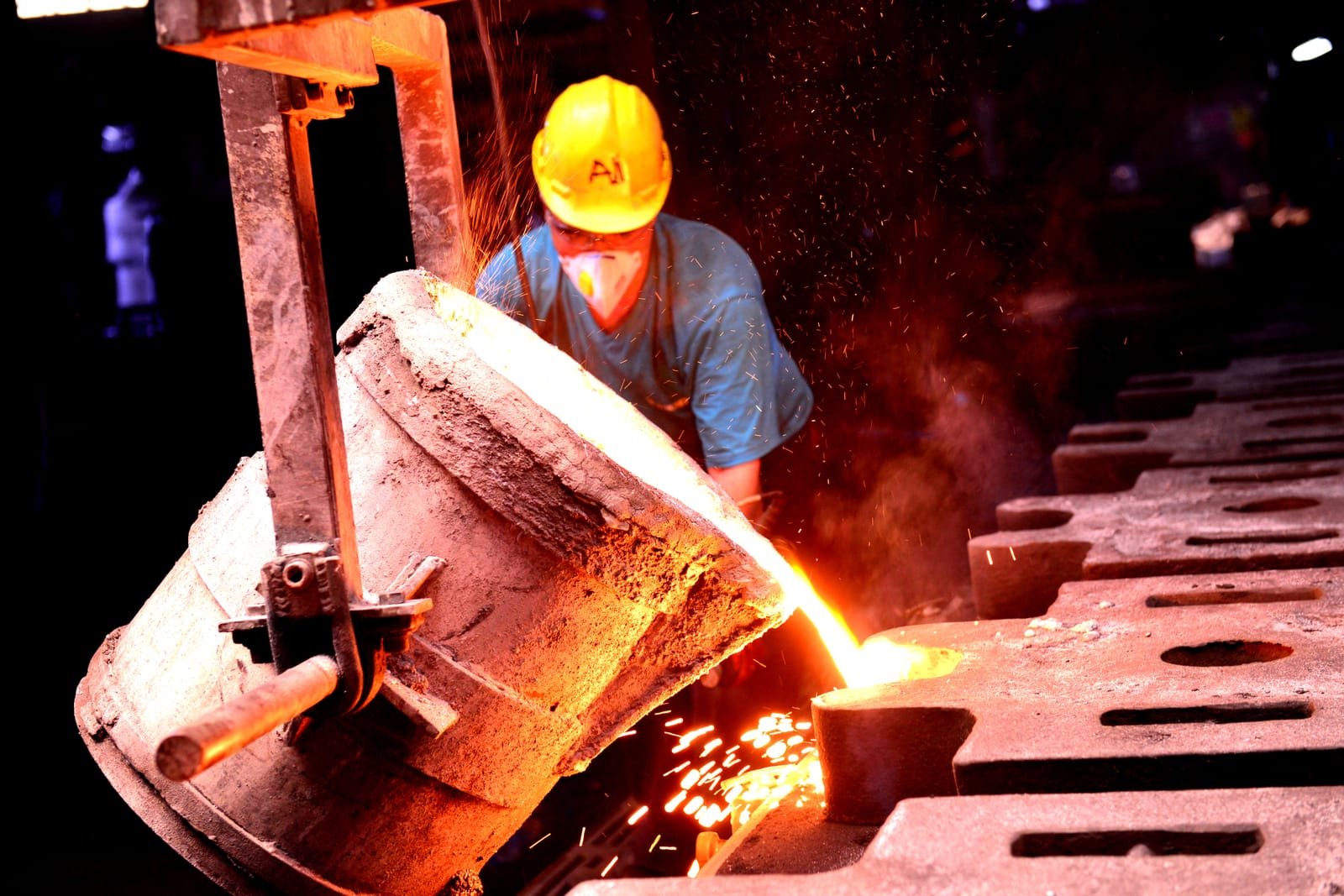 A foundry worker in a hard hat and respirator tips a ladle of molten metal into a row of moulds, sparks flying. Photo: enes cimen, via Pexels
Five checks to run in your workplace this week
1. Measure where the work happens. Not by the door, not in the office. Take the first reading when you have reason to suspect the thresholds are met, at the time of day exposure is worst, and take it again whenever conditions are expected to run 10 degrees or more above the last one. Section 3396 also lets you skip the readings and simply assume the area is covered — but then the control measures apply in full.
2. Decide what the plan covers before the next hot day. Water, access to cool-down areas, how you measure and control the heat, your emergency response and your acclimatization procedures: those five items are what the written plan must contain. Build it the way you build the rest of your written safety programs, in both required languages.
3. Fix the cool-down area, not just its location. An area does not count if the sun or a radiant source defeats the purpose of cooling down, if conditions there are unsafe, or if employees are discouraged from using it. A break room nobody is allowed to sit in during a rush is not a cool-down area.
4. Watch the new people for 14 days. Anyone newly assigned to a work area at or above the section 3396(e) thresholds must be closely observed by a supervisor or designee for the first 14 days. During a heat wave — a day whose predicted high is at least 80 degrees and at least 10 degrees above the average high of the five preceding days — all employees must be closely observed wherever no effective engineering control is holding the temperature down.
5. Check whether the outdoor standard applies too. Many employers are covered by both. Under Title 8, section 3395, shade must be present outdoors once the temperature exceeds 80 degrees, and high-heat procedures start at 95 degrees in agriculture, construction, landscaping, oil and gas extraction, and the transportation of agricultural products, construction materials or other heavy materials. A kitchen crew that also takes deliveries in the yard is in both worlds, which is why heat belongs in the same hazard review as everything else in a restaurant safety program.
Outside California there is no federal standard written for heat. Federal OSHA enforces heat through the General Duty Clause, section 5(a)(1) of the OSH Act, and its heat page encourages water, rest and shade as both prevention and treatment.
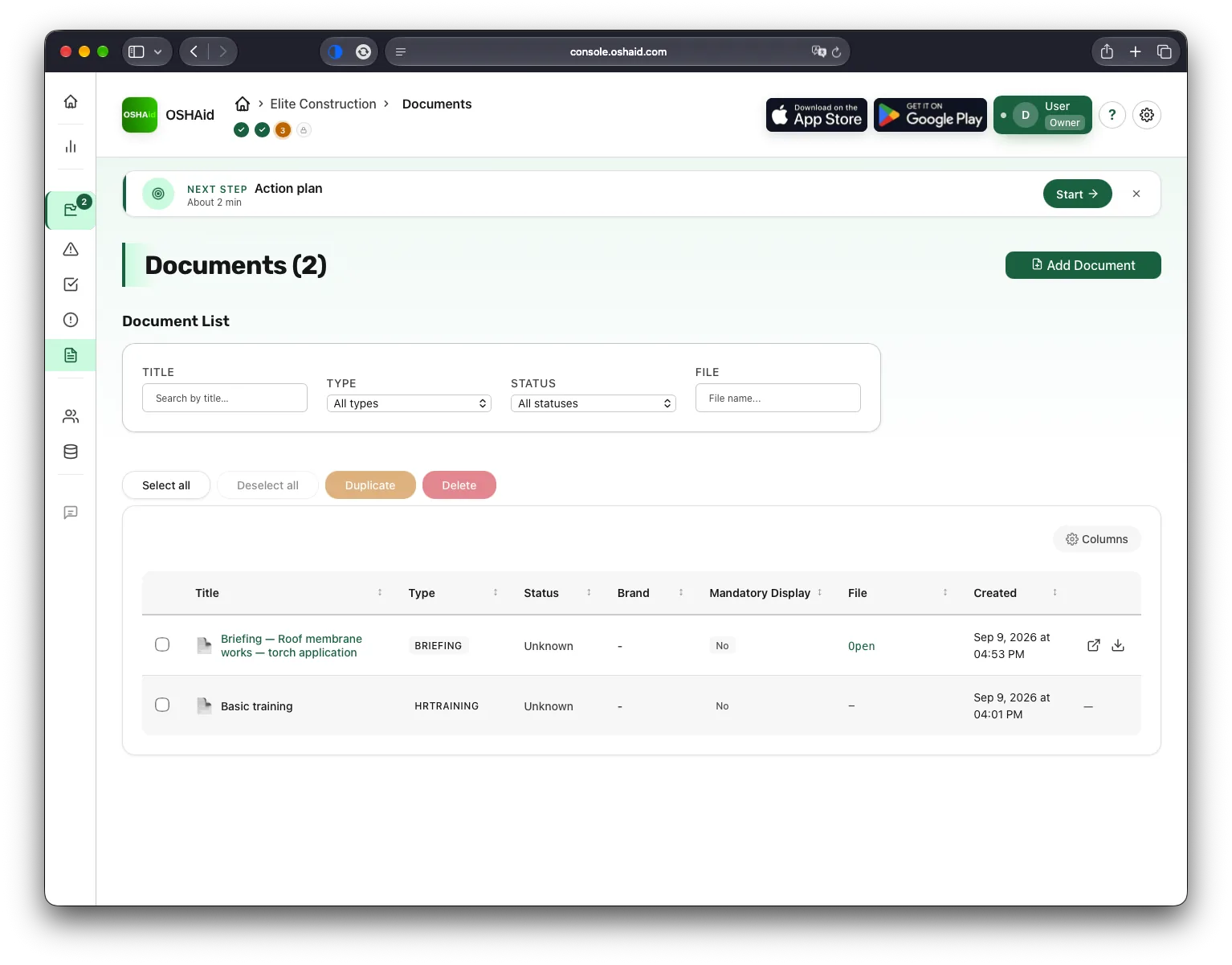 OSHAid console — the document library, where the written heat illness prevention plan sits with the rest of the safety programs
The plan is the proof
Heat is the rare hazard that announces itself. The thermometer is on the wall, the crew says it is hot, the advisory lands in your inbox. What is usually missing is not awareness but the record: the readings with their date, time and location, the plan in two languages, the training signed before the exposure, the names of the people watched through their first 14 days.
That record is the difference between an afternoon and a month when an inspector, a client or your own leadership asks what you did about the heat. Compliance is the floor. The point is a safety program you can put on a screen and show, rather than a binder you have to defend.
Questions safety officers ask
- At what temperature does California's indoor heat rule apply?
Section 3396 applies to every indoor work area where the temperature reaches 82 degrees Fahrenheit while employees are present. A second set of duties — measuring, recording and controlling the heat — starts at 87 degrees, or at 82 degrees where employees wear clothing that restricts heat removal or work in a high radiant heat area.
- Does a restaurant kitchen need a written heat illness prevention plan?
- Does federal OSHA have an indoor heat standard?
About this article
Written by the OSHAid Safety Desk from official sources (OSHA news releases, the text of the standards, BLS and NIOSH data), checked against those sources and reviewed before publication. It explains what a rule says; it is not legal advice for your situation. OSHAid
Keep your heat plan where you can show it
Create a free OSHAid account and keep your hazards, written programs, training records and corrective actions in one place. No commitment.
Create my accountFreeDownload on theApp StoreGET IT ONGoogle PlayThe intelligent OSHA companion that automates your field compliance. Mobile app + web console + specialized safety AI agent, built for US workplaces.
🇫🇷 Hosted in EuropeGDPR CompliantProductIndustriesGuides- OSHA compliance software
- Hazard assessment guide
- Safety program templates
- JHA examples
- OSHA requirements
- OSHA recordkeeping
- OSHA standards by industry
- Workplace hazards
- Get started
- What is OSHA?
- Workplace safety glossary
- Why OSHAid?
- Enterprise solutions
- About
- Blog
- Legal notice
© 2026 OSHAid - published by DUOPP (SAS). All rights reserved.