 OSHAidProductsDemosIndustriesPricingMoreClient accessCreate my accountFree🇺🇸ENCreate my accountBack to blogTrainingOctober 5, 2026· By the OSHAid Safety Desk
Free OSHA safety training: where small employers actually find it
On October 1, OSHA announced $10.2 million for 67 organizations that train workers and employers. The money is real, but it only pays off once you know which training your own standards already require.
Free OSHA safety training exists, and most small employers never go looking for it.
On October 1, 2026, the US Department of Labor announced approximately $10.2 million awarded to 67 organizations through OSHA's Susan Harwood Training Grant Program. The release says the funding supports instructor-led training and targets small businesses in industries with higher rates of injuries, illnesses and fatalities.
That is a resource, not an obligation. The obligation is older and quieter: a long list of OSHA standards that each require you to train the people exposed to a hazard, before they are exposed.
Free training only helps if you know which of those lines applies to your crew. So start with the second half of this post, and use the first half to pay for it.
Where free OSHA safety training actually comes from
Two federal channels matter to a small employer, and neither one is an inspection.
The Susan Harwood Training Grant Program. OSHA's grant program page describes it as support for training and education for employers and workers on preventing workplace hazards. Awards fall into three categories — Targeted Topic, Training and Educational Materials Development, and Capacity Building — and the page carries the list of FY2026 awardees announced on October 1.
The practical point is that the grantees are the ones who deliver. The October 1 release says the grants develop classroom-ready materials on hazard awareness, prevention and controls. If an awardee works in your industry, your state or the language your crew speaks, their training was built to be delivered to employers like you.
The program is named for Dr. Susan Harwood, who spent 17 years at OSHA developing guidelines on benzene, formaldehyde, bloodborne pathogens and lead in construction.
The On-Site Consultation Program. OSHA describes this service as no-cost and confidential, and states plainly that it is separate from OSHA enforcement. It is aimed primarily at smaller businesses. A consultant comes to your workplace, helps you find and fix hazards, and helps you establish or improve a safety and health program.
There is a condition attached, and it is the honest part of the deal: OSHA's page says employers commit to correcting serious safety hazards and implementing the other recommendations. You ask for the help, you act on what the visit finds. The route in is OSHA's consultation directory or the number 1-800-321-OSHA.
Neither channel changes what the standards require of you. That part does not move, and it is where most of the exposure sits.
 A safety officer with a clipboard briefing a worker in a hard hat on an open construction site. Photo: Mikael Blomkvist, via Pexels
Four moves to make this week
1. Write down the training your own standards already require. Not the catalogue — the standards that apply to the work your people actually do. Three examples, as the Code of Federal Regulations reads on October 1, 2026:
Hazard communication, 29 CFR 1910.1200(h)(1): train employees on the hazardous chemicals in their work area at the time of their initial assignment, and whenever a new chemical hazard they have not previously been trained about is introduced into that area.
Personal protective equipment, 29 CFR 1910.132(f): train each employee required to use PPE on when PPE is necessary, what PPE is necessary, how to don, doff, adjust and wear it, its limitations, and its care, maintenance, useful life and disposal. Each employee has to demonstrate an understanding of that training, and the ability to use the PPE properly, before being allowed to perform work that requires it.
Lockout/tagout, 29 CFR 1910.147(c)(7): training so that the purpose and function of the energy control program are understood, with retraining whenever a job assignment, a machine, a process or the energy control procedure changes.
Those are three lines out of many. If you are still mapping what OSHA compliance means for your business, that list of training duties is a good place to start, and the mandatory OSHA obligations page walks through the ones that reach almost every employer.
2. Check whether a Harwood grantee covers your trade. The FY2026 awardee list is on OSHA's Harwood page. Look for an organization working in your industry, your region, or the language your crew speaks, then ask what they are delivering this grant year.
3. Book the consultation in a quiet month. A no-cost consultation visit is worth far more before an inspection than during one, and the findings stay separate from enforcement. Go in with a list: the hazards you already know about, the written programs you have not finished, and the training you cannot prove.
4. Keep the proof. Training that cannot be shown did not happen, as far as a file review is concerned. Lockout/tagout is explicit about it: 1910.147(c)(7)(iv) requires the employer to certify that employee training has been accomplished and is being kept up to date, and that certification has to contain each employee's name and the dates of training. Keep the same record for every session — who was trained, when, on what — next to your written safety programs, not in a drawer.
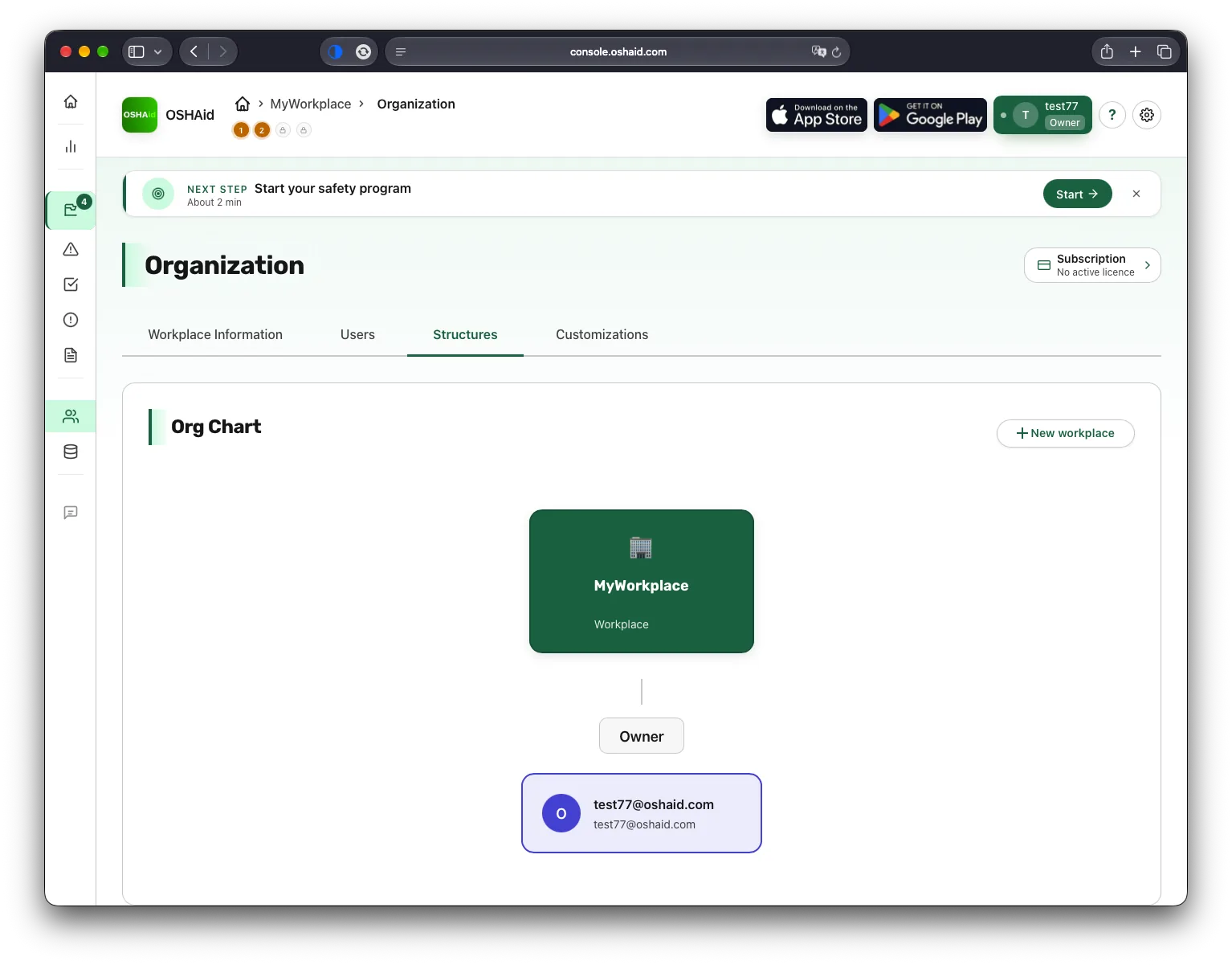 OSHAid console — workplaces and roles, where you see who does which job on which site before deciding who needs which training
Training you can show
The grant money is a reminder that OSHA would rather fund training than write citations. But a grant-funded class and a standard-required training are not the same object, and only one of them is yours to prove. The safety officer who can pull up, in a minute, which of their people were trained on which hazard and when, is the one who turns a question into a non-event — whether it comes from an inspector, a client's prequalification packet or a board meeting. Compliance is the floor. Above it, a safety program becomes something you show rather than a binder you defend.
Questions safety officers ask
- Is OSHA safety training free for small businesses?
Some of it is. OSHA funds outside organizations through the Susan Harwood Training Grant Program to deliver training to workers and employers, and its On-Site Consultation Program is described as no-cost, confidential and separate from OSHA enforcement, aimed primarily at smaller businesses.
- What is the Susan Harwood Training Grant Program?
- Does OSHA require me to keep training records?
About this article
Written by the OSHAid Safety Desk from official sources (OSHA news releases, the text of the standards, BLS and NIOSH data), checked against those sources and reviewed before publication. It explains what a rule says; it is not legal advice for your situation. OSHAid
Keep your training proof where you can show it
Create a free OSHAid account and keep your hazards, written programs, corrective actions and compliance documents in one place. No commitment.
Create my accountFreeDownload on theApp StoreGET IT ONGoogle PlayThe intelligent OSHA companion that automates your field compliance. Mobile app + web console + specialized safety AI agent, built for US workplaces.
🇫🇷 Hosted in EuropeGDPR CompliantProductIndustriesGuides- OSHA compliance software
- Hazard assessment guide
- Safety program templates
- JHA examples
- OSHA requirements
- OSHA recordkeeping
- OSHA standards by industry
- Workplace hazards
- Get started
- What is OSHA?
- Workplace safety glossary
- Why OSHAid?
- Enterprise solutions
- About
- Blog
- Legal notice
© 2026 OSHAid - published by DUOPP (SAS). All rights reserved.