 OSHAidProductsDemosIndustriesPricingMoreClient accessCreate my accountFree🇺🇸ENCreate my accountBack to blogFundamentalsOctober 6, 2026· By the OSHAid Safety Desk
Emergency action plan requirements: when OSHA actually makes you write one
29 CFR 1910.38 does not reach every workplace. It reaches the ones another standard sends there — and then it sets six elements, an alarm system, training and three review triggers.
Emergency action plan requirements trip up employers in both directions: some write a plan nobody asked for, and some skip one that a standard they already work under demands by name.
OSHA's rule is short. 29 CFR 1910.38 opens by saying an employer must have an emergency action plan whenever an OSHA standard in that part requires one. There is no blanket duty on every general-industry workplace.
So the first question is not what goes in the plan. It is whether one of the standards you already follow sends you to 1910.38 — and, if it does, whether your plan carries the six elements the section sets.
Everything below is quoted from the Code of Federal Regulations as it reads on October 2, 2026, the date eCFR shows Title 29 current to.
Emergency action plan requirements under 29 CFR 1910.38
Who is sent there. Paragraph (a) is the trigger: the requirements apply to each emergency action plan an OSHA standard in part 1910 requires. Two standards name it outright.
Process safety management of highly hazardous chemicals, 29 CFR 1910.119(n), tells the employer to establish and implement an emergency action plan for the entire plant in accordance with the provisions of 29 CFR 1910.38, and adds that the plan must include procedures for handling small releases.
Grain handling facilities, 29 CFR 1910.272(d), requires the employer to develop and implement an emergency action plan meeting the requirements contained in 29 CFR 1910.38.
A third route runs the other way, and it is the one most small employers can use. Under 29 CFR 1910.157(b), an employer who has established and implemented a written fire safety policy requiring the immediate and total evacuation of employees on the fire alarm signal, who has an emergency action plan and a fire prevention plan meeting 1910.38 and 1910.39, and who makes no extinguishers available in the workplace, is exempt from the portable fire extinguisher standard — unless a specific standard in part 1910 requires that an extinguisher be provided. A plan that instead designates certain employees as the only ones authorized to use the extinguishers on hand drops only the distribution requirements in 1910.157(d).
Written, with one exception. The plan must be in writing, kept in the workplace, and available to employees for review. An employer with 10 or fewer employees may communicate it orally.
The six elements. Paragraph (c) sets the minimum: procedures for reporting a fire or other emergency; procedures for emergency evacuation, including type of evacuation and exit route assignments; procedures for employees who remain to operate critical plant operations before they evacuate; procedures to account for all employees after evacuation; procedures for employees performing rescue or medical duties; and the name or job title of every employee who may be contacted for more information about the plan or an explanation of their duties under it.
Alarm, training, review. Paragraph (d) requires an employee alarm system with a distinctive signal for each purpose, complying with 1910.165. Paragraph (e) requires the employer to designate and train employees to assist in a safe and orderly evacuation. Paragraph (f) requires a review of the plan with each covered employee when the plan is developed or the employee is assigned initially to a job, when the employee's responsibilities under the plan change, and when the plan is changed.
 An illuminated green exit sign hanging beneath the exposed ducts and pipework of an industrial ceiling. Photo: Jakub Zerdzicki, via Pexels
Five checks to run this week
1. Decide whether a standard sends you to 1910.38. Work from what your people actually do, not from a catalogue. A documented workplace hazard assessment is the cleanest way to see which standards reach your operation, and it is the same inventory you will be asked to walk through later.
2. Read your plan against the six elements, one by one. Accounting for all employees after evacuation is the element most often thin in practice: who counts heads, where, and how the count gets reported. Rescue and medical duties is the second — if nobody is assigned to them, write what employees do instead.
3. Walk the exit routes instead of the floor plan. 29 CFR 1910.37 requires exit routes to be free and unobstructed, with no materials or equipment placed in them permanently or temporarily, and the exit access must not go through a room that can be locked, such as a bathroom, nor lead into a dead-end corridor. Each exit must be clearly visible and marked by a sign reading "Exit", in letters not less than six inches high. Each doorway along an exit access that could be mistaken for an exit must be marked "Not an Exit" or identified by a sign indicating its actual use. Sprinkler systems, alarm systems, fire doors and exit lighting must be in proper working order at all times.
4. Put names on the plan, not departments. The sixth element asks for the name or job title of every employee who may be contacted about the plan. Pair it with the evacuation assistants designated under paragraph (e), and keep both current when people change jobs or leave.
5. Record each review. The three triggers in paragraph (f) are predictable, which makes them easy to prove — a new hire, a changed role, a changed plan. Keep the dated record next to your written safety programs rather than in a separate binder, so one search answers the question.
One date for the calendar: OSHA's September 23 QuickTakes lists a Passport to Safety and Health webinar on fire safety in the workplace for October 20.
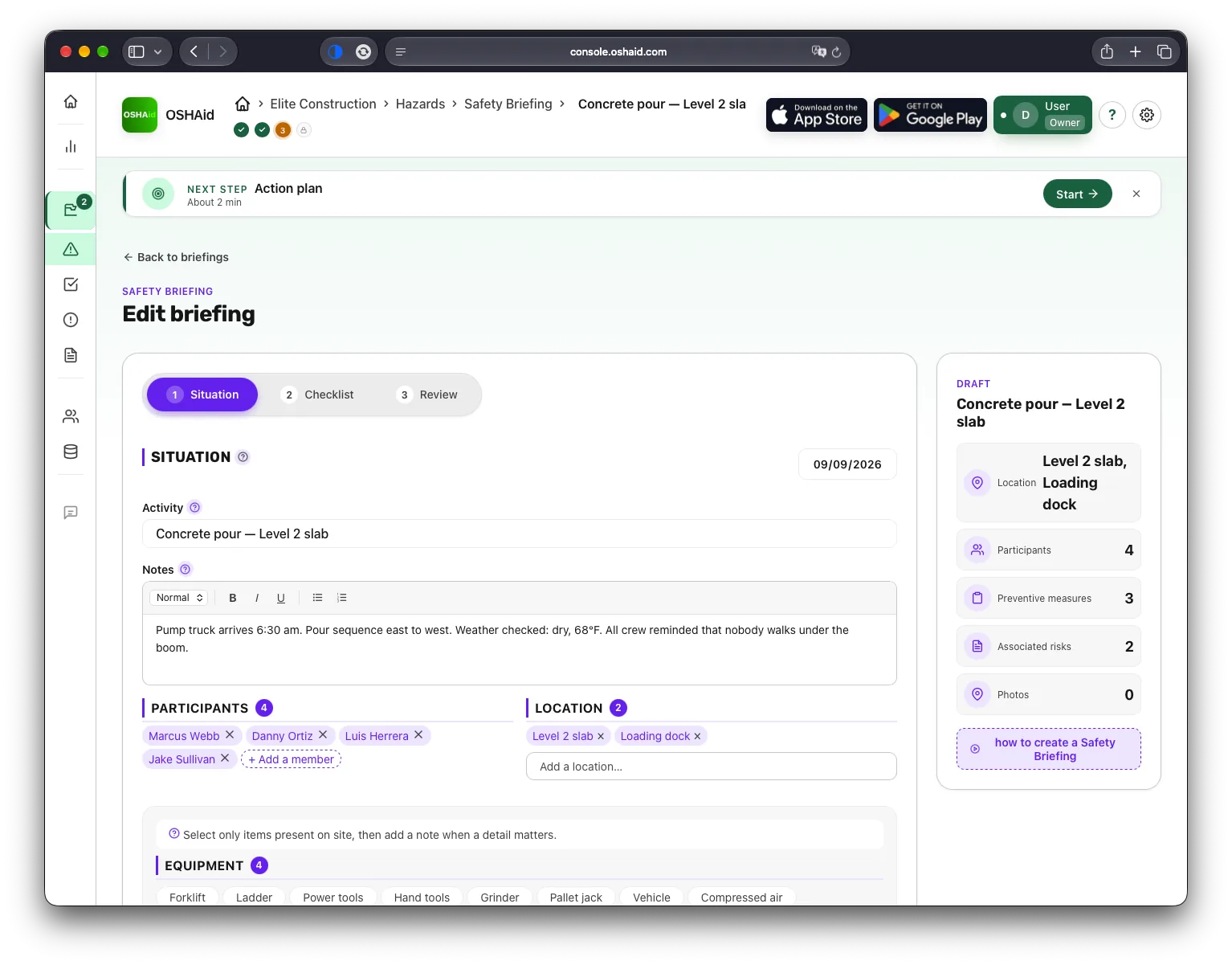 OSHAid console — the safety briefing editor, where the review of the emergency action plan with each employee is written down and dated
A plan you can show, not a binder you defend
An emergency action plan is one of the few safety documents whose value shows up outside an inspection: a client's prequalification packet asks for it, an insurer asks for it, and a new supervisor needs it on day one. The version that survives all three is not the longest one — it is the one where the six elements are visible, the names are current, and the review dates are there to be read. Compliance is the floor. Above it, the plan becomes something a safety officer can put on a screen in front of leadership, a client or an inspector, instead of a folder they have to defend.
Questions safety officers ask
- Does OSHA require every employer to have an emergency action plan?
No. 29 CFR 1910.38(a) says an employer must have one whenever an OSHA standard in part 1910 requires one. Process safety management, 1910.119(n), and grain handling, 1910.272(d), require one by name. Other employers may still want one to use an exemption in the fire extinguisher standard.
- Does an emergency action plan have to be in writing?
- What must an emergency action plan include?
About this article
Written by the OSHAid Safety Desk from official sources (OSHA news releases, the text of the standards, BLS and NIOSH data), checked against those sources and reviewed before publication. It explains what a rule says; it is not legal advice for your situation. OSHAid
Keep your emergency plan where you can show it
Create a free OSHAid account and keep your hazards, written programs, corrective actions and compliance documents in one place. No commitment.
Create my accountFreeDownload on theApp StoreGET IT ONGoogle PlayThe intelligent OSHA companion that automates your field compliance. Mobile app + web console + specialized safety AI agent, built for US workplaces.
🇫🇷 Hosted in EuropeGDPR CompliantProductIndustriesGuides- OSHA compliance software
- Hazard assessment guide
- Safety program templates
- JHA examples
- OSHA requirements
- OSHA recordkeeping
- OSHA standards by industry
- Workplace hazards
- Get started
- What is OSHA?
- Workplace safety glossary
- Why OSHAid?
- Enterprise solutions
- About
- Blog
- Legal notice
© 2026 OSHAid - published by DUOPP (SAS). All rights reserved.