 OSHAidProductsDemosIndustriesPricingMoreClient accessCreate my accountFree🇺🇸ENCreate my accountBack to blogOSHA updateOctober 7, 2026· By the OSHAid Safety Desk
OSHA's small business exemption: what it covers, and what it never removes
A September 24 Labor Department audit asked whether OSHA inspected hundreds of small employers it was not funded to inspect. The rule behind that question is one most small employers have never read.
The OSHA small business exemption is real, but it is narrower than its name suggests, and a federal audit has just put it back in front of every small employer.
On September 24, 2026, the Department of Labor's Office of Inspector General sent OSHA an alert memorandum finding the agency may have conducted up to 481 inspections that did not comply with its appropriations acts. OSHA disagrees with that finding.
That dispute is about how OSHA spends its money, not about a new duty on you. But it turns on a rule that is easy to misread in both directions: some owners assume it makes them untouchable, others assume it does nothing at all.
Here is what the rider says, who it reaches, and the obligations it leaves exactly where they were.
What the OSHA small business exemption actually says
A funding rider, not a standard. Since 1981, Congress has attached a recurring rider to OSHA's annual appropriation restricting the agency from spending funds on enforcement at certain small employers. OSHA explains how its inspectors apply it in Instruction CPL 02-00-170, signed July 18, 2024.
Two conditions, both required. OSHA's page on the Appropriations Act exemptions and limitations sets the test: the employer has 10 or fewer employees currently and has not had more than 10 at any time during the previous 12 months, and the DART rate for the employer's industry is currently below the national DART average. The directive tells inspectors to count the employees controlled by the employer.
The industry list is rebuilt every year. OSHA publishes a Low-Hazard Industries Table of the NAICS codes whose DART rate sits below the national average. The 2026 table, published February 2, 2026, uses a national private-sector average rate of 1.4 for 2024. An industry on one year's table can drop off the next.
What the rider blocks is narrow. For a qualifying employer, OSHA may not conduct a programmed safety inspection. The directive's at-a-glance table lists what it may still do: programmed health inspections, inspections in response to a complaint from a current employee, referrals where the reported condition falls into another exception, fatalities and incidents hospitalizing two or more employees, imminent danger, and Section 11(c) retaliation investigations. Consultation, technical assistance, education, training, surveys and studies are all permitted.
What the audit found. The OIG reviewed OSHA Information System data for inspections initiated and closed between November 8, 2024 and January 21, 2026, and identified 621 inspections of businesses that met the exemption criteria in that data. Of those, 140 showed a permissible exception, 201 lacked enough detail to tell, and 280 showed none; the 481 figure is the last two added together. OSHA examined 27 case files from an earlier list, attributed 23 to coding errors and found 4 that met no exception. In its written response, OSHA says the OIG's limited review of its inspection data led to unsupported conclusions.
 Two workers in a small joinery shop studying drawings on a workbench, hand tools racked on the wall behind them. Photo: cottonbro studio, via Pexels
Five things to check at your business this week
1. Count the employees you control, across 12 months. The test is not today's headcount. It reaches an employer with 10 or fewer employees now that has not had more than 10 at any point in the previous 12 months, counted as the employees controlled by the employer rather than the people on one site. A short seasonal peak of 12 ends it.
2. Find your primary NAICS code, then look it up. CPL 02-00-170 sends inspectors to 29 CFR 1904.2(b)(2) to determine an employer's primary industry classification, so start where they start, then check the 2026 table. The directive is explicit that the limit follows your primary industry, not the task you happen to be performing. If you are unsure which rules your code pulls in, begin with OSHA standards by industry.
3. Read the exceptions before you rely on the rule. Health inspections stay fully available to OSHA at an exempt employer. So does a complaint from a current employee, an imminent danger, a fatality, an incident hospitalizing two or more employees, and a retaliation complaint under Section 11(c). The rider removes one scheduling route. It does not remove OSHA.
4. Your reporting duty does not move. 29 CFR 1904.39 requires a covered employer to report a work-related fatality within 8 hours, and an in-patient hospitalization of one or more employees, an amputation or the loss of an eye within 24 hours. The directive's own FAQ answers this for employers on the Low-Hazard Industries Table: you still report. Keep the number and the procedure beside your injury and illness records.
5. Do not confuse it with the recordkeeping exemption. Two different rules use similar words. 29 CFR 1904.1 partially exempts a company with 10 or fewer employees at all times during the last calendar year from keeping the 300, 300A and 301 forms, and 29 CFR 1904.2 partially exempts establishments in the industries listed in appendix A to that subpart. Different thresholds, different lists, and neither touches your duty to comply with what OSHA requires of every employer.
If you operate in a State Plan state, check the state's own policy: CPL 02-00-170 required State Plans to say whether their procedures are identical to the federal program or different.
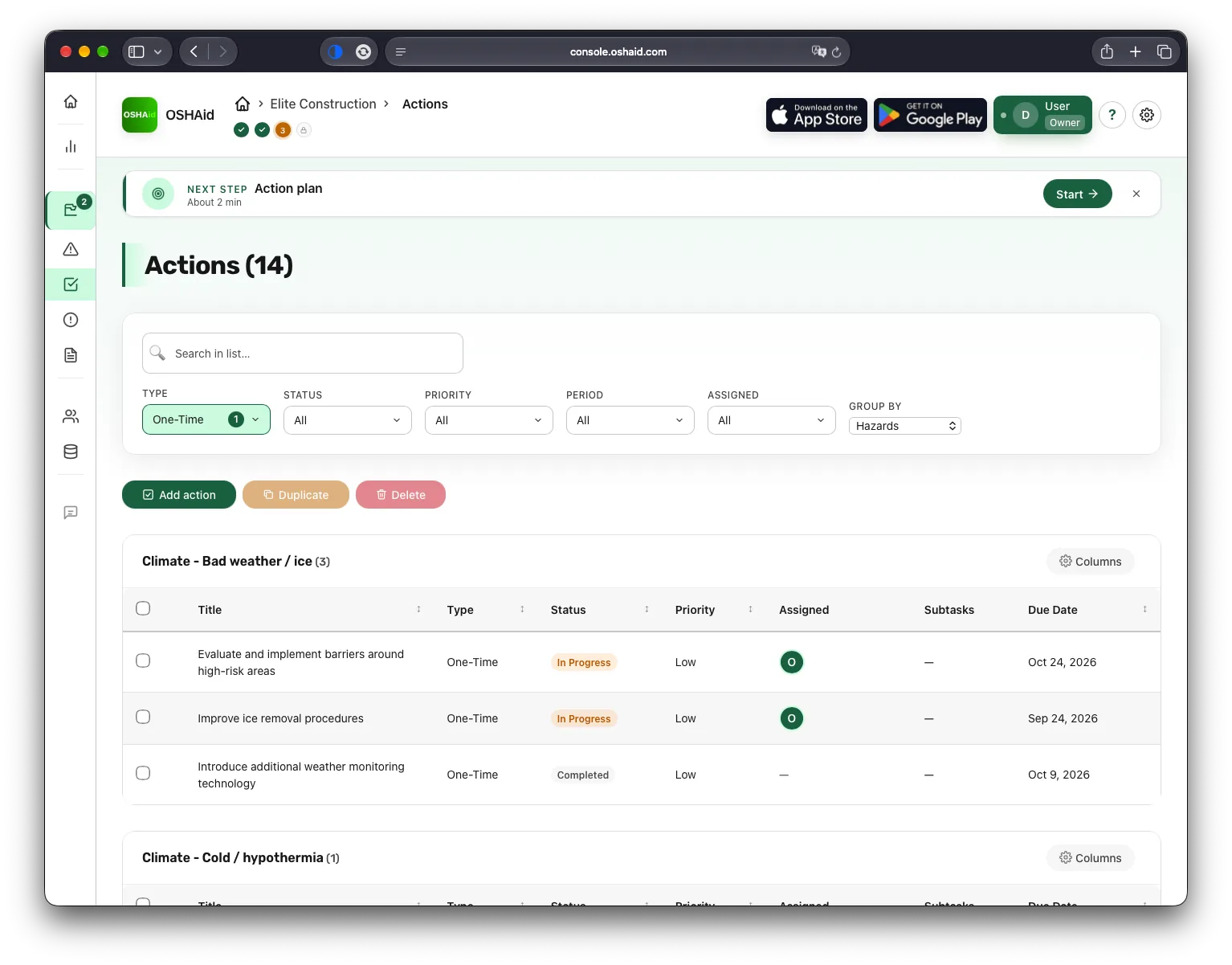 OSHAid console — the corrective action plan, where each hazard found at a small establishment gets an owner and a due date
Exempt from an inspection is not exempt from the duty
Every employer covered by the OSH Act owes its people a workplace free from recognized hazards, and a rider written into a funding bill does not change that. What it changes is who can knock on your door unannounced, and when. The small employers who get the most out of it are the ones who can answer quickly: here is our headcount over the last 12 months, here is our primary NAICS code, here is the hazard list and what we did about each item. That answer is also what a client's prequalification packet and an insurer's questionnaire ask for. Compliance is the floor. Above it, the safety program becomes something you can show on a screen rather than a binder you have to defend.
Questions safety officers ask
- Is my small business exempt from OSHA?
No. The appropriations rider only stops OSHA from running a programmed safety inspection at an employer with 10 or fewer employees whose primary industry sits on OSHA's Low-Hazard Industries Table. Health inspections, current-employee complaints, imminent danger, fatalities and retaliation investigations stay available, and the OSH Act still applies.
- How many employees can you have and still be exempt from OSHA inspections?
- Does a small business still have to report a workplace fatality to OSHA?
About this article
Written by the OSHAid Safety Desk from official sources (OSHA news releases, the text of the standards, BLS and NIOSH data), checked against those sources and reviewed before publication. It explains what a rule says; it is not legal advice for your situation. OSHAid
Know where you stand before anyone asks
Create a free OSHAid account and keep your hazards, corrective actions, incident reports and compliance documents in one place. No commitment.
Create my accountFreeDownload on theApp StoreGET IT ONGoogle PlayThe intelligent OSHA companion that automates your field compliance. Mobile app + web console + specialized safety AI agent, built for US workplaces.
🇫🇷 Hosted in EuropeGDPR CompliantProductIndustriesGuides- OSHA compliance software
- Hazard assessment guide
- Safety program templates
- JHA examples
- OSHA requirements
- OSHA recordkeeping
- OSHA standards by industry
- Workplace hazards
- Get started
- What is OSHA?
- Workplace safety glossary
- Why OSHAid?
- Enterprise solutions
- About
- Blog
- Legal notice
© 2026 OSHAid - published by DUOPP (SAS). All rights reserved.