 OSHAidProductsDemosIndustriesPricingMoreClient accessCreate my accountFree🇺🇸ENCreate my accountBack to blogOSHA updateOctober 13, 2026· By the OSHAid Safety Desk
OSHA lead respirator requirements: what still applies
On October 9, 2026 the record closed on OSHA proposals to rewrite the respirator provisions inside 16 chemical standards. Lead is one of them, and until a final rule the current text is the one you are inspected against.
OSHA closed the written record on October 9, 2026 on a set of proposals that would rewrite the respirator provisions sitting inside 16 substance-specific health standards. Lead is one of them.
The OSHA lead respirator requirements live in two places: 29 CFR 1910.1025(f) for general industry and 29 CFR 1926.62(f) for construction. Between them they say when a respirator must be worn, which one you may hand out, and what your program must contain.
OSHA published the 16 proposals on July 1, 2025, held an informal public hearing on August 25, 2026, took post-hearing comments until September 24 and set October 9, 2026 for final written briefs, according to OSHA's deregulatory rulemaking page.
A closed record is not a final rule. Read in the eCFR on October 13, 2026, with Title 29 current as of October 8, 2026, both lead standards read exactly as they did last year. Here is what they ask of you today, and what OSHA has put on the table.
What the OSHA lead respirator requirements say today
Two numbers sit behind every respirator decision. The permissible exposure limit for lead is 50 micrograms per cubic meter of air averaged over 8 hours, in both standards. The action level, 30 micrograms per cubic meter as an 8-hour average, is calculated without any credit for the respirator your crew is wearing.
When a respirator is required. 29 CFR 1910.1025(f)(1) requires respirator use during the periods needed to install or implement engineering or work-practice controls, during work operations where those controls are not sufficient to reduce exposure to or below the PEL, and when an employee requests one. The construction standard words it differently: a respirator whenever exposure exceeds the PEL, plus interim protection while you assess exposure on the tasks listed at 1926.62(d)(2).
The program behind the mask. Paragraph (f)(2)(i) of both standards sends you to the Respiratory Protection standard: the program runs in accordance with 1910.134(b) through (d), except (d)(1)(iii), and (f) through (m). That makes it a written, worksite-specific program under a trained administrator, covering selection, medical evaluation, fit testing, proper use, cleaning and storage, breathing air quality, training and a regular evaluation of whether any of it works.
Selection is where the current text is prescriptive. Paragraph (f)(3)(i)(B) requires a full facepiece instead of a half mask against lead aerosols that cause eye or skin irritation at the use concentrations. Paragraph (f)(3)(i)(C) requires HEPA filters for powered and non-powered air-purifying respirators. Paragraph (f)(3)(ii) requires you to provide a powered air-purifying respirator when an employee chooses one and it gives adequate protection.
What the proposal would change. In the lead proposal published at 90 FR 28277, OSHA proposes to drop the full-facepiece limitation, since the protective clothing paragraph (g)(1) already addresses skin and eye irritation; to drop the HEPA requirement, because NIOSH certification under 42 CFR part 84 now covers other particulate filters; to replace the two general paragraphs at (f)(1)(i) and (ii) with a cross reference to 1910.134(a)(2); and to remove the respirator-training paragraph that repeats 1910.134(k). On that first change OSHA writes that employers in compliance with the current version of 1910.1025(f)(1) and 1926.62(f)(1) "would not have to change any of their practices to remain in compliance".
What OSHA did not propose. The agency says it is considering, but is not proposing, removing the duty to provide a respirator when an employee requests one, or the duty to provide a PAPR when an employee chooses one. Both stand.
 A renovation worker in a hard hat and white overalls wearing a half-mask respirator with two cartridges, holding a spray line in a stripped room. Photo: Antoni Shkraba, via Pexels
Five checks before your next lead job
1. List the tasks, not just the job. In construction, 1926.62(d)(2) presumes exposure for named tasks until your own assessment documents otherwise. Where lead-containing paint or coatings are present, manual demolition, manual scraping, manual sanding, heat gun applications and power tool cleaning with dust collection — plus spray painting with lead paint — are treated as above the PEL and not more than ten times it. Rivet busting, power tool cleaning without dust collection, cleanup where dry expendable abrasives are used, abrasive blasting enclosure movement and removal, lead burning and lead-containing mortar are treated as above 500 micrograms per cubic meter. The presumption decides the respirator you hand out on day one, before any sampling result comes back; what else applies on a construction site follows the same logic.
2. Make the determination, then write it down. In general industry, 1910.1025(d)(2) requires you to determine whether any employee may be exposed at or above the action level. That initial determination may rest on a representative sample of the employees you believe are most exposed, but the general rule at (d)(1)(ii) is a full-shift personal sample of at least 7 continuous hours, at least one per shift for each job classification in each work area. A job title is not a determination. A documented hazard assessment, with who was sampled, where and for how long, is what turns a guess into a record.
3. Read your own program against 1910.134(c)(1). Nine elements are listed there, and the one most often missing is the last: a procedure for regularly evaluating whether the program works. Check too that it is written for this site and these tasks, and updated when conditions change — a new paint system, a new enclosure, a new crew.
4. Keep the two employee-choice provisions alive. A worker who asks for a respirator on a lead job gets one, and a worker who chooses a PAPR over a negative-pressure respirator gets the PAPR where it protects adequately. OSHA flagged both as candidates for removal and chose not to propose it; supervisors should know they are still live.
5. Put the annual training on a calendar. Training repeats at least annually under 1910.1025(l)(1)(iv), and (l)(1)(v)(C) requires it to cover the purpose, proper selection, fitting, use and limitations of respirators. Record what was covered, who attended and on what date, because that record is the only part an inspector can read.
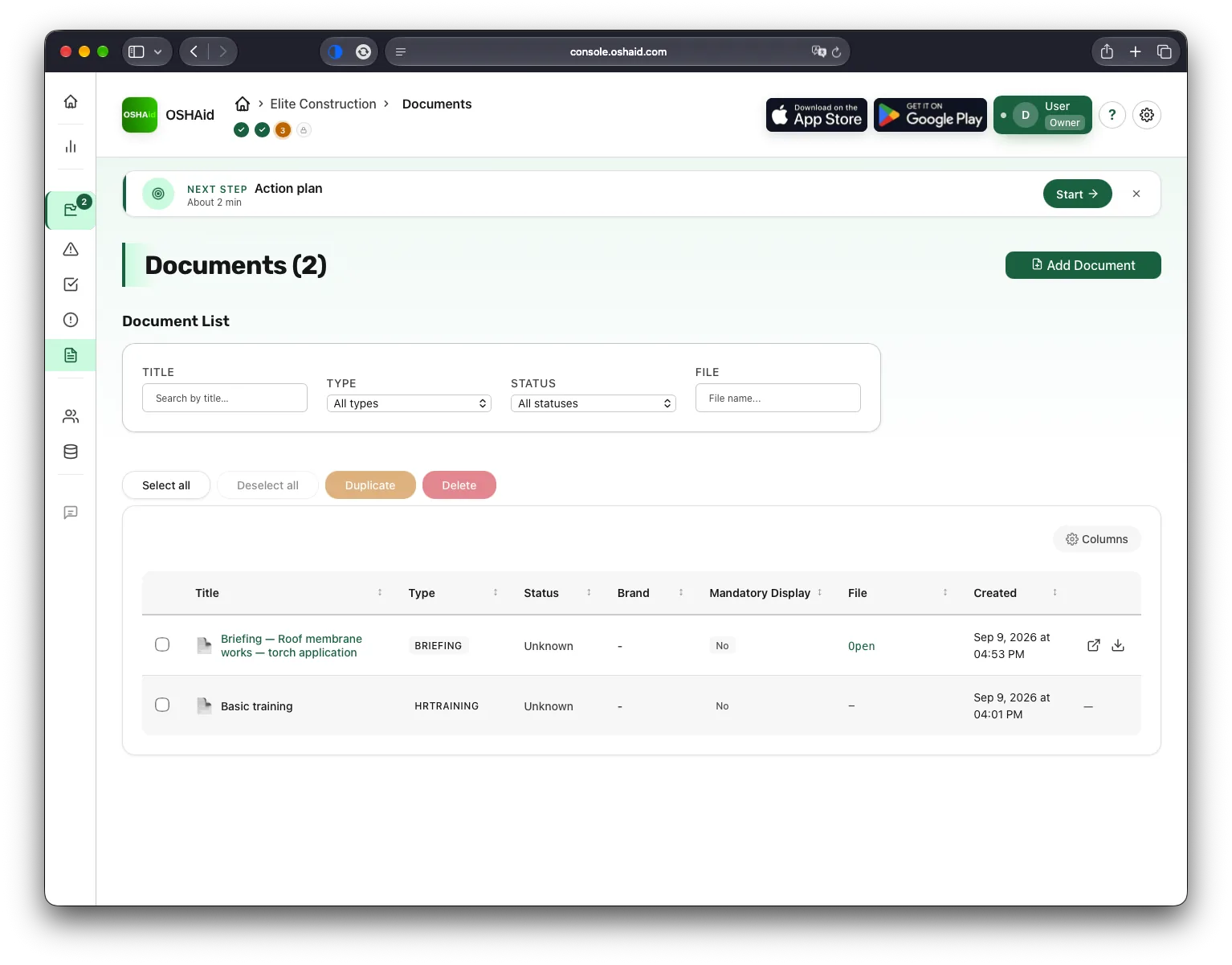 OSHAid console, the document library: written programs, assessments and training records filed by workplace
A rulemaking you cannot plan around
Deregulatory proposals are easy to over-read. Nothing in the lead standards changed on October 9; a closed record means OSHA now has to decide, and a final rule can land next quarter, next year or never. The only version you can be cited against is the one printed in the Code of Federal Regulations today. That is also the practical answer for a safety officer: build on the current text, and keep the assessments, the selection rationale, the fit tests and the training dates together. A rule change then becomes a half-day edit instead of a rebuild, and the same file is what you show a client, an insurer or a new operations director.
Questions safety officers ask
- Does OSHA require a written respiratory protection program for lead work?
Yes. 29 CFR 1910.1025(f)(2)(i) and 1926.62(f)(2)(i) require a program in accordance with 1910.134(b) through (d), except (d)(1)(iii), and (f) through (m), for each employee required to use a respirator. 1910.134(c)(1) makes that program written, with worksite-specific procedures.
- What is OSHA's lead PEL and action level?
- Can I give my crew half-mask respirators on a lead job?
About this article
Written by the OSHAid Safety Desk from official sources (OSHA news releases, the text of the standards, BLS and NIOSH data), checked against those sources and reviewed before publication. It explains what a rule says; it is not legal advice for your situation. OSHAid
Keep your lead program in one place
Create a free OSHAid account and keep your hazards, audits, corrective actions and compliance documents in one place. No commitment.
Create my accountFreeDownload on theApp StoreGET IT ONGoogle PlayThe intelligent OSHA companion that automates your field compliance. Mobile app + web console + specialized safety AI agent, built for US workplaces.
🇫🇷 Hosted in EuropeGDPR CompliantProductIndustriesGuides- OSHA compliance software
- Hazard assessment guide
- Safety program templates
- JHA examples
- OSHA requirements
- OSHA recordkeeping
- OSHA standards by industry
- Workplace hazards
- Get started
- What is OSHA?
- Workplace safety glossary
- Why OSHAid?
- Enterprise solutions
- About
- Blog
- Legal notice
© 2026 OSHAid - published by DUOPP (SAS). All rights reserved.