 OSHAidProductsDemosIndustriesPricingMoreClient accessCreate my accountFree🇺🇸ENCreate my accountBack to blogTrainingOctober 12, 2026· By the OSHAid Safety Desk
OSHA hearing conservation program: what 85 decibels triggers
NIOSH published a free Noise and Hearing Protection toolbox talk on October 1. Behind that one-page talk sits a standard with monitoring, audiograms and annual training in it.
NIOSH's October 2026 eNews, dated October 1, 2026, lists four new toolbox talks. One of them is Noise and Hearing Protection, publication 2026-118: a single page, free to download, built for a ten-minute talk at the start of a shift.
The talk is the easy part. What it points at is the OSHA hearing conservation program, and that one has dates, tests and records in it.
OSHA's noise standard sets a permissible exposure limit of 90 decibels on the A scale, averaged over 8 hours. A second number, 85 decibels, is the one most employers miss: cross it and a whole program switches on. OSHA estimates that 22 million workers are exposed to potentially damaging noise at work each year.
The text below was read in the eCFR on October 12, 2026, with Title 29 current as of October 8, 2026.
What the OSHA hearing conservation program requires
Two numbers, two different duties. Table G-16 of 29 CFR 1910.95 allows 90 dBA for 8 hours, 95 dBA for 4 hours, 100 dBA for 2 hours and 115 dBA for 15 minutes or less. Above those levels, paragraph (b)(1) tells you to use feasible administrative or engineering controls first, and hearing protection only if the controls fail to bring exposure within the table.
Paragraph (c)(1) sets the second number. Whenever employee noise exposures equal or exceed an 8-hour time-weighted average of 85 decibels — a 50 percent dose, the standard's action level — you must administer a continuing, effective hearing conservation program. That exposure is calculated without any credit for the hearing protection your crew is wearing.
Monitoring. When information indicates that an employee's exposure may reach 85 dBA as an 8-hour average, paragraph (d) requires a monitoring program, with all sound levels from 80 to 130 decibels integrated into the measurement. Monitoring is repeated whenever a change in production, process, equipment or controls pushes more people over the line. Each employee at or above 85 dBA has to be told their result.
Audiometric testing, at your cost. Paragraph (g) requires a baseline audiogram within 6 months of an employee's first exposure at or above the action level, preceded by at least 14 hours without workplace noise. Where a mobile test van is used, the baseline may be obtained within 1 year, and employees wear hearing protectors for any period beyond those first six months. After the baseline, a new audiogram is due at least annually.
A standard threshold shift — an average change of 10 dB or more at 2000, 3000 and 4000 Hz in either ear — starts a clock: the employee must be told in writing within 21 days, refitted and retrained in hearing protectors, and referred for clinical evaluation where it is needed.
Protectors, training, records. Hearing protectors are made available at no cost to everyone at or above 85 dBA, from a variety the employee can choose from, with initial fitting supervised by the employer. They must attenuate exposure to at least 90 dBA, or to 85 dBA for an employee who has had a shift. Training repeats annually and covers the effects of noise, the types of protectors and their attenuation, fitting and care, and what the hearing test is for. A copy of the standard goes up in the workplace. Noise exposure records are kept 2 years; audiometric records last the whole of the employee's employment.
On a construction site, the rule is shorter but not softer: 29 CFR 1926.52 carries the same table and requires the same continuing, effective program wherever those levels are exceeded, and 1926.101 requires ear protective devices fitted individually by a competent person. Plain cotton is not an acceptable protective device.
 A worker in a hard hat and high-visibility vest holding a foam earplug to each ear before starting work. Photo: Kindel Media, via Pexels
Five checks to run this week
1. Run the toolbox talk. The NIOSH page gives you the one-page PDF. It carries a field test anyone can apply the same morning: if you have to shout to be understood at arm's length, about 3 feet, the area needs hearing protection. It also points to the NIOSH sound level meter app for a first look at your own numbers.
2. Decide whether you are over 85. The raised-voice test tells you where to measure, not what to record. If any area or task may average 85 dBA over 8 hours, you need real monitoring, and where people move around or the noise swings, representative personal sampling rather than area readings. Write down what you measured, where and when.
3. Put the audiograms on a calendar. Baseline within 6 months of first exposure, annual test after that, written notice within 21 days of a standard threshold shift. These are the dates that quietly slip when a hire happens in a busy month. Track them where your other deadlines live — a list of actions with owners and due dates does more for this than a reminder in one person's inbox, and a written program your team can actually follow is what holds it together.
4. Look at what your people are actually wearing. Protectors on a shelf are not protectors in use. Check that there is a genuine choice, that someone showed each person how to seat an earplug, and that the attenuation you are relying on brings exposure under 90 dBA — or under 85 for anyone who has had a shift.
5. Check the hearing loss column on your log. Under 29 CFR 1904.10, a work-related standard threshold shift becomes recordable when the employee's total hearing level is also 25 dB or more above audiometric zero, averaged at 2000, 3000 and 4000 Hz, in the same ear. You may retest within 30 days; if the retest confirms it, record it within 7 calendar days and tick the hearing loss column. Audiometric results arrive from a clinic months after the exposure that caused them, which is exactly how these cases go unrecorded — our OSHA recordkeeping guide sets out how the 300 Log and its columns fit together.
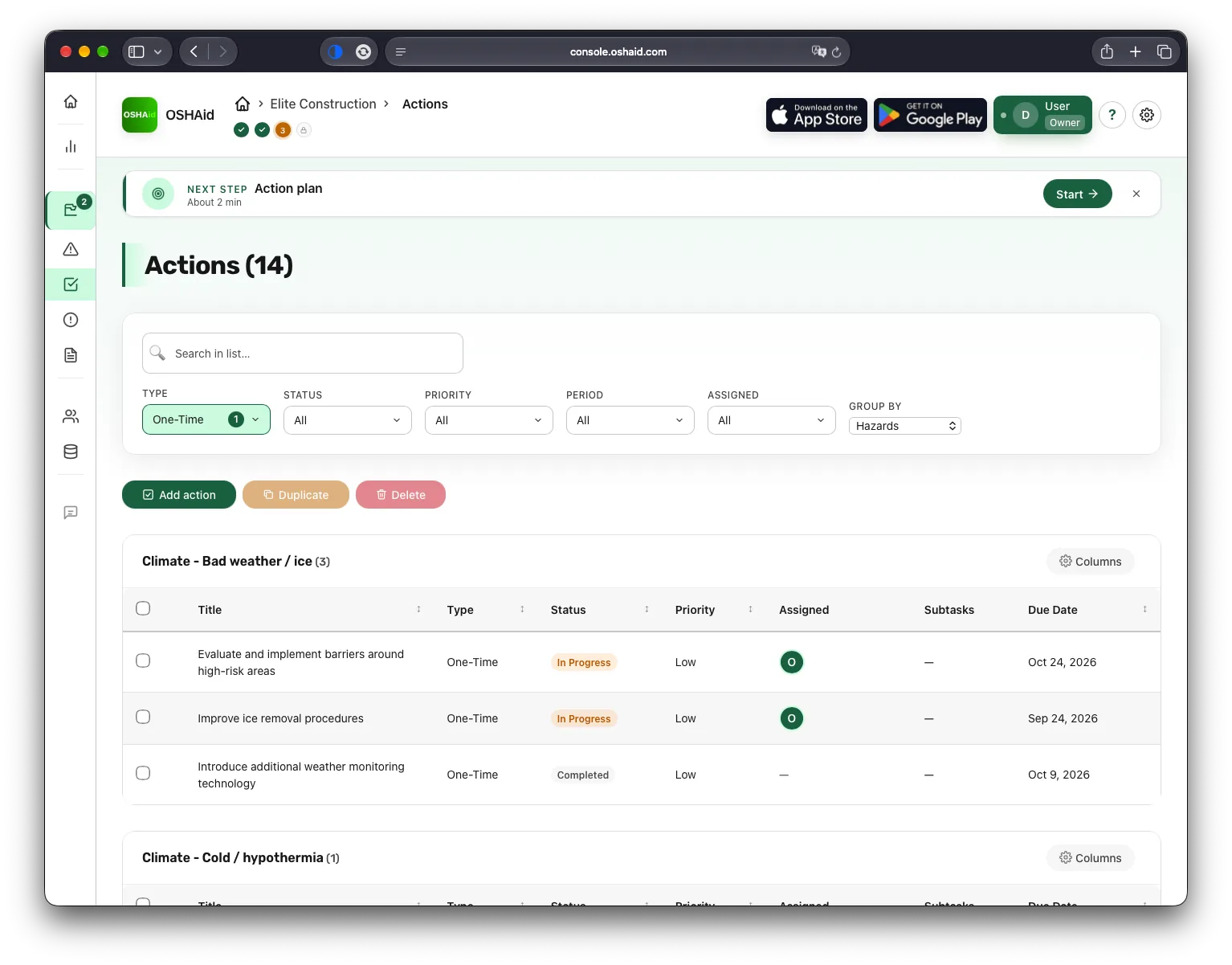 OSHAid console, the action plan table: each corrective action with its owner, its due date and its status
A program you can show, not a box of earplugs
Hearing loss is the slowest injury on your site. Nobody goes to the hospital, nothing gets reported, and the damage shows up years later in an audiogram someone else reads. That is precisely why this program is built out of paper: measurements, test dates, training records, the shift notice signed within 21 days. When an inspector, an insurer or a new operations director asks what you do about noise, the answer should not be a walk to the PPE cabinet. It should be a file that shows who is exposed, what you measured, when each person was last tested and what changed after the last shift — the difference between running a program and being able to prove one.
Questions safety officers ask
- At what decibel level does OSHA require hearing protection?
OSHA's permissible exposure limit is 90 dBA averaged over 8 hours. At an 8-hour average of 85 dBA, the action level, 29 CFR 1910.95 requires a hearing conservation program and hearing protectors available at no cost. Wearing them is mandatory for employees with no baseline audiogram yet or a standard threshold shift.
- How often does OSHA require hearing tests?
- Is work-related hearing loss recordable on the OSHA 300 Log?
About this article
Written by the OSHAid Safety Desk from official sources (OSHA news releases, the text of the standards, BLS and NIOSH data), checked against those sources and reviewed before publication. It explains what a rule says; it is not legal advice for your situation. OSHAid
Keep your noise records where you can find them
Create a free OSHAid account and keep your hazards, audits, corrective actions and compliance documents in one place. No commitment.
Create my accountFreeDownload on theApp StoreGET IT ONGoogle PlayThe intelligent OSHA companion that automates your field compliance. Mobile app + web console + specialized safety AI agent, built for US workplaces.
🇫🇷 Hosted in EuropeGDPR CompliantProductIndustriesGuides- OSHA compliance software
- Hazard assessment guide
- Safety program templates
- JHA examples
- OSHA requirements
- OSHA recordkeeping
- OSHA standards by industry
- Workplace hazards
- Get started
- What is OSHA?
- Workplace safety glossary
- Why OSHAid?
- Enterprise solutions
- About
- Blog
- Legal notice
© 2026 OSHAid - published by DUOPP (SAS). All rights reserved.