 OSHAidProductsDemosIndustriesPricingMoreClient accessCreate my accountFree🇺🇸ENCreate my accountBack to blogOSHA updateOctober 11, 2026· By the OSHAid Safety Desk
OSHA safety color code: what 1910.144 still requires
OSHA has proposed deleting the safety color code standard. The rulemaking record closed on October 10, 2026, and no final rule has been published.
The OSHA safety color code is one of the oldest standards in Part 1910, and OSHA has proposed deleting it. The rulemaking record closed on October 10, 2026.
29 CFR 1910.144 makes red the basic color for danger and for stop, and yellow the basic color for caution and for marking physical hazards. On July 1, 2025, OSHA published a proposed rule at 90 FR 28282 that would remove that standard from the Code of Federal Regulations, together with three provisions in other standards that point to it.
An informal public hearing was held on August 26, 2026. OSHA's deregulatory rulemaking page set September 25, 2026 for post-hearing comments and October 10, 2026 for final written briefs.
A closed record is not a final rule. Read in the eCFR on October 11, 2026, with Title 29 current as of October 7, 2026, 1910.144 reads as written. Here is what it asks of you, and what stays required whichever way OSHA goes.
What the OSHA safety color code requires today
Red is the color of danger and stop. Under 29 CFR 1910.144(a)(1), red is the basic color for the identification of danger and of stop, and the standard supplies its own examples. Safety cans and other portable containers of flammable liquids with a flash point at or below 80 °F are painted red, with either a yellow band around the can or the name of the contents stenciled or painted on it in yellow. Red lights are provided at barricades and at temporary obstructions. Danger signs are painted red. Emergency stop bars on hazardous machines, and stop buttons or electrical switches used for emergency stopping of machinery, are red.
One line of that paragraph no longer says anything: subparagraph (a)(1)(i), fire protection equipment and apparatus, is marked [Reserved] in the current text.
Yellow is the color of caution and physical hazards. Paragraph (a)(3) makes yellow the basic color for designating caution and for marking physical hazards, and it names five of them: striking against, stumbling, falling, tripping, and caught in between. That single sentence is the authority behind most of the yellow paint in an American plant.
Three other standards point back to it. Paragraph (c)(8) of the Textiles standard, 29 CFR 1910.262, requires identification of physical hazards in accordance with 1910.144. Paragraph (c)(11) of the Sawmills standard, 29 CFR 1910.265, requires physical hazard marking as specified in 1910.144. For shipyard employment, 29 CFR 1915.90 states that its requirements are identical to those set at 1910.144. All four provisions are in the proposal.
What OSHA argues in the proposal. OSHA's preliminary judgment is that the hazards these standards address are already covered by state and local building and fire codes and by its Specifications for Accident Prevention Signs and Tags standard, 29 CFR 1910.145. The proposal adds that identifying hazards by color alone may be ineffective for people with a color vision deficiency, and that OSHA has cited these standards about 4 times a year on average since 2012, against roughly 7,000 citations a year for fall protection. OSHA counted 7,452,757 establishments in general industry and shipyards affected by the color coding standards, and estimated about $87.6 million a year in savings from the removal, nearly all of it time that new employers and newly hired safety specialists spend learning the rule.
None of that has been decided. A proposal, a hearing and a closed record change nothing in the CFR until a final rule is published.
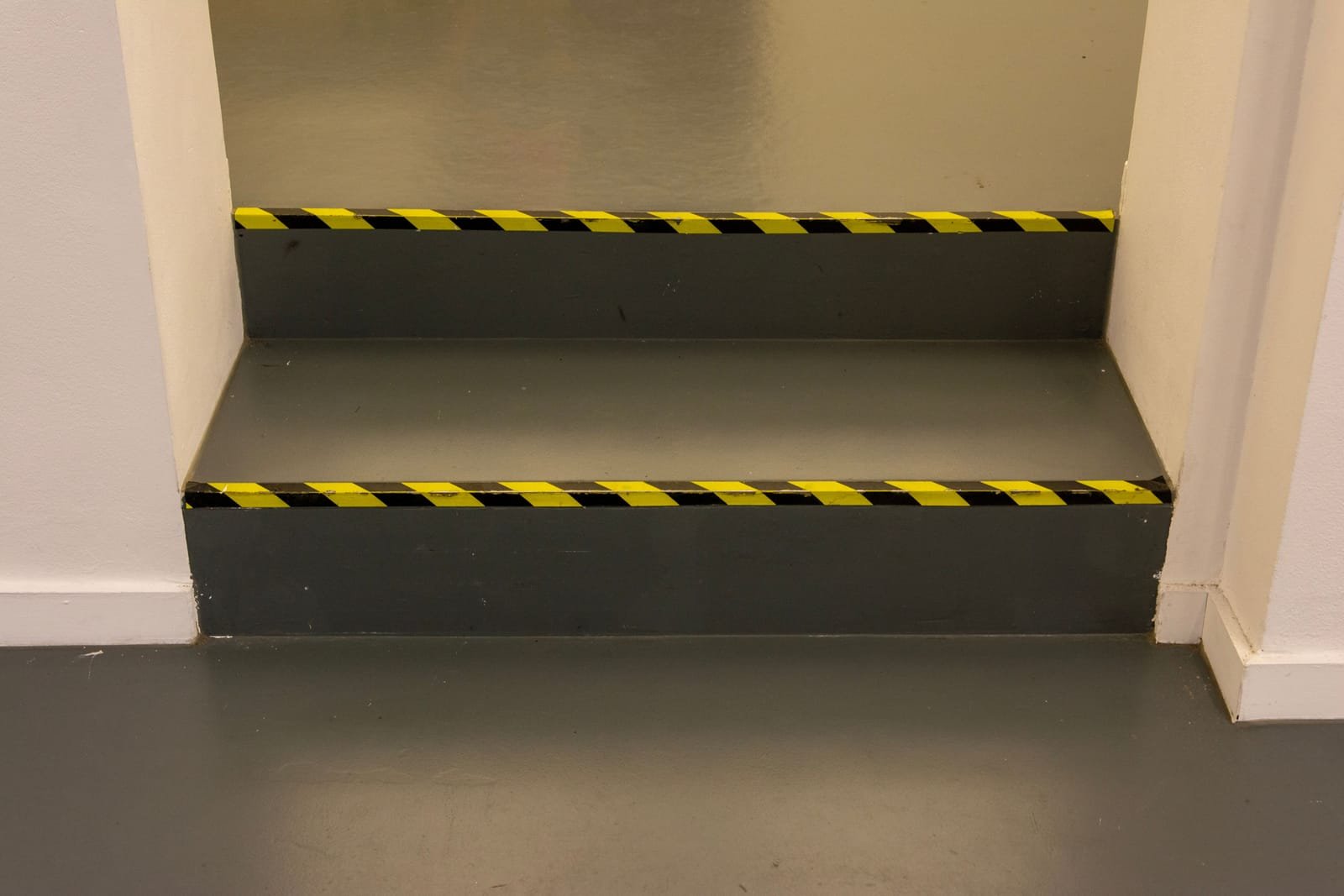 Two low steps in a doorway, their edges taped in black and yellow diagonal stripes to mark a trip hazard. Photo: Jan van der Wolf, via Pexels
Five checks before you change any marking
1. Treat 1910.144 as live. Paint budgets get planned on rumors. Until a final rule publishes, a compliance officer can still cite the color code, and in textiles, sawmills and shipyards can cite the industry standard that points to it. Nothing you remove today becomes correct retroactively if the rule survives.
2. Walk your emergency stops. Stop bars on hazardous machines and the buttons or switches used to stop machinery in an emergency are the items the standard names first. Check that each one is red, reachable without reaching across the hazard, and not hidden behind stock or a pallet.
3. Walk the five yellow hazards. Striking against, stumbling, falling, tripping, caught in between. In practice that is low beams and pipework, floor level changes, the edges of pits and docks, open-side platforms, pinch points on conveyors and doors. Mark what a visitor would walk into, not only what your crew has learned to avoid.
4. Know whether an industry standard pulls the rule onto you. A textile plant, a sawmill and a shipyard each reach 1910.144 through their own standard, which is why the proposal has to remove four provisions rather than one. If you are not sure which sector rules apply to your work, start from OSHA standards by industry and list the ones that name your operations.
5. Do not let color do the work alone. The signs and tags standard, 29 CFR 1910.145, is not in this proposal and sets out danger, caution and safety instruction signs, their colors and wording, and the accident prevention tags of paragraph (f). Words and symbols next to the color also answer OSHA's own objection about color vision deficiency. Deciding what to mark comes before deciding how: our workplace hazard assessment guide walks through finding the hazards, area by area, so the marking plan has a reason behind every stripe.
 OSHAid console, the risk assessment table: each hazard with its location, its risk score and the corrective action attached to it
Marking you can explain, not just paint
Hazard marking is the part of a safety program that everyone sees and nobody can document. The paint is on the floor, the reason is in someone's memory, and when a client, an insurer or a compliance officer asks why that pinch point is striped and the one next to it is not, the answer takes a walk around the building. It does not have to. A hazard assessment that lists each hazard, its location, its control and the marking that goes with it turns a wall of yellow into a record you can show in a minute, and it survives the people who painted it. Whether 1910.144 stays or goes, that record is what proves you looked.
Questions safety officers ask
- What does the OSHA safety color code require?
29 CFR 1910.144 makes red the basic color for identifying danger and stop, including emergency stop bars and stop buttons, red lights at barricades, danger signs and safety cans of flammable liquids. Yellow is the basic color for caution and for marking physical hazards: striking against, stumbling, falling, tripping and caught in between.
- Is OSHA removing 29 CFR 1910.144?
- Does OSHA require yellow floor marking?
About this article
Written by the OSHAid Safety Desk from official sources (OSHA news releases, the text of the standards, BLS and NIOSH data), checked against those sources and reviewed before publication. It explains what a rule says; it is not legal advice for your situation. OSHAid
Show your hazard marking instead of defending it
Create a free OSHAid account and keep your hazards, audits, corrective actions and compliance documents in one place. No commitment.
Create my accountFreeDownload on theApp StoreGET IT ONGoogle PlayThe intelligent OSHA companion that automates your field compliance. Mobile app + web console + specialized safety AI agent, built for US workplaces.
🇫🇷 Hosted in EuropeGDPR CompliantProductIndustriesGuides- OSHA compliance software
- Hazard assessment guide
- Safety program templates
- JHA examples
- OSHA requirements
- OSHA recordkeeping
- OSHA standards by industry
- Workplace hazards
- Get started
- What is OSHA?
- Workplace safety glossary
- Why OSHAid?
- Enterprise solutions
- About
- Blog
- Legal notice
© 2026 OSHAid - published by DUOPP (SAS). All rights reserved.