 OSHAidProductsDemosIndustriesPricingMoreClient accessTry OSHAidFree🇺🇸ENTry OSHAidBack to blogCase studySeptember 25, 2026· By the OSHAid Safety Desk
Lockout tagout requirements: the gaps OSHA keeps citing
A car wash operator was cited for servicing equipment without locking out hazardous energy. Here is what 29 CFR 1910.147 actually asks of you.
Lockout tagout requirements are among the rules OSHA cites most often, and the reason is rarely exotic. On September 23, 2026, the U.S. Department of Labor announced citations against an express car wash operator in Sicklerville, New Jersey, proposing $446,864 in penalties for exposing workers to hazardous energy and excessive noise.
You do not need to run a car wash for this one to matter. The gaps OSHA describes — no documented energy control procedure, no training record, no lockout devices on the machine — are the same gaps that turn up in bakeries, food plants, print shops and repair bays. Here is what the standard says, and what you can verify on your own floor this week.
What OSHA cited, and what the standard says
OSHA's September 23, 2026 news release states that the agency found ModWash LLC, an express car wash service with five locations in Sicklerville, willfully exposed workers to hazardous energy by failing to lock out equipment prior to maintenance activities and not using energy control procedures.
Two repeat violations followed: no clear lockout procedures with specific instructions for controlling all energy sources, and no training of employees on equipment lockout/tagout processes. Five serious violations covered the rest — no noise monitoring program, no baseline audiogram established within six months of exposure, no training for employees exposed to noise above 85 decibels, and lockout/tagout devices neither provided nor attached to machines before servicing.
The penalties are proposed, not final. The release states the company has 15 business days from receipt of the citations to comply, request an informal conference with OSHA, or contest the findings before the independent Occupational Safety and Health Review Commission.
The standard behind the willful citation is 29 CFR 1910.147, the control of hazardous energy. It calls for an energy control program built on three legs: energy control procedures, employee training and periodic inspections.
Procedures must be developed, documented and utilized. They have to outline the scope and purpose, the specific steps for shutting down, isolating, blocking and securing the equipment, the placement, removal and transfer of lockout or tagout devices, and the testing that verifies the isolation worked. Training is split by role — authorized employees who apply the locks, affected employees who operate the machine, and everyone else working in the area — and the employer must certify that training was accomplished, with each employee's name and the dates. Each energy control procedure must be inspected at least annually by an authorized employee other than the one using it, and that inspection must be certified as well.
The noise citations track 29 CFR 1910.95: a monitoring program when information indicates exposures may equal or exceed an 8-hour time-weighted average of 85 decibels — the action level — and a valid baseline audiogram within 6 months of an employee's first exposure at or above it.
Lockout/tagout ranked fourth on OSHA's Top 10 Most Frequently Cited Standards for Fiscal Year 2025. If you are not sure which machines in your shop fall under it, our workplace hazards guide maps hazard families to the standards behind them.
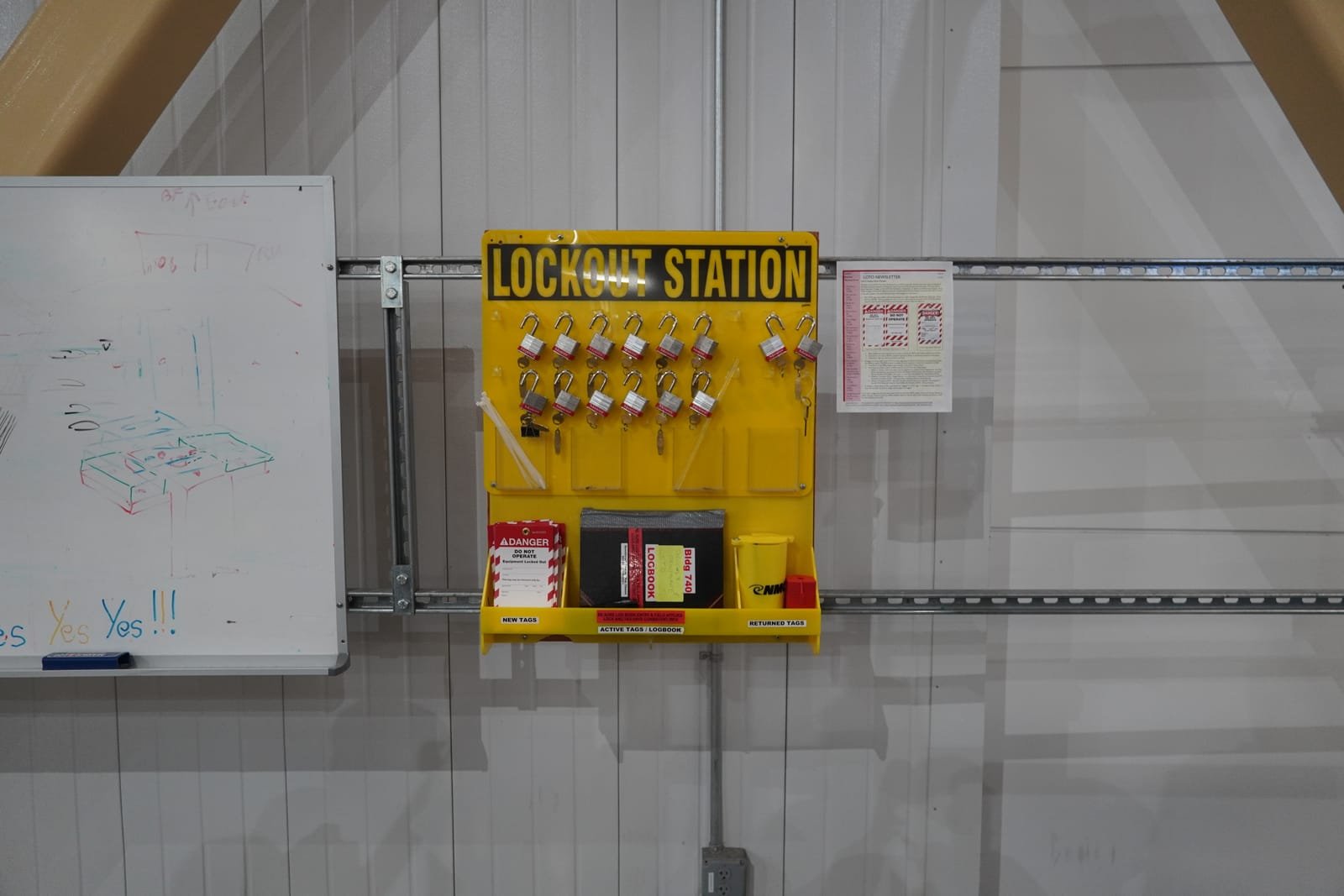 A lockout station at a research facility: padlocks, danger tags and the logbook the standard expects. Photo: Henrysz, via Wikimedia Commons (CC BY 4.0)
Lockout tagout requirements: five checks for this week
1. List the machines that get serviced. Anything an employee cleans, unjams, adjusts or repairs where unexpected start-up or stored energy could cause injury. Conveyors, mixers, compactors, dough dividers, presses, pumps. Write the list before you write anything else.
2. Open the procedure for one of them. Not the general policy — the machine-specific procedure. It should name the energy sources, the isolation points, the order of steps and how the technician verifies zero energy. A policy with no per-machine steps is the gap OSHA cited twice in this case.
3. Walk to the machine and check the hardware. Locks, hasps and tags have to exist, be available to the person doing the work, and actually sit on the energy isolating device during service. A procedure nobody can execute is a paper program.
4. Pull the training certification. Names and dates, for authorized and affected employees alike. If you cannot produce it in five minutes, assume an inspector could not either.
5. Date the last periodic inspection. Annual, performed by someone other than the person who uses that procedure, and certified in writing with the machine, the date, the employees included and the inspector.
On the noise side, if you have employees around loud equipment for full shifts and nobody has ever measured, the monitoring program comes first — hearing protection handed out at the door is not a substitute for knowing the exposure.
Each of those five checks is a short, assignable task with an owner and a due date, which is exactly how a corrective action list should read. If you are starting from a blank page, our safety program templates give you the written structure to fill in.
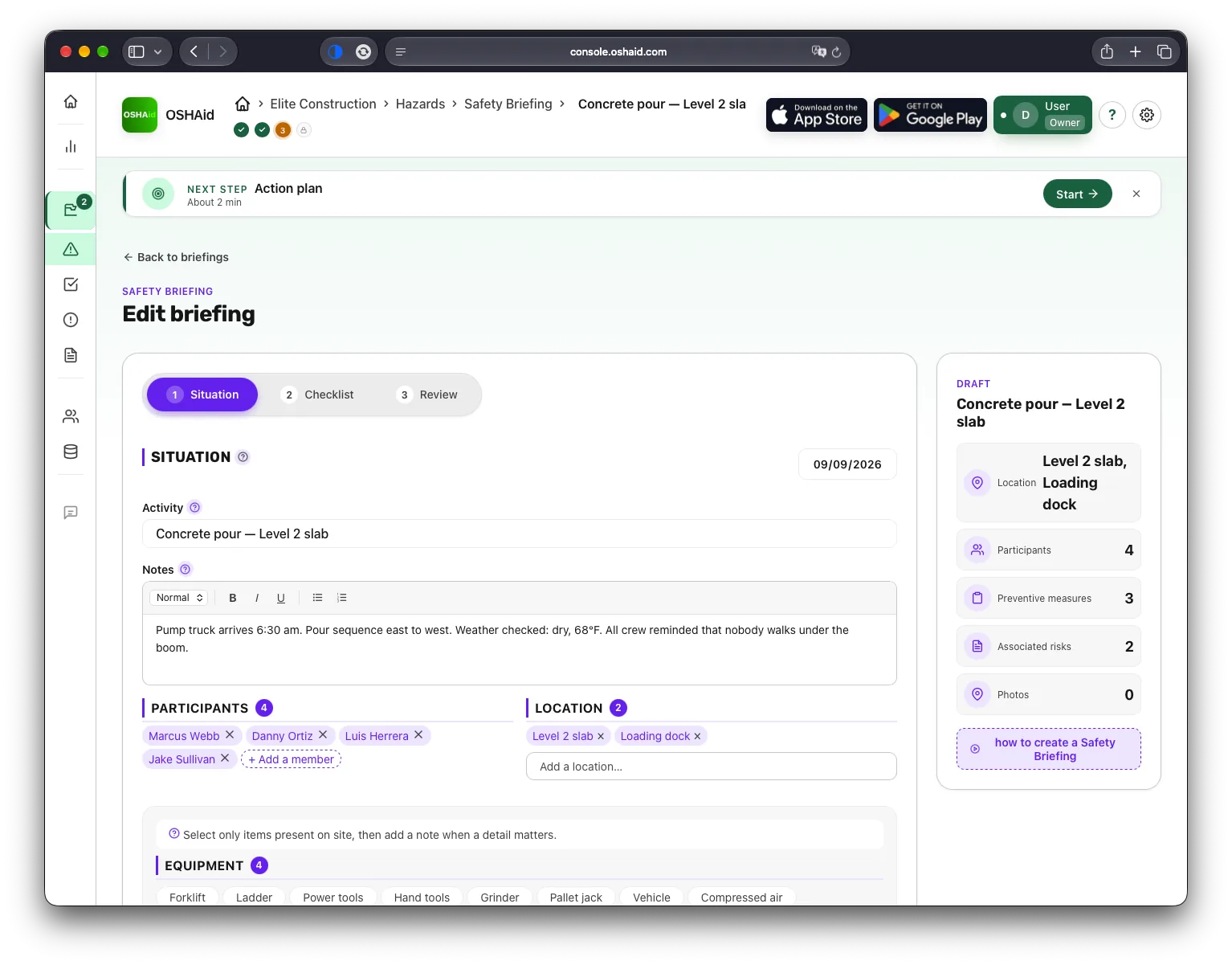 OSHAid console — safety briefing editor used to record lockout/tagout training
A program you can show, not defend
The distance between a compliant shop and a cited one is rarely intent. It is whether the procedure, the training record and the inspection certificate can be produced on the day someone asks for them. What OSHA described in this case is a company with equipment and employees, but without the documents and the training that make a lockout actually work.
OSHAid keeps those pieces in one place: machine-level hazards with risk scores, written procedures in a document library, safety briefings with who attended and when, and corrective actions with owners and deadlines. When leadership, a client or an inspector asks what you do about hazardous energy, you open the record instead of rebuilding it.
Questions safety officers ask
- What does an OSHA energy control program have to include?
29 CFR 1910.147 requires three things: documented, machine-specific energy control procedures; training for authorized, affected and other employees, certified with names and dates; and a periodic inspection of each procedure at least annually, by someone other than the employee using it.
- Are the $446,864 in penalties final?
- When does the noise standard require a hearing conservation program?
Related reading
All posts- Nov 20, 2026Rubber insulating glove testing requirements: the six-month clockOSHA update
- Nov 3, 2026OSHA lithium-ion battery requirements: no single standard, fourteen that applyOSHA update
- Sep 26, 2026Naloxone in the workplace: what OSHA's new fact sheet saysOSHA update
- Jun 3, 2026Web Console: manage your establishments and usersNew
About this article
Written by the OSHAid Safety Desk from official sources (OSHA news releases, the text of the standards, BLS and NIOSH data), checked against those sources and reviewed before publication. It explains what a rule says; it is not legal advice for your situation. OSHAid
Close your lockout/tagout gaps
Create a free OSHAid account, list your machines and assign the actions. No commitment.
Try OSHAidFreeDownload on theApp StoreGET IT ONGoogle PlayThe intelligent OSHA companion that automates your field compliance. Mobile app + web console + specialized safety AI agent, built for US workplaces.
ProductIndustriesGuides- OSHA compliance software
- Hazard assessment guide
- Safety program templates
- JHA examples
- OSHA requirements
- OSHA recordkeeping
- OSHA standards by industry
- Workplace hazards
- Get started
- What is OSHA?
- Workplace safety glossary
- Why OSHAid?
- Enterprise solutions
- About
- Blog
- Legal notice
© 2026 OSHAid - published by DUOPP (SAS). All rights reserved.
Help us improve OSHAid
We only measure site traffic. No advertising, no resale of data.
OKDeclineLearn more