 OSHAidProductsDemosIndustriesPricingMoreClient accessTry OSHAidFree🇺🇸ENTry OSHAidBack to blogOSHA updateSeptember 26, 2026· By the OSHAid Safety Desk
Naloxone in the workplace: what OSHA's new fact sheet says
OSHA published guidance on opioid overdose reversal medications on September 24, 2026. It adds no new requirements, and it hands you a ready-made checklist.
Naloxone in the workplace has been a question with no clear federal answer. On September 24, 2026, the U.S. Department of Labor's Occupational Safety and Health Administration answered part of it: a new fact sheet, Opioid Overdose Rescue with Reversal Medications, sets out how employers and workers can prepare for an opioid overdose emergency on site.
Start with what the document is not. It states plainly that it "does not impose any new compliance requirements." Nothing in it obliges you to buy naloxone or write a policy. What it gives you is the federal government's own account of how these medications work, how to get them, where to keep them and what to train people on: the raw material for a short procedure you can show, instead of a decision made in the moment by whoever happens to be closest.
What OSHA's new fact sheet says
OSHA's September 24, 2026 news release announced the guidance, and the fact sheet itself (publication FS-4519, dated 9/2026) carries the detail. It covers four things: what the medications are, how to get them, how to keep them and what to teach your crew.
The medications. OSHA names two FDA-approved opioid overdose reversal medications, or OORMs: naloxone and nalmefene, sold under several brand names. They attach to receptors in the brain to reverse and block the effects of opioids so normal breathing can resume, and they only work if someone has opioids in their system. Nasal sprays are the most common form because they need no needles or special training; injectables are used more often by first responders and healthcare workers. The instruction to employers: tell employees which form is available at your workplace and make sure they know how to use it.
Getting them. The fact sheet lists six routes: pharmacies, where FDA-approved nonprescription naloxone nasal spray can be bought without a prescription; wholesale or bulk purchasing through pharmaceutical distributors; state standing orders that let pharmacies dispense prescription naloxone in bulk; group purchasing organizations; manufacturer programs for employers; and public health partnerships, since many local and state health departments distribute naloxone at low or no cost.
Keeping them. Treat the kit like first aid. OSHA says to follow the storage conditions in the product labeling, keep it away from direct light and excessive heat and never freeze it; to track expiration dates and assign someone, such as a safety officer, to manage the supply; and to keep it in visible, easy-to-reach locations, such as with automated external defibrillators and first aid kits, with clear signs. One point appears twice: the medications work quickly but are temporary, so call 911 whenever one is administered, and expect that a further dose may be needed.
None of this is new law, but it sits next to duties you already have. 29 CFR 1910.151(b) requires that, absent an infirmary, clinic or hospital in near proximity, "a person or persons shall be adequately trained to render first aid" and that first aid supplies be readily available. Where another standard requires an emergency action plan, 29 CFR 1910.38(c)(5) requires that plan to cover the "procedures to be followed by employees performing rescue or medical duties." An overdose response belongs in those two places, not in a binder of its own. If you are unsure which baseline duties already apply to you, our guide to mandatory OSHA requirements sets them out.
For scale: the BLS Census of Fatal Occupational Injuries Summary, 2024, published February 19, 2026, recorded drug or alcohol overdoses at work "dropping to 410 fatal injuries in 2024 from 512 fatalities in 2023."
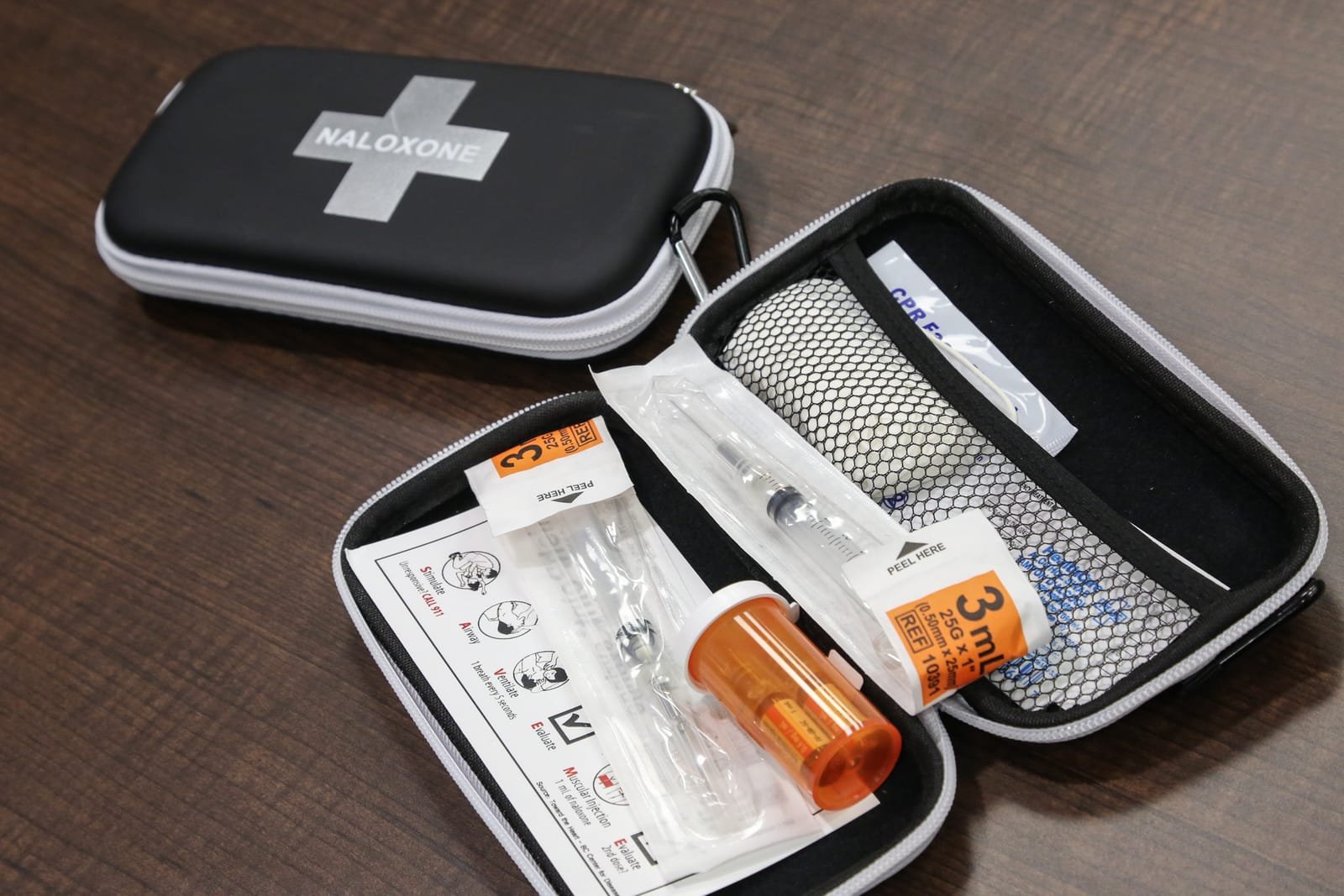 A naloxone kit as workplaces stock it: the drug, a syringe, gloves and a rescue card that walks a bystander through the steps. Photo: Government of New Brunswick, via Wikimedia Commons (CC0)
Naloxone in the workplace: five steps for this week
1. Decide, and write the decision down. Stocking OORMs is voluntary. Deciding not to is a legitimate answer; deciding nothing leaves your supervisors improvising. Put a dated line in your emergency procedures saying what your site does and who calls 911.
2. Pick the form and the supply route. Outside healthcare that usually means nonprescription nasal spray, which OSHA describes as the easier form to use. Before you buy, call your local or state health department: the fact sheet says many distribute naloxone at low or no cost.
3. Put it where people already look. With the AED, with the first aid kits, and signed. If you run more than one floor or building, plan for more than one. A kit in a locked office is a kit nobody reaches.
4. Give the supply an owner. One name, responsible for expiration dates, storage conditions and restocking. OSHA suggests the safety officer. Make it a recurring task with a due date, the same way you handle extinguisher checks.
5. Train on OSHA's own list. The fact sheet sets out the topics for a voluntary training program: calling 911 even if the person regains consciousness; recognizing the signs of an overdose, such as slow or stopped breathing, blue lips, unresponsiveness and pinpoint pupils; how OORMs work and how to use them; the possible need for additional doses; withdrawal symptoms after use; the recovery position; the Good Samaritan laws in your state; treating people with respect; and linking someone who has overdosed to ongoing care. Record who attended and when. A topic with no attendance list is a plan, not a program.
For outside help, the fact sheet points to OSHA's On-Site Consultation Program, which it describes as free and confidential advice for small and medium-sized businesses, with priority given to high-hazard worksites.
This guidance does not settle whether a given case belongs on your OSHA log. That is a work-relatedness question under 29 CFR Part 1904, where 1904.5(a) turns on whether an event or exposure in the work environment caused or contributed to the condition, and paragraph (b)(2) lists nine situations that are not work-related. Work it through with the rules rather than on instinct: our OSHA recordkeeping guide explains how the determination and the forms fit together.
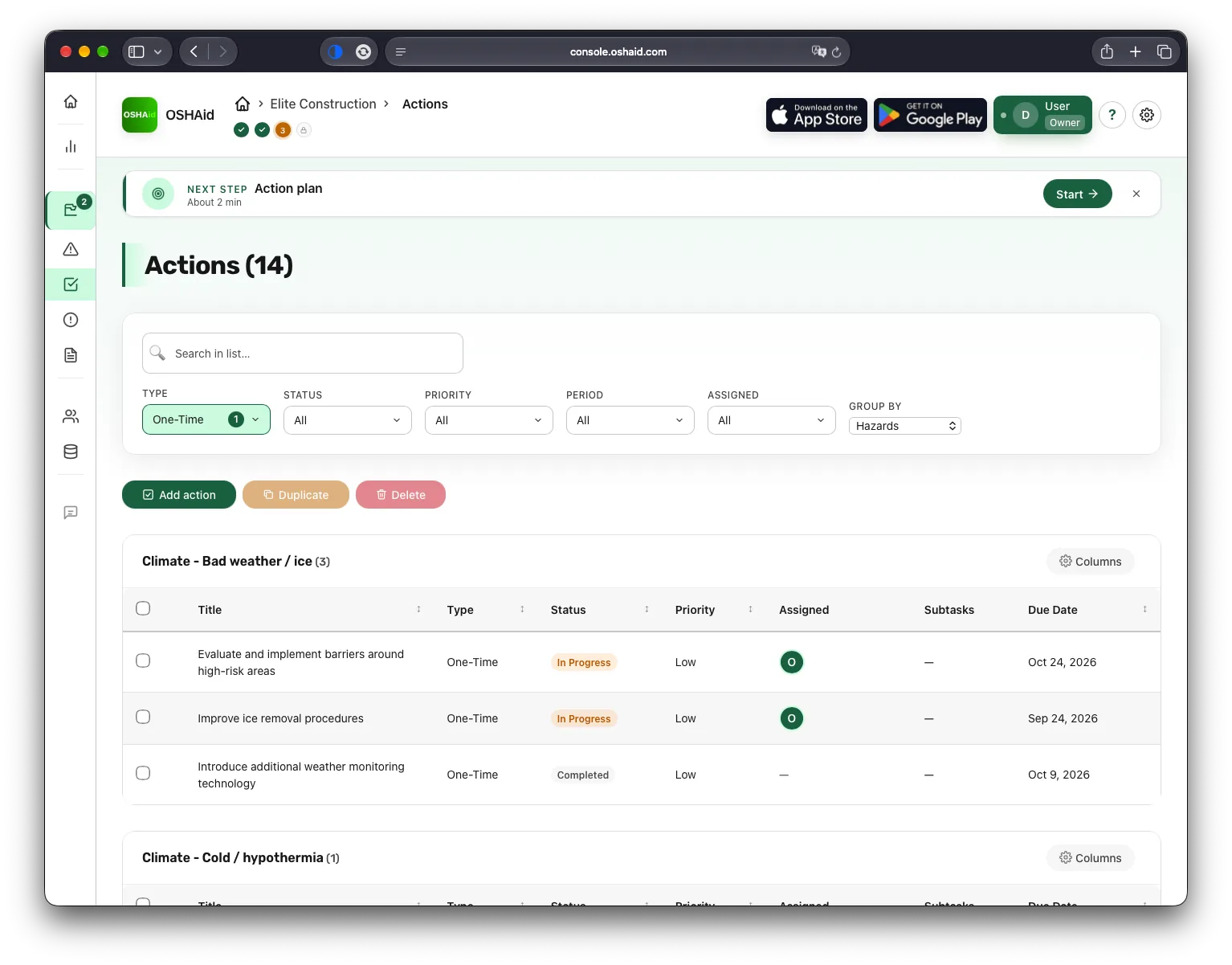 OSHAid console — action plan with an owner and a due date on every preparedness step
A response you can show, not improvise
An overdose is the kind of event measured in minutes, where nobody has time to look anything up. OSHA has now put the preparation in writing and said it is asking for nothing new, which leaves one question: has your site made a decision, and can you show it? A dated line in the emergency procedures, a kit people can find, a name against the expiration dates, an attendance list for the training. OSHAid keeps those pieces together, so when leadership, a client or an inspector asks what happens if someone goes down on your floor, you open the record instead of rebuilding it.
Questions safety officers ask
- Does OSHA require employers to keep naloxone at work?
No. OSHA's September 2026 fact sheet on opioid overdose reversal medications states that it does not impose any new compliance requirements, and describes preparedness practices employers may adopt voluntarily. Separately, 29 CFR 1910.151(b) requires trained first aid responders and readily available first aid supplies when no infirmary, clinic or hospital is in near proximity.
- Which overdose reversal medications does OSHA name?
- Where should naloxone be stored in a workplace?
Related reading
All posts- Nov 1, 2026OSHA 300 log requirements: who keeps one, and what goes on itFundamentals
- Oct 25, 2026OSHA national emphasis program: how an industry gets targetedEnforcement
- Sep 28, 2026HazCom deadline: what you must update by November 20Deadline
- Sep 25, 2026Lockout tagout requirements: the gaps OSHA keeps citingCase study
About this article
Written by the OSHAid Safety Desk from official sources (OSHA news releases, the text of the standards, BLS and NIOSH data), checked against those sources and reviewed before publication. It explains what a rule says; it is not legal advice for your situation. OSHAid
Put your overdose response in writing
Create a free OSHAid account, store the procedure and assign the training. No commitment.
Try OSHAidFreeDownload on theApp StoreGET IT ONGoogle PlayThe intelligent OSHA companion that automates your field compliance. Mobile app + web console + specialized safety AI agent, built for US workplaces.
ProductIndustriesGuides- OSHA compliance software
- Hazard assessment guide
- Safety program templates
- JHA examples
- OSHA requirements
- OSHA recordkeeping
- OSHA standards by industry
- Workplace hazards
- Get started
- What is OSHA?
- Workplace safety glossary
- Why OSHAid?
- Enterprise solutions
- About
- Blog
- Legal notice
© 2026 OSHAid - published by DUOPP (SAS). All rights reserved.
Help us improve OSHAid
We only measure site traffic. No advertising, no resale of data.
OKDeclineLearn more