 OSHAidProductsDemosIndustriesPricingMoreClient accessCreate my accountFree🇺🇸ENCreate my accountBack to blogFundamentalsNovember 1, 2026· By the OSHAid Safety Desk
OSHA 300 log requirements: who keeps one, and what goes on it
Your recordkeeping year closes on December 31 and the Form 300A summary goes on the wall by February 1. 29 CFR 1904 decides who has to keep the log behind it, which cases belong on it, and how many days you have to write one down.
OSHA 300 log requirements trip up small employers in two opposite directions. Some keep a log they never had to keep. Others find out in February that they should have been keeping one all year, and twelve months of cases cannot be reconstructed from memory.
The rule is 29 CFR 1904. It answers three questions in order: does your company have to keep records at all, which cases go on the log, and what has to exist on paper when the year closes.
This is the quiet part of the calendar. Nothing is due today. Everything that will be due on February 1 is being decided now, entry by entry.
What the OSHA 300 log requirements actually say
Two partial exemptions, and neither one is total. 29 CFR 1904.1 exempts a company that had 10 or fewer employees at all times during the last calendar year. The test is peak employment across the entire company, not one site, so it fails the moment the company passed 10 employees for a single day.
The industry exemption works per establishment. 29 CFR 1904.2 exempts an establishment classified in one of the NAICS groups listed in Appendix A to Subpart B. That list includes 7221 Full-Service Restaurants, 7222 Limited-Service Eating Places, 6111 Elementary and Secondary Schools, 6211 Offices of Physicians, 5411 Legal Services and 8121 Personal Care Services. It does not include construction, manufacturing, grocery stores or truck transportation. Because the exemption attaches to the establishment, one company can have a site that keeps records and a site that does not.
Both exemptions have a floor. Partially exempt or not, every employer covered by the OSH Act still reports a work-related fatality to OSHA within 8 hours, and an in-patient hospitalization, an amputation or an employee's loss of an eye within 24 hours. Either exemption also disappears if OSHA or the Bureau of Labor Statistics asks you in writing to keep records.
Three forms, one chain. 29 CFR 1904.29 names them: the OSHA 300 Log of Work-Related Injuries and Illnesses, the 300-A Summary of Work-Related Injuries and Illnesses, and the OSHA 301 Injury and Illness Incident Report. Every case entered on the Log gets a 301. Equivalent forms are allowed when they carry the same information, are as readable, and are completed using the same instructions; records may be kept on a computer on the same condition.
Seven calendar days, counted from information. Each recordable injury or illness goes on the 300 Log and the 301 within seven calendar days of your receiving information that it occurred, not within seven days of the incident.
What makes a case recordable. 29 CFR 1904.4 sets three conditions at once: the case is work-related, it is a new case, and it meets one of the general recording criteria. Those criteria, in 29 CFR 1904.7, are death, days away from work, restricted work or transfer to another job, medical treatment beyond first aid, loss of consciousness, or a significant injury or illness diagnosed by a physician or other licensed health care professional.
Work-relatedness is presumed. If an event or exposure in the work environment caused or contributed to the condition, or significantly aggravated a pre-existing one, the case is work-related unless an exception in 1904.5(b)(2) applies, such as the person being present as a member of the general public, symptoms that surface at work but result solely from a non-work exposure, voluntary participation in a wellness, fitness or recreational activity, or eating and drinking for personal consumption.
 Two stockroom staff between racking bays going through a checklist on a clipboard, one of them in a high-visibility vest. Photo: Centre for Ageing Better, via Pexels (Pexels License)
OSHA 300 log requirements: what to check before December 31
1. Settle the exemption question in writing. Pull peak employment for the last calendar year across the whole company, then check each establishment's NAICS code against Appendix A. Date the answer and keep it. Our guide to OSHA recordkeeping and the 300, 300A and 301 forms covers the forms themselves. If you run restaurants, settle it before you assume the log applies: the hazards still do, as our page on OSHA compliance for restaurants sets out.
2. Re-read each case against 1904.7, not against the insurance claim. Workers' compensation and OSHA recordability are different tests, and the line that decides most arguments is medical treatment beyond first aid.
3. Check the dates, not only the entries. The seven-day clock runs from the day you received information. A case a supervisor reported late is still a case, and the log should show it.
4. Update the day counts. When an employee is still out, the rule expects an estimate now and the real number once it is known. Days away are counted in calendar days.
5. Handle privacy concern cases correctly. For the categories listed in 1904.29(b)(7), among them an injury or illness to an intimate body part or the reproductive system, one resulting from a sexual assault, mental illnesses, and needlesticks and sharps cuts contaminated with another person's blood, you enter “privacy case” on the 300 Log instead of the name and keep a separate, confidential list of case numbers and names.
6. Line up the certifier now. A company executive must certify the annual summary: an owner, if the company is a sole proprietorship or partnership; an officer of the corporation; the highest ranking company official working at the establishment; or that person's immediate supervisor. The summary is then posted where notices to employees are customarily posted, unaltered, from February 1 through April 30, under 29 CFR 1904.32.
7. Check whether you also file electronically. Establishments with 250 or more employees that are required to keep records, and those with 20 to 249 employees in the industries listed in Appendix A to Subpart E, submit 300A information; establishments with 100 or more employees in the Appendix B industries also submit the 300 and the 301. The deadline is March 2 of the following year, and OSHA's recordkeeping page notes that the Injury Tracking Application takes those filings from January 2.
8. Keep the records five years. The 300 Log, the privacy case list, the annual summary and the 301 forms are saved for five years after the end of the year they cover, and stored logs are updated when a case changes. The rest of what every covered employer owes sits in our summary of mandatory OSHA obligations.
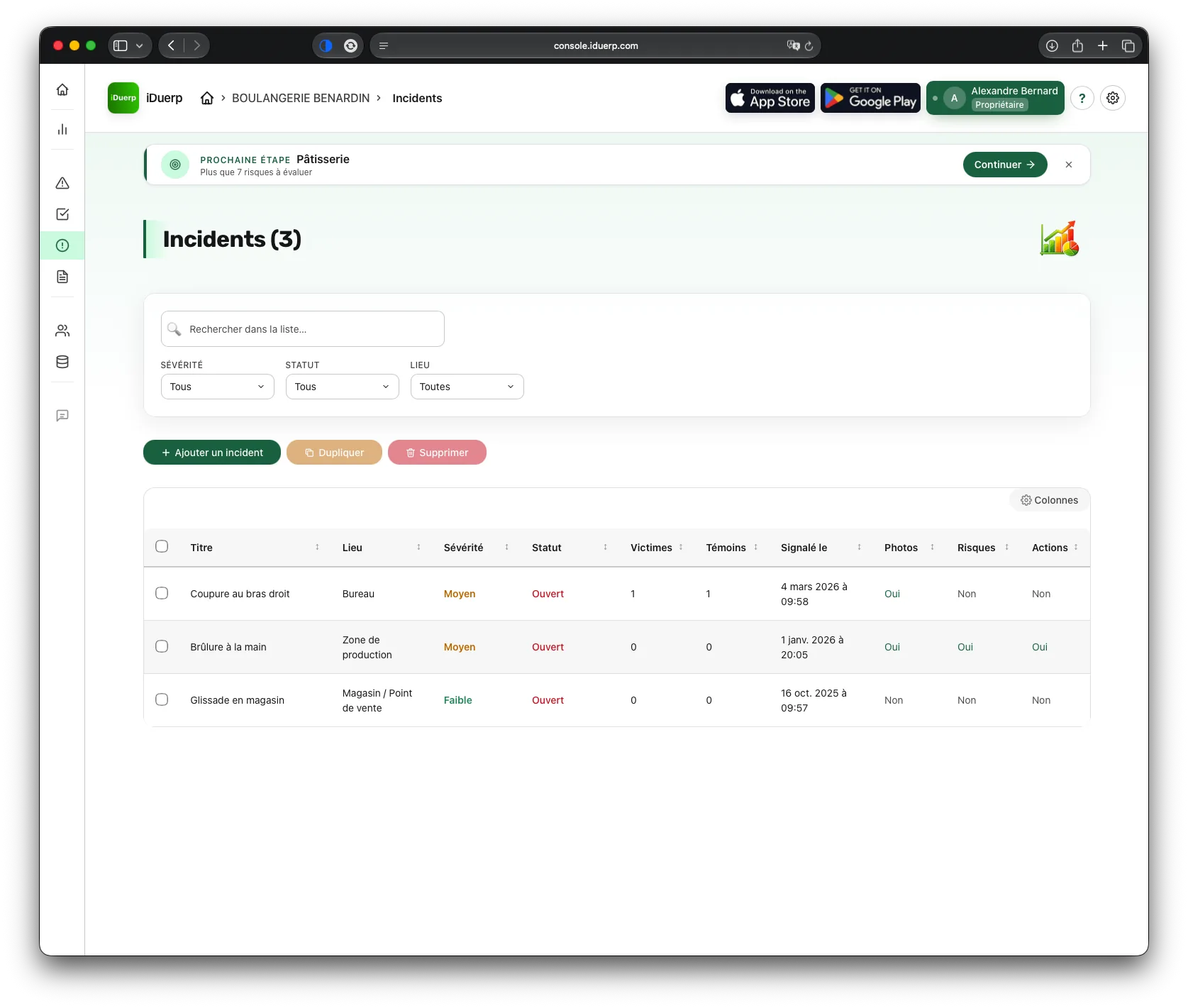 OSHAid console incident log: reported events listed with date, site, type and status, ready to export
The log is the evidence
A 300 log is not a form you complete for OSHA. It is the only continuous record of what actually went wrong in your workplace, and the one document an inspector, an insurer or a prospective client can read in two minutes. As a stack of paper found in January, it is something you defend. As entries with dates, the 301 behind each one and the corrective action that closed it, it is something you can show.
Questions safety officers ask
- Who has to keep an OSHA 300 log?
Any company that had more than 10 employees at any time during the last calendar year, unless the establishment is classified in a partially exempt industry listed in Appendix A to Subpart B of Part 1904. Either exemption ends if OSHA or the Bureau of Labor Statistics asks in writing for records.
- How long do I have to record an injury on the OSHA 300 log?
- When must the OSHA 300A summary be posted?
Related reading
All posts- Oct 31, 2026Oregon workplace violence prevention rule: what to have ready by January 1State rule
- Oct 30, 2026OSHA general duty clause: a rule you do not enforce is not a defenseCase law
- Oct 25, 2026OSHA national emphasis program: how an industry gets targetedEnforcement
- Sep 26, 2026Naloxone in the workplace: what OSHA's new fact sheet saysOSHA update
About this article
Written by the OSHAid Safety Desk from official sources (OSHA news releases, the text of the standards, BLS and NIOSH data), checked against those sources and reviewed before publication. It explains what a rule says; it is not legal advice for your situation. OSHAid
Keep the log current instead of catching it up
Create a free OSHAid account: log incidents as they happen with photos and notes, keep your 300, 300A and 301 records in one place, and follow corrective actions through to closure. No commitment.
Create my accountFreeDownload on theApp StoreGET IT ONGoogle PlayThe intelligent OSHA companion that automates your field compliance. Mobile app + web console + specialized safety AI agent, built for US workplaces.
🇫🇷 Hosted in EuropeGDPR CompliantProductIndustriesGuides- OSHA compliance software
- Hazard assessment guide
- Safety program templates
- JHA examples
- OSHA requirements
- OSHA recordkeeping
- OSHA standards by industry
- Workplace hazards
- Get started
- What is OSHA?
- Workplace safety glossary
- Why OSHAid?
- Enterprise solutions
- About
- Blog
- Legal notice
© 2026 OSHAid - published by DUOPP (SAS). All rights reserved.