 OSHAidProductsDemosIndustriesPricingMoreClient accessTry OSHAidFree🇺🇸ENTry OSHAidBack to blogCase lawNovember 5, 2026· By the OSHAid Safety Desk
OSHA asbestos awareness training: the duty that follows the building
OSHA cited a Portland mail station over asbestos housekeeping and training and proposed $108,042. On October 28, 2026 a judge's decision vacating all six items became a final order of the Review Commission. The standard behind it reaches any building constructed no later than 1980.
If your building went up before 1981, OSHA asbestos awareness training is probably already owed to the person who mops your floors: once a year, at no cost, covering five topics the standard names one by one.
That duty was tested in a case that closed on October 28, 2026, when an administrative law judge's decision became a final order of the Occupational Safety and Health Review Commission. OSHA had cited the U.S. Postal Service over asbestos housekeeping, employee notification and training at its East Portland Station in Portland, Oregon, and proposed a total penalty of $108,042. The judge vacated all six citation items and assessed no penalty.
The useful part is not the outcome. It is the list of things the employer could point to.
What OSHA asbestos awareness training requires
The trigger is the building, not the job. Under 29 CFR 1910.1001(j)(2), employers and building owners must treat installed thermal system insulation and sprayed-on or troweled-on surfacing material as asbestos-containing in any building constructed no later than 1980. Asphalt and vinyl flooring installed no later than 1980 counts too. OSHA calls this presumed asbestos-containing material, or PACM, and the presumption stands until someone rebuts it. Read on eCFR, current as of November 3, 2026.
The owner finds it; the employer tells the crew. Paragraph (j)(3)(i) puts the duty to determine the presence, location and quantity of ACM and PACM on the building and facility owner, and requires owners and employers to exercise due diligence in informing employers and employees. Paragraph (j)(3)(ii) makes the owner keep those records for the duration of ownership and pass them to the next owner. Paragraph (j)(3)(iii) is the one that reaches the cleaning staff: owners inform employers, and employers inform employees who perform housekeeping in areas containing ACM or PACM of its presence and location.
The training has five named elements. Paragraph (j)(7)(iv) requires an asbestos awareness training course, at no cost, for employees who perform housekeeping operations in an area which contains ACM or PACM. At a minimum it covers the health effects of asbestos, the locations of ACM and PACM in the building or facility, recognition of ACM and PACM damage and deterioration, the requirements in the standard relating to housekeeping, and proper response to fiber release episodes. Each such employee is trained at least once a year.
Housekeeping is a short list with sharp edges. Paragraph (k) requires all surfaces to be maintained as free as practicable of ACM waste and debris and accompanying dust, spills and sudden releases to be cleaned up as soon as possible, and asbestos waste to be collected in sealed impermeable bags or other closed, impermeable containers. Compressed air may not be used to clean contaminated surfaces. Dry sweeping and shoveling are allowed only where vacuuming and wet cleaning are not feasible, and HEPA-filtered vacuuming equipment must be used for asbestos waste and debris, and emptied in a manner that minimizes reentry of asbestos into the workplace.
Signs, labels and the chemical list. At entrances to mechanical rooms containing ACM or PACM that employees can reasonably be expected to enter, (j)(4)(iv) has the building owner post signs identifying the material, its location and the work practices that keep it undisturbed. Paragraph (j)(1)(iii) folds asbestos into hazard communication: it belongs in the program, with labels and safety data sheets accessible to employees and training delivered under both rules.
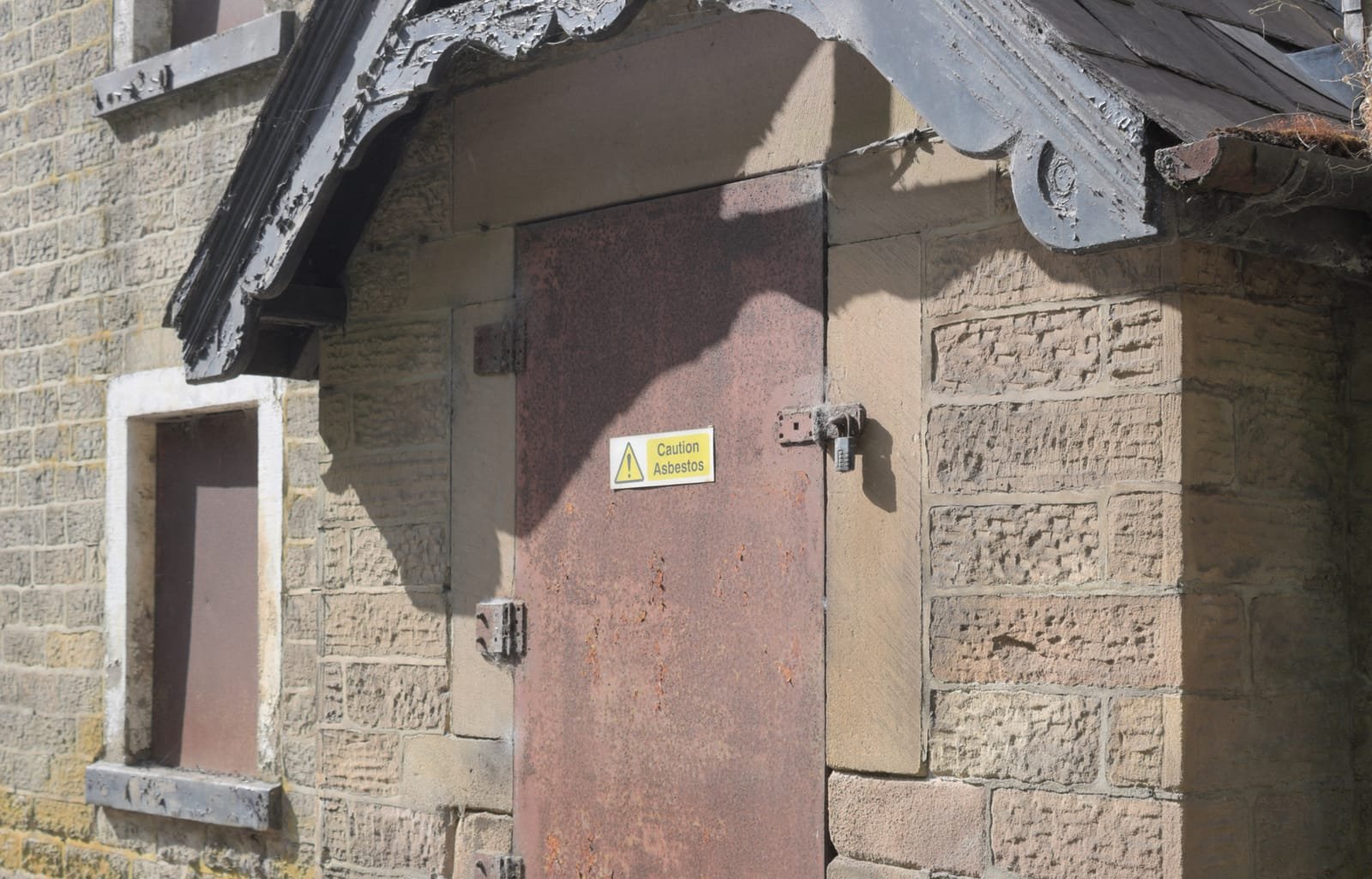 A rusted steel door padlocked shut in the stone wall of a derelict building, with a small yellow and white sign reading "Caution Asbestos" fixed at eye height. Photo: Aethonatic, via Wikimedia Commons (CC0 1.0)
Seven checks to run this week
1. Date the building before anything else. Construction no later than 1980 turns flooring and pipe lagging into PACM by default. A deed, a permit record or the facility file settles it in ten minutes.
2. Find the survey, or commission one. The owner's duty under (j)(3)(i) is to know the presence, location and quantity. In the Portland case the employer could point to a 1997 building survey that employees had access to, with detailed information on where asbestos sat in the station. If you have no survey, the walk-around in our workplace hazard assessment guide is where the list of suspect materials starts.
3. Rebut PACM the way the rule allows, or not at all. Paragraph (j)(8)(ii) accepts a completed inspection under AHERA, 40 CFR part 763 subpart E, or tests of bulk samples collected in the manner described in 40 CFR 763.86 by an accredited inspector or a certified industrial hygienist, analysed by a laboratory with demonstrated proficiency such as NVLAP or the AIHA round robin. An opinion over the phone is not one of the routes.
4. Put the annual course on the calendar, and date the record. OSHA argued here that the training records were undated and so could not show the custodian was trained annually. The judge never reached that argument: the agency failed to produce sufficient evidence of a violation in the first instance. A dated roster costs nothing and removes the question. Our written safety program templates keep the course outline and the attendance record in one place.
5. Say where, not just what. The recurring safety talk addressed asbestos, where it may be found including vinyl floor tiles, and how to work safely around it. What the judge weighed was that managers added the locations inside that building when they delivered it, alongside posted signs and access to the survey. The duty in (j)(3)(iii) is about your building, not asbestos in general.
6. Look at how the floor actually gets cleaned. Compressed air on a contaminated surface, dry sweeping where wet cleaning would work, a filter pulled out and dropped into an open trash can: each one meets a line of paragraph (k), and each is visible on a walk-through.
7. Add asbestos to the hazard communication inventory. Two of the six items were hazard communication items: not listing asbestos among the hazardous chemicals present, and not making safety data sheets available. They are the easiest two to check and the easiest two to forget.
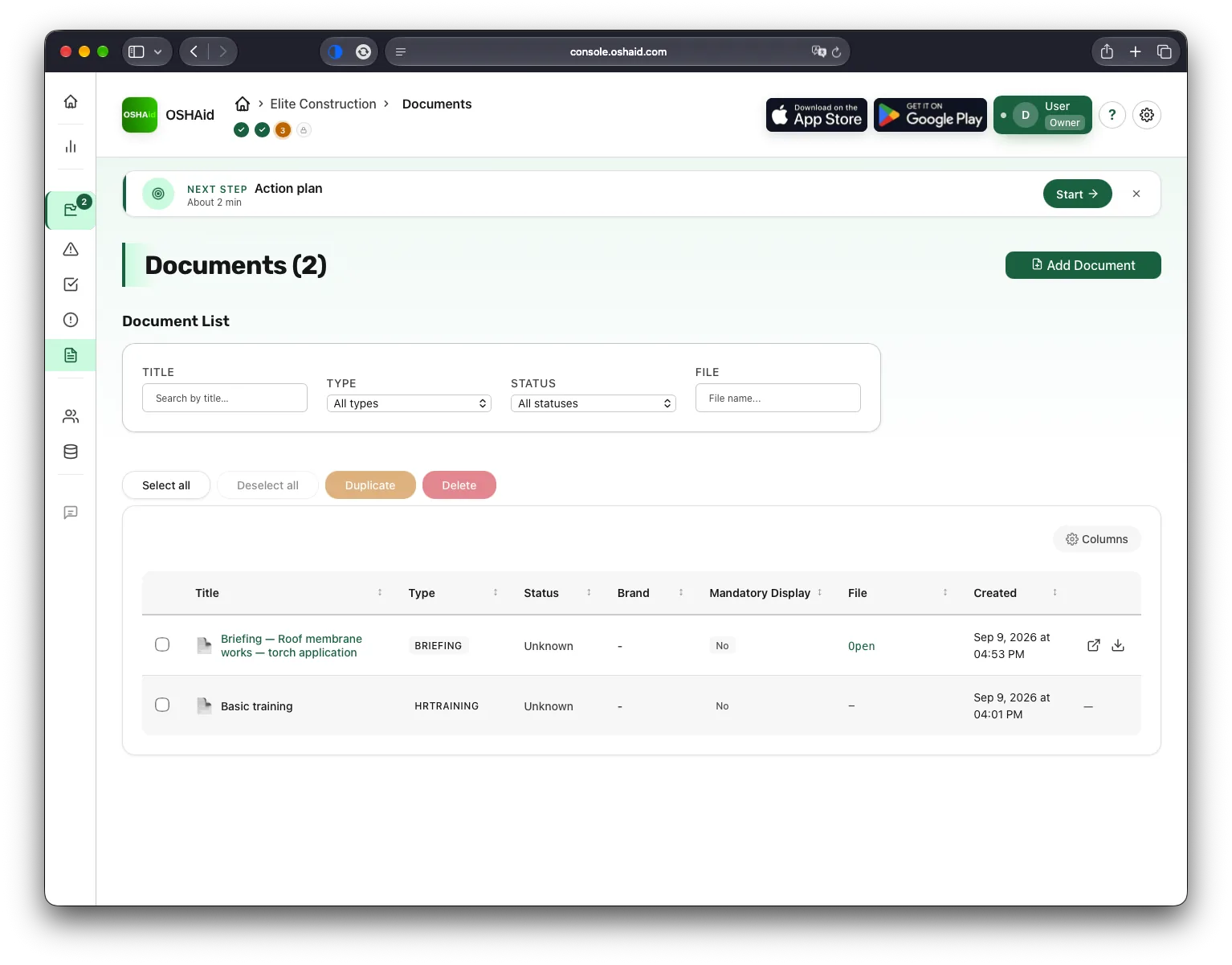 OSHAid console — the document library, where the asbestos survey, the awareness training outline and the dated attendance record are filed together
A file you can hand over
No judge ruled that asbestos stopped being a hazard in that building. The flooring had been encapsulated in three layers and overlaid, the custodian swept and spot-mopped daily, the recurring safety talk ran several times a year, signs were posted and the survey was on hand. That is what the record looked like in the decision in OSHRC Docket No. 23-1008.
For a safety officer the lesson is narrower than it sounds: almost everything 1910.1001 asks of a building with asbestos in it is a document you either have or do not have. The survey. The dated roster. The course outline. The posted signs. The hazard communication entry.
Kept together and kept current, they stop being a binder you defend and become a file you can show.
Questions safety officers ask
- Who needs OSHA asbestos awareness training?
29 CFR 1910.1001(j)(7)(iv) requires it for employees who perform housekeeping operations in an area which contains asbestos-containing material or presumed asbestos-containing material. The employer provides the course at no cost to those employees, and each one must be trained at least once a year.
- What must asbestos awareness training cover?
- What counts as presumed asbestos-containing material?
Related reading
All posts- Nov 20, 2026Rubber insulating glove testing requirements: the six-month clockOSHA update
- Nov 6, 2026OSHA ladder inspection requirements: what a 3.66 million-unit recall asks of youRecall
- Nov 4, 2026OSHA eye protection requirements: when safety glasses are not enoughOSHA update
- Oct 6, 2026Emergency action plan requirements: when OSHA actually makes you write oneFundamentals
About this article
Written by the OSHAid Safety Desk from official sources (OSHA news releases, the text of the standards, BLS and NIOSH data), checked against those sources and reviewed before publication. It explains what a rule says; it is not legal advice for your situation. OSHAid
Keep the survey and the training in one place
Create a free OSHAid account: record the asbestos hazard where it sits, attach the survey, schedule the annual awareness training and keep the attendance record dated. No commitment.
Try OSHAidFreeDownload on theApp StoreGET IT ONGoogle PlayThe intelligent OSHA companion that automates your field compliance. Mobile app + web console + specialized safety AI agent, built for US workplaces.
ProductIndustriesGuides- OSHA compliance software
- Hazard assessment guide
- Safety program templates
- JHA examples
- OSHA requirements
- OSHA recordkeeping
- OSHA standards by industry
- Workplace hazards
- Get started
- What is OSHA?
- Workplace safety glossary
- Why OSHAid?
- Enterprise solutions
- About
- Blog
- Legal notice
© 2026 OSHAid - published by DUOPP (SAS). All rights reserved.
Help us improve OSHAid
We only measure site traffic. No advertising, no resale of data.
OKDeclineLearn more