 OSHAidProductsDemosIndustriesPricingMoreClient accessCreate my accountFree🇺🇸ENCreate my accountBack to blogWhistleblowerOctober 2, 2026· By the OSHAid Safety Desk
Refusing unsafe work: when a stand-down is protected
OSHA found a railroad illegally fired a yardman who stopped work for nearby lightning. The order is under appeal. The rules behind it are not.
Refusing unsafe work is a decision one of your employees may make during the next thunderstorm, and how a supervisor answers in the next five minutes can cost far more than the lost production. On October 1, 2026, OSHA announced that a railroad broke federal law when it fired a yardman who stopped work because of nearby lightning, in news release 26-1252-KAN.
OSHA determined that the employee raised concerns about nearby lightning, cited OSHA and NOAA lightning safety guidelines, initiated a safety stand-down, and refused to work until the storm passed. Union Pacific Railroad Co. removed the employee from service within minutes, later charged him with insubordination, and terminated his employment on May 30, 2024.
On June 10, 2026, OSHA ordered the company to clear the incident from the employee's records and to pay back wages, lost benefits, compensatory and punitive damages totaling at least $304,869, plus attorney's fees. Union Pacific filed objections and requested a hearing before a Department of Labor Administrative Law Judge, so the order is not final. The rules it turns on are, and they reach well beyond the railroad.
When refusing unsafe work is protected
Railroads answer to a statute of their own. The Federal Railroad Safety Act, 49 U.S.C. 20109, protects a rail employee who reports a hazardous safety or security condition in good faith, or refuses to work when confronted by one. Complaints under it are due within 180 days.
Most employers are not railroads, and the general rule is narrower. Section 11(c) of the Occupational Safety and Health Act, 29 U.S.C. 660(c), bars retaliation against an employee who files a complaint, takes part in a proceeding, or exercises any right afforded by the Act. That complaint has to reach OSHA within 30 days.
Walking off a job is not, by itself, one of those rights. 29 CFR 1977.12 says so directly: as a general matter, there is no right afforded by the Act that would entitle employees to walk off the job because of potential unsafe conditions at the workplace. An employer would not ordinarily violate section 11(c) by disciplining an employee for refusing to perform normal job activities because of alleged safety or health hazards.
Then comes the exception, the one your supervisors have to recognize on sight. The same section covers the employee confronted with "a choice between not performing assigned tasks or subjecting himself to serious injury or death." Four conditions must line up at once:
The refusal is in good faith, with no reasonable alternative. A reasonable person, under the circumstances then confronting the employee, would conclude there is a real danger of death or serious injury. There is insufficient time, given the urgency, to eliminate the danger through regular statutory enforcement channels. And where possible, the employee has asked the employer to correct the condition and has not obtained it.
A storm overhead compresses all four into about a minute. That is why weather refusals end up in front of an investigator: nobody has time to call anyone, the danger is visible to everyone on the ground, and the supervisor answers before anyone opens a policy. Lightning belongs with heat, cold and wind among the workplace hazards that arrive on their own schedule, not yours.
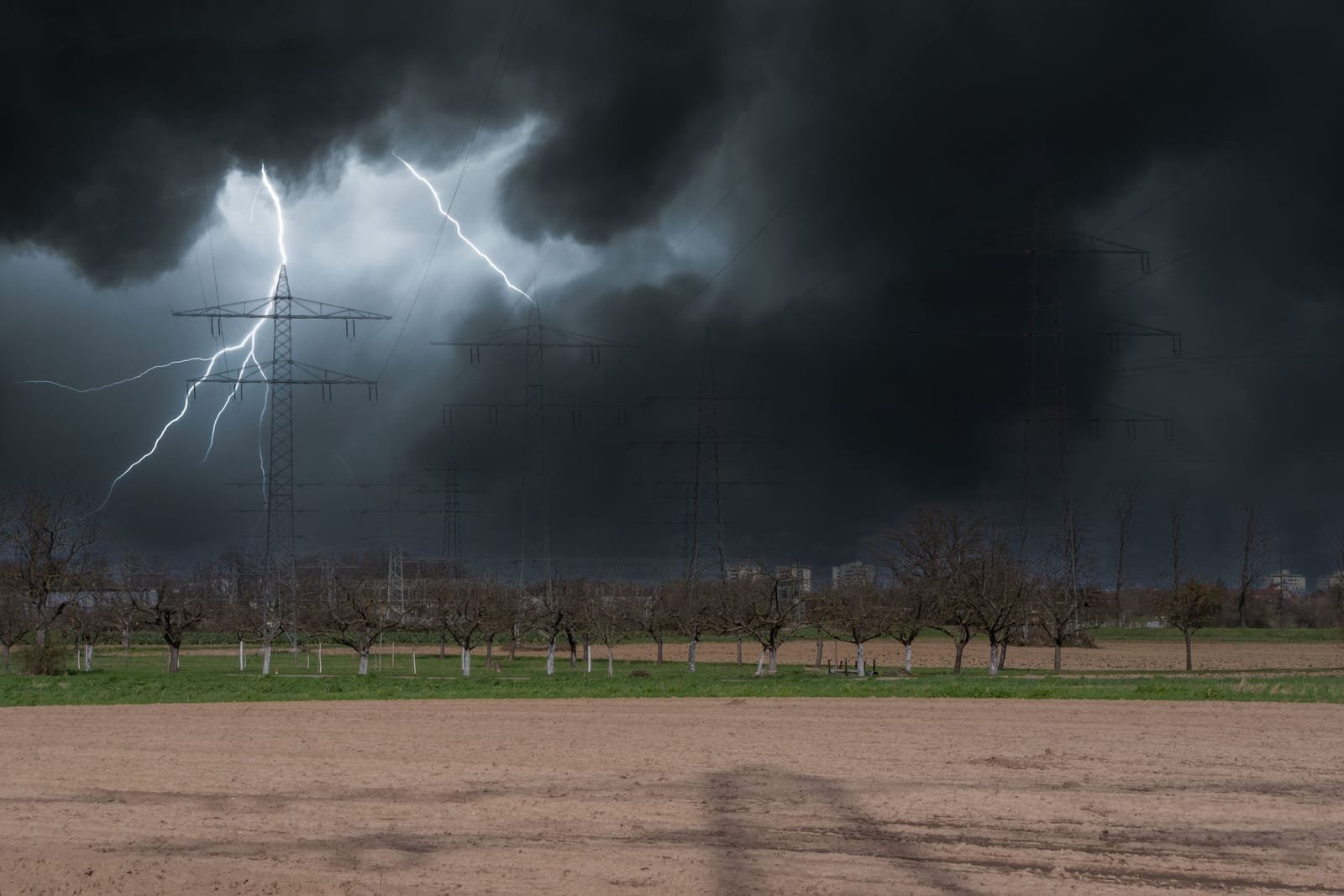 Lightning striking a high-voltage transmission tower above an open field under a black storm front. Photo: Manfred Langpap, via Pexels
What to put in place before the next storm
1. Write the lightning protocol. The OSHA and NOAA fact sheet Lightning Safety When Working Outdoors (FS-3863, June 2021) says employers should have a written Emergency Action Plan, as outlined in 29 CFR 1910.38 or 29 CFR 1926.35, including a written lightning safety protocol. It should tell supervisors and workers to act after hearing thunder or seeing lightning, say how workers are notified, identify safe shelters and the response time to reach them, and set when outdoor work is suspended and resumed.
2. Name who can call the stop, in writing. The expensive version of this story is a supervisor improvising. Put the authority to suspend outdoor work in the plan, name the roles that hold it, and make clear any worker may raise the alarm. It belongs with the rest of the obligations every US employer carries, not in a weather memo nobody reads.
3. Define the shelter and the clock. NOAA recommends fully enclosed buildings with electrical wiring and plumbing; where none is reachable, hard-topped metal vehicles with the windows rolled up. In either case, stay at least 30 minutes after the last sound of thunder. Sheds, pavilions, tents and covered porches do not provide adequate protection.
4. Know the three jobs that stop by rule. During storms or high winds, OSHA prohibits work on or from scaffolds (29 CFR 1926.451(f)(12)), crane hoists (29 CFR 1926.1431(k)(8)) and work on top of walls (29 CFR 1926.854(c)). Scaffold work may continue only if a qualified person determines it is safe and personal fall protection or wind screens are provided; crane hoists, on the same determination.
5. Train per site, not per company. OSHA says training should be provided for each outdoor worksite, so supervisors and workers know in advance where that site's safe shelters are and how long they take to reach. For transportation and field crews the shelter changes with the route, which is why it has to be settled before the sky does.
6. Document the stop the day it happens. Record who raised the condition, what was reported, when work stopped, what you checked, the decision, and when work resumed. That entry is the whole defense if a retaliation complaint arrives months later.
7. Keep performance decisions away from the report. Discipline issued minutes after a safety concern is the pattern investigators look for. If a performance issue is genuinely separate, let the record show it: different date, different evidence, different conversation.
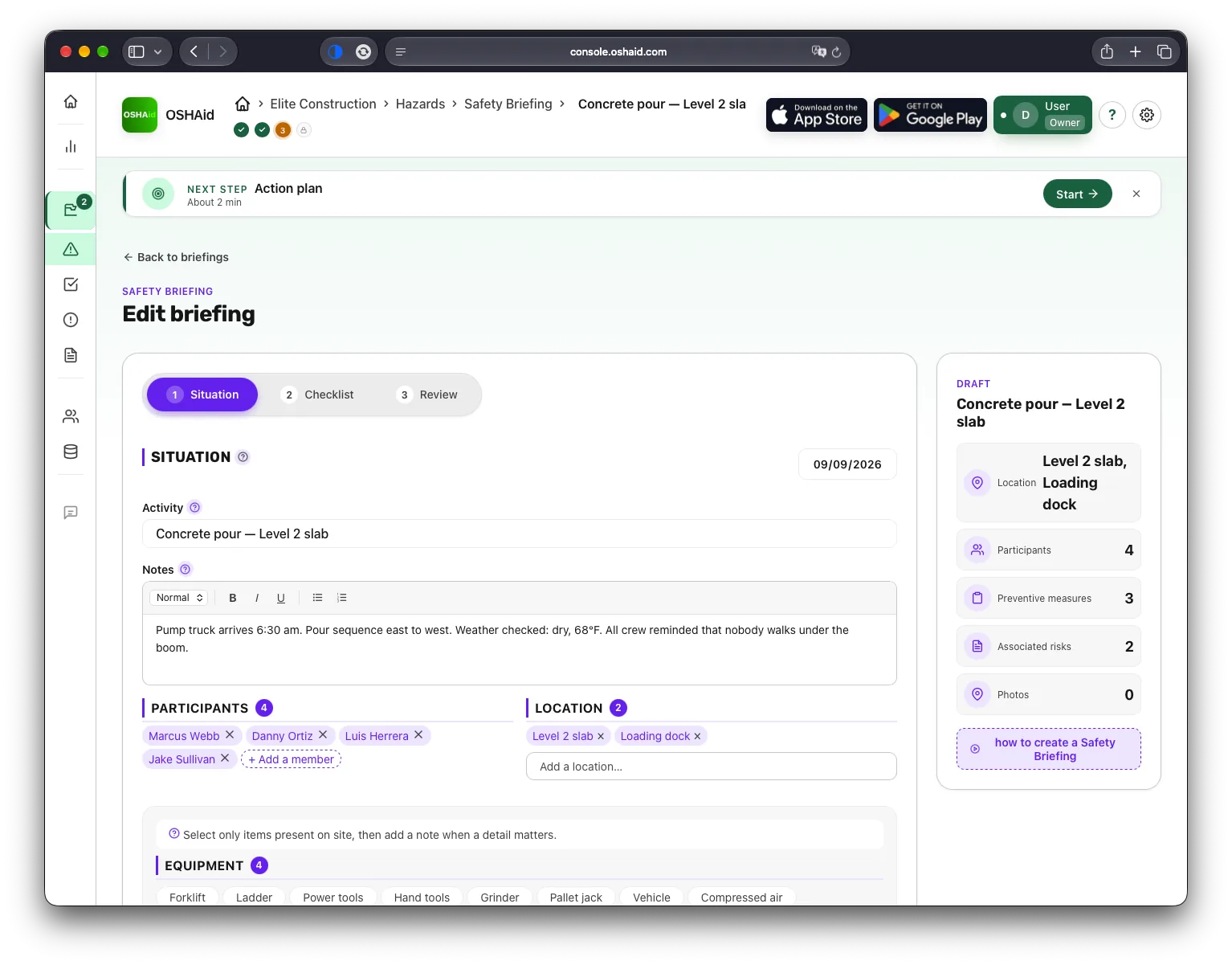 OSHAid console — the safety briefing editor, where a lightning protocol and its toolbox talk are prepared
A stop-work call you can show
A work refusal is a short conversation that turns into a long record. Months later, what an investigator reads is not what your supervisor meant. It is what exists on paper: the written lightning protocol, the training sheet with that supervisor's name on it, the entry showing what was reported and when, the decision taken, and the hour work resumed. An employer holding all of that spends an afternoon answering; one rebuilding it from a group chat and three recollections spends weeks. That is the argument for keeping hazards, training records, incidents and corrective actions in one system rather than a binder: when someone outside your company asks what you did about a hazard, you want to show them, not assemble it.
Questions safety officers ask
- Can an employee refuse to work in unsafe conditions?
Only in narrow circumstances. Under 29 CFR 1977.12 there is generally no right to walk off the job over potential unsafe conditions. A refusal is protected when a reasonable person would conclude there is a real danger of death or serious injury, there is no time for regular enforcement channels, and the employee asked the employer to correct it.
- How long does a worker have to file an OSHA retaliation complaint?
- Does OSHA have a lightning safety standard?
About this article
Written by the OSHAid Safety Desk from official sources (OSHA news releases, the text of the standards, BLS and NIOSH data), checked against those sources and reviewed before publication. It explains what a rule says; it is not legal advice for your situation. OSHAid
Make your stop-work record easy to show
Create a free OSHAid account and keep your hazards, training records, incidents and documents in one place. No commitment.
Create my accountFreeDownload on theApp StoreGET IT ONGoogle PlayThe intelligent OSHA companion that automates your field compliance. Mobile app + web console + specialized safety AI agent, built for US workplaces.
🇫🇷 Hosted in EuropeGDPR CompliantProductIndustriesGuides- OSHA compliance software
- Hazard assessment guide
- Safety program templates
- JHA examples
- OSHA requirements
- OSHA recordkeeping
- OSHA standards by industry
- Workplace hazards
- Get started
- What is OSHA?
- Workplace safety glossary
- Why OSHAid?
- Enterprise solutions
- About
- Blog
- Legal notice
© 2026 OSHAid - published by DUOPP (SAS). All rights reserved.