 OSHAidProductsDemosIndustriesPricingMoreClient accessTry OSHAidFree🇺🇸ENTry OSHAidBack to blogResearchNovember 8, 2026· By the OSHAid Safety Desk
Bloodborne pathogens PPE requirements: what a wiped gown no longer does
NIOSH reported on November 2, 2026 that wiping protective clothing with disinfecting wipes lowered its resistance to liquids on most fabrics tested. OSHA calls PPE "appropriate" only if blood cannot pass through it. Those two sentences meet in your supply cupboard.
Bloodborne pathogens PPE requirements are usually read as a shopping list: gloves, gowns, face shields, eye protection. The standard is stricter than a list. It describes a result, and a garment that stops producing that result stops counting.
On November 2, 2026 NIOSH gave the Research Rounds section of its November 2026 eNews to a study of what disinfecting wipes do to protective clothing. Nine models of gowns and coveralls were tested, 10 samples of each, before and after wiping with pre-moistened wipes containing quaternary ammonium compounds, with and without alcohol. Resistance to liquids decreased on most of the fabrics tested. Only fabrics with plastic-like surfaces, such as laminate or polyethylene reinforcement, held their level, and drying generally did not restore what was lost.
The work behind it is a research letter, Disinfecting Wipes and Barrier Resistance of Protective Clothing, published in JAMA Network Open on October 24, 2025 by four NIOSH and CDC authors. What turns a laboratory result into an employer's problem is a definition OSHA wrote into the standard.
What the bloodborne pathogens PPE requirements actually say
"Appropriate" is a defined word, not a judgment call. 29 CFR 1910.1030(d)(3)(i) requires the employer, where there is occupational exposure, to provide at no cost to the employee appropriate personal protective equipment: gloves, gowns, laboratory coats, face shields or masks and eye protection, and mouthpieces, resuscitation bags, pocket masks or other ventilation devices. Then it defines the word. PPE is appropriate only if it does not permit blood or other potentially infectious materials to pass through to or reach the employee's work clothes, street clothes, undergarments, skin, eyes, mouth or other mucous membranes under normal conditions of use and for the duration of time which the protective equipment will be used. Read on eCFR, title 29 current as of November 5, 2026.
Two clauses in that definition do the work. "Under normal conditions of use", and "for the duration of time which the protective equipment will be used". A gown that performs out of the box but not after a long procedure, or not after it has been wiped down, is not appropriate for the way you are using it.
Replacement is the employer's job, by name. Paragraph (d)(3)(v) requires the employer to repair or replace personal protective equipment as needed to maintain its effectiveness, at no cost to the employee. Paragraph (d)(3)(iv) puts cleaning, laundering and disposal on the employer as well.
A penetrated garment comes off. Under (d)(3)(vi), a garment penetrated by blood or other potentially infectious materials shall be removed immediately or as soon as feasible. Paragraph (vii) has all PPE removed before leaving the work area, and (viii) has it placed in a designated area or container for storage, washing, decontamination or disposal.
Gloves have their own rule about reuse. Paragraph (d)(3)(ix)(B) is one line: disposable single-use gloves shall not be washed or decontaminated for re-use. Utility gloves are treated differently. Paragraph (ix)(C) allows them to be decontaminated for re-use if the integrity of the glove is not compromised, and requires them discarded when they are cracked, peeling, torn, punctured or show other signs of deterioration.
The general PPE rule sits over the top of all of it. 29 CFR 1910.132(a) requires protective equipment, including protective clothing, to be provided, used and maintained in a sanitary and reliable condition. Sanitary and reliable are not the same word, and the NIOSH finding is about the second one.
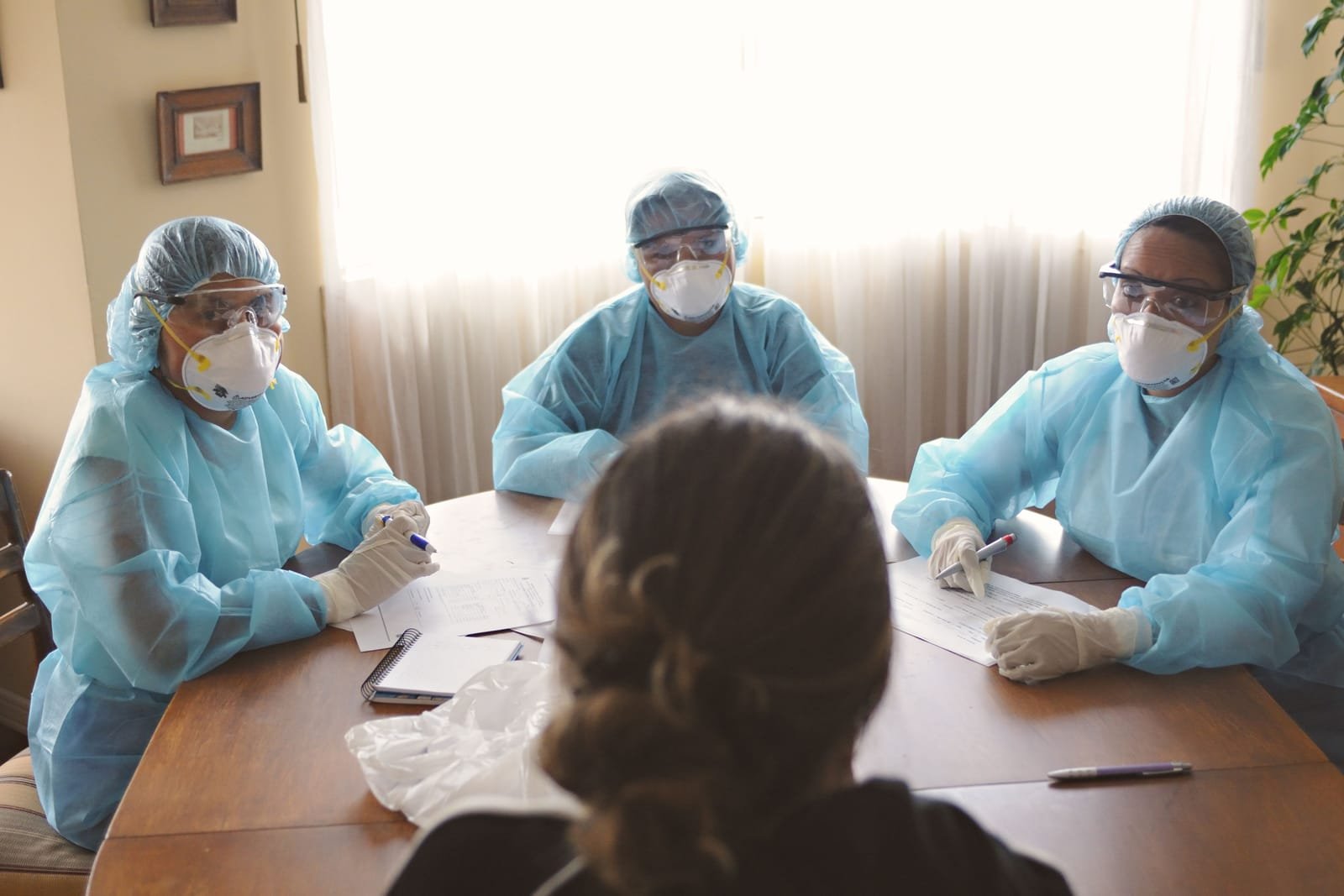 Three healthcare workers in disposable isolation gowns, gloves, respirators and goggles sit at a table taking notes during a patient interview. Photo: Dave Garcia (@davegarcia), via Pexels (Pexels License)
Six checks to run on your protective clothing this week
1. Write down which garments you treat as single use and which as reusable. The exposure determination required by 1910.1030(c)(2) already lists the job classifications in which employees have occupational exposure. The garment each classification wears belongs on the same line.
2. Ask the manufacturer before anything gets wiped. That is NIOSH's own closing line: workers should consult protective clothing manufacturers before using disinfecting wipes. In the study, the only fabrics that kept a similar level of resistance after wiping were those with laminate or polyethylene reinforcement.
3. Stop washing single-use gloves. Paragraph (d)(3)(ix)(B) does not allow it, in any volume, for any reason.
4. Put the replacement trigger in writing. Paragraph (d)(3)(v) says "as needed to maintain its effectiveness" and leaves the trigger to you. Name the signs your staff should act on; the list the standard uses for utility gloves in (ix)(C) is a usable model: cracked, peeling, torn, punctured, or any other sign the barrier is compromised.
5. Make sizes and alternatives reachable. Paragraph (d)(3)(iii) requires appropriate PPE in the appropriate sizes to be readily accessible at the worksite or issued to employees, and hypoallergenic gloves, glove liners, powderless gloves or similar alternatives readily accessible to employees who are allergic to the gloves normally provided.
6. Fold all of it into the Exposure Control Plan, then review it. Paragraph (c)(1) requires a written Exposure Control Plan containing the exposure determination and the schedule and method of implementation for paragraph (d), which is where PPE lives. Paragraph (c)(1)(iv) requires that plan reviewed and updated at least annually, and whenever new or modified tasks affect occupational exposure. Training under (g)(2)(ii) runs at initial assignment and at least annually thereafter, and (g)(2)(v) adds training when procedures change. If your plan has not been opened since the last survey, our guide to written safety programs and what each one must contain is where to rebuild it, and the standards that come with the sector are in our OSHA guide for healthcare employers.
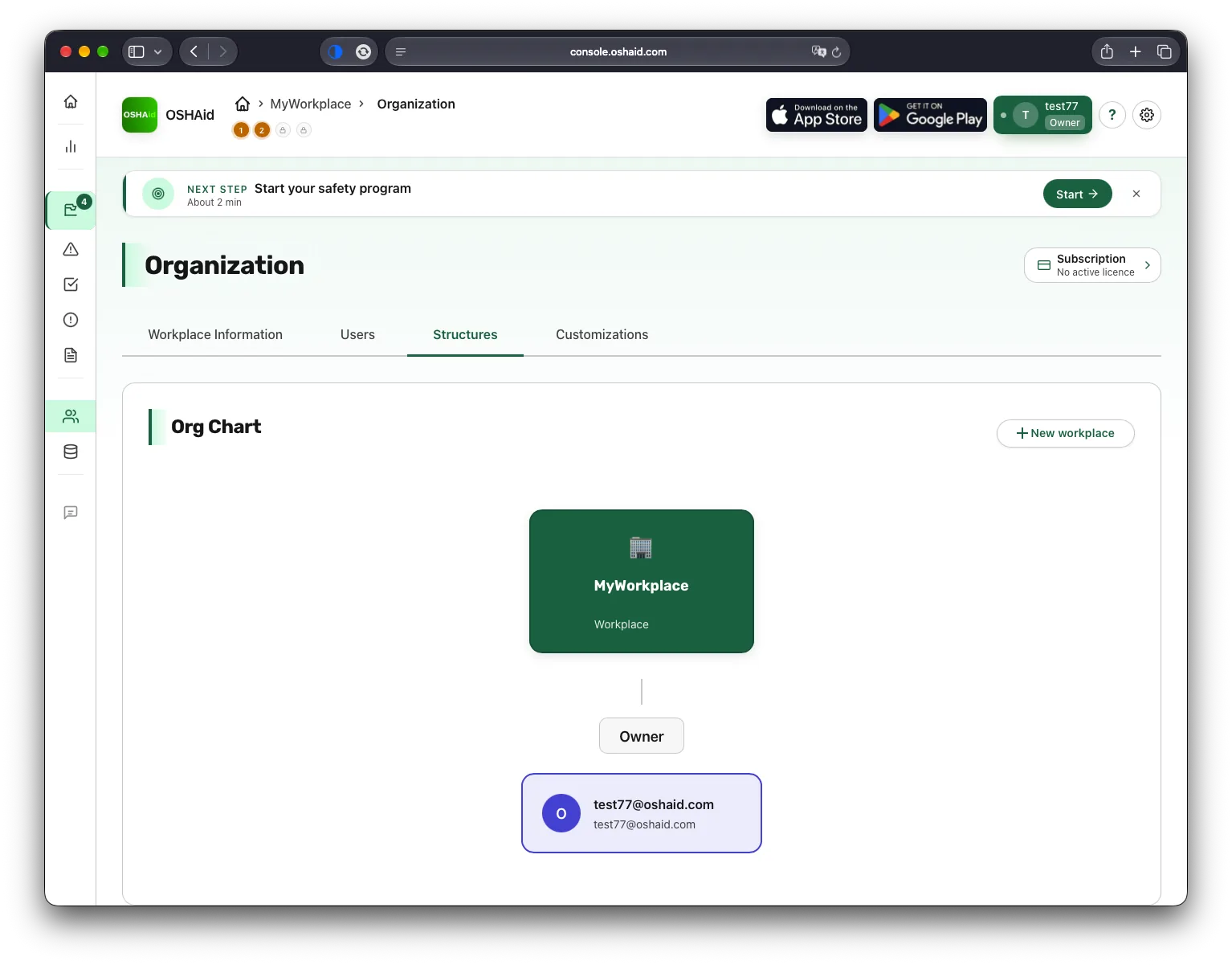 OSHAid console: the organization view, where each job classification carries its exposure determination and the protective clothing that goes with it
Nobody asks for the invoice
An inspector or a surveyor does not ask what you bought. The questions are which job classifications are exposed, what those people wear, who decided it was appropriate for that task and that shift length, when it gets replaced, and who paid for it.
Those answers already exist in your workplace. They are usually spread across a supply order, a shift habit, an onboarding conversation and a plan in a drawer. Put in one place, with the job classification, the garment, the replacement rule and the dated training beside each other, the same facts become something you can show to a client, a surveyor or your own leadership without rebuilding anything the night before.
That is the difference between a binder you defend and a safety program you can show.
Questions safety officers ask
- What PPE does the OSHA bloodborne pathogens standard require?
29 CFR 1910.1030(d)(3)(i) names gloves, gowns, laboratory coats, face shields or masks and eye protection, and mouthpieces, resuscitation bags, pocket masks or other ventilation devices, provided at no cost. It counts as appropriate only if blood or other potentially infectious materials cannot pass through to skin, clothes or mucous membranes in normal use.
- Can disposable gloves be washed and reused?
- Who pays to replace protective clothing that no longer works?
Related reading
All posts- Nov 20, 2026Rubber insulating glove testing requirements: the six-month clockOSHA update
- Nov 9, 2026Trichloroethylene exposure limit: California proposes 0.24 ppmRulemaking
- Nov 7, 2026OSHA notice of contest: the 15 days, and the case that followsEnforcement
- Oct 1, 2026Hospital weapons screening: what Cal/OSHA's draft would requireDraft rule
About this article
Written by the OSHAid Safety Desk from official sources (OSHA news releases, the text of the standards, BLS and NIOSH data), checked against those sources and reviewed before publication. It explains what a rule says; it is not legal advice for your situation. OSHAid
Keep the PPE decision beside the job that needs it
Create a free OSHAid account: list each job classification with its exposure, the protective clothing it requires and the training that goes with it, and keep the Exposure Control Plan beside them. No commitment.
Try OSHAidFreeDownload on theApp StoreGET IT ONGoogle PlayThe intelligent OSHA companion that automates your field compliance. Mobile app + web console + specialized safety AI agent, built for US workplaces.
ProductIndustriesGuides- OSHA compliance software
- Hazard assessment guide
- Safety program templates
- JHA examples
- OSHA requirements
- OSHA recordkeeping
- OSHA standards by industry
- Workplace hazards
- Get started
- What is OSHA?
- Workplace safety glossary
- Why OSHAid?
- Enterprise solutions
- About
- Blog
- Legal notice
© 2026 OSHAid - published by DUOPP (SAS). All rights reserved.
Help us improve OSHAid
We only measure site traffic. No advertising, no resale of data.
OKDeclineLearn more