 OSHAidProductsDemosIndustriesPricingMoreClient accessTry OSHAidFree🇺🇸ENTry OSHAidBack to blogRulemakingNovember 9, 2026· By the OSHAid Safety Desk
Trichloroethylene exposure limit: California proposes 0.24 ppm
On October 30, 2026 California opened comment on cutting the TCE permissible exposure limit from 25 ppm to 0.24 ppm and withdrawing the short-term and ceiling limits. The federal limit is 100 ppm. In the state's own count, 56% of the businesses affected are auto repair shops.
The trichloroethylene exposure limit is one of the few numbers in workplace safety that can differ by a factor of 100 depending on which state the work happens in. California has proposed making that gap much wider.
On October 30, 2026 the California Occupational Safety and Health Standards Board opened a 45-day comment period on a proposal to amend section 5155 for trichloroethylene. The notice is plain about what it would do: reduce the TCE permissible exposure limit in Table AC-1 to 0.24 ppm (1.3 mg/m3), down from 25 ppm, and withdraw the existing 100 ppm short-term exposure limit and 300 ppm ceiling limit. Written comments are due by 5:00 p.m. on December 17, 2026, the day of the public hearing.
The reach is narrower than the number suggests, and more familiar than you would expect. The Board counted 367 California businesses that had reported using TCE to the state's environmental reporting system as of December 2024, employing 3,582 people between them. Of those businesses, 363 are small businesses and 207 — 56% — are auto repair shops.
What the trichloroethylene exposure limit says today
The federal limit is 100 ppm, and it is inherited. Trichloroethylene, CAS number 79-01-6, sits in Table Z-2 of 29 CFR 1910.1000, carried over from the 1967 ANSI standard Z37.19. The table gives an 8-hour time-weighted average of 100 ppm, an acceptable ceiling concentration of 200 ppm, and an acceptable maximum peak above that ceiling of 300 ppm for 5 minutes in any 2 hours. Read on eCFR, title 29 current as of November 5, 2026.
California's limit is 25 ppm, and it was written for a different health effect. The Board's notice records that the 25 ppm PEL was established in 1988 on evidence of central nervous system impairment, cognitive decrements and renal toxicity, before TCE was confirmed to be a human carcinogen. The notice cites the U.S. EPA's 2011 classification of TCE as a known human carcinogen and the International Agency for Research on Cancer's 2014 Group 1 classification.
The proposed number comes out of a risk calculation. The Board works to a cancer risk threshold of one case per 1,000 workers over a working lifetime. Using EPA's 2011 unit risk estimate, the notice of proposed action calculates that a working lifetime at 25 ppm would produce 106 cases per 1,000 workers. At 0.24 ppm it produces one.
The short-term limits go because they stop being reachable. The notice puts the threshold for mild central nervous system depression from TCE in the range of 81 to 110 ppm. A single 15-minute exposure at 81 ppm, with no other exposure in the shift, already works out to an 8-hour average of 2.5 ppm — more than 12 times the proposed PEL. Air cannot approach the old STEL or ceiling without breaking the 8-hour limit first, so both are withdrawn.
A limit is not only a number to measure against. Paragraph (e) of 1910.1000 requires administrative or engineering controls to be determined and implemented first, whenever feasible, and allows protective equipment only where those controls cannot achieve full compliance. Where respirators are used, their use has to comply with 1910.134. The hierarchy is in the rule, not in the guidance.
Where the solvent turns up. The notice names the two major uses as removing grease from metal parts and making other chemicals, and lists extraction of greases and oils, textile scouring, dry cleaning, and use in adhesives, lubricants, paints, varnishes, paint strippers, pesticides and cold metal cleaners.
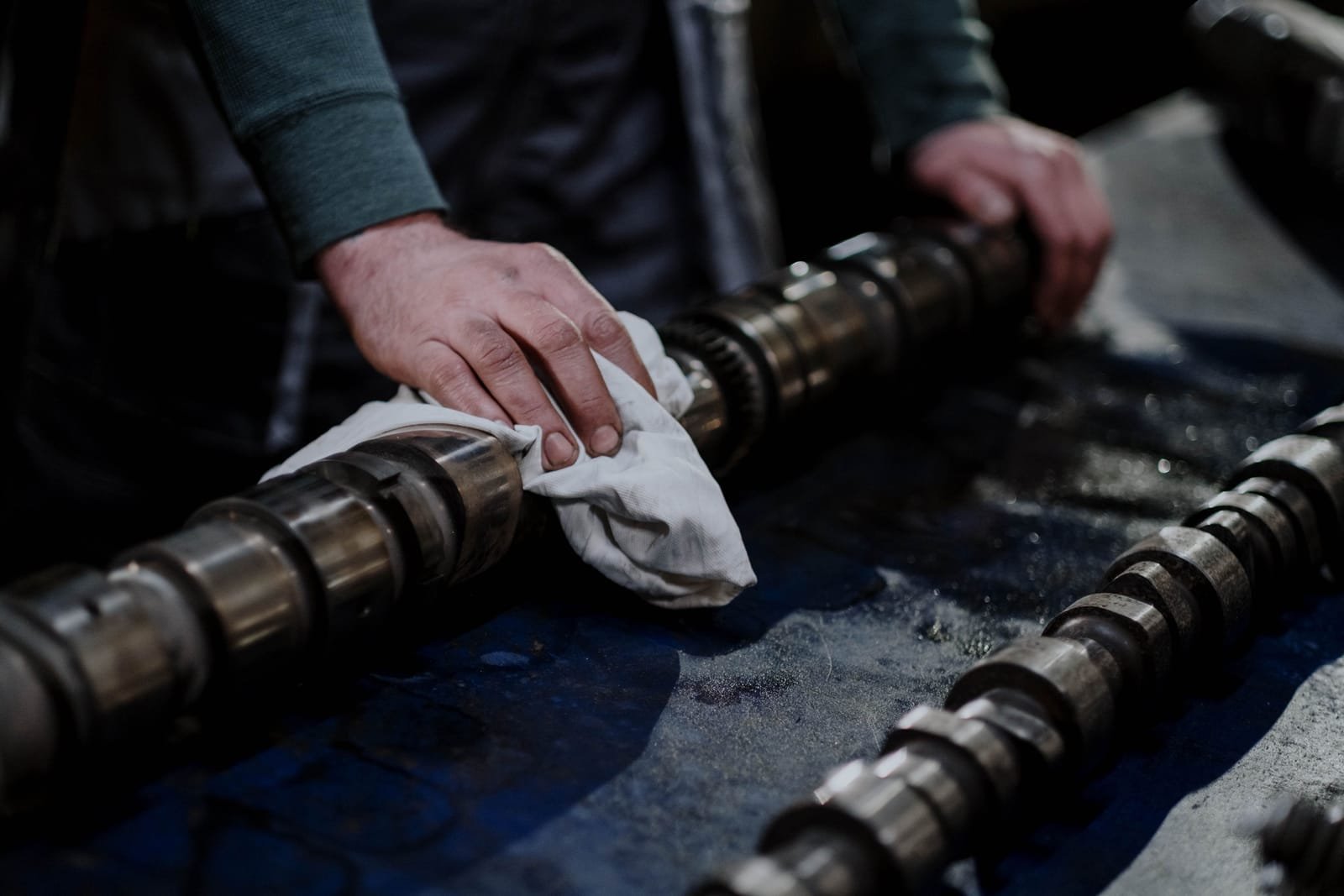 A worker's bare hands wiping machined camshafts clean with a white cloth on a workbench covered in metal parts. Photo: cottonbro studio, via Pexels (Pexels License)
Six checks if a solvent is still on your shelf
1. Establish whether you have it at all. Look for CAS number 79-01-6 in section 3 of the safety data sheet of every degreaser, cold cleaner and paint stripper you buy. 29 CFR 1910.1200(g)(8) requires you to keep a safety data sheet for each hazardous chemical in the workplace and to keep it readily accessible during each work shift to employees in their work areas. Electronic access is allowed as long as nothing stands between an employee and immediate access.
2. Write down which limit binds you. Outside a state plan it is the federal 8-hour average of 100 ppm with its 200 ppm ceiling. In California it is 25 ppm today, and 0.24 ppm if this proposal is adopted. A shop with sites in two states can be working to two different numbers on the same task.
3. Look at the task, not the drum. Exposure comes from how the solvent is used: a part degreased by hand over an open tray, a cold cleaning tank left without a lid, a stripper used in a back room with the door shut. Those are the jobs worth writing into a hazard assessment, alongside the workplace hazard categories and the controls that go with them.
4. Treat substitution as the first control, not the last. The Board's small business analysis reports that 98% of the affected auto repair facilities had identified and implemented alternatives to TCE for cleaning and degreasing tasks as of December 2024. It expects the businesses that cannot substitute to need additional local exhaust ventilation.
5. Retrain when the product changes. 1910.1200(h)(1) requires effective information and training on the hazardous chemicals in an employee's work area at the time of initial assignment, and whenever a new chemical hazard they have not been trained on is introduced. Swapping one degreaser for another is exactly that moment, and the new product's data sheet is the material.
6. Note the date if you want to be heard. Written comments go to the Standards Board by 5:00 p.m. on December 17, 2026, the day of the public hearing. The standards that come with a service business, auto repair included, are collected in our OSHA guide for service companies.
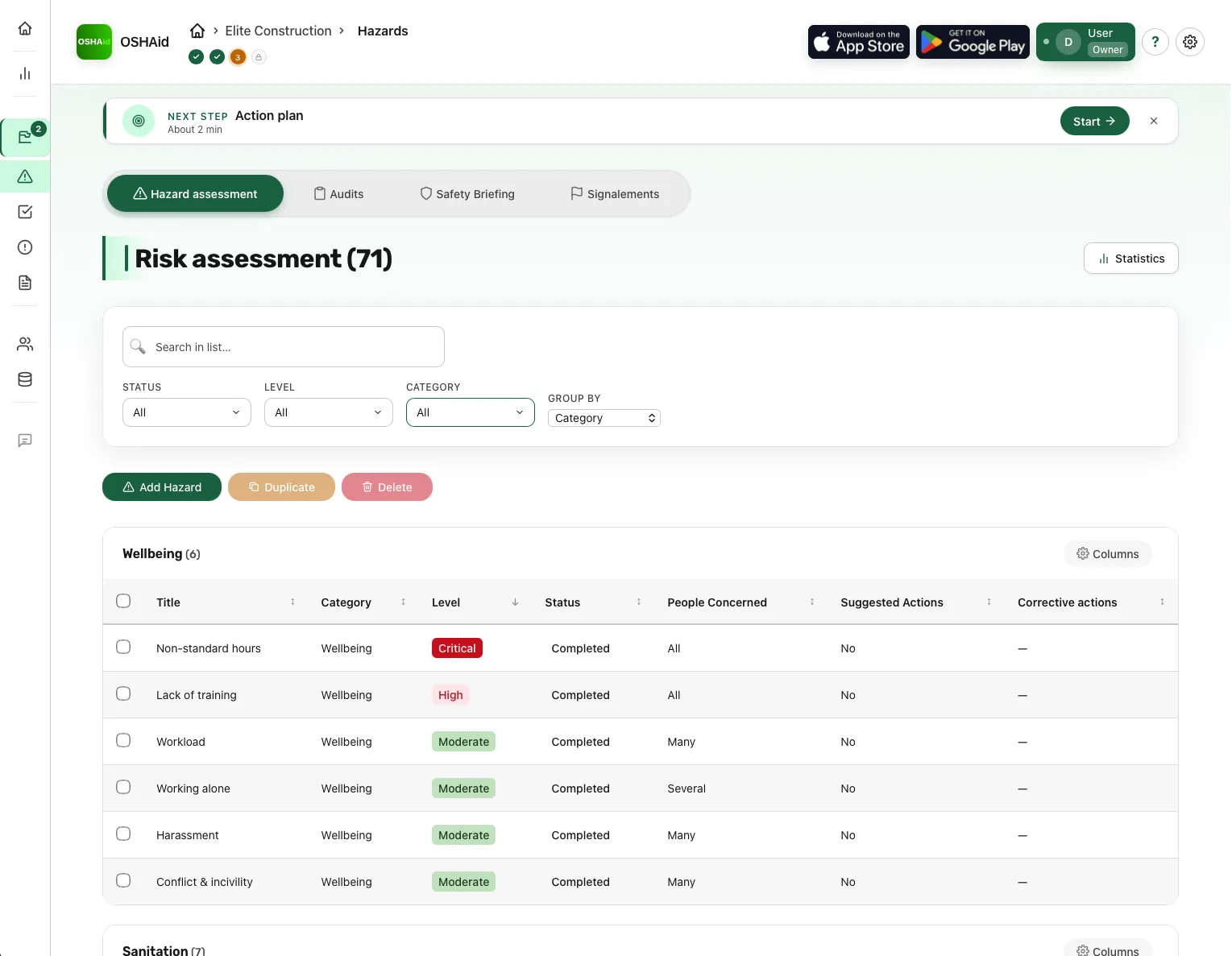 OSHAid console: the hazard list, where a solvent task carries its exposure, its control and the person responsible for it
The number changes; the file is what you show
A proposed limit is a reminder that the numbers in a chemical safety program are the part most likely to move. The 25 ppm in California was set in 1988. The federal 100 ppm was carried over from a 1967 consensus standard. Both outlived the science that produced them, and one of them is now being revisited in public.
What does not move is the question you get asked. Which products in this building are hazardous, which tasks expose someone to them, what control is in place, who was trained on it, and when. A shop that can answer those five questions in order can absorb a limit changing by a factor of 100 — it swaps a product, records the substitution and retrains. A shop that keeps the answers in a cupboard starts from the beginning each time.
That is the difference between a binder you defend and a safety program you can show.
Questions safety officers ask
- What is the OSHA exposure limit for trichloroethylene?
Under federal OSHA, Table Z-2 of 29 CFR 1910.1000 sets an 8-hour time-weighted average of 100 ppm for trichloroethylene, an acceptable ceiling of 200 ppm and a maximum peak of 300 ppm for 5 minutes in any 2 hours. California's limit is 25 ppm, with 0.24 ppm now proposed.
- Is trichloroethylene considered a carcinogen?
- When is the deadline to comment on California's TCE limit?
Related reading
All posts- Nov 14, 2026Storm cleanup safety requirements before your crew goes outStorm season
- Nov 10, 2026Respirator storage requirements: what a stockpile still has to proveGuidance
- Nov 8, 2026Bloodborne pathogens PPE requirements: what a wiped gown no longer doesResearch
- Oct 20, 2026NRTL approved equipment: what OSHA means by "approved"OSHA update
About this article
Written by the OSHAid Safety Desk from official sources (OSHA news releases, the text of the standards, BLS and NIOSH data), checked against those sources and reviewed before publication. It explains what a rule says; it is not legal advice for your situation. OSHAid
Keep every chemical beside the task that uses it
Create a free OSHAid account: list the products in use, the tasks that expose your crew, the control chosen for each and the training that goes with it — and keep the safety data sheets in the same place. No commitment.
Try OSHAidFreeDownload on theApp StoreGET IT ONGoogle PlayThe intelligent OSHA companion that automates your field compliance. Mobile app + web console + specialized safety AI agent, built for US workplaces.
ProductIndustriesGuides- OSHA compliance software
- Hazard assessment guide
- Safety program templates
- JHA examples
- OSHA requirements
- OSHA recordkeeping
- OSHA standards by industry
- Workplace hazards
- Get started
- What is OSHA?
- Workplace safety glossary
- Why OSHAid?
- Enterprise solutions
- About
- Blog
- Legal notice
© 2026 OSHAid - published by DUOPP (SAS). All rights reserved.
Help us improve OSHAid
We only measure site traffic. No advertising, no resale of data.
OKDeclineLearn more