 OSHAidProductsDemosIndustriesPricingMoreClient accessTry OSHAidFree🇺🇸ENTry OSHAidBack to blogCitationsNovember 18, 2026· By the OSHAid Safety Desk
OSHA abatement certification: the step that closes a citation
On November 16 the Department of Labor proposed more than $1.6 million in penalties against a Houston powder coating company, two of the three inspections being follow-ups to violations found in December 2023. Fixing a hazard is only half of what 29 CFR 1903.19 asks for; the other half is telling OSHA, on time and in writing.
An OSHA abatement certification is the step that closes a citation, and it is the one most often left undone. The guard gets replaced, the penalty gets negotiated, the file gets closed internally - and nobody tells OSHA.
On November 16, 2026 the Department of Labor cited a Houston powder coating company for 3 willful, 18 repeat, 18 serious and 1 other-than-serious violations, and proposed $1,640,888 in penalties. Two of the three inspections behind that figure, all conducted on April 10, 2026, were follow-ups to violations found in a December 2023 inspection. A formal settlement agreement had been finalized in December 2024.
That is what an open citation looks like three years on. The rule that closes one is short, and it runs on a clock.
What OSHA abatement certification requires
Ten calendar days after the abatement date. 29 CFR 1903.19(c)(1) requires an employer who receives a citation to certify to OSHA that each cited violation has been abated, within 10 calendar days after the abatement date. The one exception is at (c)(2): no certification is needed where the compliance officer observed abatement within 24 hours of identifying the violation and noted that on the citation.
Three things go in the certification. Paragraph (c)(3) asks, for each violation, the date of abatement, the method of abatement, and a statement that affected employees and their representatives have been informed. "Affected employees" is defined at (b) as those exposed to the hazards identified as violations.
Willful and repeat items need evidence, not just a statement. Under (d)(1), abatement documents are required for each willful or repeat violation, and for any serious violation where the citation says so; they are submitted with the certification. Paragraph (d)(2) names what counts - among other written records, evidence of the purchase or repair of equipment, and photographic or video evidence of abatement.
A fix that takes more than 90 days needs a plan. Paragraph (e)(1) lets OSHA require an abatement plan for any cited violation other than other-than-serious when the abatement period runs more than 90 calendar days, and the citation must say so. The plan is due within 25 calendar days from the final order date and sets out the steps, a schedule, and how employees are protected in the meantime. Paragraph (f) adds periodic progress reports where the citation requires them, the first due no sooner than 30 calendar days after the plan.
The clock starts at the final order date. For an uncontested citation, (b) defines that as the fifteenth working day after the employer receives it.
Cited equipment gets tagged. Paragraph (i) requires a warning tag, or a copy of the citation, on the operating controls or the cited component of movable equipment for serious, repeat and willful violations - immediately on receipt for hand-held equipment, and before it is moved for anything else. It stays attached until the violation is abated and the abatement documents are submitted.
Employees see what you send. Paragraph (g) requires a copy or summary of each document submitted to OSHA to be posted near where the violation occurred, at the same time as or before it goes to OSHA, and to stay up for three working days after submission. Employees may ask to examine and copy abatement documents within three working days of that notice, and you have five working days to comply.
And the citation itself stays on the wall. 29 CFR 1903.16 requires it to be posted at or near the place of the violation until the violation is abated, or for three working days, whichever is later. Contesting does not suspend that duty unless the Review Commission vacates the citation, and failing to post is itself citable. Not correcting a cited violation has its own price: 29 CFR 1903.15(d)(5) provides that a failure-to-correct penalty under section 17(d) of the Act shall not exceed $16,550 per day.
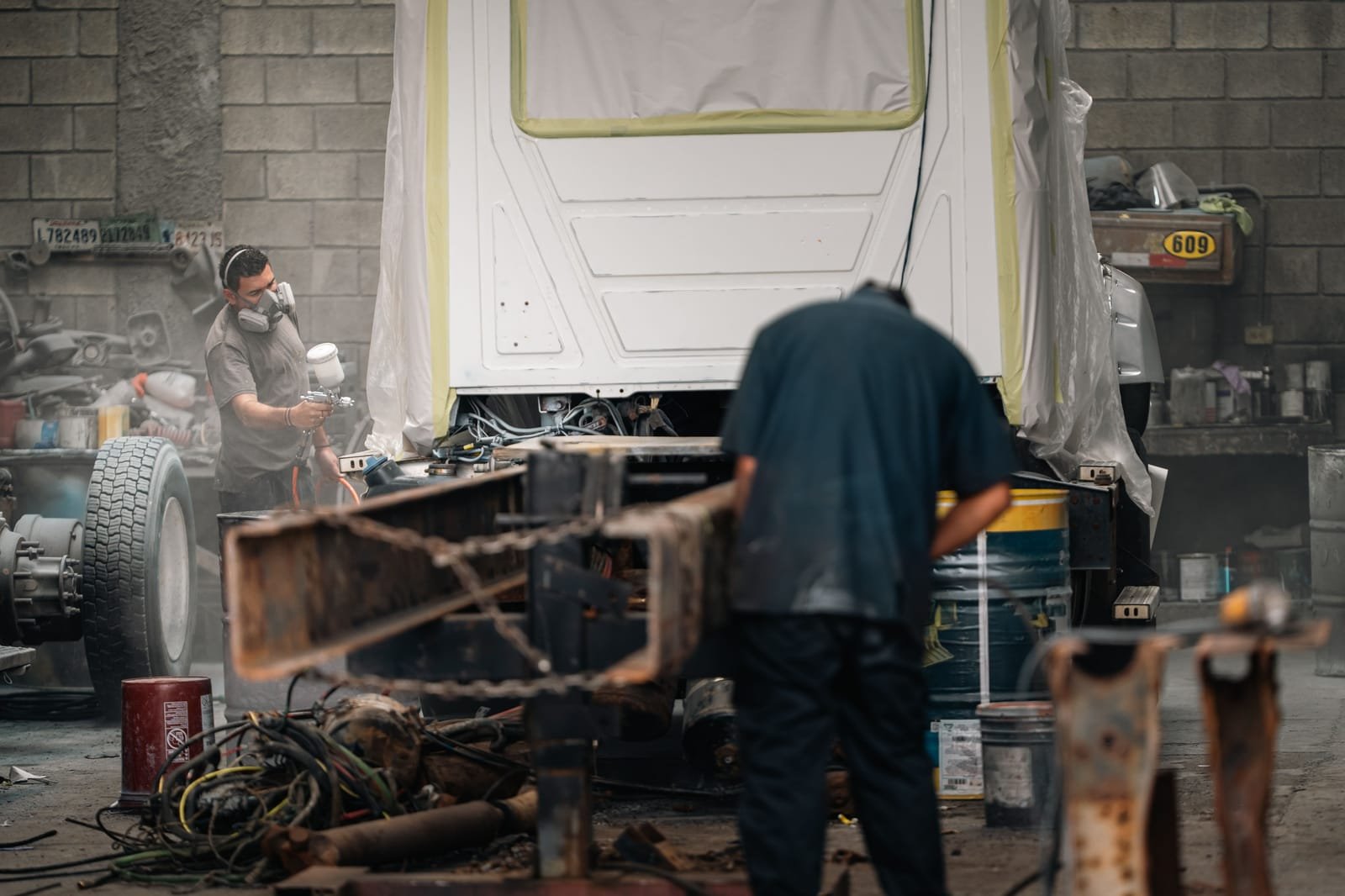 A worker wearing a half-mask respirator spray-painting a truck cab in an open repair shop, overspray drifting across the floor while a second worker stands a few feet away without one. Photo: Mario Spencer, via Pexels (Pexels License)
Six checks before the inspector comes back
1. Put both dates in the same calendar. The abatement date is one entry; the certification is a second one, 10 calendar days later. Diarize them the day the citation arrives, not the day you remember.
2. Write the method, not the intention. "Corrected" is not a method. "Interlock replaced on press 4, part number and invoice attached, verified by the maintenance lead" is. The certification asks for the method because that is what a follow-up inspection checks.
3. Photograph the fix on the day it happens. Paragraph (d)(2) accepts photographic and video evidence. The photo taken three weeks later shows a machine, not an abatement; the one taken on the day shows both.
4. Tag the cited equipment before anyone moves it. A forklift or a grinder cited for a serious violation carries the tag until the paperwork is in. Equipment that leaves the site untagged is the easiest thing for a returning compliance officer to find.
5. Post what you send, and leave the citation up. Both duties are separate from the abatement itself, and both are citable on their own. Three working days is the floor, not the target. Our guide to the OSHA obligations every employer carries covers the posting duties that sit alongside them.
6. Fix the program, not the instance. A repeat violation is the same standard cited twice, which usually means the written program behind it never changed. If respiratory protection or hazard communication is in your citation, the abatement is the program - selection, training, records - not one respirator. Our written safety program requirements and templates show what that document has to contain.
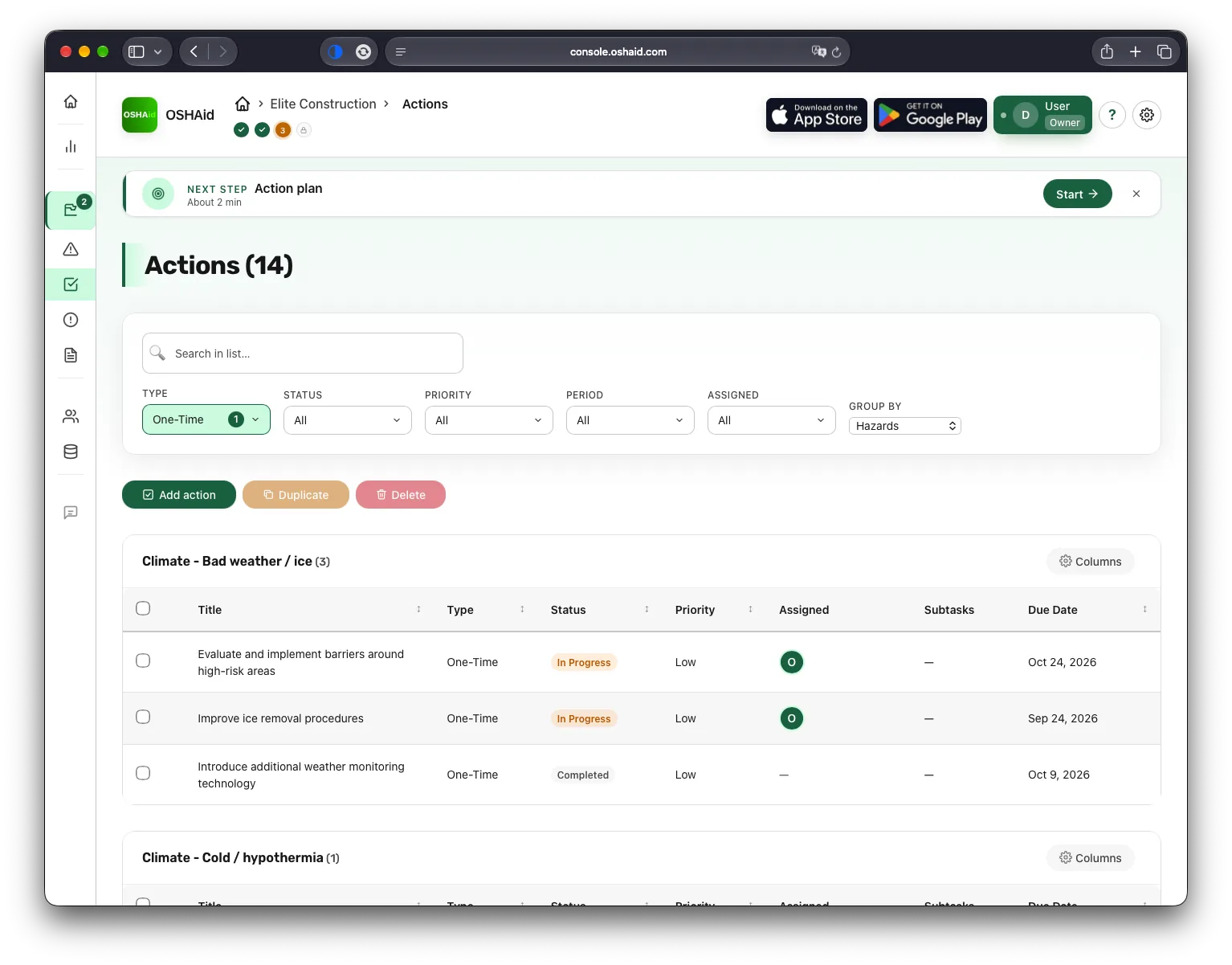 OSHAid console: the action plan, where each corrective action carries an owner, a due date and a status, so the abatement date and the proof sit in the same place
The file that closes the case
The Houston case took thirteen years and a signed settlement to reach $1.6 million, and nothing in it required special knowledge to avoid. It required the boring half of enforcement: a date, a method, a photograph, a signature, sent in.
That file does more than close a citation. It is the same evidence a client asks for during a prequalification, an insurer asks for at renewal and leadership asks for after an incident - proof that a hazard was found, assigned, fixed and verified, with dates.
Built once, in one place, it stops being a binder you defend and becomes a safety program you can show.
Questions safety officers ask
- How long do I have to certify abatement to OSHA?
Under 29 CFR 1903.19(c)(1), within 10 calendar days after the abatement date. No certification is required where the compliance officer observed the abatement within 24 hours of identifying the violation and noted that on the citation.
- What proof of abatement does OSHA require?
- Do I still have to post a citation I am contesting?
Related reading
All posts- Nov 20, 2026Rubber insulating glove testing requirements: the six-month clockOSHA update
- Nov 19, 2026OSHA incident rate by industry: what the 2025 data showsData
- Nov 14, 2026Storm cleanup safety requirements before your crew goes outStorm season
- Nov 11, 2026Respirator fit test requirements: the annual clock in 1910.134Fundamentals
About this article
Written by the OSHAid Safety Desk from official sources (OSHA news releases, the text of the standards, BLS and NIOSH data), checked against those sources and reviewed before publication. It explains what a rule says; it is not legal advice for your situation. OSHAid
Keep the proof beside the fix
Create a free OSHAid account: record each corrective action with its owner, its due date and the photo that closes it, and keep your written programs and training records next to it. No commitment.
Try OSHAidFreeDownload on theApp StoreGET IT ONGoogle PlayThe intelligent OSHA companion that automates your field compliance. Mobile app + web console + specialized safety AI agent, built for US workplaces.
ProductIndustriesGuides- OSHA compliance software
- Hazard assessment guide
- Safety program templates
- JHA examples
- OSHA requirements
- OSHA recordkeeping
- OSHA standards by industry
- Workplace hazards
- Get started
- What is OSHA?
- Workplace safety glossary
- Why OSHAid?
- Enterprise solutions
- About
- Blog
- Legal notice
© 2026 OSHAid - published by DUOPP (SAS). All rights reserved.
Help us improve OSHAid
We only measure site traffic. No advertising, no resale of data.
OKDeclineLearn more