 OSHAidProductsDemosIndustriesPricingMoreClient accessTry OSHAidFree🇺🇸ENTry OSHAidBack to blogOSHA updateNovember 4, 2026· By the OSHAid Safety Desk
OSHA eye protection requirements: when safety glasses are not enough
An employer asked OSHA whether trash collection workers need eye and face protection. The answer in the November 2 QuickTakes points at 29 CFR 1910.133 — and at the hazard assessment that decides which device goes on the face.
OSHA eye protection requirements come up in the oddest places. Not the welding bay, where everyone expects them, but the route truck, the loading dock, the maintenance closet — jobs where the hazard is unpredictable debris, not a scheduled operation.
OSHA answered one of those cases directly. In the "You Ask...We Answer" section of its November 2, 2026 QuickTakes newsletter, an employer asked whether face and eye protection has to be provided for trash collection workers. OSHA's answer: workers must be equipped with appropriate eye or face protection whenever they are exposed to hazards from flying particles, objects or debris that could cause an eye injury, and the employer must assess the workplace to find where those hazards occur.
Two sentences, two duties. The standard behind them is short enough to read in five minutes, and precise enough that most eyewear programs miss at least one line of it.
What the OSHA eye protection requirements actually say
Six hazards, named one by one. 29 CFR 1910.133(a)(1) requires the employer to ensure that each affected employee uses appropriate eye or face protection when exposed to eye or face hazards from flying particles, molten metal, liquid chemicals, acids or caustic liquids, chemical gases or vapors, or potentially injurious light radiation. The text was read on eCFR, current as of November 2, 2026.
Side protection is its own requirement. Where there is a hazard from flying objects, the eye protection must provide side protection, and detachable side protectors — clip-on or slide-on side shields — are acceptable when they meet the pertinent requirements of the section. That is the line behind OSHA's trash collection answer: safety glasses with side shields rated for impact are the minimum, and goggles are often the better choice because they seal more tightly against debris arriving from the side or at an angle.
Prescription lenses have two routes, and no third. An employee who wears prescription lenses during operations that involve eye hazards either wears eye protection that incorporates the prescription in its design, or wears protection that goes over them without disturbing the proper position of either set of lenses.
Every device carries a manufacturer's mark. Eye and face PPE must be distinctly marked to facilitate identification of the manufacturer. It is the first thing a bin of mixed, unlabeled eyewear fails.
The ANSI editions are not a suggestion. OSHA's eye and face protection standards page describes ANSI consensus standards in general as not being OSHA regulations. Eye protection is where that needs care: 1910.133(b)(1) incorporates three editions by reference — ANSI/ISEA Z87.1-2010, ANSI Z87.1-2003 and ANSI Z87.1-1989 (R-1998). A device must comply with one of them, or the employer must demonstrate under (b)(2) that it is at least as effective as a device built to one of them. A newer edition printed on a sales sheet does not answer that question by itself.
Injurious light radiation comes with a table. Paragraph (a)(5) sets minimum filter shade numbers by operation: 2 for torch soldering, 3 for torch brazing, 4 for light gas welding on plate under 1/8 inch, 7 for shielded metal arc welding with electrodes smaller than 3/32 inch at under 60 amps, and 14 for carbon arc welding.
Construction has its own section, nearly word for word. 29 CFR 1926.102 repeats those general duties and the same three ANSI editions, then adds six minimum requirements for the protector itself: adequate protection against the particular hazard, reasonable comfort, a snug fit that does not unduly interfere with movement, durability, and the ability to be disinfected and easily cleaned.
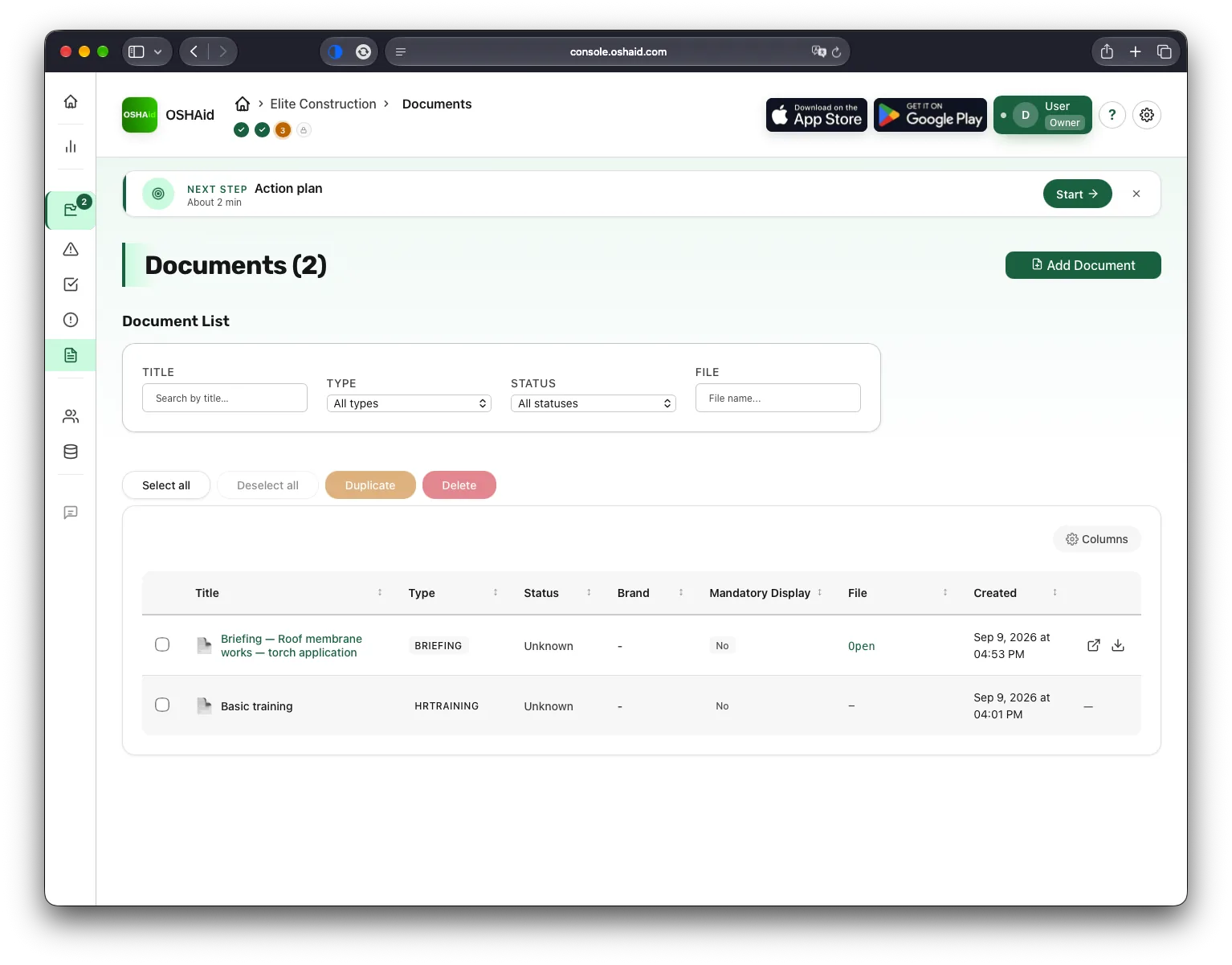 OSHAid console — the document library, where the hazard assessment certification and the eyewear selection decision are filed together
Meeting the OSHA eye protection requirements this week
1. Write the assessment that chooses the device. Under 29 CFR 1910.132(d)(1) you assess the workplace to determine whether hazards are present or likely to be present, then select the PPE that will protect each affected employee from the hazards identified, communicate those selection decisions, and select PPE that properly fits each affected employee. Our workplace hazard assessment guide walks through the walk-around that produces it.
2. Certify it, with the four elements the rule names. Paragraph (d)(2) asks for a written certification that identifies the workplace evaluated, the person certifying that the evaluation was performed, the date or dates of the hazard assessment, and the document itself as a certification of hazard assessment. A dated hazard list is not a certification until it says it is one.
3. Decide glasses or goggles task by task. OSHA's November answer treats unpredictable debris as the reason to move up from glasses to goggles. Waste collection, janitorial routes, pressure washing and dry sweeping share that profile, and our page on OSHA compliance for service businesses covers the duties that follow those crews.
4. Read the markings in your own stock. Pull the eyewear out of the drawer and look for the manufacturer's mark. Anything unmarked, badly scratched or cracked is out of service: 1910.132(e) states that defective or damaged personal protective equipment shall not be used.
5. Settle who pays, before someone asks. 1910.132(h)(1) requires the employer to provide PPE at no cost to employees. The exception in (h)(2) is non-specialty prescription safety eyewear, which the employer need not pay for provided it permits the eyewear to be worn off the job site. Replacement PPE is on the employer under (h)(5), except where the employee lost it or intentionally damaged it, and ordinary sunglasses are excluded by (h)(4)(iii).
6. Train, then record that it landed. Paragraph (f)(1) requires training on when PPE is necessary, what PPE is necessary, how to properly don, doff, adjust and wear it, its limitations, and its proper care, maintenance, useful life and disposal. Each employee must demonstrate an understanding of that training and the ability to use the PPE properly before doing work that requires it, and retraining is owed when the workplace changes, the PPE changes, or performance shows the understanding is missing.
7. Confirm those paragraphs reach eye protection — they do. Paragraph (g) states that the hazard assessment and training requirements apply to 1910.133 among other sections. Eye and face protection is not one of the standards carved out of them.
 OSHAid console — the safety briefing editor, where the eye protection training is written, delivered and signed
A chain you can hand over
An eye injury is the kind of case where the paperwork decides the argument. The device on the worker's face either matches a hazard somebody wrote down, or it was whatever was left in the box.
What a safety officer can show instead is the chain: the assessment that found flying debris on the route, the certification that dated it, the selection decision communicated to the crew, the training record behind it, and the replacement log. Every one of those is a line in a standard. Together they are the difference between defending a program and presenting one.
Questions safety officers ask
- Does OSHA require safety glasses to have side shields?
Where there is a hazard from flying objects, yes. 29 CFR 1910.133(a)(2) requires eye protection that provides side protection, and detachable clip-on or slide-on side protectors are acceptable when they meet the pertinent requirements of that section.
- Which ANSI Z87.1 edition does OSHA require?
- Does an employer have to pay for prescription safety glasses?
Related reading
All posts- Nov 20, 2026Rubber insulating glove testing requirements: the six-month clockOSHA update
- Nov 9, 2026Trichloroethylene exposure limit: California proposes 0.24 ppmRulemaking
- Nov 5, 2026OSHA asbestos awareness training: the duty that follows the buildingCase law
- Nov 3, 2026OSHA lithium-ion battery requirements: no single standard, fourteen that applyOSHA update
About this article
Written by the OSHAid Safety Desk from official sources (OSHA news releases, the text of the standards, BLS and NIOSH data), checked against those sources and reviewed before publication. It explains what a rule says; it is not legal advice for your situation. OSHAid
Keep the assessment and the training together
Create a free OSHAid account: record the eye hazard, score it, attach the selection decision and the training record, and keep the certification dated. No commitment.
Try OSHAidFreeDownload on theApp StoreGET IT ONGoogle PlayThe intelligent OSHA companion that automates your field compliance. Mobile app + web console + specialized safety AI agent, built for US workplaces.
ProductIndustriesGuides- OSHA compliance software
- Hazard assessment guide
- Safety program templates
- JHA examples
- OSHA requirements
- OSHA recordkeeping
- OSHA standards by industry
- Workplace hazards
- Get started
- What is OSHA?
- Workplace safety glossary
- Why OSHAid?
- Enterprise solutions
- About
- Blog
- Legal notice
© 2026 OSHAid - published by DUOPP (SAS). All rights reserved.
Help us improve OSHAid
We only measure site traffic. No advertising, no resale of data.
OKDeclineLearn more