 OSHAidProductsDemosIndustriesPricingMoreClient accessTry OSHAidFree🇺🇸ENTry OSHAidBack to blogGuidanceNovember 22, 2026· By the OSHAid Safety Desk
OSHA machine guarding requirements: what to check on every machine
On November 19, 2026, Washington's Department of Labor & Industries pointed employers to a two-part machine safety checklist: one list before you buy a machine, one for routine guarding inspections. The federal duty behind it is 29 CFR 1910.212, number 10 on OSHA's most-cited list.
A guard someone took off to clear a jam, and nobody put back, is the most ordinary machine hazard there is. The machine guarding requirements in 29 CFR 1910.212 are OSHA's answer to it, and they reach every employer who owns a machine with a moving part - not only factories.
On November 19, 2026, Washington's Department of Labor & Industries sent employers a machine safety bulletin pointing to an updated machine safety page and an example checklist in two parts: one to run before you buy a machine or start it for the first time, and one for routine guarding inspections.
Washington runs its own state plan, so its rules are not yours unless you operate there. The checklist is still worth an hour: it asks the questions the federal standard leaves you to work out, and machine guarding is number 10 on OSHA's preliminary list of the most frequently cited standards for fiscal year 2026.
What the machine guarding requirements say
The duty is to pick a method, not to buy a part. 29 CFR 1910.212(a)(1) requires one or more methods of machine guarding to protect the operator and other employees in the machine area from hazards such as those created by point of operation, ingoing nip points, rotating parts, and flying chips and sparks. It names barrier guards, two-hand tripping devices and electronic safety devices as examples: the standard sets the result, you choose the means.
The guard has to stay on the machine. Paragraph (a)(2) requires guards to be affixed to the machine where possible, and secured elsewhere when attachment is not possible. It adds that the guard must not create an accident hazard of its own.
Point of operation is what gets looked at first. The point of operation is the area where work is actually performed on the material being processed. Under (a)(3)(ii), the point of operation of a machine whose operation exposes an employee to injury must be guarded, and where no specific standard applies, the guarding must be designed so the operator cannot have any part of the body in the danger zone during the operating cycle. Paragraph (a)(3)(iv) lists machines that usually need it: guillotine cutters, shears, alligator shears, power presses, milling machines, power saws, jointers, portable power tools, and forming rolls and calenders.
Special hand tools supplement a guard, they do not replace one. Under (a)(3)(iii), tools for placing and removing material may not be used in lieu of other required guarding.
Three specifics people forget. Revolving drums, barrels and containers must be guarded by an enclosure interlocked with the drive mechanism, so the drum cannot revolve unless the enclosure is in place - paragraph (a)(4). A fan whose blade periphery is less than 7 feet above the floor or working level must have its blades guarded, with openings no larger than half an inch - paragraph (a)(5). And machines designed for a fixed location must be securely anchored to prevent walking or moving - paragraph (b).
Power transmission has its own section. 29 CFR 1910.219 covers belts, pulleys, gears, shafting and flywheels. A flywheel with any part 7 feet or less above the floor or platform must be guarded by one of the listed methods: an enclosure of sheet, perforated or expanded metal or woven wire; guard rails placed 15 to 20 inches from the rim; or, on a smooth-rim flywheel 5 feet or less in diameter, an attached disk. Both sections are current in the eCFR as of November 19, 2026.
OSHA inspects for this on purpose. The National Emphasis Program on Amputations in Manufacturing Industries, CPL-03-00-027, is on OSHA's list of current national emphasis programs.
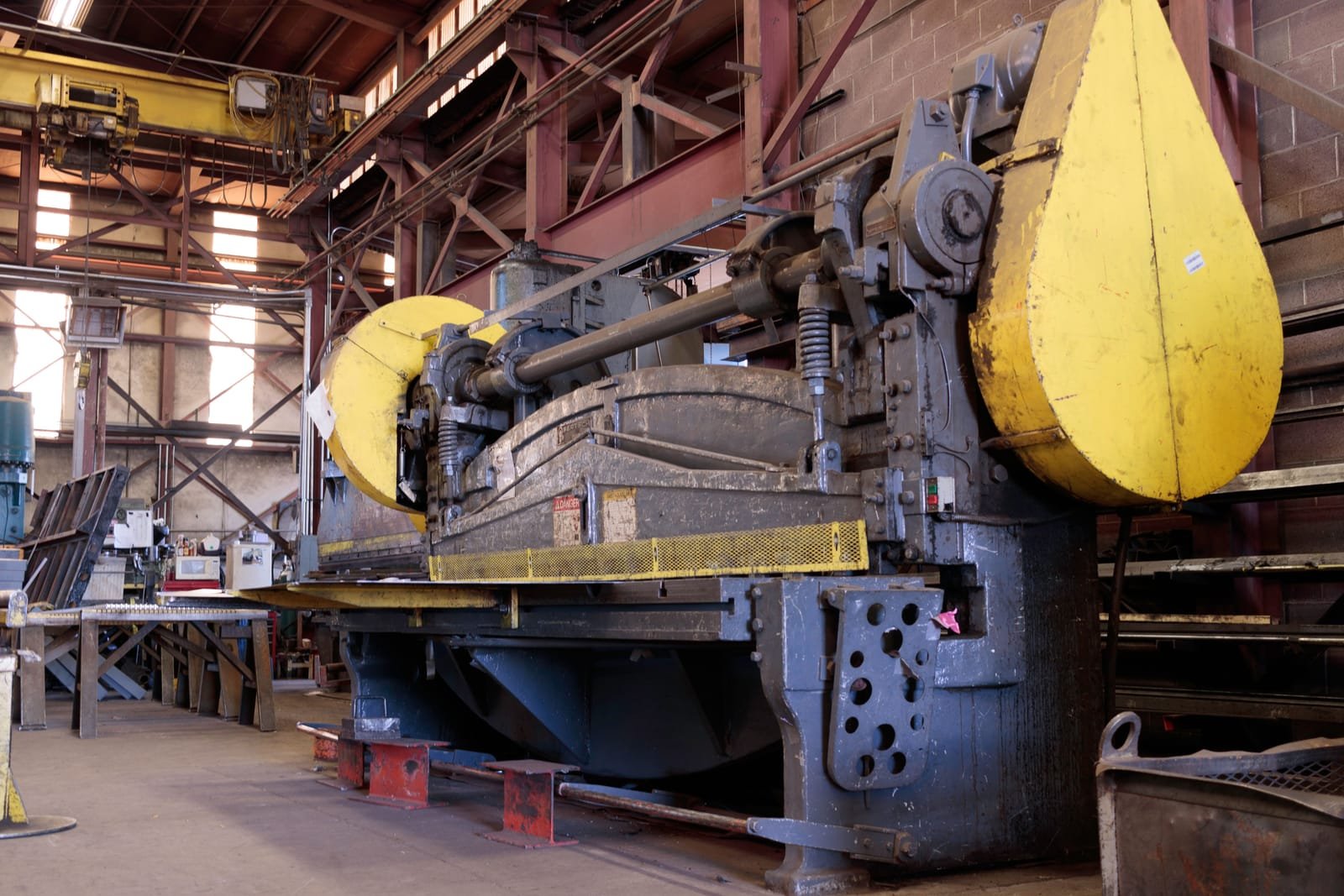 A large mechanical press in an industrial shop, its two flywheels covered by bright yellow guards and a yellow barrier guard running the length of the bed. Photo: J E, via Pexels (Pexels License)
The two checks to run this week
Washington's machine safety page splits the work in two, and the split is the useful part: one list runs once, before a machine is bought or first started; the other runs forever.
1. Before the machine arrives. The example checklist asks whether drawings and manuals have been reviewed for guarding issues and the manufacturer's recommended guarding; whether pulleys, belt drives, chain drives, gears, sprockets and flywheels are guarded front and back; whether point-of-operation guards are fitted; whether lathes have interlocked chuck guards; whether chip guards and rakes are provided where a machine throws metal chips; whether emergency stop controls are in easy reach of the operator; whether the noise level has been assessed against your hearing conservation program; and whether an ergonomic evaluation has been done.
2. On the machines you already run. The routine list asks whether safeguards cover all hazardous moving parts; whether they are secured in place and not easily removed; whether the machine can be oiled, greased or adjusted without bypassing a safeguard; whether it is shut down and locked or tagged out before a safeguard is removed; whether guard inspections are part of preventive maintenance; whether operators and maintenance personnel have been trained on the hazards and the safeguards; and whether prohibited clothing and jewelry are documented and clear to the operator.
3. Write it down against the task, not the nameplate. Whether a machine can be greased without removing a guard is answered by watching the job, not the manual. That is what a job hazard analysis is for, and our job hazard analysis examples show the format - task, hazard, control - that machine guarding fits exactly.
4. Do not file this under factories. A cardboard baler in a stockroom, a compactor on a loading dock and a slicer behind a deli counter all have a point of operation. The OSHA standards that reach retail stores include the same 1910.212 that reaches a press shop.
5. Date every answer. A checklist with no date tells you nothing six months later. Record who ran it, on which machine, and which items are still open.
6. Take the free visit. Washington's Division of Occupational Safety and Health offers confidential, no-fee on-site consultations. Where federal OSHA enforces, the On-Site Consultation Program is free for small and medium-sized businesses and separate from enforcement.
 OSHAid console: the audits list, where a machine guarding inspection is recorded with its date, the machine it covered and what was left open
A guard you can account for
Machine guarding is one of the few duties where the proof is physical. Either the guard is on the machine, secured, and the operator cannot reach the danger zone, or it is not. No document makes an open nip point compliant.
What a document does is say when somebody last looked: a dated inspection against a named machine, the training record for its operator, a note of why a guard came off and when it went back on.
Compliance is the floor. Walking an inspector or a client down the line and showing, machine by machine, who checked what and when - that is the part you can show.
Questions safety officers ask
- What does OSHA require for machine guarding?
29 CFR 1910.212(a)(1) requires one or more methods of machine guarding to protect the operator and other employees from hazards such as point of operation, ingoing nip points, rotating parts, and flying chips and sparks. Guards must be affixed to the machine where possible, and must not create a hazard themselves.
- Which machines need point of operation guarding?
- Does OSHA require a fan to be guarded?
Related reading
All posts- Nov 21, 2026Temporary worker safety training: who gives it, who proves itCase study
- Oct 27, 2026OSHA hard hat requirements: when Type I is not enoughOSHA update
- Oct 23, 2026OSHA hydrogen sulfide exposure limit: a ceiling, not an averageFundamentals
- Oct 16, 2026OSHA sling inspection requirements and recordsOSHA update
About this article
Written by the OSHAid Safety Desk from official sources (OSHA news releases, the text of the standards, BLS and NIOSH data), checked against those sources and reviewed before publication. It explains what a rule says; it is not legal advice for your situation. OSHAid
Know which guard was checked last
Create a free OSHAid account: list your machines, record guard inspections and training against each one, and keep the hazard assessment that explains the controls in the same place. No commitment.
Try OSHAidFreeDownload on theApp StoreGET IT ONGoogle PlayThe intelligent OSHA companion that automates your field compliance. Mobile app + web console + specialized safety AI agent, built for US workplaces.
ProductIndustriesGuides- OSHA compliance software
- Hazard assessment guide
- Safety program templates
- JHA examples
- OSHA requirements
- OSHA recordkeeping
- OSHA standards by industry
- Workplace hazards
- Get started
- What is OSHA?
- Workplace safety glossary
- Why OSHAid?
- Enterprise solutions
- About
- Blog
- Legal notice
© 2026 OSHAid - published by DUOPP (SAS). All rights reserved.
Help us improve OSHAid
We only measure site traffic. No advertising, no resale of data.
OKDeclineLearn more