 OSHAidProductsDemosIndustriesPricingMoreClient accessCreate my accountFree🇺🇸ENCreate my accountBack to blogOSHA updateOctober 10, 2026· By the OSHAid Safety Desk
Respirator medical evaluation requirements: what has to happen before the fit test
OSHA has proposed exempting filtering facepiece respirators and loose-fitting PAPRs from the medical evaluation in paragraph (e). The rulemaking record closed on October 4. The standard has not changed.
Respirator medical evaluation requirements sit at the front of every respiratory protection program. Before an employee is fit tested or required to wear a respirator at work, 29 CFR 1910.134(e)(1) requires the employer to provide a medical evaluation of that employee's ability to use one.
That paragraph is under review. On July 1, 2025, OSHA published a proposed rule at 90 FR 28463 that would exempt the required use of filtering facepiece respirators and of loose-fitting powered air-purifying respirators from paragraph (e). The record has now closed: OSHA's deregulatory rulemaking page set October 4, 2026 as the deadline for final written briefs, after informal hearings held on August 19 and 20, 2026.
A closed record is not a final rule. Read in the eCFR on October 10, 2026, with Title 29 current as of October 7, 2026, paragraph (e) still reads as written.
So this is a good week to know who on your crew needs an evaluation today, and what a final rule would leave untouched.
What the respirator medical evaluation requirements say today
The evaluation comes before the fit test. 29 CFR 1910.134(e)(1) requires the employer to provide a medical evaluation of the employee's ability to use a respirator, before that employee is fit tested or required to use one in the workplace. The employer may discontinue the evaluations when the employee is no longer required to wear a respirator.
A licensed professional makes the call. Paragraph (e)(2) requires the employer to identify a physician or other licensed health care professional (PLHCP) to perform the evaluation, using a medical questionnaire or an initial medical examination that obtains the same information. The evaluation must obtain what Sections 1 and 2, part A of appendix C ask. A positive answer to any of questions 1 through 8 in Section 2, part A triggers a follow-up medical examination under paragraph (e)(3).
The employer owes the PLHCP five facts. Before the recommendation is made, paragraph (e)(5) requires the employer to supply the type and weight of the respirator, the duration and frequency of use, the expected physical work effort, any additional protective clothing to be worn, and the temperature and humidity extremes that may be encountered, together with the written program and a copy of the standard. The questionnaire is administered confidentially, at a time and place convenient to the employee, who must be able to discuss the results with the PLHCP. Under paragraph (c)(4), none of it is at the employee's expense.
Re-evaluation is triggered by events, not by a calendar. Paragraph (e)(7) requires an additional evaluation when an employee reports medical signs or symptoms related to the ability to use a respirator, when a PLHCP, a supervisor or the program administrator says someone needs to be reevaluated, when information from the program indicates a need, or when workplace conditions change in a way that may substantially increase the physiological burden on the employee.
What the proposal would, and would not, do. The proposed regulatory text adds a paragraph (e)(1)(ii) stating that the medical evaluation requirements do not apply to the required use of filtering facepiece respirators or of loose-fitting powered air-purifying respirators. OSHA's preliminary conclusion is that the available data are insufficient to establish that medical evaluations meaningfully reduce material impairment from wearing those two types. The notice states that paragraphs (e)(2) through (e)(7) would not be affected, and that where an evaluation is still required, the employer must meet all of paragraph (e). Fit testing sits elsewhere: under 1910.134(f)(2), an employee using a tight-fitting facepiece respirator is fit tested before initial use, whenever a different facepiece is used, and at least annually after that. A filtering facepiece is a tight-fitting facepiece.
The proposal has not had a clean run. OSHA consulted its Advisory Committee on Construction Safety and Health on March 31, 2026. On April 1, by a vote of five to four, the committee recommended that OSHA not proceed and keep looking for best practices to give employers. OSHA reopened the record for 30 more days of comment on June 3, 2026, then held the August hearings.
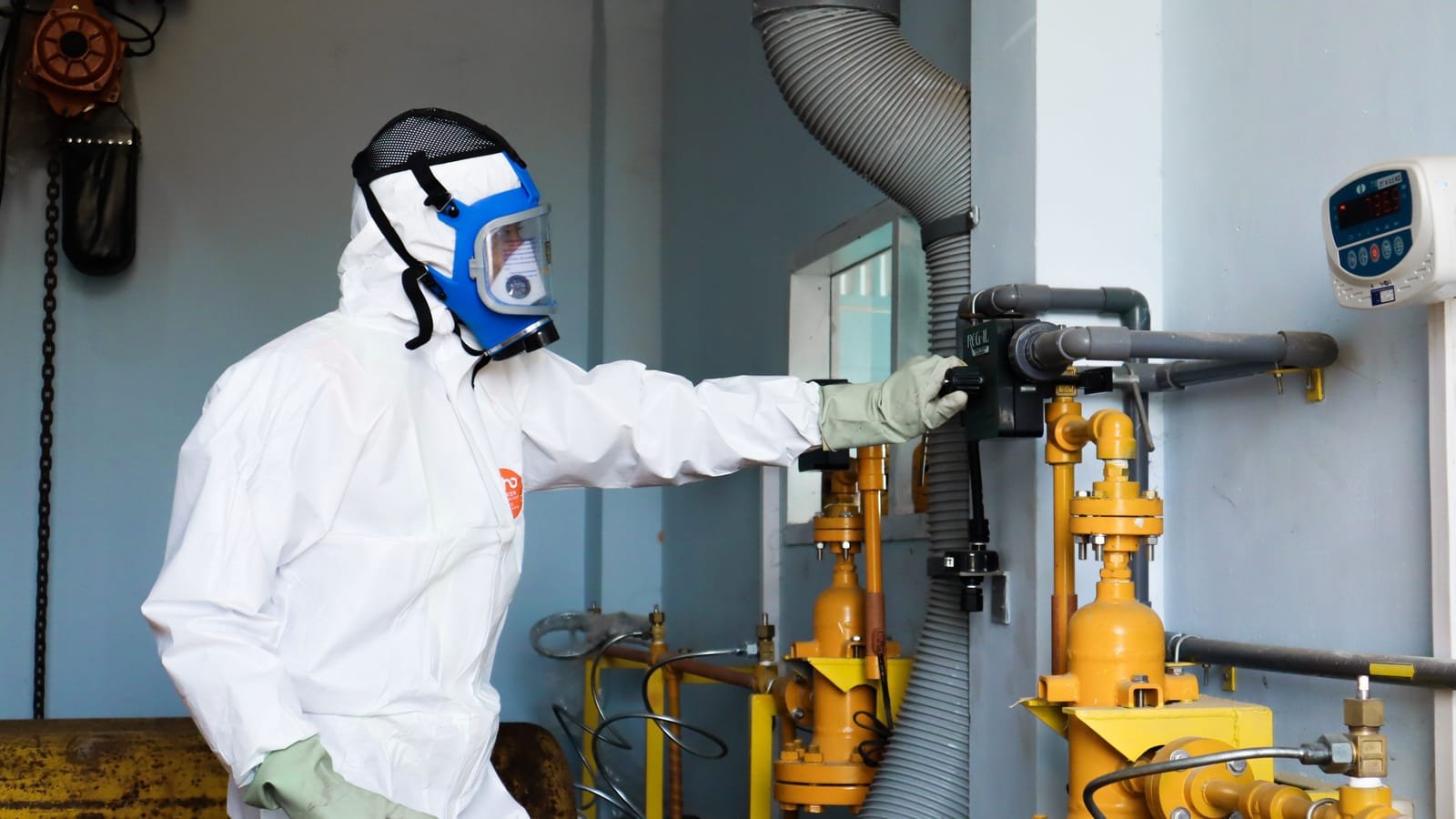 A worker in coveralls and a full-facepiece air-purifying respirator operating a valve manifold inside a process plant. Photo: Govin MU, via Pexels
Five checks on your respirator program this week
1. Sort your respirator users by respirator type. The proposed exemption is drawn on type, not on hazard: filtering facepieces and loose-fitting PAPRs on one side; tight-fitting half masks, full facepieces, tight-fitting PAPRs and atmosphere-supplying respirators on the other. A roster that records only "respirator" cannot tell you which employees a final rule would reach.
2. Check the date and the trigger on every evaluation. The standard sets no annual repeat for a respirator medical evaluation, so an older one is not automatically stale. What matters is whether anything in paragraph (e)(7) has happened since: a reported symptom, a heavier work effort, added protective clothing, a hotter work area, a supervisor's request.
3. Re-read the file you send the PLHCP. The five items in paragraph (e)(5)(i) are the ones employers most often leave out, and they are what lets a clinician judge the actual job rather than a generic one. Send the written program and a copy of the standard with them, and keep the written recommendation that comes back.
4. Do not merge medical evaluation with fit testing. They are different paragraphs with different triggers. Even if the proposal becomes a final rule, an employee required to wear an N95 would still need the fit test of paragraph (f), the training of paragraph (k) and the written program of paragraph (c).
5. File it where the rest of the program lives. Who wears a respirator is decided by the hazard assessment that came before it, and the evaluation is one record in that chain. Our guide to workplace hazards and their controls sets out the categories to file respiratory hazards under, and the OSHA requirements every employer has to meet puts the respiratory program beside the posting, reporting and training duties that travel with it.
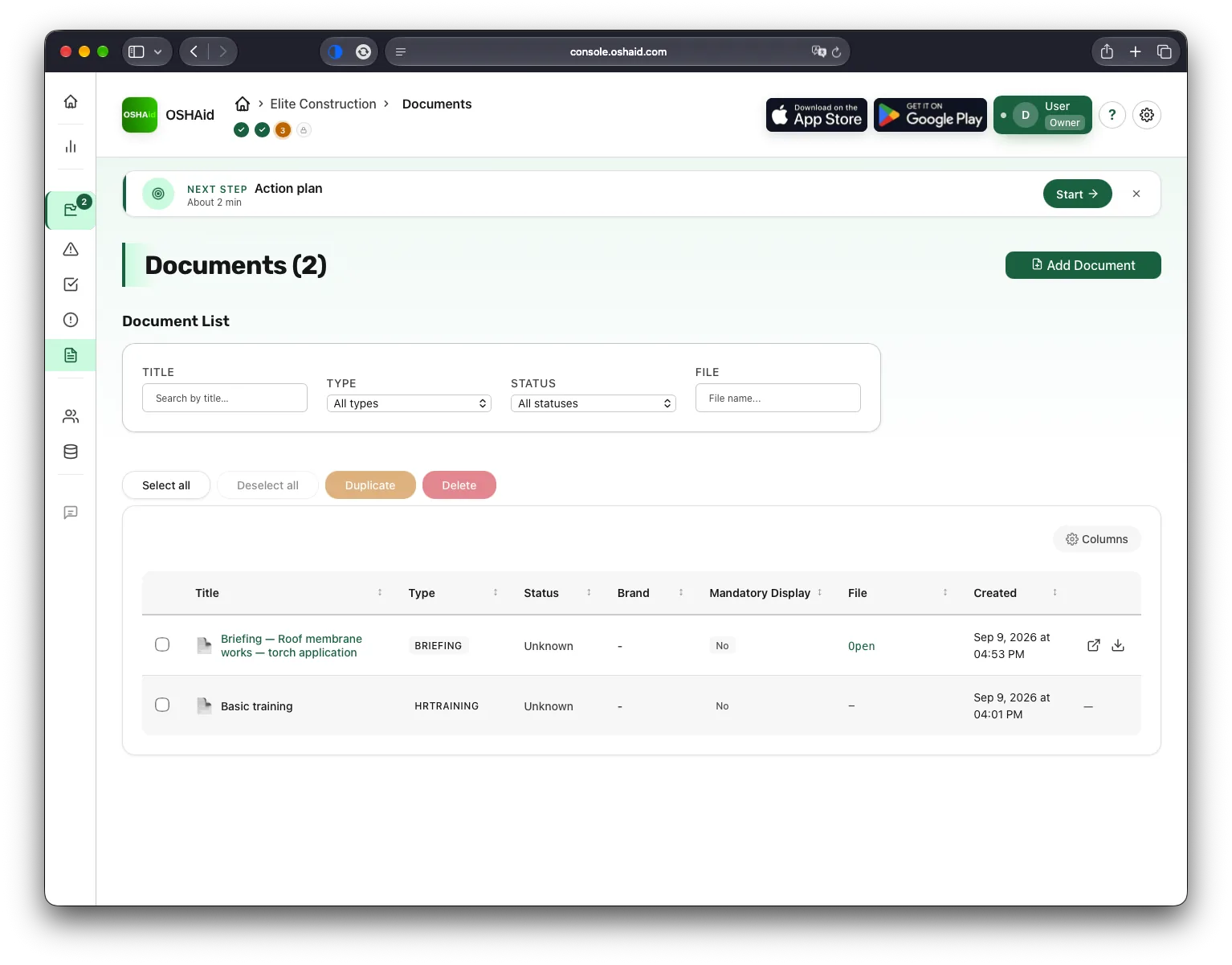 OSHAid console, the document library: written programs, evaluations and compliance records filed by workplace and by category
A program you can show, in five records
The paperwork behind a respiratory protection program is short: who wears what, when the medical evaluation was done, what the PLHCP recommended, when the last fit test was, when the training happened. What makes it hard is that those five records usually live in five places, a clinic's inbox, a binder, a supervisor's phone, a spreadsheet nobody owns. Kept together, they answer the only question an inspector or a client ever asks, who wears what and on what basis, in the time it takes to open a screen. That is worth building whichever way paragraph (e) goes.
Questions safety officers ask
- Does OSHA require a medical evaluation before an employee wears an N95?
Today, yes. 29 CFR 1910.134(e)(1) requires the employer to provide a medical evaluation before an employee is fit tested or required to use a respirator, and a filtering facepiece is a respirator. OSHA has proposed exempting required filtering facepiece use from that paragraph, but no final rule has been published.
- Who can perform a respirator medical evaluation?
- How often does a respirator medical evaluation have to be repeated?
About this article
Written by the OSHAid Safety Desk from official sources (OSHA news releases, the text of the standards, BLS and NIOSH data), checked against those sources and reviewed before publication. It explains what a rule says; it is not legal advice for your situation. OSHAid
Show your respiratory protection program instead of defending it
Create a free OSHAid account and keep your hazards, audits, corrective actions and compliance documents in one place. No commitment.
Create my accountFreeDownload on theApp StoreGET IT ONGoogle PlayThe intelligent OSHA companion that automates your field compliance. Mobile app + web console + specialized safety AI agent, built for US workplaces.
🇫🇷 Hosted in EuropeGDPR CompliantProductIndustriesGuides- OSHA compliance software
- Hazard assessment guide
- Safety program templates
- JHA examples
- OSHA requirements
- OSHA recordkeeping
- OSHA standards by industry
- Workplace hazards
- Get started
- What is OSHA?
- Workplace safety glossary
- Why OSHAid?
- Enterprise solutions
- About
- Blog
- Legal notice
© 2026 OSHAid - published by DUOPP (SAS). All rights reserved.