 OSHAidProductsDemosIndustriesPricingMoreClient accessTry OSHAidFree🇺🇸ENTry OSHAidBack to blogGuidanceNovember 10, 2026· By the OSHAid Safety Desk
Respirator storage requirements: what a stockpile still has to prove
On November 5, 2026 NIOSH published a Science Bulletin on how to sample and test respirators held in storage. The guidance is new; the duty behind it is not. 29 CFR 1910.134(h) has always described storage as a result, not a closet.
Respirator storage requirements are the part of 29 CFR 1910.134 nobody reads until the box comes back out of the storeroom. Most US employers have one of those boxes. The N95s bought in 2020 and 2021 are still on a shelf somewhere, and the shelf is rarely the one the manufacturer had in mind.
On November 5, 2026 NIOSH published a Science Bulletin, Monitoring Stockpiled Respirator Quality, written by two researchers at its National Personal Protective Technology Laboratory. It sets out how to sample a stored supply for testing, and opens with the reason: "Because respirator materials degrade over time, manufacturers often recommend storage conditions and shelf-life limits." Outside those conditions and limits, it says, "manufacturers cannot guarantee their products will provide the expected protection."
The bulletin is guidance, not a rule. The rule is already on the books, and it is shorter than you would expect.
What the respirator storage requirements say
Storage is written as a result, not a place. 29 CFR 1910.134(h)(2)(i) requires that all respirators be stored to protect them from damage, contamination, dust, sunlight, extreme temperatures, excessive moisture and damaging chemicals, and that they be packed or stored to prevent deformation of the facepiece and exhalation valve. Read on eCFR, title 29 current as of November 6, 2026.
Emergency respirators carry three extra conditions. Under (h)(2)(ii) they must be kept accessible to the work area, stored in compartments or in covers clearly marked as containing emergency respirators, and stored in accordance with any applicable manufacturer instructions.
NIOSH's warning signs are that same list, seen from the warehouse floor. The bulletin tells you what to look for when the pallet is opened: extensive dust, light exposure, nearby chemicals, and crushed cases, boxes or respirators. Those four map almost word for word onto dust, sunlight, damaging chemicals and deformation in (h)(2)(i).
Inspection has a schedule. Paragraph (h)(3)(i) requires respirators used in routine situations to be inspected before each use and during cleaning; respirators maintained for emergency use to be inspected at least monthly and in accordance with the manufacturer's recommendations, and checked for proper function before and after each use; and emergency escape-only respirators to be inspected before being carried into the workplace. Paragraph (h)(3)(ii) says what an inspection covers: respirator function, tightness of connections, the condition of the facepiece, head straps, valves, connecting tube and cartridges, canisters or filters, and a check of elastomeric parts for pliability and signs of deterioration.
A respirator that fails comes out of service. Paragraph (h)(4) requires respirators that fail an inspection, or are otherwise found defective, to be removed from service and then discarded, repaired or adjusted — repairs made only by trained people, using the manufacturer's NIOSH-approved parts.
Shelf life is where the standard and the bulletin meet. 1910.134(d)(1)(ii) requires the employer to select a NIOSH-certified respirator, used in compliance with the conditions of its certification. The bulletin closes on exactly that point: "even if your respirators pass testing, they are not NIOSH Approved if they are past their shelf life." A laboratory result can tell you a lot is in good condition. It cannot put the approval back.
Voluntary use does not switch the storage rule off. Under (c)(2)(ii), where respirator use is not required, the employer must still implement the elements needed to ensure the respirator is cleaned, stored and maintained so that its use does not present a health hazard to the user. Employees whose only use is the voluntary use of filtering facepieces are exempt from the written program — not from how the masks are kept.
 A half-mask respirator with its cartridges left open on a wooden shelf next to a butane torch and jars of pigment. Photo: Thirdman, via Pexels (Pexels License)
Six checks on the respirators you already own
1. Find out what you actually have. The bulletin's first step is an inventory: every manufacturer, every model, every production lot, and the number of units in each. Its worked example is one lot of 100 cases, 8 boxes per case and 20 units per box — 16,000 respirators. A count by lot is what makes everything below possible.
2. Open the boxes and write down what you see. NIOSH asks you to inspect all pallets, cases, boxes and units and to document the findings so trends show up. Dust, light, chemicals stored alongside, crushed packaging: each is also a storage failure under (h)(2)(i), and the fix is the storeroom, not the respirator.
3. Sample before you test. The bulletin recommends lot quality assurance sampling and, for employers with no sampling expert on hand, its own study model: "Randomly choose 40 respirators from each production lot," drawn from different pallets, cases and boxes where practical.
4. Know what a laboratory will measure. NIOSH points to three of its Standard Test Procedures for N95 filtering facepiece respirators: exhalation resistance (TEB-APR-STP-0003) and inhalation resistance (TEB-APR-STP-0007), both run at 85 liters per minute, and filter efficiency (TEB-APR-STP-0059). A unit passes exhalation resistance below 25 mm H2O column, inhalation resistance below 35 mm H2O column, and filter efficiency at 5.0% particulate penetration or less. Filter efficiency is run last because it uses a salt aerosol. A third-party lab should list all three tests in its accreditation.
5. Decide in advance what a failure means. NIOSH's order is to re-read the visual inspection notes for a storage problem the failing units share, then confirm that temperature and humidity stayed inside the manufacturer's limits, and correct the storage if they did not. If storage was correct and the units are still within shelf life, report it to NIOSH at PPEConcerns@cdc.gov and to the manufacturer.
6. Put the schedule in the program, not in your head. 1910.134(c)(1)(v) requires the written respiratory protection program to contain procedures and schedules for cleaning, disinfecting, storing, inspecting, repairing, discarding and otherwise maintaining respirators. If your program names a storeroom, a temperature range and a monthly check, this week's work is already written down. If it does not, our written safety program requirements and templates are the place to start. 1910.134 reaches general industry, shipyards, marine terminals, longshoring and construction, so read it next to the OSHA standards that apply to your industry.
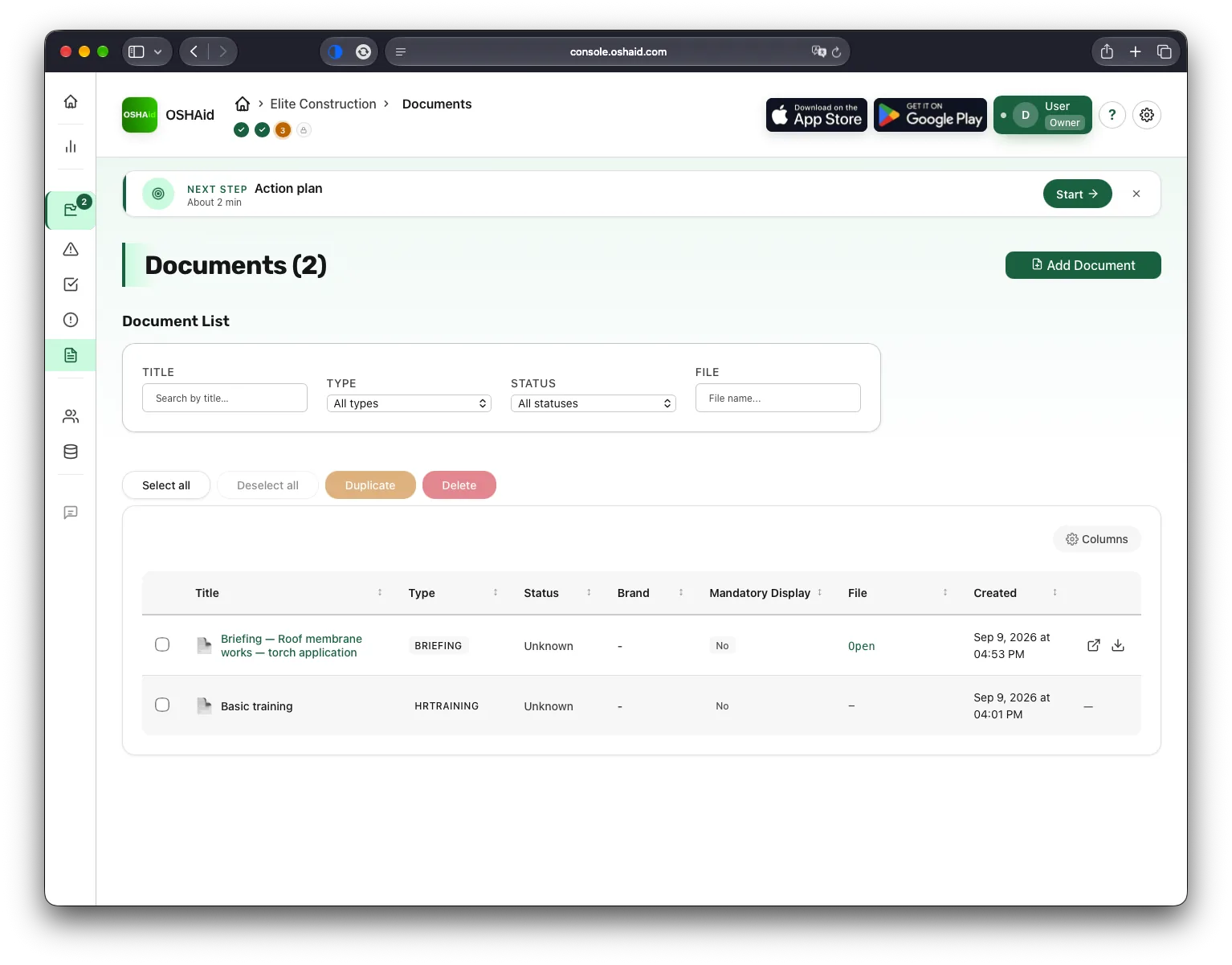 OSHAid console: the document library, where a written respiratory protection program and its storage and inspection schedule stay in one place
A stockpile is only an asset if you can describe it
A pallet of respirators looks like preparedness. Until someone opens it, it is a guess. The difference between the two is a list: which models, which lots, how many, stored where, inspected when, and by whom.
That list is also the answer to the only question an inspector, a client or your leadership will ask about the stockpile. NIOSH's bulletin gives you the laboratory half of it; the standard has had the paperwork half since 1998, in one sentence about procedures and schedules.
A safety program that produces that list in a minute turns a supply closet into something you can show. One that cannot starts over every time the subject comes up.
Questions safety officers ask
- Do N95 respirators expire?
Manufacturers set shelf-life limits because respirator materials degrade over time. NIOSH's November 5, 2026 bulletin states that outside those limits manufacturers cannot guarantee the expected protection, and that respirators past their shelf life are not NIOSH Approved even when laboratory testing shows they pass.
- How does OSHA say respirators must be stored?
- Do voluntary-use dust masks need a written program?
Related reading
All posts- Nov 11, 2026Respirator fit test requirements: the annual clock in 1910.134Fundamentals
- Nov 9, 2026Trichloroethylene exposure limit: California proposes 0.24 ppmRulemaking
- Oct 29, 2026OSHA grain handling requirements: the paperwork OSHA just listedOSHA update
- Oct 24, 2026Permit-required confined space: what has to happen before entryCase study
About this article
Written by the OSHAid Safety Desk from official sources (OSHA news releases, the text of the standards, BLS and NIOSH data), checked against those sources and reviewed before publication. It explains what a rule says; it is not legal advice for your situation. OSHAid
Keep the stockpile beside the program that governs it
Create a free OSHAid account: keep your written respiratory protection program, the storage and inspection schedule it sets, and the corrective actions a check produces — in one place your team can open. No commitment.
Try OSHAidFreeDownload on theApp StoreGET IT ONGoogle PlayThe intelligent OSHA companion that automates your field compliance. Mobile app + web console + specialized safety AI agent, built for US workplaces.
ProductIndustriesGuides- OSHA compliance software
- Hazard assessment guide
- Safety program templates
- JHA examples
- OSHA requirements
- OSHA recordkeeping
- OSHA standards by industry
- Workplace hazards
- Get started
- What is OSHA?
- Workplace safety glossary
- Why OSHAid?
- Enterprise solutions
- About
- Blog
- Legal notice
© 2026 OSHAid - published by DUOPP (SAS). All rights reserved.
Help us improve OSHAid
We only measure site traffic. No advertising, no resale of data.
OKDeclineLearn more