 OSHAidProductsDemosIndustriesPricingMoreClient accessTry OSHAidFree🇺🇸ENTry OSHAidBack to blogOSHA updateNovember 20, 2026· By the OSHAid Safety Desk
Rubber insulating glove testing requirements: the six-month clock
On November 18, 2026 OSHA asked OMB to extend the information-collection requirements in the electrical protective equipment standards. The standard has not changed - but the notice is a plain list of the records it has always required.
If anyone on your payroll pulls on rubber insulating gloves to work on or near energized parts, the rubber insulating glove testing requirements in 29 CFR 1910.137 are not housekeeping. They are a dated certification an OSHA inspector can ask to see, and that your own employees can ask to see.
On November 18, 2026, OSHA asked the Office of Management and Budget to extend its approval of the information-collection requirements in the electric power generation, transmission and distribution standards and the electrical protective equipment standards, in a notice published in the Federal Register. Comments are due January 19, 2027.
Nothing in the standards changes. What the notice does is set out, in OSHA's own words, the records those standards already require - and the testing certification for rubber insulating equipment is one of them. A good week to find out whether you could produce yours.
What the rubber insulating glove testing requirements say
The interval is six months, and it is not the only trigger. Table I-5 of 29 CFR 1910.137 sets the maximum intervals between electrical tests. Rubber insulating gloves are tested before first issue and every 6 months thereafter; also upon indication that the insulating value is suspect, after repair, and after any use without protectors. Rubber insulating blankets and sleeves are tested before first issue and every 12 months thereafter. Rubber insulating line hose and covers have no fixed interval: they are tested when the insulating value is suspect and after repair.
Stock on the shelf ages too. A footnote to the same table is the one most inventories miss: equipment tested but not issued for service may not be placed into service unless it was tested within the previous 12 months.
Testing does not replace looking. Paragraph (c)(2)(ii) requires insulating equipment to be inspected for damage before each day's use, and immediately following any incident that can reasonably be suspected of causing damage. Insulating gloves get an air test along with that inspection.
Five defects end a glove's service. Under (c)(2)(iii), insulating equipment may not be used if it has a hole, tear, puncture or cut; ozone cutting or ozone checking; an embedded foreign object; swelling, softening, hardening or becoming sticky or inelastic; or any other defect that damages the insulating properties.
Protectors are the default, not an option. Paragraph (c)(2)(vii) requires protector gloves over insulating gloves, with narrow exceptions for Class 0 and - below 250 volts ac or 375 volts dc - Class 00 gloves, in limited-use conditions needing unusually high finger dexterity. Gloves used without protectors may not be reused until retested.
The record is the part OSHA collects. Paragraph (c)(2)(xii) requires the employer to certify that equipment has been tested. The certification must identify the equipment that passed the test and the date it was tested, and be made available on request to the Assistant Secretary and to employees or their authorized representatives. A note to the paragraph names two acceptable means: marking the equipment, and entering the test results and dates onto logs.
This is not a utility-only standard. 29 CFR 1910.335(a)(1) requires employees working in areas where there are potential electrical hazards to be provided with, and to use, electrical protective equipment appropriate for the work - and requires that equipment to be maintained in a safe, reliable condition and periodically inspected or tested as required by 1910.137. A maintenance technician in a school, a plant or a store is covered by the same sentence as a lineman. OSHA's November 18 notice puts the two standards together at 24,151 respondents and 2,137,282 responses a year, a burden it estimates at 407,614 hours, up 13,000 hours because the number of affected projects has risen.
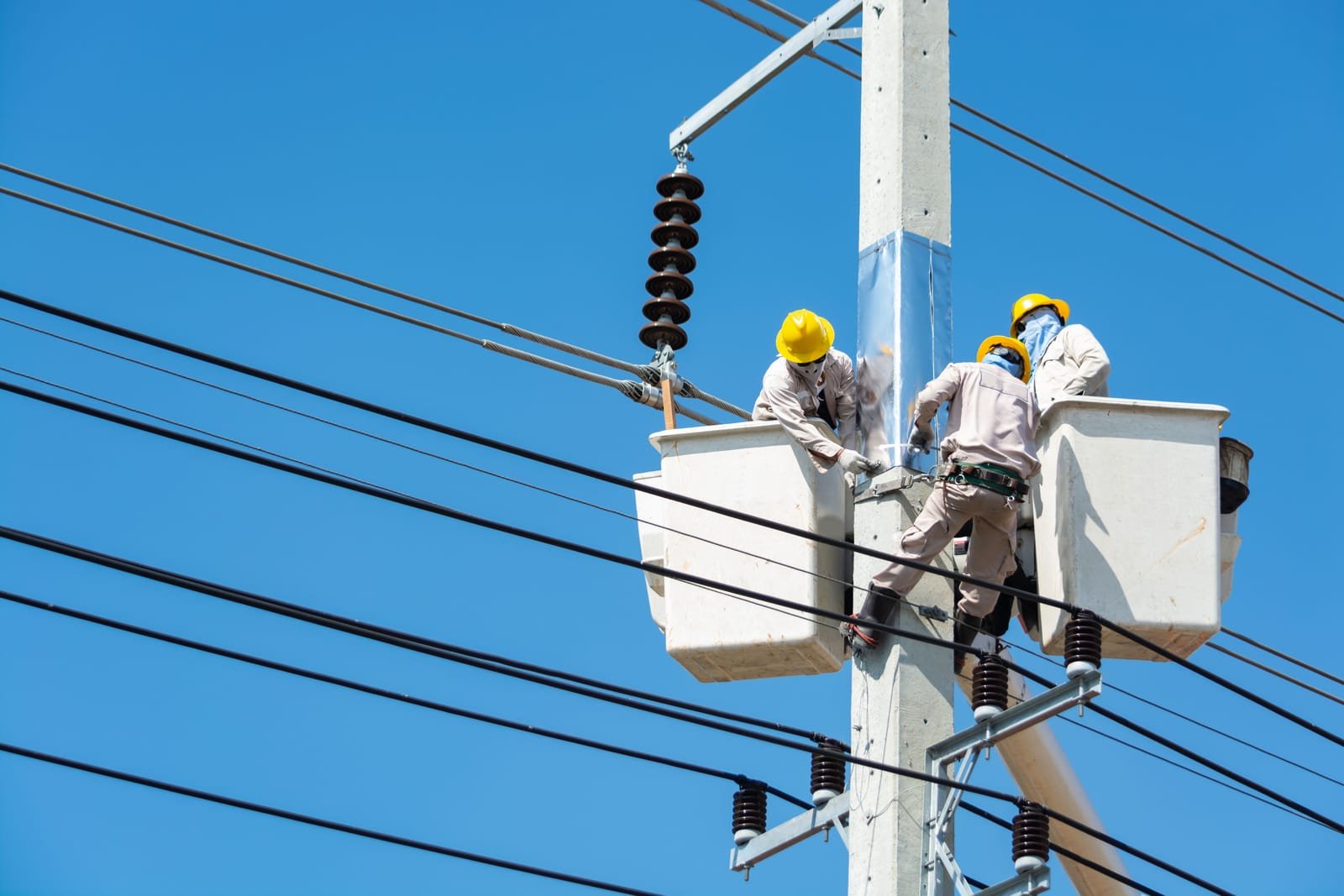 Three utility workers in hard hats and gloves at the top of two bucket lifts, working on the crossarm of an energized distribution pole against a clear blue sky. Photo: Thampapon Otavorn, via Pexels (Pexels License)
Seven things to settle this week
1. Inventory what you actually own. Gloves, sleeves, blankets, line hose, covers. Class and type are marked on the equipment itself - Class 00 through Class 4, Type I for nonozone-resistant and Type II for ozone-resistant - and on a glove the marking is confined to the cuff.
2. Put a next-test date against every item. Six months for gloves. Twelve months for blankets and sleeves. For anything sitting in a cabinet untouched, the question is not when it was bought but whether it was tested within the previous 12 months before it goes out.
3. Name who does the testing. The standard requires a test method that reliably indicates whether the equipment can withstand the voltages involved, and its note points to the ASTM specifications - D120 for gloves, D1051 for sleeves, D1048 for blankets. In practice that means a laboratory, whose certificate is your record only if it identifies the equipment and the date.
4. Fix the format of the certification before you need it. Equipment identified, date tested. Choose marking, a log, or both - and keep it where the person asked for it can reach it, not in the lab's email thread.
5. Put the daily inspection where the work starts. Before each day's use, and after any incident that could have damaged the equipment. The air test on gloves belongs in the same two minutes - in the job briefing, not a binder nobody opens.
6. Decide the protector-glove question in writing. If anyone works Class 0 or Class 00 gloves bare-handed under the dexterity exception, that decision, the voltage involved and the quarantine-until-retested rule need to be stated somewhere. A written safety program your crew can actually follow is where that belongs.
7. Check whether the standard reaches you at all. The trigger in 1910.335 is "areas where there are potential electrical hazards" - which is a question your hazard assessment answers, not your job titles. If panels, controls or energized equipment are opened by your own staff, a documented hazard assessment is what shows you asked the question.
And if OSHA's burden estimate does not match what this costs you, the docket is open: comments on Docket No. OSHA-2017-0005 are due January 19, 2027.
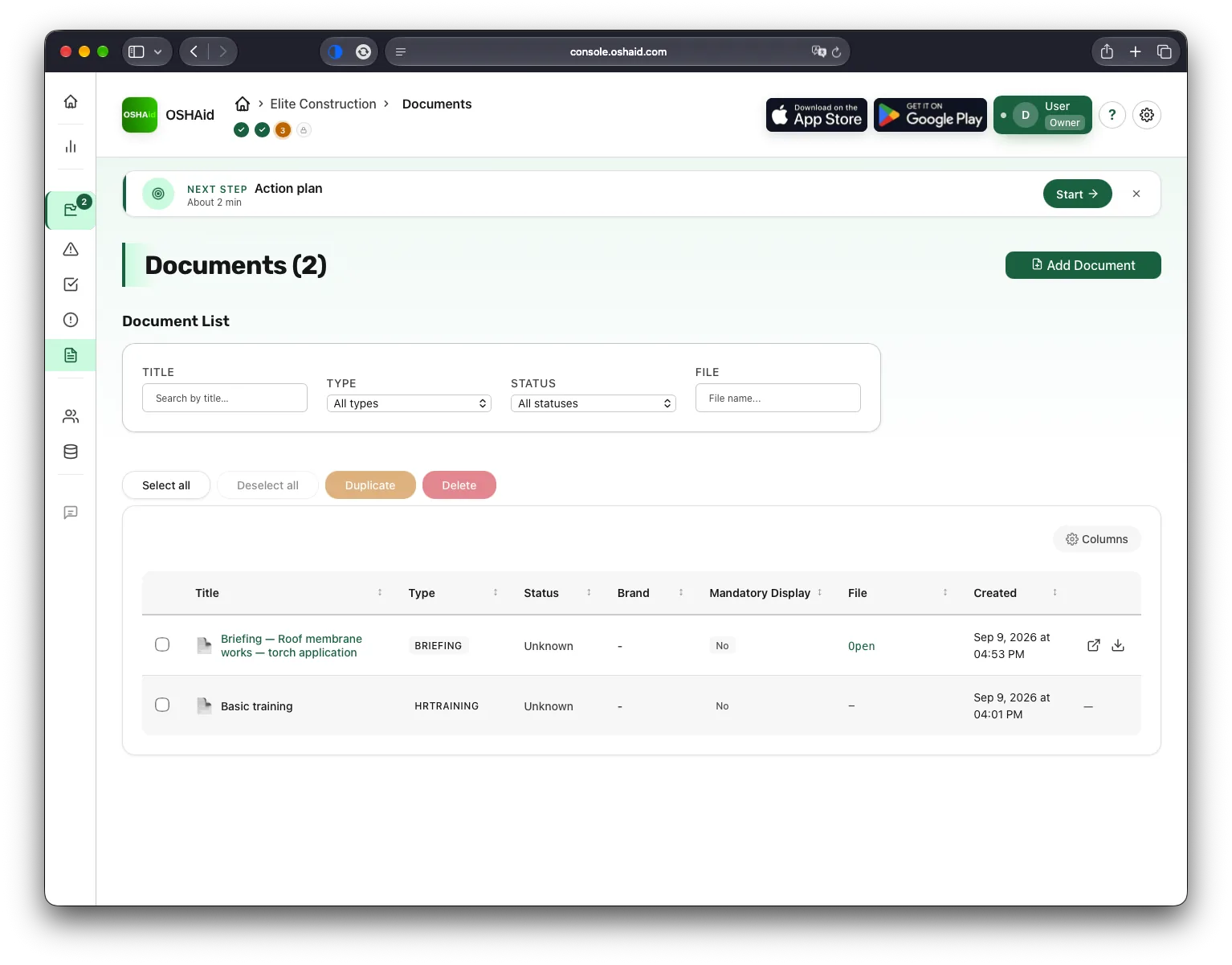 OSHAid console: the document library, where test certificates and written programs sit against the equipment they belong to instead of in an email thread
A glove bag you can open in front of anyone
Rubber insulating equipment is one of the few things in a safety program where the standard says exactly what proof looks like: this item, this date, it passed. No judgment call to argue about, nowhere to improvise after the fact.
That makes it a fair test of everything else. If you can open the cabinet, name every pair, and show when each was last tested and by whom, the rest of the program is probably in the same condition. If you cannot, the six-month clock has been running anyway.
Keep the inventory, the test dates and the daily inspection in one place, and the certification stops being a document you hunt for and becomes something you can show.
Questions safety officers ask
- How often do rubber insulating gloves have to be tested?
Table I-5 of 29 CFR 1910.137 requires rubber insulating gloves to be electrically tested before first issue and every 6 months thereafter. They must also be tested whenever the insulating value is suspect, after any repair, and after any use without protector gloves.
- What has to be in the testing certification?
- Do rubber insulating gloves have to be worn with protector gloves?
Related reading
All posts- Nov 21, 2026Temporary worker safety training: who gives it, who proves itCase study
- Nov 19, 2026OSHA incident rate by industry: what the 2025 data showsData
- Nov 5, 2026OSHA asbestos awareness training: the duty that follows the buildingCase law
- Oct 6, 2026Emergency action plan requirements: when OSHA actually makes you write oneFundamentals
About this article
Written by the OSHAid Safety Desk from official sources (OSHA news releases, the text of the standards, BLS and NIOSH data), checked against those sources and reviewed before publication. It explains what a rule says; it is not legal advice for your situation. OSHAid
Know when every glove is due
Create a free OSHAid account: list your protective equipment, track test and inspection dates against it, and keep the certificates beside the hazard assessment that explains why you hold them. No commitment.
Try OSHAidFreeDownload on theApp StoreGET IT ONGoogle PlayThe intelligent OSHA companion that automates your field compliance. Mobile app + web console + specialized safety AI agent, built for US workplaces.
ProductIndustriesGuides- OSHA compliance software
- Hazard assessment guide
- Safety program templates
- JHA examples
- OSHA requirements
- OSHA recordkeeping
- OSHA standards by industry
- Workplace hazards
- Get started
- What is OSHA?
- Workplace safety glossary
- Why OSHAid?
- Enterprise solutions
- About
- Blog
- Legal notice
© 2026 OSHAid - published by DUOPP (SAS). All rights reserved.
Help us improve OSHAid
We only measure site traffic. No advertising, no resale of data.
OKDeclineLearn more