 OSHAidProductsDemosIndustriesPricingMoreClient accessCreate my accountFree🇺🇸ENCreate my accountBack to blogCase studyOctober 3, 2026· By the OSHAid Safety Desk
Struck-by hazards: stop the machine before the repair starts
OSHA has proposed the maximum willful penalty against a Florida pipeline contractor after a worker was struck by a rotating drill stem. The standards behind the citation apply to every site with powered equipment.
Struck-by hazards are the ones a crew stops seeing after the third week on a site. The machine is loud, it has always been loud, and the task takes two minutes. On September 23, 2026, OSHA cited an Orlando pipeline contractor over exactly that moment, in news release 26-1414-ATL.
OSHA says that on March 17, 2026, at a New Smyrna Beach worksite, an employee was struck and killed when a pipe stem on a horizontal drilling machine began rotating unexpectedly while workers were replacing a drill bit. The agency issued a willful citation to T & T Pipeline Co. Inc. for exposing employees to struck-by hazards when working on a horizontal directional drilling machine, and proposed a penalty of $165,514.
That is not a round number. It is the ceiling, and the rules behind it apply to any site where someone puts a hand on powered equipment.
Struck-by hazards and what the citation says
$165,514 is the maximum OSHA lists for a single willful or repeated violation on its penalties page. A serious violation tops out at $16,550. Proposing the ceiling is how the agency signals that the hazard was known.
None of it is final. The release says the company has 15 business days from receipt of the citations to comply, request an informal conference with OSHA, or contest the findings before the independent Occupational Safety and Health Review Commission. Read the citation as what OSHA alleges. Read the standards behind it as what already applies to you.
Struck-by is one of the four hazards in OSHA's Construction Focus Four training, with falls, caught-in or -between, and electrocution. It is not a rare event class. BLS counted 756 fatal contact incidents in 2024: 357 workers struck by a propelled, falling or suspended object, and 213 struck, caught or compressed by running powered equipment.
That second figure is the one this case belongs to, and it describes a particular kind of work. Not the machine running normally with everyone clear of it. Someone with their hands on it: changing a bit, clearing a jam, freeing a stuck part, adjusting something that was easier to reach with the engine on.
Those tasks share a pattern. They are short, they are usually done by the most experienced person on the crew, and they rarely appear in the job hazard analysis, because the analysis covers the job — boring, laying pipe, backfilling — and not the five-minute repair inside it.
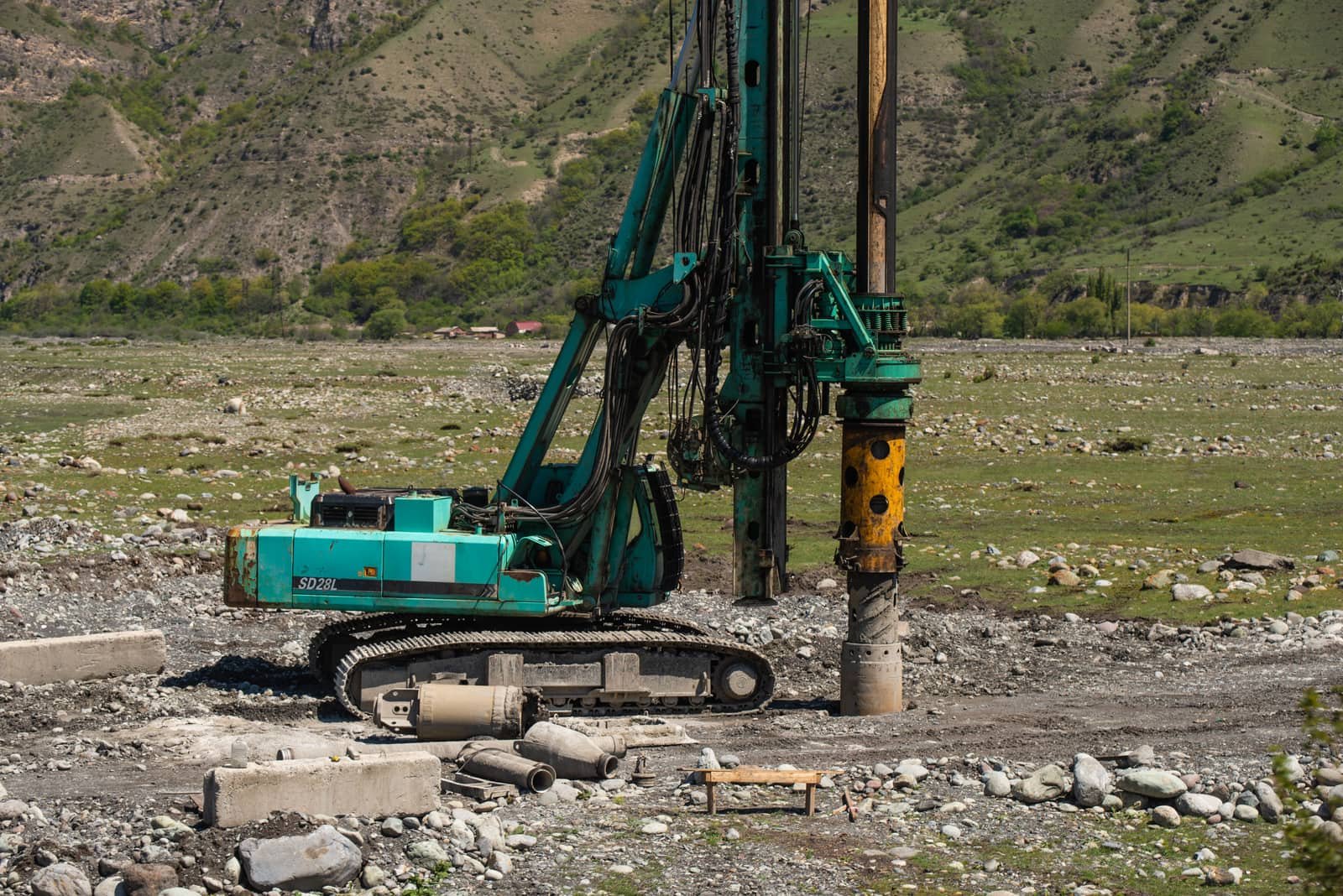 A tracked drilling rig boring into the ground on an open worksite, with drill tooling and pipe sections lying beside it. Photo: Павел Хлыстунов, via Pexels
Five things to check on your sites this week
1. Kill the energy before the hands go in. For construction equipment under repair, 29 CFR 1926.600(a)(3)(i) is explicit: "All controls shall be in a neutral position, with the motors stopped and brakes set, unless work being performed requires otherwise." Blades, buckets and dump bodies must be fully lowered or blocked, and anything suspended or held aloft by slings, hoists or jacks must be substantially blocked or cribbed before anyone works under or between it. The text is at 29 CFR 1926.600.
2. Walk the yard and look at the guards. 29 CFR 1926.300(b)(2) requires that belts, gears, shafts, pulleys, sprockets, spindles, drums, fly wheels, chains "or other reciprocating, rotating or moving parts of equipment shall be guarded if such parts are exposed to contact by employees or otherwise create a hazard." The guard that matters is usually the one taken off for a repair and never put back.
3. Write your own de-energizing step. 29 CFR 1910.147, the lockout/tagout standard, is written for general industry. OSHA's page on the control of hazardous energy points construction to the electrical, concrete and masonry, and power transmission subparts of Part 1926. Separately, 29 CFR 1926.20(b)(3) requires equipment that is not in compliance to be identified as unsafe by tagging or locking the controls to render them inoperable, or physically removed from its place of operation. The absence of one construction-wide procedure is a reason to write yours, not to skip it.
4. Put the service task in the hazard analysis. List bit changes, jam clearing, greasing and troubleshooting as steps of their own, each with its own controls and its own stop condition. They belong with the rest of your workplace hazards and their controls, not in the operator's manual.
5. Name the competent person and the qualified operator. 29 CFR 1926.20(b)(2) requires frequent and regular inspections of job sites, materials and equipment by competent persons designated by the employer, and 1926.20(b)(4) permits only employees qualified by training or experience to operate equipment and machinery. Under 29 CFR 1926.21(b)(2) you must instruct each employee in the recognition and avoidance of unsafe conditions. Assign those roles per site, the way you assign the rest of the standards that apply to construction.
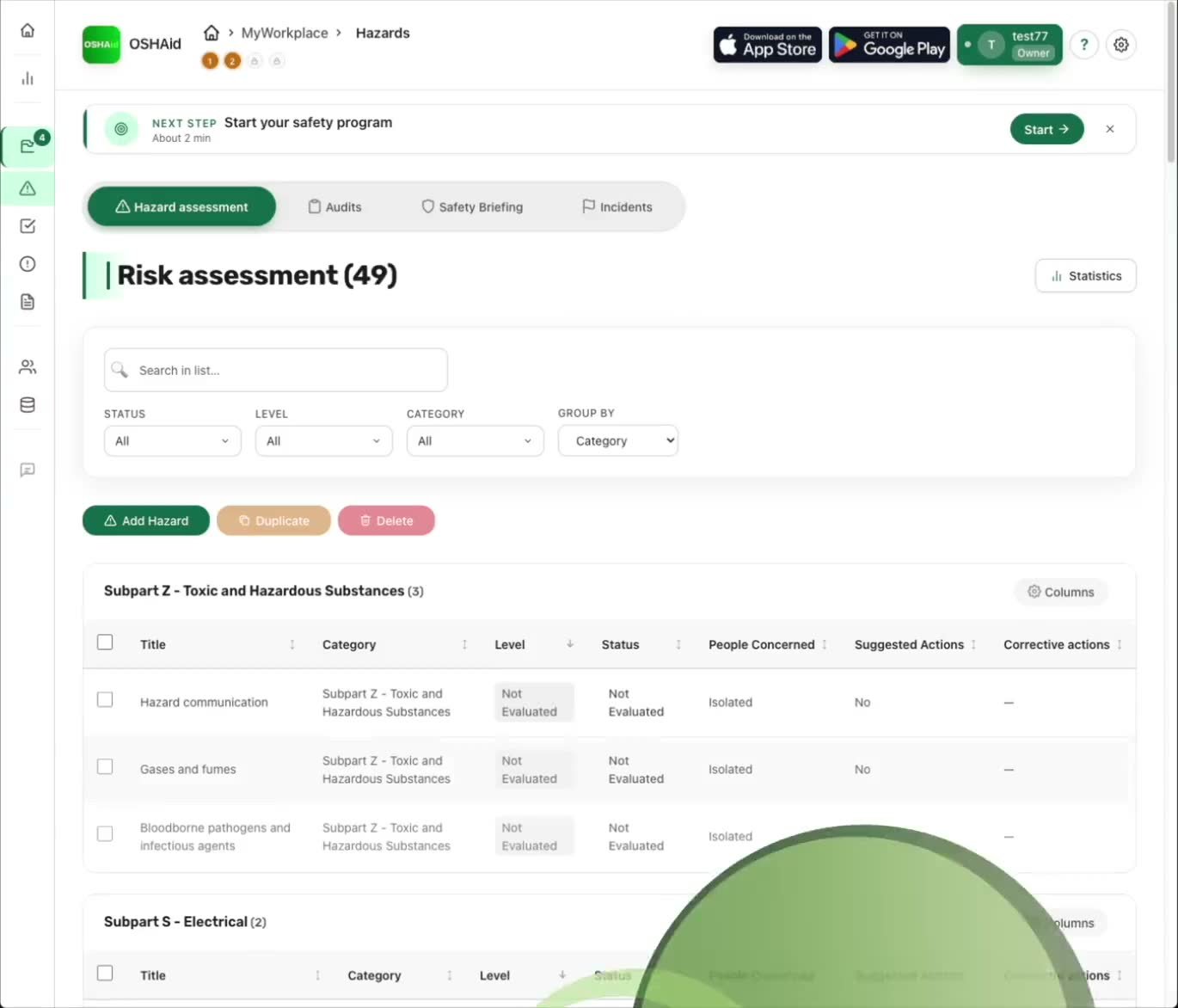 OSHAid console — the risk assessment table, where each task carries its own hazards, rating and controls
A program you can show, not a binder you defend
Nobody schedules the repair that goes wrong. What you can decide in advance is whether the rule for it exists before the crew needs it: the machine off, the controls neutral, the guard back on, the person doing the work named and trained, and the whole thing written somewhere other than one supervisor's memory.
That record is also the difference between an afternoon and a month when someone outside your company asks what you did about the hazard. An employer who can pull up the equipment checks, the service task in the hazard analysis, the training sheet and the corrective action answers the question. An employer rebuilding it from photos on three phones defends a binder. Compliance is the floor; the point is a safety program you can show.
Questions safety officers ask
- What counts as a struck-by hazard?
Struck-by is one of OSHA's Construction Focus Four hazards, with falls, caught-in or -between, and electrocution. BLS recorded 357 deaths in 2024 from being struck by a propelled, falling or suspended object, and 213 from being struck, caught or compressed by running powered equipment.
- Does OSHA require equipment to be shut down before a repair?
- How much is a willful OSHA violation?
About this article
Written by the OSHAid Safety Desk from official sources (OSHA news releases, the text of the standards, BLS and NIOSH data), checked against those sources and reviewed before publication. It explains what a rule says; it is not legal advice for your situation. OSHAid
Show what you did about the hazard
Create a free OSHAid account and keep your hazards, job hazard analyses, equipment checks and corrective actions in one place. No commitment.
Create my accountFreeDownload on theApp StoreGET IT ONGoogle PlayThe intelligent OSHA companion that automates your field compliance. Mobile app + web console + specialized safety AI agent, built for US workplaces.
🇫🇷 Hosted in EuropeGDPR CompliantProductIndustriesGuides- OSHA compliance software
- Hazard assessment guide
- Safety program templates
- JHA examples
- OSHA requirements
- OSHA recordkeeping
- OSHA standards by industry
- Workplace hazards
- Get started
- What is OSHA?
- Workplace safety glossary
- Why OSHAid?
- Enterprise solutions
- About
- Blog
- Legal notice
© 2026 OSHAid - published by DUOPP (SAS). All rights reserved.