 OSHAidProductsDemosIndustriesPricingMoreClient accessTry OSHAidFree🇺🇸ENTry OSHAidBack to blogExposure limitsNovember 23, 2026· By the OSHAid Safety Desk
OSHA carbon monoxide exposure limit: what 50 ppm actually covers
On November 23, 2026, NIOSH opened public comment on replacing the carbon monoxide ceiling it recommended in 1972 with a 200 ppm, 10-minute short-term exposure limit. The enforceable number has not moved: OSHA's permissible exposure limit is still 50 ppm, averaged over 8 hours.
The OSHA carbon monoxide exposure limit is a single number - 50 parts per million - averaged across a whole shift. That average is also the catch. A short, heavy exposure, from a propane forklift working a closed dock or a gas range under a hood that has stopped pulling, can make someone sick during a shift whose 8-hour average still lands under the limit.
On November 23, 2026, NIOSH asked for public comment on a draft document, Proposed Short-Term Exposure Limit for Occupational Exposure to Carbon Monoxide, in a notice in the Federal Register. It asks whether the 200 ppm ceiling NIOSH recommended in 1972 should be replaced by a 200 ppm limit measured as a 10-minute time weighted average. Comments are due by February 22, 2027.
Nothing you owe changes today: a NIOSH recommended exposure limit is advice, not a standard. What the notice does is name the gap every safety officer feels in winter, when the doors close and the heaters come on.
What the OSHA carbon monoxide exposure limit requires
The enforceable number, general industry. Carbon monoxide sits in Table Z-1 of 29 CFR 1910.1000 under CAS 630-08-0, at 50 ppm or 55 mg/m3. Paragraph (a)(2) governs it: exposure must not exceed that 8-hour time weighted average in any 8-hour work shift of a 40-hour work week. Table and paragraph are both current in the eCFR as of November 19, 2026.
The same number on a construction site. Table 1 of 29 CFR 1926.55 carries carbon monoxide at the same 50 ppm and 55 mg/m3, determined from breathing-zone air samples as an 8-hour time weighted average in any work shift. Paragraph (b) then sets the order of work: administrative or engineering controls must be implemented first whenever feasible, and respirators only come in where those controls cannot achieve full compliance.
Table Z-1 gives CO an average, not a ceiling. A substance with a ceiling value in Table Z-1 carries the letter C before its number and may not be exceeded at any time. Carbon monoxide carries no C, so the standard's own test for it is the shift average - the arithmetic NIOSH's third question is about. Other duties still reach a short exposure: 29 CFR 1910.146 for confined-space entry testing, and 29 CFR 1910.134 wherever respirators are relied on.
What NIOSH recommends today. The NIOSH Pocket Guide entry for carbon monoxide gives a recommended exposure limit of 35 ppm as a time weighted average with a 200 ppm ceiling, lists OSHA's PEL as 50 ppm, and puts the concentration immediately dangerous to life or health at 1,200 ppm.
What the notice proposes. Filed under docket numbers CDC-2026-1849 and NIOSH-357, the notice states that NIOSH's existing carbon monoxide recommendations were published in 1972, and asks whether the scientific evidence and modeling support replacing the 1972 200 ppm ceiling with a 200 ppm, 10-minute time weighted average. One of its five questions asks whether a 10-minute averaging period protects workers across a work day as well as over those ten minutes.
Maritime already works this way. OSHA's Carbon Monoxide Poisoning fact sheet states that the 8-hour PEL in maritime operations is also 50 ppm, that workers must be removed from exposure if the concentration exceeds 100 ppm, and that the peak level for employees engaged in roll-on roll-off cargo operations is 200 ppm.
 A pan over the blue flame of a gas burner on a commercial range in a professional kitchen, with a chargrill in the foreground. Photo: RDNE Stock project, via Pexels (Pexels License)
What to check before the first cold week
OSHA's fact sheet states in its footer that it imposes no new compliance requirements. It is the agency's list of what employers should do, rather than a rule - and a good hour's work against your own building.
1. List every fuel-burning thing that runs indoors. The fact sheet names the fuels that produce CO when they burn incompletely: natural gas, gasoline, kerosene, oil, propane, coal and wood. It adds that one of the most common sources of exposure in the workplace is the internal combustion engine, and names warehouses and boiler rooms among the places where harmful levels occur, forklift operators and garage mechanics among those at risk.
2. Service the appliances, do not just light them. OSHA asks employers to maintain equipment and appliances that can produce CO - it names water heaters, space heaters and cooking ranges - in good working order, both to run them safely and to reduce CO formation. In a commercial kitchen that is the range, the charbroiler, the gas water heater and the hood that is supposed to pull over them: the OSHA standards that reach restaurants start with the equipment you run every service.
3. Get engines out of enclosed areas. The fact sheet asks employers to prohibit gasoline-powered engines or tools in poorly ventilated areas, and to consider switching to equipment powered by electricity, batteries or compressed air where that can be done safely.
4. Fix the ventilation before you buy anything. The first prevention step on OSHA's list is an effective ventilation system that removes CO from work areas - the same order 1926.55(b) puts into regulatory text.
5. Then put the monitor where the work is. OSHA asks employers to provide personal CO monitors with audible alarms where potential exposure to CO exists, and to test air regularly in areas where CO may be present, including confined spaces.
6. Teach the symptoms by name. The fact sheet lists tightness across the chest, headache, fatigue, dizziness, drowsiness and nausea as initial signs, worsening with prolonged or high exposure to vomiting, confusion and collapse. A crew that files those under a long shift will not report them.
7. Settle the rescue rule before you need it. OSHA warns that a rescuer may be exposed to fatal levels of CO during a rescue attempt, and that employers should make sure rescuers are not exposed to dangerous levels while performing one.
8. Put it in the assessment, not in a memo. Carbon monoxide has a season, an exposed group and one control per source. That is a row in a hazard assessment, and our guide to workplace hazard categories and controls shows the shape it should take.
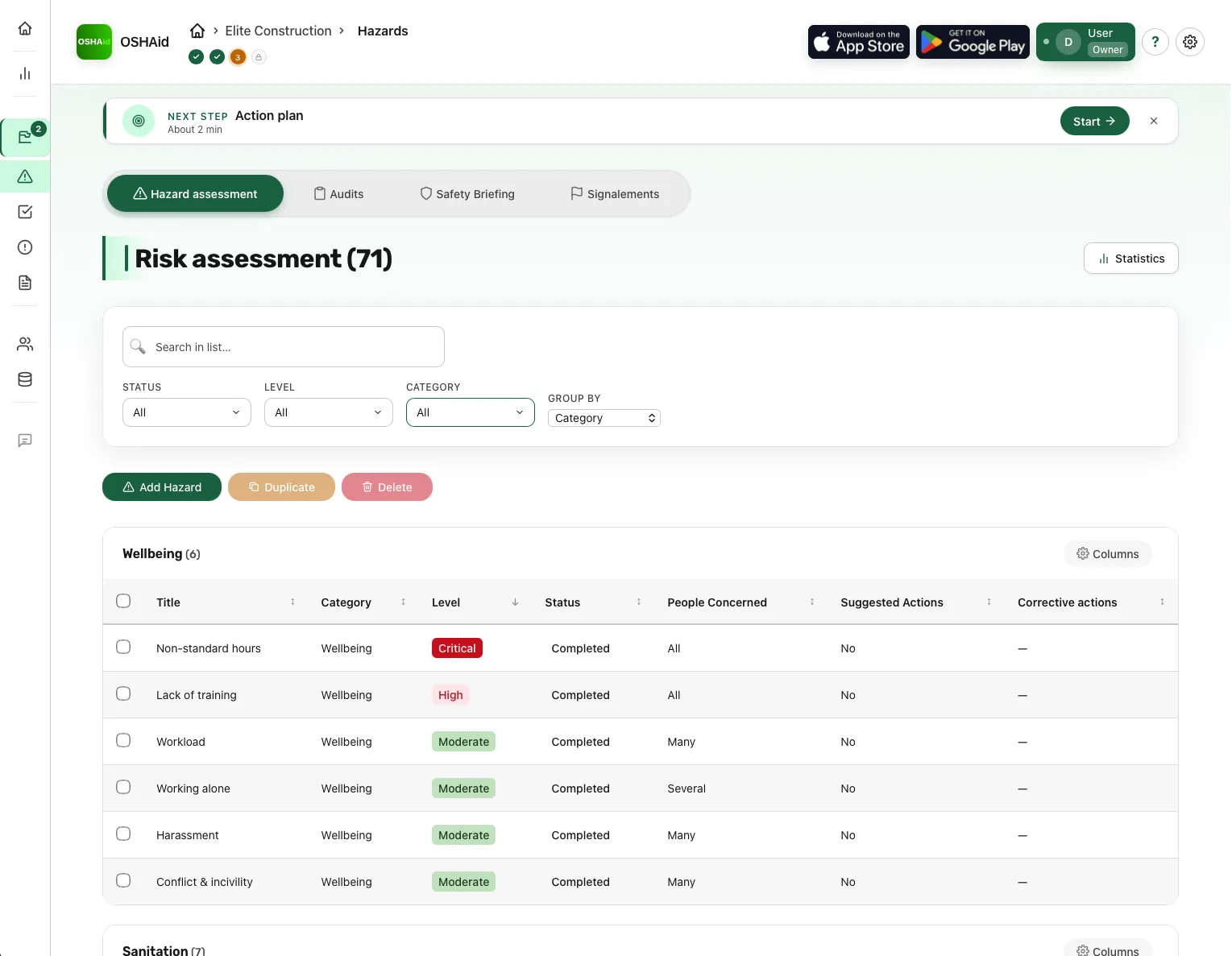 OSHAid console: the hazard list, where carbon monoxide is recorded against the equipment that produces it and the control that handles it
A limit you can show you measured
Carbon monoxide leaves nothing behind: nothing to see, nothing to smell, nothing on the floor afterwards. It tends to be found by reading a monitor log, not by walking a workplace.
That cuts both ways. With the monitor record, the service history for the heater, and a hazard row naming who is exposed and what controls it, the question takes a minute to answer. Without them, it cannot be answered at all.
Compliance is the floor. Being able to show leadership, a client or an inspector when the range was last serviced and what the dock read on the coldest morning is the part worth building.
Questions safety officers ask
- What is the OSHA exposure limit for carbon monoxide?
50 parts per million, or 55 mg/m3, as an 8-hour time weighted average. It appears in Table Z-1 of 29 CFR 1910.1000 for general industry and in Table 1 of 29 CFR 1926.55 for construction. The limit carries no C prefix, so it is an average rather than a ceiling.
- Is the NIOSH carbon monoxide limit the same as OSHA's?
- Does OSHA require carbon monoxide monitors?
Related reading
All posts- Nov 22, 2026OSHA machine guarding requirements: what to check on every machineGuidance
- Nov 14, 2026Storm cleanup safety requirements before your crew goes outStorm season
- Nov 11, 2026Respirator fit test requirements: the annual clock in 1910.134Fundamentals
- Nov 9, 2026Trichloroethylene exposure limit: California proposes 0.24 ppmRulemaking
About this article
Written by the OSHAid Safety Desk from official sources (OSHA news releases, the text of the standards, BLS and NIOSH data), checked against those sources and reviewed before publication. It explains what a rule says; it is not legal advice for your situation. OSHAid
Know what the dock read last winter
Create a free OSHAid account: record carbon monoxide against the equipment that produces it, keep service and monitoring records with the hazard itself, and answer with a date instead of a search through email. No commitment.
Try OSHAidFreeDownload on theApp StoreGET IT ONGoogle PlayThe intelligent OSHA companion that automates your field compliance. Mobile app + web console + specialized safety AI agent, built for US workplaces.
ProductIndustriesGuides- OSHA compliance software
- Hazard assessment guide
- Safety program templates
- JHA examples
- OSHA requirements
- OSHA recordkeeping
- OSHA standards by industry
- Workplace hazards
- Get started
- What is OSHA?
- Workplace safety glossary
- Why OSHAid?
- Enterprise solutions
- About
- Blog
- Legal notice
© 2026 OSHAid - published by DUOPP (SAS). All rights reserved.
Help us improve OSHAid
We only measure site traffic. No advertising, no resale of data.
OKDeclineLearn more