 OSHAidProductsDemosIndustriesPricingMoreClient accessTry OSHAidFree🇺🇸ENTry OSHAidBack to blogCase studyNovember 21, 2026· By the OSHAid Safety Desk
Temporary worker safety training: who gives it, who proves it
On November 16, 2026 OSHA cited a pastry manufacturer and the staffing agency that supplied its workers, after two injuries in three months. Both were cited over the same gap: nobody had trained the temporary workers on the machine they were cleaning.
When a staffing agency sends you workers, temporary worker safety training is the first thing that falls between two desks. The agency assumes the host trains on the equipment. The host assumes the agency covered safety. OSHA's answer is that both employers are responsible - and it cites both.
On November 16, 2026, OSHA cited Banneton Bakery LLC of Pedricktown, New Jersey, and Idalia's Staffing Agency, proposing $340,479 and $10,641 in penalties, in a news release from the Department of Labor's Boston region numbered 26-1608-BOS. The penalties are proposed, not final: the employers have 15 business days to comply, request an informal conference or contest the citations before the independent Occupational Safety and Health Review Commission.
What matters here is the duty, not the case. This is how OSHA splits training between a host employer and a staffing agency, and what each one has to be able to show.
What temporary worker safety training requires
What OSHA cited. The release describes a temporary worker whose arm was caught on April 28 while cleaning a moving conveyor belt, and an earlier event on January 16, 2026 in which a worker cleaning the same conveyor suffered a broken arm because the machinery had not been locked out.
The bakery was cited for two willful violations: failing to develop and use lockout/tagout procedures, and failing to provide adequate training to ensure employees understood the purpose and function of energy control programs. Three serious violations followed - ladder side rails that did not extend at least 42 inches above the top access level, workers not protected from falling through a ladderway floor hole, and group lockout devices not used properly. The staffing agency was cited for one serious violation: not ensuring temporary employees received training on using lockout/tagout procedures.
Cleaning a running machine is covered work. 29 CFR 1910.147(a)(2)(ii) pulls servicing performed during normal production operations into the lockout/tagout standard whenever an employee has to remove or bypass a guard, or place part of the body into the point of operation or a danger zone during a machine cycle. A conveyor someone reaches into to clean is that machine.
Both employers owe the training. OSHA treats a staffing agency and its client as joint employers of the temporary worker. Its Temporary Worker Initiative Bulletin No. 10 divides the work: the agency may provide generic information and training about hazardous energy, while the host employer, usually in the best position at its own worksite, develops the site-specific program and provides the site-specific training. The same bulletin states that while employers may agree to divide responsibilities, "neither employer may avoid its ultimate responsibilities under the OSH Act by shifting responsibilities to the other employer", and that the agency must take reasonable steps to confirm the host actually trained the workers.
The standard sets both the content and the proof. Paragraph (c)(7)(i) requires training so that the purpose and function of the energy control program are understood. Someone who merely works in the area is an affected employee and must be instructed in the purpose and use of the procedure; someone who shuts a machine down to service it is an authorized employee and must be trained in the energy sources present, their magnitude, and the means of isolation. Paragraph (c)(7)(iii) requires retraining whenever job assignments, machines, processes or procedures change. Paragraph (c)(7)(iv) requires the employer to certify that training has been done and kept up to date, with each employee's name and the dates of training.
 Two bakery workers shaping dough pieces by hand along a floured production-line belt in an industrial bakery, with machinery at the end of the line. Photo: Anna Shvets, via Pexels (Pexels License)
Six things to settle before the next temp arrives
1. Decide who trains on what, in writing. Generic hazard training on the agency's side, site-specific procedures and equipment on yours. OSHA's guidance says those details can be set out in the contract language between the two employers - and that neither of you escapes the duty by assigning it to the other column.
2. Treat the first shift as training, not orientation. A temporary worker put on a machine is an affected or authorized employee from the first hour. The retraining trigger in 1910.147(c)(7)(iii), a change in job assignment, is met every time a new person arrives.
3. List the machines that get cleaned while running. Walk the line and note every point where someone reaches past a guard or into a danger zone. Those are the procedures to write first. A written safety program built around your actual equipment is the deliverable - not a binder of generic text.
4. Certify the training with names and dates. That is exactly what paragraph (c)(7)(iv) asks for, and it is the record an inspector asks for first. A dated sheet naming who was trained satisfies it; a memory of a toolbox talk does not.
5. Settle who records an injury before there is one. Under 29 CFR 1904.31, you must record injuries and illnesses of workers who are not on your payroll if you supervise them on a day-to-day basis - the normal arrangement with temporary staff. OSHA asks the host and the agency to coordinate so that each case is recorded once, on one log. Our OSHA recordkeeping guide covers what belongs on the 300 Log.
6. Check the group lockout. Where a crew services equipment under one device, 1910.147(f)(3) requires each authorized employee to affix a personal lockout or tagout device to the group lockbox when they begin work and remove it when they stop. A temporary worker without a lock of their own is relying on someone else's.
If you run a bakery or any food production line, the hazards in this case are the familiar ones: conveyors cleaned in motion, mixers, ovens, ladders and floor openings. The OSHA standards that reach bakeries are a short list, and hazardous energy control sits at the top of it.
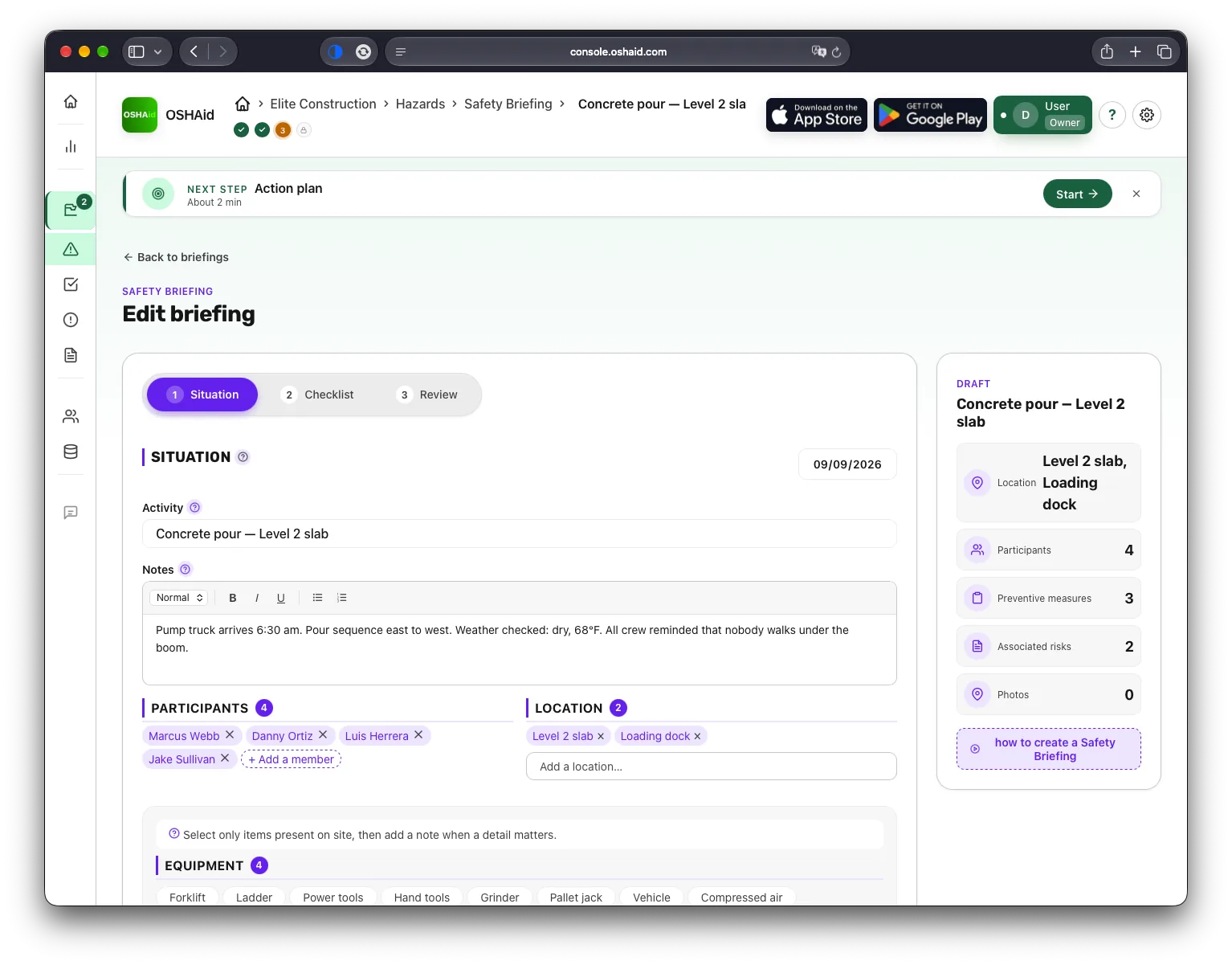 OSHAid console: the safety briefing editor, where the site-specific training a temporary worker receives on day one is written down and dated
A program that survives a new face
Temporary staff are the stress test for a safety program. A settled crew can run for years on habit and memory. Someone who arrives on Monday has neither, so everything the program never wrote down shows up in that first week.
That is also what makes it worth fixing. Procedures tied to named machines, training certified with names and dates, one clear answer about who records an injury: those are things you can hand to an agency, show a client auditing your site, or put in front of an inspector without a hunt through email.
Compliance is the floor. A program a stranger can follow on day one is the part you can actually show.
Questions safety officers ask
- Who is responsible for training temporary workers, the staffing agency or the host employer?
Both. OSHA treats them as joint employers. Its Temporary Worker Initiative guidance says a staffing agency may provide generic safety and health training, while the host employer provides training specific to the workplace equipment and hazards. Neither employer can avoid its responsibilities by shifting them to the other.
- Does a temporary worker's injury go on the host employer's OSHA 300 Log?
- What lockout/tagout training records does OSHA require?
Related reading
All posts- Nov 22, 2026OSHA machine guarding requirements: what to check on every machineGuidance
- Nov 20, 2026Rubber insulating glove testing requirements: the six-month clockOSHA update
- Nov 19, 2026OSHA incident rate by industry: what the 2025 data showsData
- Nov 13, 2026OSHA whistleblower complaint: the hearing rules change on December 9Rule change
About this article
Written by the OSHAid Safety Desk from official sources (OSHA news releases, the text of the standards, BLS and NIOSH data), checked against those sources and reviewed before publication. It explains what a rule says; it is not legal advice for your situation. OSHAid
Bring on a temp without a gap
Create a free OSHAid account: keep machine-specific procedures, training records and incident reports in one place, so the person who starts tomorrow gets the same program as the crew that has been there for years. No commitment.
Try OSHAidFreeDownload on theApp StoreGET IT ONGoogle PlayThe intelligent OSHA companion that automates your field compliance. Mobile app + web console + specialized safety AI agent, built for US workplaces.
ProductIndustriesGuides- OSHA compliance software
- Hazard assessment guide
- Safety program templates
- JHA examples
- OSHA requirements
- OSHA recordkeeping
- OSHA standards by industry
- Workplace hazards
- Get started
- What is OSHA?
- Workplace safety glossary
- Why OSHAid?
- Enterprise solutions
- About
- Blog
- Legal notice
© 2026 OSHAid - published by DUOPP (SAS). All rights reserved.
Help us improve OSHAid
We only measure site traffic. No advertising, no resale of data.
OKDeclineLearn more