




OSHA's General Duty Clause (Section 5(a)(1) of the OSH Act of 1970) requires every employer to furnish a workplace that is free from recognized hazards likely to cause death or serious physical harm, regardless of company size or industry.

To comply, the employer must first identify and evaluate the workplace hazards their employees may be exposed to, and then document the findings along with the controls put in place to protect workers' health and safety.

Conducting a workplace hazard assessment is the legal responsibility of the employer. It is part of the employer's general duty to provide a safe workplace and protect every worker from foreseeable occupational risks.

What is OSHA and the General Duty Clause?

Hierarchy of Controls

OSHA Requirements
OSHA requires a Hierarchy of Controls to manage workplace hazards. The first five steps are listed from most to least effective. The last four are supporting practices that keep your safety program working.
  • Eliminate — remove the hazard completely (best solution)

  • Substitute — replace it with something safer

  • Engineering controls — design safer equipment/workspaces

  • Administrative controls — improve procedures, training, and rules

  • PPE — use protective gear (last line of defense)

  • Check regularly — identify risks early (JHAs, inspections)

  • Train workers — ensure everyone understands safety

  • Track incidents — keep accurate OSHA records

  • Encourage reporting — let workers speak up safely

OSHA Hazard Assessment Process

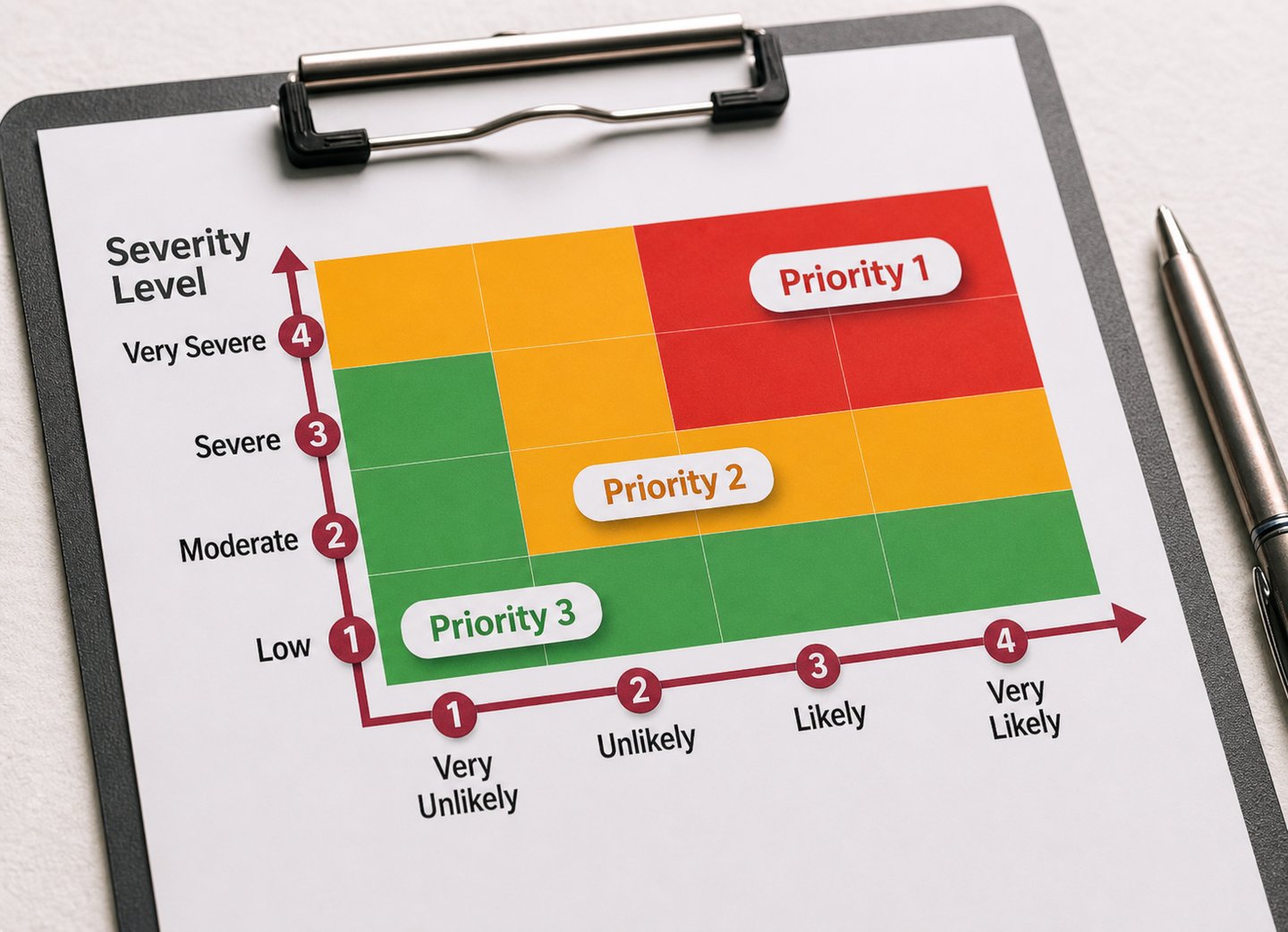
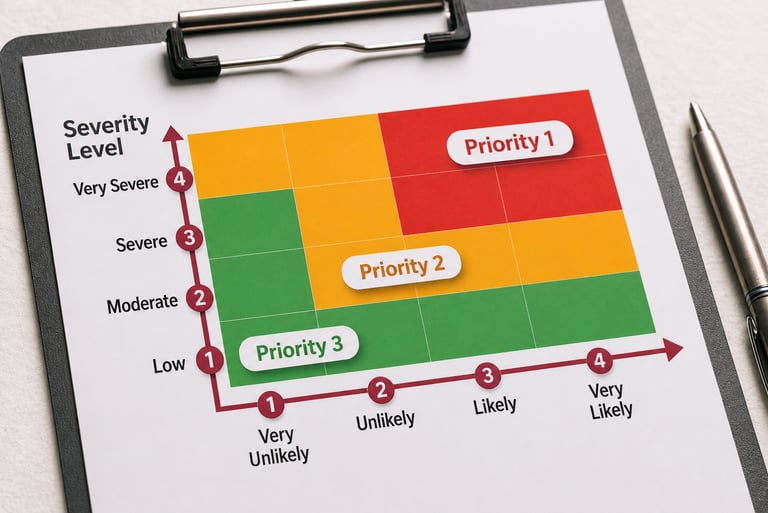
An OSHA-aligned risk assessment follows four core steps. First, plan the assessment by defining the scope of work. Next, identify hazards through walk-throughs, Job Hazard Analyses (JHAs), employee interviews, and a review of incident data. Then, evaluate and prioritize risks based on the severity and likelihood of harm. Finally, select, implement, and document control measures using the Hierarchy of Controls.

A hazard assessment means identifying all dangers that could affect a worker’s safety or health, including ergonomic, chemical, biological, physical, and psychosocial hazards. It requires a complete inventory of hazards and a risk analysis for every job task and work area, including exposure to noise, heat, cold, hazardous chemicals, and other conditions covered by 29 CFR 1910 and 1926.

For example, stairs and live electrical equipment are common hazards. The associated risks include falling on stairs or being shocked when changing a light bulb, which must be properly controlled.

The level of required documentation depends on the employer’s size and industry. OSHA mandates written programs for certain standards, such as Hazard Communication, Lockout/Tagout, Bloodborne Pathogens, Respiratory Protection, and Permit-Required Confined Spaces. Recordkeeping requirements under 29 CFR 1904 apply to most employers.

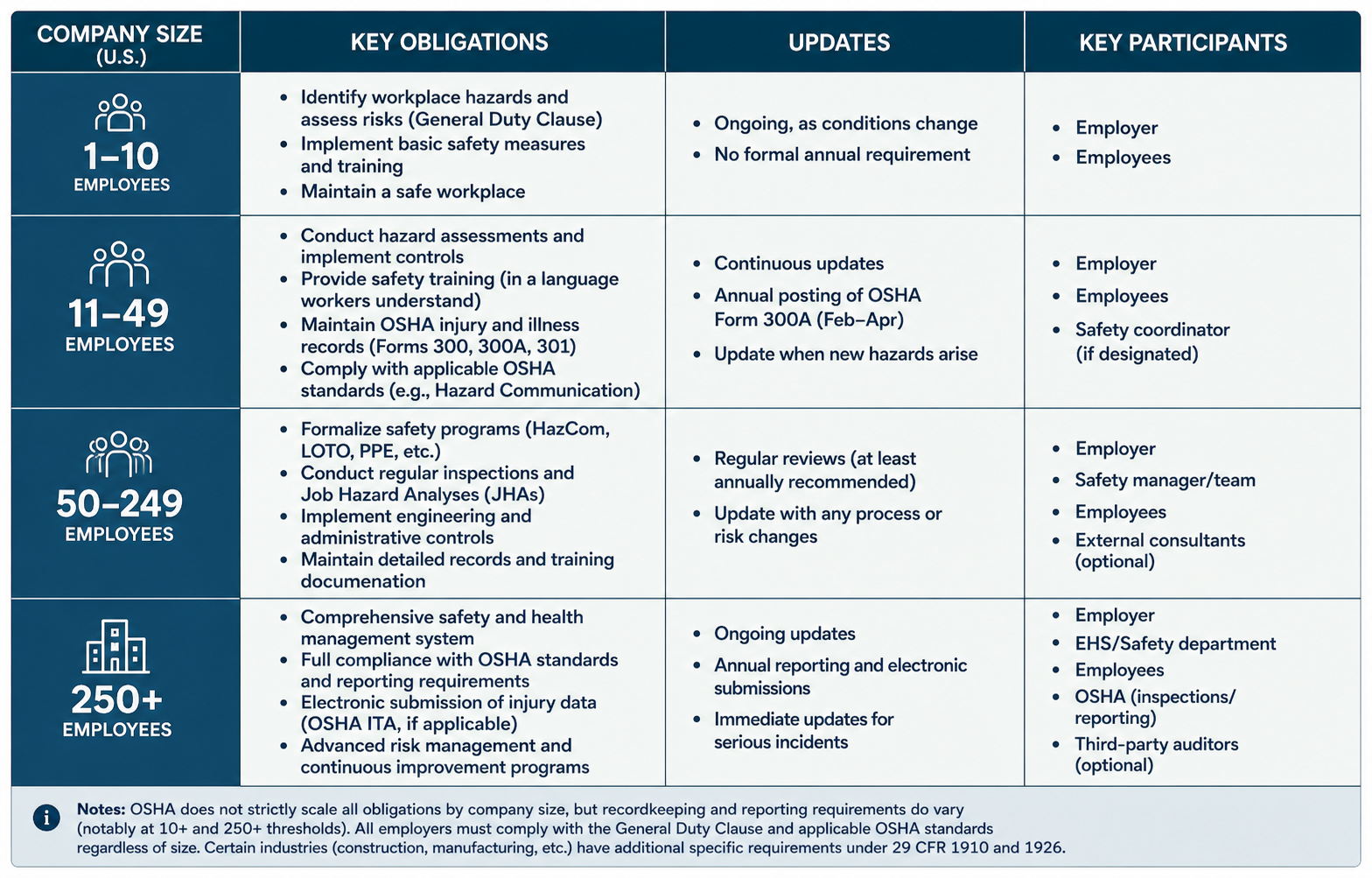
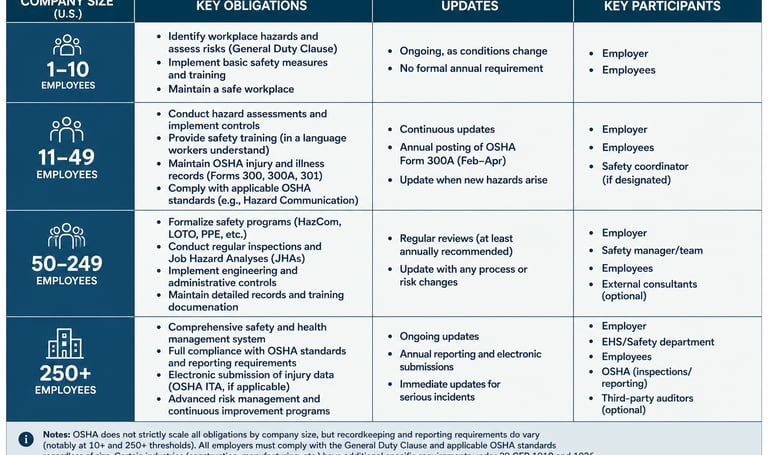
Employer Obligations by Company Size

Common requirements for all U.S. employers:

Recordkeeping: OSHA Forms 300, 300A, and 301 must be retained for at least 5 years following the end of the calendar year they cover (29 CFR 1904.33).

Access: Records and the written safety program must be made available to current and former employees, their representatives, OSHA inspectors, and authorized state-plan agencies upon request.

a man with a bandaged eye and a piece of paper on his forehead

$16,500

brown game pieces on white surface
gray metal frame
gray metal frame

Sanctions

Individual liability

Company liability

$165,514

Up to 6 months in prison

Délit d'entrave

*OSHA penalty amounts (FY 2026, adjusted annually for inflation): up to $16,550 per Serious or Other-than-Serious violation, up to $16,550 per day for Failure to Abate, and up to $165,514 per Willful or Repeat violation. Willful violations that result in the death of an employee can also lead to criminal prosecution and imprisonment of up to 6 months under Section 17(e) of the OSH Act.

per violation

per violation

in case of employee's death

References

Laws & Regulations
framed eyeglasses on top open book

Occupational Safety and Health Act of 1970, Section 5(a)(1) — General Duty Clause requiring a workplace free from recognized hazards.

29 CFR 1903 — OSHA inspections, citations, and proposed penalties.

29 CFR 1904 — Recording and reporting occupational injuries and illnesses (Forms 300, 300A, 301).

29 CFR 1910 — Occupational safety and health standards for general industry.

29 CFR 1926 — Safety and health regulations for the construction industry.

29 CFR 1910.132 — Personal Protective Equipment (PPE) and required hazard assessment.

29 CFR 1910.1200 — Hazard Communication Standard (HazCom 2012, aligned with GHS).

man sitting in front of table

OSHA Law and Regulations — osha.gov/laws-regs

OSHA Recordkeeping (Forms 300, 300A, 301) — osha.gov/recordkeeping

OSHA eTools and Small Business Resources — osha.gov/etools

NIOSH Hierarchy of Controls — cdc.gov/niosh/hierarchy-of-controls

OSHA Free On-Site Consultation Program for small employers — osha.gov/consultation

Useful Links

Contact us about OSHA Compliance

For any question about OSHA compliance, recordkeeping, or workplace hazard assessments, please contact our team.